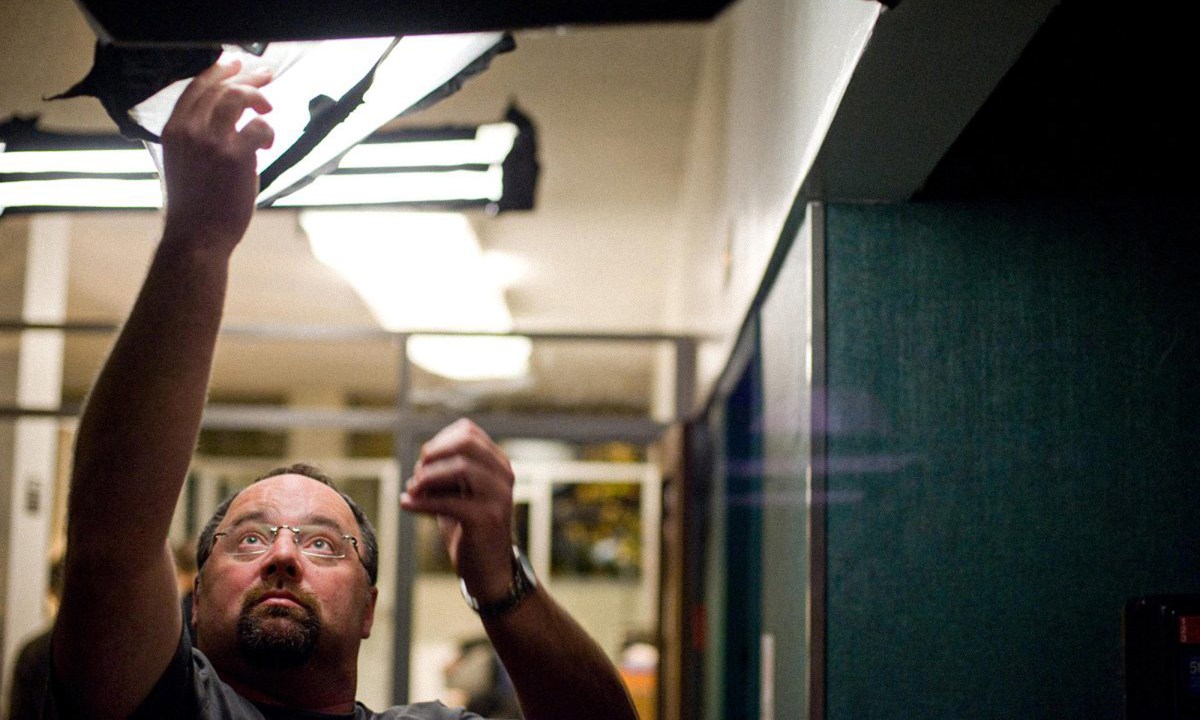
Fight Club cinematographer Jeff Cronenweth talks us through this iconic shot and many others in David Fincher‘s masterpiece. We also discuss how the relative naturalism of The Social Network was just as difficult to achieve, and whether something is lost with VFX even when it looks perfect.
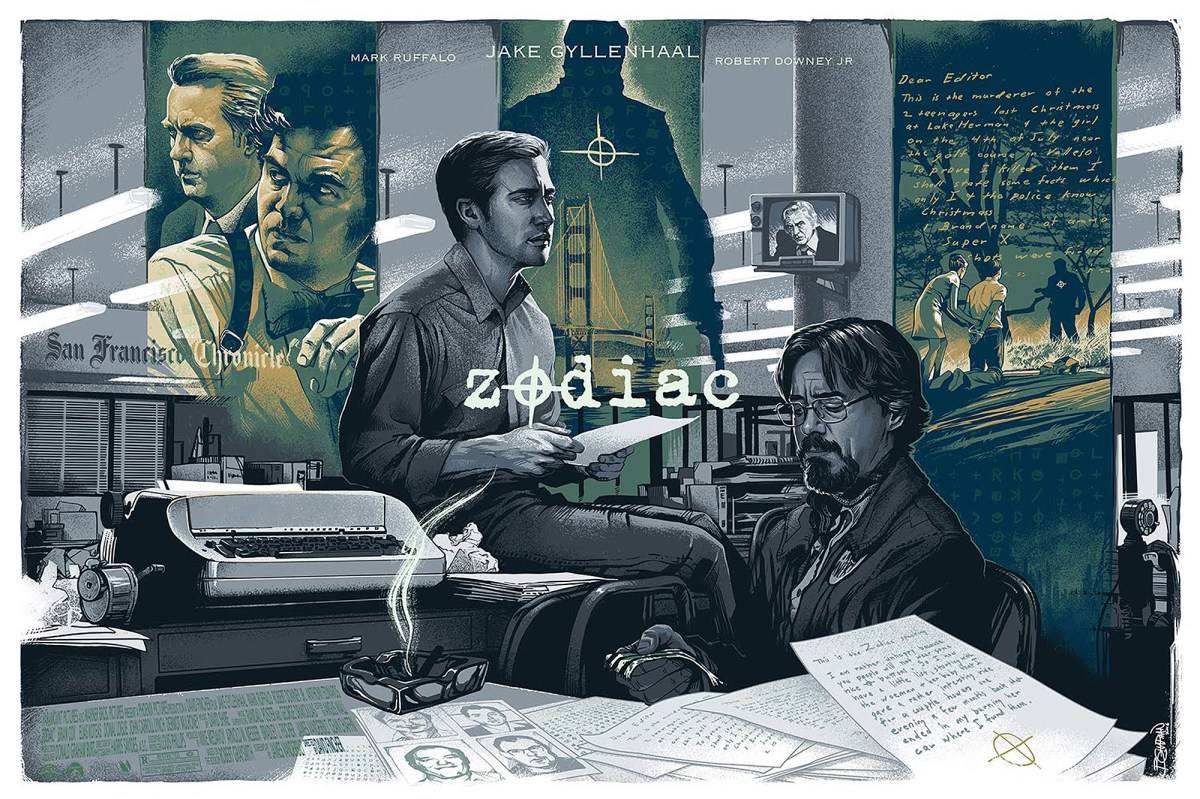
If you asked David Fincher about the childhood years he spent in San Anselmo in Marin County during the 1960s, the topic that would undoubtedly pop up would be that of an infamous serial killer who, in the director’s eyes, was “the ultimate boogeyman.” For it was precisely that time and that general area that saw the rise of the Zodiac, a murderer who frequently wrote letters and sent coded messages to local newspapers, gleefully taking credit for the gruesome killing sprees that would inevitably trigger waves of paranoia across the West Coast. As Fincher recalls: “I remember coming home and saying the highway patrol had been following our school buses for a couple weeks now. And my dad, who worked from home, and who was very dry, not one to soft-pedal things, turned slowly in his chair and said: ‘Oh yeah. There’s a serial killer who has killed four or five people, who calls himself Zodiac, who’s threatened to take a high-powered rifle and shoot out the tires of a school bus, and then shoot the children as they come off the bus.’” Fincher’s fascination with the mystery man who wreaked havoc in Northern California during the late 60s and early 70s, claiming to have taken the lives of thirty-seven people (out of which only five were confirmed as being his victims), ultimately resulted in the director gladly accepting to work on Zodiac, a 2007 movie written by James Vanderbilt. The screenwriter had read a 1986 non-fiction book of the same name while he was still in high school, years before pursuing his eventual career. After getting into screenwriting, he had the chance to meet Zodiac author Robert Graysmith, a cartoonist who had been working for one of the newspapers the killer wrote to during the 1960s, and decided to make a screenplay based on the information-packed book. Having creative control over the material was of the utmost importance to Vanderbilt, given the fact that the endings of his previous scripts had been altered. Together with producers from Phoenix Pictures, Vanderbilt bought the rights to both Zodiac and its follow-up, entitled Zodiac Unmasked, after which the Seven director was asked to come on board.
Apart from having a personal attachment to the story of the notorious serial killer who was never brought to justice, what drew Fincher to work on the project was also the fact that the ending of Vanderbilt’s script was left unresolved, thereby staying true to real-life events. But Fincher’s perfectionism and his wish to depict the open case as accurately as possible led to him asking that the screenplay be rewritten, for the wanted to research the original police reports from scratch. He also decided that he, Vanderbilt and producer Bradley J. Fischer should personally interview the people who were involved in the case so that they could discern for themselves whether the testimonies were to be believed or not. The people they spent months interviewing were family members of suspects, the Zodiac killer’s two surviving victims, witnesses, investigators both current and retired, as well as the mayors of Vallejo and San Francisco. As Fincher elaborated: “Even when we did our own interviews, we would talk to two people. One would confirm some aspects of it and another would deny it. Plus, so much time had passed, memories are affected and the different telling of the stories would change perception. So when there was any doubt we always went with the police reports.” They also hired a forensic linguistics expert to analyze the killer’s letters, with the expert’s focus being on how the Zodiac spelled words and structured sentences, as opposed to the emphasis that was put on the Zodiac’s handwriting by document examiners in the 1970s.
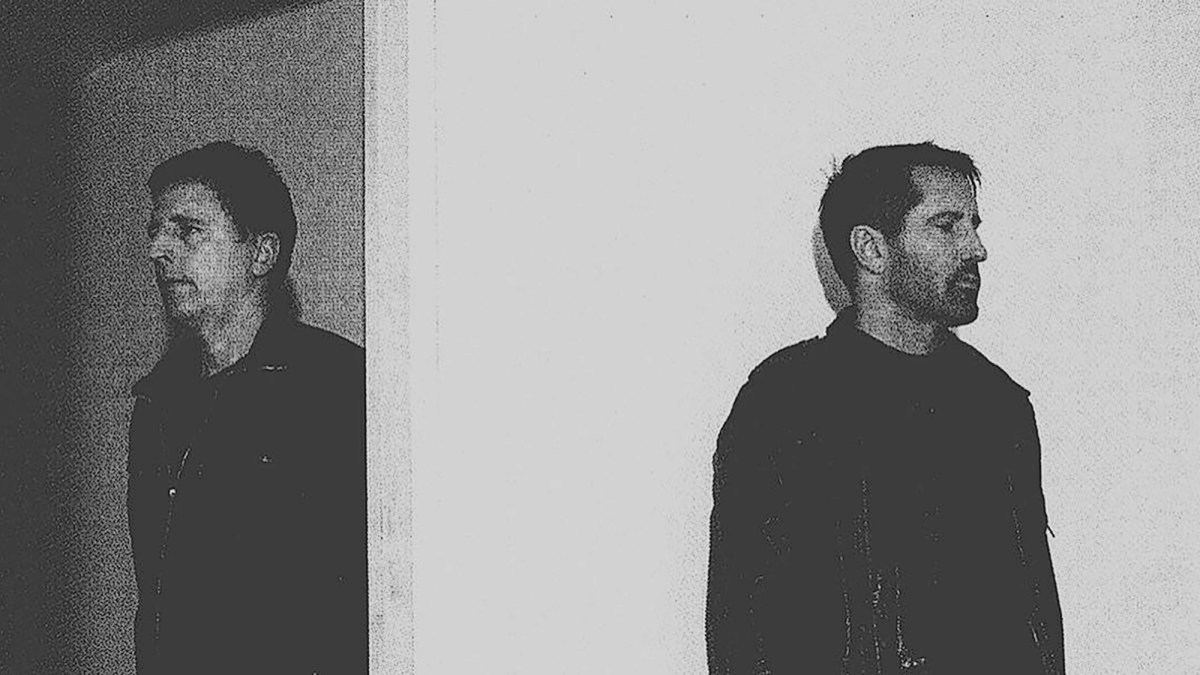
Director David Fincher — who first dragged Reznor and Ross into the film-scoring game by enlisting them for 2010’s The Social Network — is currently shooting the film Mank, a biopic about Herman J. Mankiewicz, the screenwriter of Orson Welles‘ Citizen Kane, played by Gary Oldman. As such, the movie is set in 1940. “We’re not gonna be using the modular synthesizer on that one,” Reznor revealed. “We think we’re gonna be period authentic, so it just creates a new set of challenges.”
“Fight Club” is twenty years old. In the decades since its release, box-office disappointment and reinvention through myriad DVD and Blu-ray releases (thirteen million DVDs by 2014), Brad Pitt established himself as a productive, adventurous film producer, with his Plan B productions involved with this summer’s “Ad Astra,” but also award-winning work like “Moonlight,” “Killing Them Softly,” “Tree of Life,” “Twelve Years A Slave,” “Okja” and “The Last Black Man In San Francisco.” Edward Norton, who has moved away from acting, directed and stars in his own adaptation of Jonathan Lethem’s 1999 novel, “Motherless Brooklyn” in November.
“Fight Club” is a ride, a sneaky mindfuck of a movie, and a thunderous journey into the darkest parts of one man’s mind. Within a few dozen seconds, we rush through someone’s brain and out onto a rooftop where another character holds a gun in his mouth. The ride begins.
Brad Pitt plays Tyler Durden, a trickster character who insurance agency flunky Edward Norton meets at a time when he’s been wishing for someone who could push him over the edge. By night, Norton’s unnamed narrator trolls support groups for the grievously ill, pretending to have illnesses in order to sob. That’s where he meets fellow grief-ghoul Helena Bonham Carter. But that’s set-up. The impression is out there that “Fight Club” is about yuppies gathering in alleys to beat each other up. Uh-uh. There’s more to it.
Everyone’s stuck—in their jobs, their bodies or their heads. Except for Tyler, everyone’s a flunky, a waiter, a cop, solid blue-collar stock. “Fight Club” is one of the funniest, most piercing movies you’d hope for, a ferocious satire that builds on the madness of Chuck Palahniuk’s novel, and in its many richly detailed scenes, exceeds even what David Fincher accomplished in “Seven.”
When we talked, no one knew yet if “Fight Club” could be the first epic audience movie of the new millennium, or whether it would tank. Pitt, thirty-five, has a reputation as a reluctant interview, but after talking with him, it seems it may be more out of modesty than ego or fear. Norton, thirty, was his customary talkative self.
Does the actor Brad Pitt exist in the universe of “Fight Club”?
Pitt: [shaking his head] What does that mean, what does that mean, what does that mean?
There are in-jokes throughout the movie, marquees showing “Seven Years in Tibet,” “Wings of the Dove” and “Larry Flynt.” And Tyler tells the narrator at one point, “I’m what you want to be like.” If you ask guys what they want to be like, a typical guy would be happy to be you.
Norton: I thought that was a great perversion of Bradley’s baggage.
Pitt: Yeah. Perverting the baggage. That was dealing more with the projection and the image, y’know, that’s out there. Good and bad. Myself, I’ve certainly never felt a part of that.
You talk about good-looking guys in the movies, a few names come up: Mel Gibson, Brad Pitt…
Norton: Edward Norton.
Pitt: Edward Norton. You sexy fool!
Norton: He never hurts my feelings.
There’s a lot of yelling in the movie, it seems cathartic, especially in the bedroom scenes with Helena.
Pitt. [whispers] Sex. You look through the crack and you just see all these crazy gymnastics going. Doing gymnastics. Yeah, we’re just jumping on the bed.
You’ve worked with David Fincher before…
Pitt: He’s one of the guys leading the pack. There are a lot of interesting guys out there, who are pushing the medium, but I’ve said this before, I think Finch is picking up where Kubrick left off.
Norton: If anyone can do it, he can.
Pitt: This thing he created here is extraordinary. It’s beyond all our hopes and he always set out with an image of what this thing could be. This thing just roars.
Norton: I don’t feel like I’ve seen a film—
Pitt: It’s a monster.
Norton: —That’s that far out there in terms of its technique, its use of style to enhance the emotional themes of a narrative. When you work with Fincher, you slowly absorb that he is the complete filmmaker. He is the most comprehensive modern filmmaker. He has a complete command of all the tools that are available to a filmmaker now. He’s as good a DP as his DP, he’s as good at sound—
Pitt: —all his tweaking—
Norton: —his technical tweaking as the guys who work for him. He’s an excellent script doctor—
Pitt:—A storyteller.
Norton: He’ll even come in and give you a good line reading at times. And yet he’s dealing in f/stops. He knows more about CGI as anyone.
Pitt: And not only that, ideas. He takes whatever groundbreaking technology is available, like the Rolling Stones video in Central Park where they’re giants. There was this technique meant for something else, and Fincher goes, “Can’t I take this and actually make them people?” He’s inventive that way. But on a directorial level, this thing is one to be studied. There are so many things that are fine-tuned, from sound on. All the way from opening up coming out of a brain to the product placement. Any product placement you see, like Pepsi machines, it’s always put in a somewhat violent scene. It’s just these little, little comments that are more subliminal than anything.
Cinematographer Jeff Cronenweth, ASC lensed his first feature, “Fight Club,” in 1998. He earned Best Cinematography nominations from the Academy of Motion Picture Arts and Sciences and the American Society of Cinematographers for two more collaborations with director David Fincher, “The Girl With the Dragon Tattoo” (2011) and “The Social Network” (2010). Cronenweth also shot Fincher’s “Gone Girl” (2014), Kathryn Bigelow’s “K-19: The Widowmaker” (2002) and Sasha Gervasi’s “Hitchcock” (2012). He recently completed director Sam Taylor-Johnson’s “A Million Little Pieces,” based on the literary hit.
In addition to his feature career, Cronenweth is known for his stylish and CLIO Award-winning music videos and commercials. In the last two years he shot music videos for Katie Perry, Jennifer Lopez, Pink, Maroon 5 and Taylor Swift. A native Angelino, Cronenweth studied filmmaking at the University of Southern California (USC) and began his professional career apprenticing to some of the industry’s greatest cinematographers, including Sven Nykvist, ASC, John Toll, ASC, Conrad Hall, ASC and his father, the late Jordan Cronenweth, ASC.
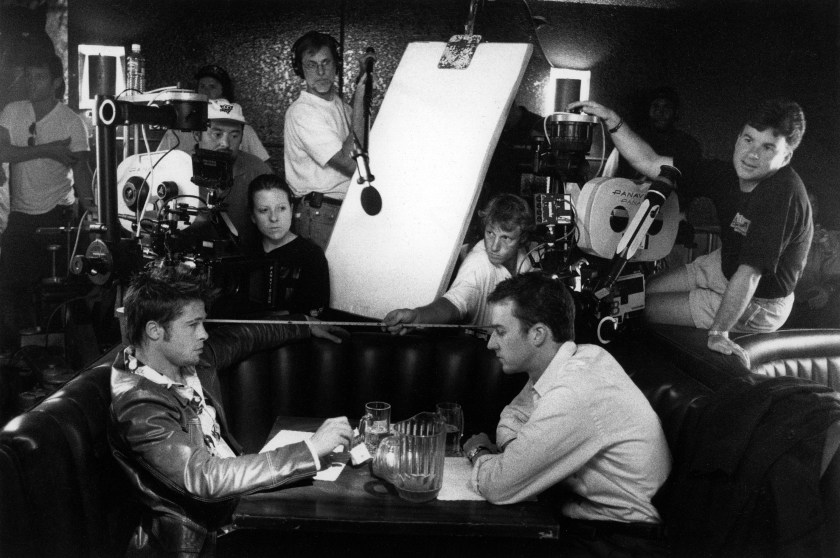
Cronenweth, behind the camera A on left, and his crew set up double coverage for a scene between Tyler Durden (Brad Pitt) and the film’s nameless narrator (Edward Norton). On the right, B camera operator (and future Panic Room cinematographer) Conrad W. Hall. (1999, Merrick Morton)
What was your pathway into this field?
“My great-grandfather owned a photo store in Pennsylvania. My dad’s dad won the last Oscar given for portrait photography: He was a staff photographer for Columbia [Pictures]. My grandmother was a Ziegfeld Follies dancer. My dad [Jordan Cronenweth, ASC] won a BAFTA for ‘Blade Runner’ (1983) and got an Oscar nomination for ‘Peggy Sue Go Married’ (1987). So as a child I often visited sets and went on location for extended stays. I felt like I wanted to be part of that great experience, that camaraderie. Each day was like a military unit battling to bring back great images.
“I knew I wanted to do something in the industry: I had been around it all and found it all so exciting. I made many Super 8 films in high school and decided USC (the University of Southern California) was where I wanted to attend film school. But two years into school Film Fair, a commercial production company my father had collaborated with, had a position open for a staff loader and that job offered the opportunity to get into the union. I visited my dad as often as I could when he was shooting ‘Blade Runner’ and assisted him on other movies as a camera operator and on second unit. A lot of relationships I formed then carried over when my dad retired.
“I met [director] David Fincher on a Madonna video my father photographed and I shot second unit for in the heyday of music videos – it was a very creative and innovative time, and I was grateful to be there. I was his camera assistant on the documentary ‘U2: Rattle & Hum’ (1988) and the film ‘State of Grace’ (1990), both directed by Phil Joanou, a former USC film school classmate. Then I got my first feature as a cinematographer, ‘Fight Club,’ with Fincher. Not a bad credit for the first time out of the gate!”
In a world filled with police procedurals, Netflix’s “Mindhunter” has attracted a lot of attention.
Created by Joe Penhall, the series is a police procedural about two FBI special agents, Holden Ford (Jonathan Groff) and Bill Tench (Holt McCallany). It has attracted top-tier talent such as David Fincher, Carl Franklin (“One False Move”) and executive producer Charlize Theron.
The second season dropped last month on the streaming platform. The Australian-born editor Kirk Baxter, ACE, a two-time Academy Award-winner for Fincher’s “The Social Network” (2011) and “The Girl with the Dragon Tattoo” (2012), is the editor of four of the nine episodes.
In an exclusive interview, Baxter talked about serial killers, editing difficult material, and working with the notorious perfectionist Fincher.
You you have had a long and very successful creative collaboration with Fincher. How did you first meet?
Kirk Baxter: I got introduced to David through Angus Wall when Angus was editing “Zodiac” (2007). I got brought into helping out, so I met David when I was already cutting a scene for him. Things went well. I became a puppy that never left.
How you would describe your working methods?
Baxter: I try to rely on him as little as possible because I am familiar with what his days are like, especially during the shooting process. David is incredibly busy, and I like to get on with it.
We work through PIX [a workflow tool that allows production teams to securely share and review content], so I will put a lot of stuff up for him every day and it is the day’s PIX that we critique and do back and forth at his pace.
David is pretty good at being all-consuming. He will tend to get back to me immediately. I don’t really hit him with questions. I just hit him with work.
He shoots, I select, put something together and send it to him and I take the feedback kind of dryly. I don’t take anything from [it as] a personal affront. I just work until it is there, until we are happy with it. I am trying to outgrow the part where you loathe yourself until you like the scene. I am getting better, but I haven’t perfected it yet.
Wheat tends to happen is during the shooting process, the initial assembly is just misery. We all hate ourselves, hate the show, and then once it is beginning to take shape, there is more of a jovial atmosphere where you start to feel comfortable that things are working.
In Season 2, was there a conscious decision to take the work in different stylistic or formal directions?
Baxter: No. David might have had that conversation with the cinematographer Erik Messerschmidt, but certainly not with me. Again, rarely am I going to have a philosophical conversation about what we want to do. My communication with David is just by doing.
When David Fincher transitioned from music videos to feature films in the 1990s, the descriptors “glossy,” “slick” and “stylized” were frequently affixed to his work. Those adjectives were often aimed as pejoratives, categorizing Fincher as a technical virtuoso who created shiny but hollow thrillers.
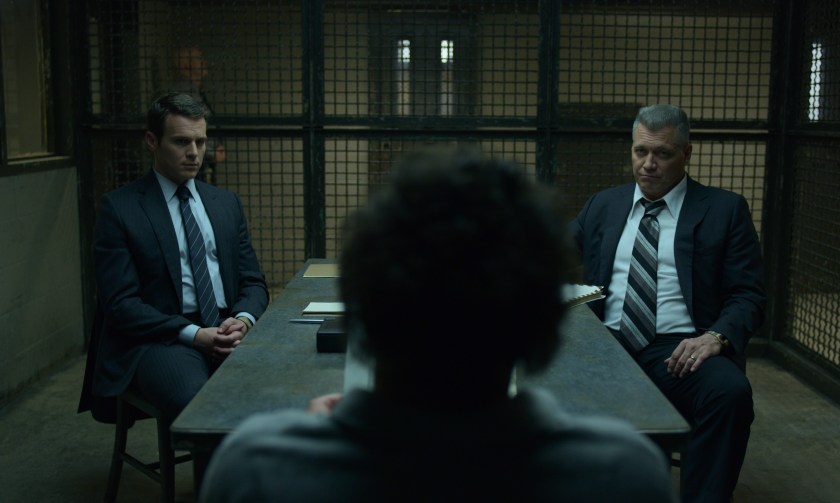
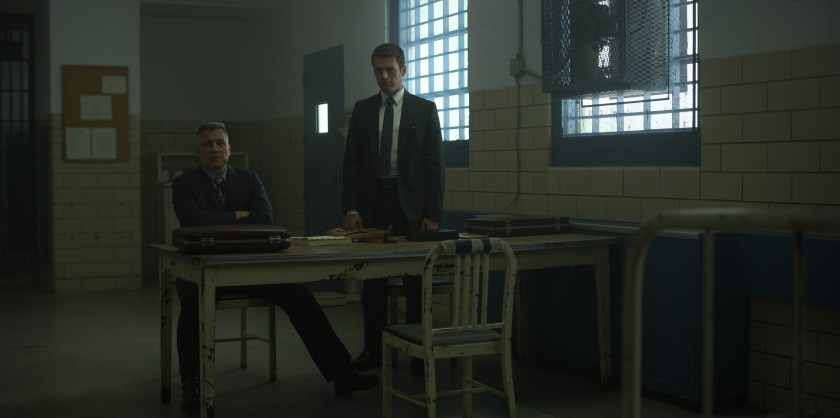
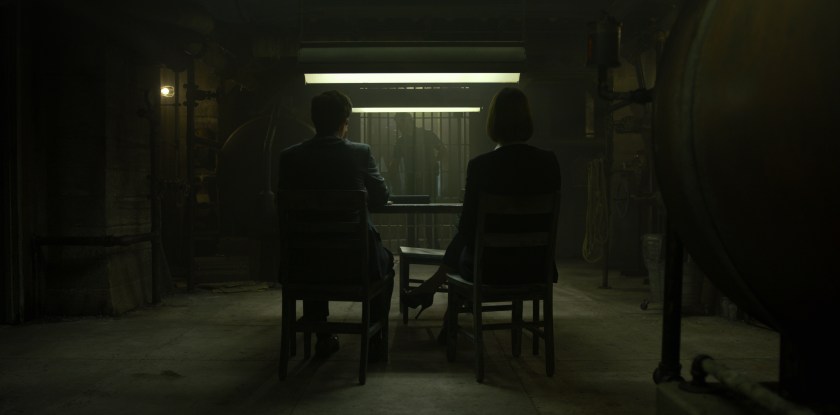
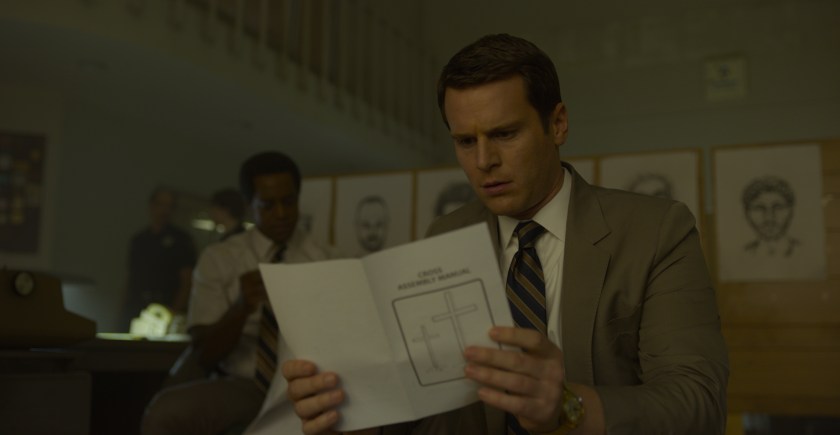
Watching the second season of Netflix’s Mindhunter—executive produced and partially directed by Fincher—the evolution of the filmmaker’s aesthetic is striking. As FBI profilers Bill Tench (Holt McCallany) and Holden Ford (Jonathan Groff) interview America’s most notorious serial killers, the camera rarely moves. Instead, it unobtrusively observes.
What hasn’t changed over the years is Fincher’s unwavering exactitude, exemplified by the show’s almost mathematically meticulous compositions. Cinematographer Erik Messerschmidt is the guardian of that precision, carrying season two’s restrained yet formal style across episodes directed by Fincher, Andrew Dominik (Killing Them Softly) and Carl Franklin (One False Move).
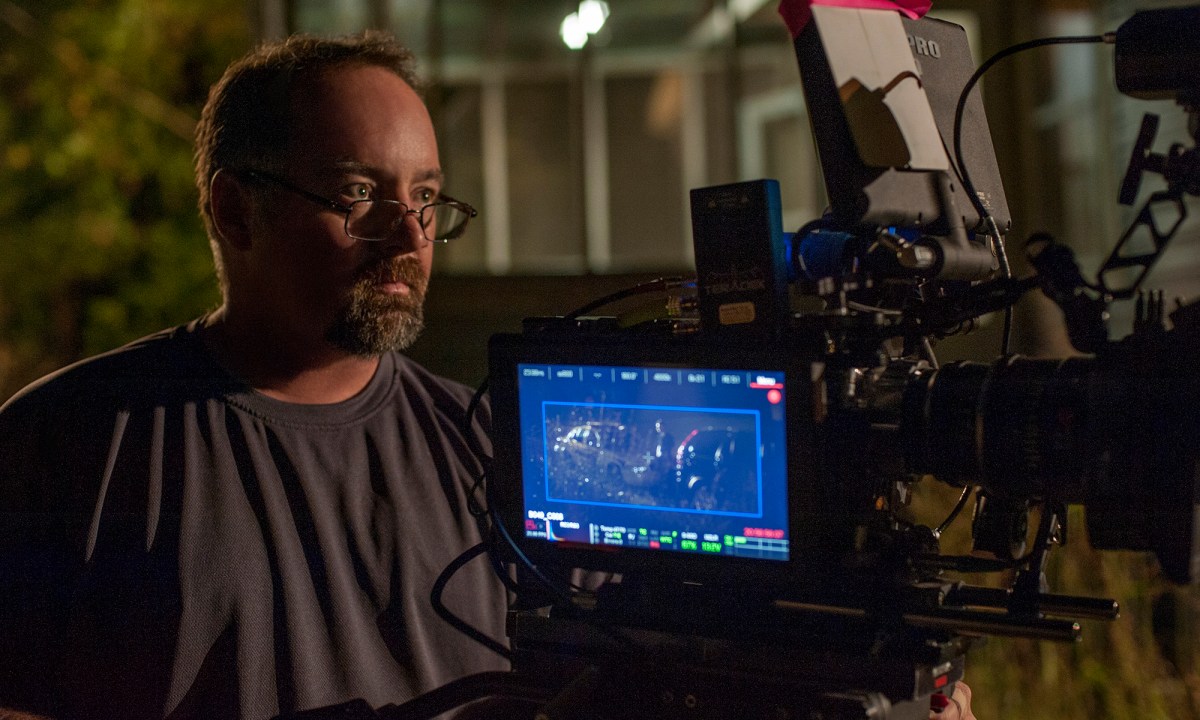
With season two now streaming on Netflix, Messerschmidt spoke with Filmmaker about the necessity of HDR monitoring, creating faux-anamorphic effects, and his hockey puck-sized secret weapon for eye lights.
Filmmaker: It’s been two years since season one of Mindhunter, which you shot on custom Weapon Red Dragons (nicknamed Xenomorphs). I guess it shows how quickly camera technology is changing, because since that time Red has gone to a universal DSMC2 brain and the Dragon sensor is only in their lowest-cost camera. Now the Monstro 8K VV and the Helium 8K S35 are Red’s top-of-the-line offerings. Did you change cameras for season two?
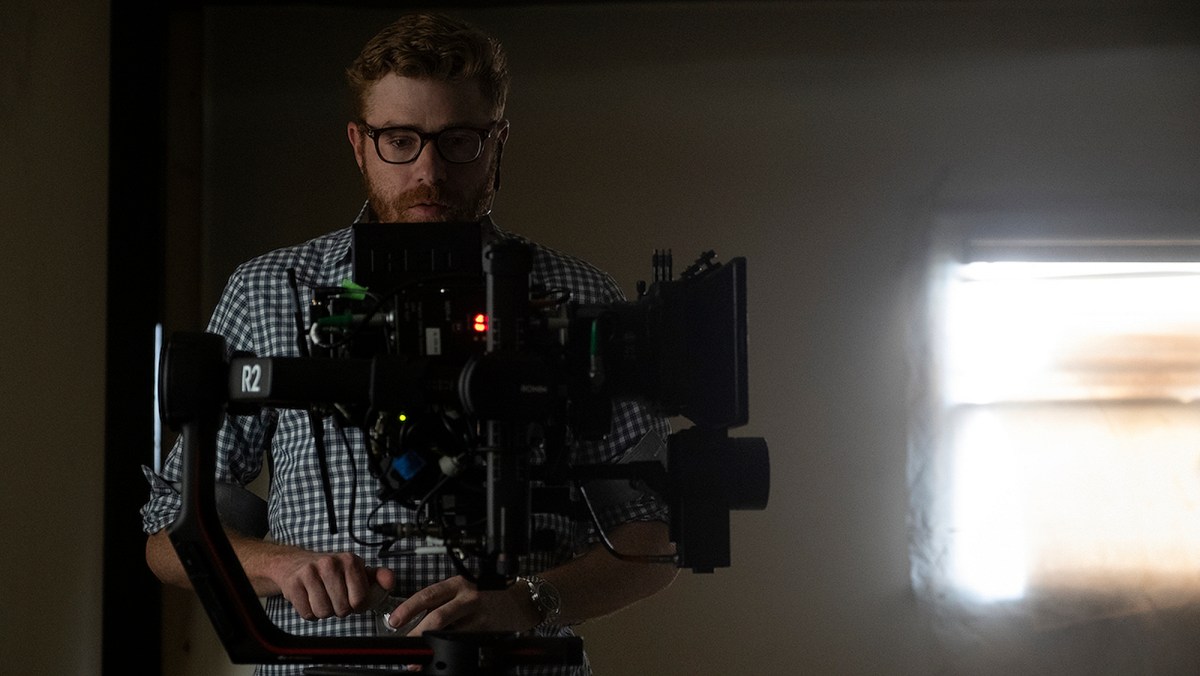
Messerschmidt: For season two we switched to Red’s Helium sensor, shooting in 8K 2:1 with 8:1 compression. Out of the 8K raster we framed for a 6.5K extraction area, which left room for stabilization in post. We did extensive lighting, color and workflow tests prior to the decision to switch camera sensors and ended up loving the results of the Helium. We found the noise floor to be substantially lower, the color fidelity to be better and the sensitivity to be higher than the Dragon.
Filmmaker: Did you have any additional custom Xenomorph tweaks for the new cameras?
Messerschmidt: For season two Red built us a new model of the Xenomorph dubbed the Mark II. The new body included the DSMC2 brain with the Helium sensor. It was upgraded with redesigned cooling, integrated lens motors and the new Teradek Bolt video transmitters.
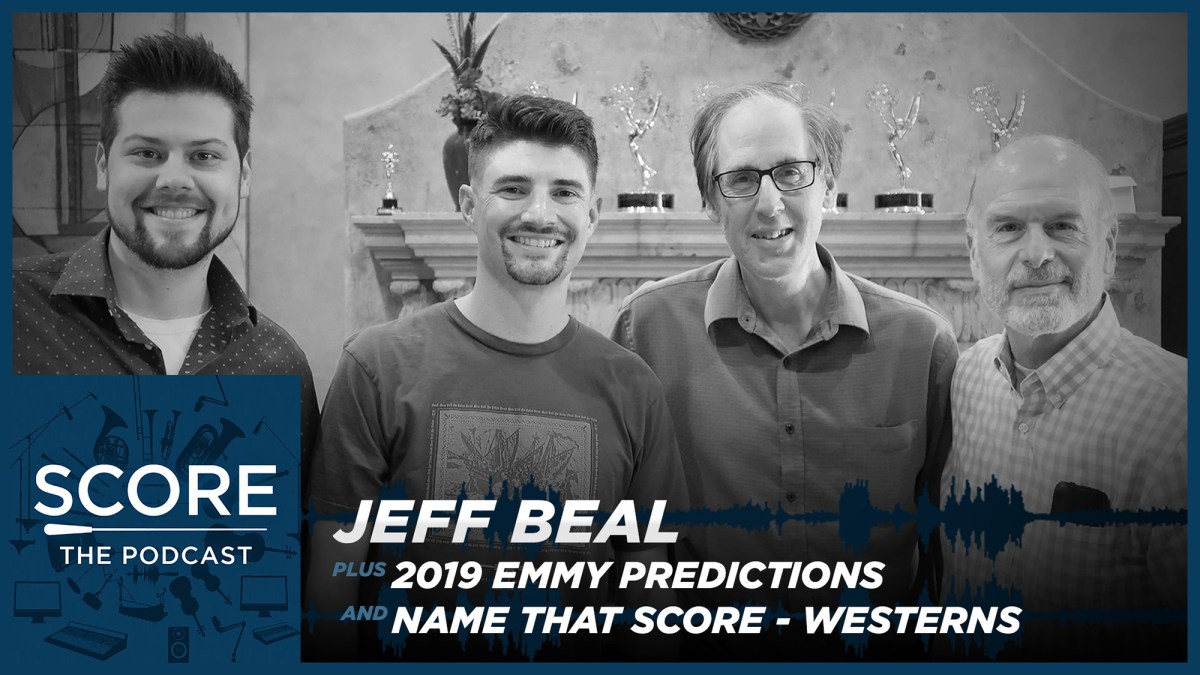
Season 2 Episode 16 | Jeff Beal got fired from Monk, then won an Emmy for it
Robert and Kenny begin the show joined by Matt Schrader and Carol Kuswanto for the show’s annual Emmy predictions. The group makes predictions for seven categories: Drama Series, Comedy Series, Limited Series, Original Main Title Theme Music, Music – Limited Series, Music – Documentary Series, Music – Series.
Then 5x Emmy-winning composer and current Emmy nominee Jeff Beal joins the show telling the story of getting fired on his first TV show Monk, winning the Emmy for main title theme, then getting rehired. Jeff also discusses his working relationship with David Fincher on the Netflix hit series House of Cards and exclusively reveals his first sketch of the main title theme.
Lastly, Jeff join the guys for a special round of #NameThatScore with a “westerns” theme.
Jazz/Classical hybrid composer Jeff Beal speaks to us about the musical inspiration behind his game changing soundtrack/opening to the award winning House of Cards series.
Jason Hill is the hypnotic composer, producer, recording artist, songwriter, and multi-instrumentalist, admired for his arcane musical stylings and idiosyncratic approach. He is the frontman and thought leader of controversial post-punk band, Louis XIV, member of alternative supergroup, Vicky Cryer, and founder of The Department of Recording and Power, a voluminous vintage studio in Glendale, California. A contrarian musical nomad, Jason has thrived in myriad roles within the music business, working with David Bowie, The Killers, Robbie Williams, New York Dolls, Jet, Sky Ferreira, Macy Gray, The Virgins, Richard Butler of The Psychedelic Furs, and many others. After being tapped to fulfill the official trailer and teaser for Gone Girl, legendary director, David Fincher invited Jason to conjure a musical macrocosm for Netflix’s gripping criminal psychology thriller series, Mindhunter. Over two critically acclaimed seasons, Jason’s score negotiates the liminal space between masks of normalcy and unbridled savagery, masterfully evoking unseen traumas. In our sprawling discussion, Jason details his lifelong rejection of sonic mores and how he made Netflix history with his haunting re-imagining of the Mindhunter theme for the season two finale.
Before becoming a composer for media, you explored many artistic avenues in the music industry — Louis XIV, Vicky Cryer, and beyond. Could you describe some of your most fulfilling pursuits before you changed your professional trajectory? What are the advantages of having a strong pre-existing relationship to storytelling through music?
Well, it’s an interesting thought about the storytelling aspect. With songwriting, you’re trying to tell these mini stories, but I’ve had many, many fulfilling artistic projects. Louis XIV, I absolutely loved doing, and in fact, for the first time in 10 years, we’re in the middle of making another record. We’ve got a few songs so far, and it’s fun to come back around to it after we went pretty hard, toured the world, and made records. “The Best Little Secrets are Kept” is one of the records I’m very, very proud of. I just loved making it.
Looking back, I lived in this little, tiny…it wasn’t even an apartment, and it overlooked a Shell gas station. It didn’t have a shower or anything. I would literally connect a hose to the faucet and drag it out on the balcony that overlooked the gas station. In the middle of the night, I would hose myself to take a shower unless I was staying at girlfriends’ houses. I had a futon in the corner, but the rest of the place was just my recording gear. I was broke, but I was happy to be making music. That’s where all the Louis XIV material came about. It was essentially from those late nights, and that was a really great experience.
I’ve actually had so many great experiences related to music. There were times when me and my past bandmates moved to a place called Jamul up in the mountains, about an hour outside of downtown San Diego. We lived in this old adobe house on forty-six acres that an artist built. That was one of the places where we learned to sing harmonies and write together. That was also where I really learned how to record. We just had reel-to-reels, and I figured out how to do it. I’ve always lived in pursuit of trying to figure out how to do things by myself. If I signed a record deal, instead of giving another producer a bunch of money in the studio to make a record, it was like, “No. Let’s just buy a bunch of gear ourselves, and now, we can make records for the rest of our lives.” That’s why I have the arsenal of stuff I have to this day.
There are so many incarnations of my life in music, starting from the moment I first fell in love with it. I remember as a little kid; I was actually plagued by these things in my head, which later I learned were melodies. It would drive me nuts. To be honest with you, as a nine-year-old kid, I would have all these tiny, weird symphonies playing in my mind, but I didn’t know what they were until I started figuring out what music really was. Of course, I knew what music “was,” and I even wrote a song around age five, but at that point, I didn’t know how to make these melodies I was hearing come to life. It was like, “How do I get this out of my head and into the cosmos? How do I play it on a guitar or a piano?”. Oh god, it was so tough. That was a thing like, “I gotta figure this out because otherwise, it’s going to kill me.”
I think it’s always been a pursuit of the fog. It’s like a foggy mirror after a hot shower. Little by little, the fog comes clear, and you are able to see your reflection. That’s what music has been, for me, for my entire life, and now, I just have a lot more control over it. That said, it’s still this elusive thing, and I love that elusive thing. I love the feeling of not knowing, so I still dance in that realm.
The Glass Armonica, invented by Benjamin Franklin.
Taking place in the late ’70s through the early ’80s, Mindhunter charts the origin of the FBI’s Behavioral Science Unit and the practice of criminal profiling. Together, agents, Holden Ford and Bill Tench, alongside psychologist, Wendy Carr interview and analyze incarcerated serial killers across the nation, applying this groundbreaking knowledge to solve cases. In your collaboration with David Fincher, what concepts and musical references does he bring to the table, and how does that inform your approach?
[David Fincher] is so articulate. He’s a brilliant man. I can’t stress that enough, really. He gives you these prompts, but they’re rarely specific. Nowhere in there is he saying, “Do this,” or “Make this piece exactly like this.” He just gives you these open-ended questions.
This time around, one of his prompts was ‘the death of disco’ and what that sounded like. It was a very interesting thing to consider when you think of our score and where it ended up. How does finding out what the death of disco sounds like translate to season two of Mindhunter? I still don’t know, but it led me in a place of trying to figure it out, which was a bit of a mind fuck.
This week on Pop Culture Confidential we are thrilled to have screenwriter Liz Hannah in conversation about the incredible new season of Mindhunter, as well as working with Steven Spielberg on The Post and more!
Liz Hannah burst onto the scene a couple of years ago when her first screenplay, a spec script about Washington Post owner Kay Graham and her decision to publish the Pentagon Papers, was picked up none other than Steven Spielberg. That became The Post starring Meryl Streep and Tom Hanks. Liz Hannah went on the write the critically acclaimed comedy Long Shot starring Charlize Theron and Seth Rogen.
Now she is onboard Mindhunter season two as a writer and producer. Liz Hannah talks to us about her career, working with David Fincher (exec producer and director on Mindhunter), writing and staging one of the most intense episodes of TV this year, the Charles Manson episode, getting into the heads of serial killers and much more.