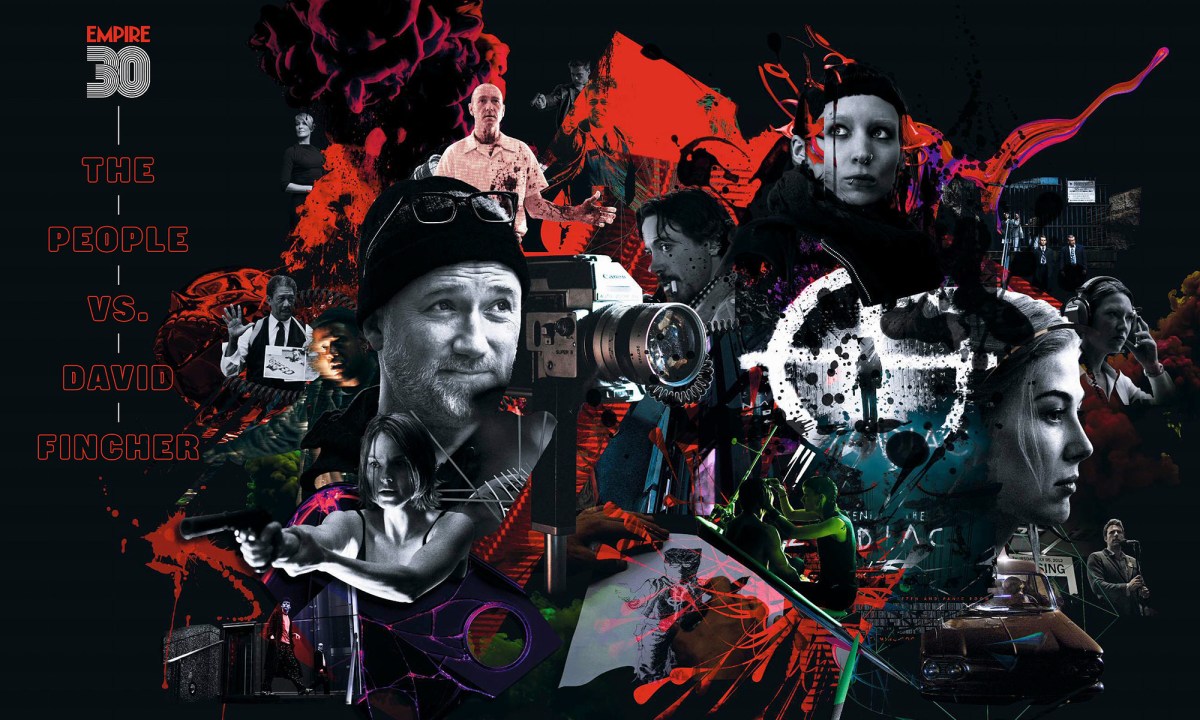
From the 30th Anniversary Exclusive Subscriber Cover by Supertotto.
As part of our Empire 30 celebrations, we presented your reader questions to filmmaker David Fincher. Originally published in the December 2019 issue of Empire.
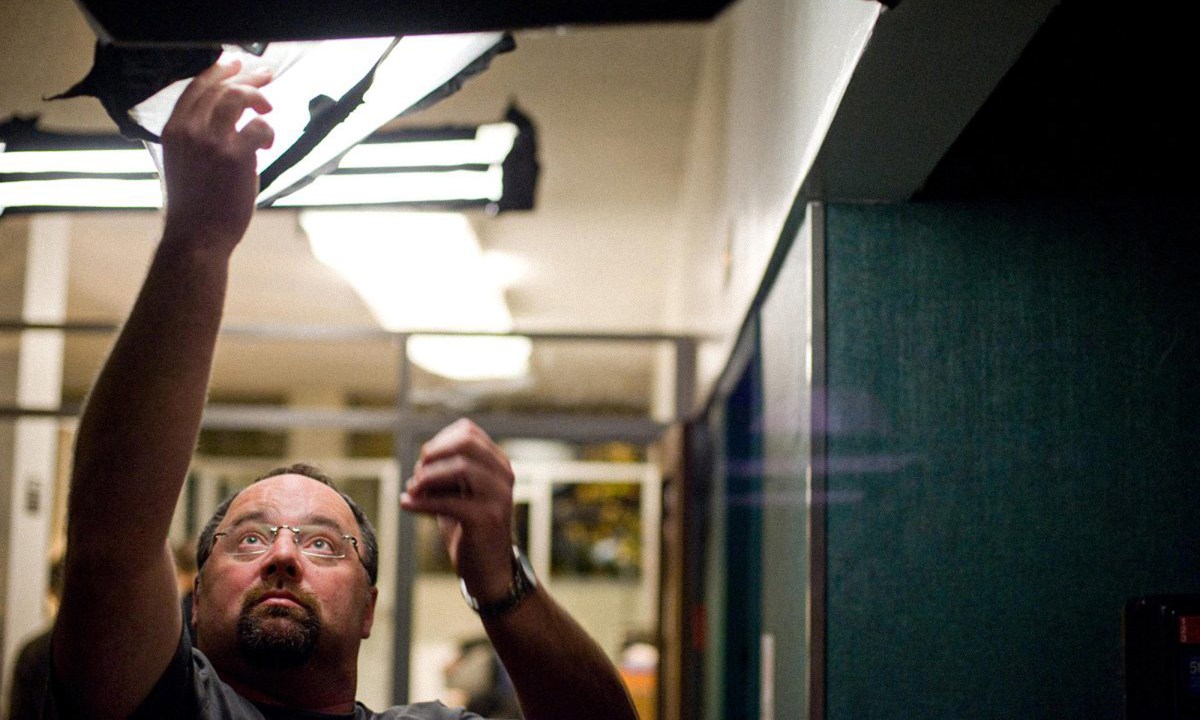
Cinematography is a true art form. To compose a memorable shot is something that one really does need a skill for. That doesn’t even take into account how a cinematographer must work well with a director, have an understanding of their camera, and an infinite number of other assets necessary to help make a movie succeed. Earlier this week, we got a chance to talk with two time Academy Award nominated cinematographer Jeff Cronenweth, who was able to detail just some of what goes into being a quality DP.
Cronenweth has been cited by the Academy twice. Both times, collaborations with director David Fincher (The Social Network, followed by The Girl with the Dragon Tattoo) received Oscar nominations in Best Cinematography. Tomorrow, he ventures into television for the first time, collaborating with filmmaker Mark Romanek on an episode of the new Amazon Prime science fiction series Tales from the Loop. Generously chatting on the phone for nearly a half hour, Cronenweth details not just working on the show, but with Fincher as well. He even tells us a few interesting stories about his father Jordan Cronenweth, a famous cinematographer in his own right. It’s an informative and loose interview, so we hope you enjoy it…
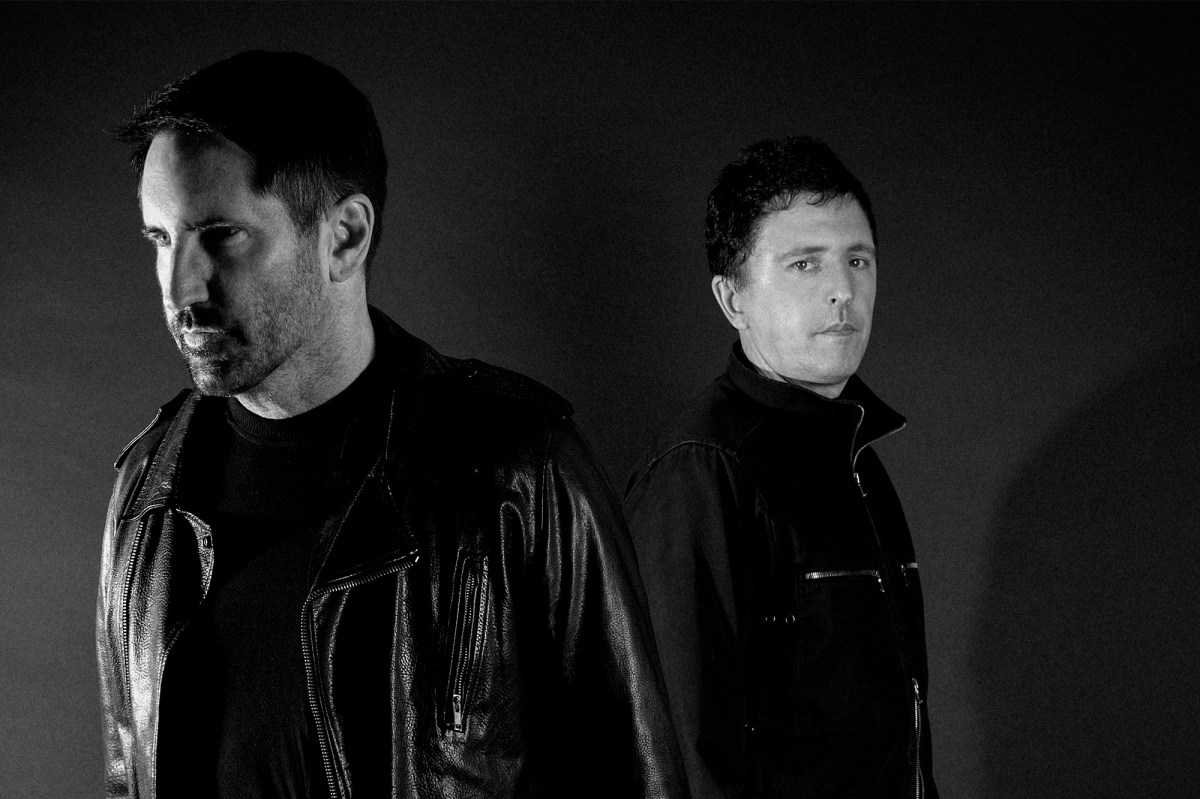
And Trent Reznor explains why David Fincher is great to work with.
Reznor and Ross share some glimpses on their work with Fincher on Mank at the end of their interview about their score for HBO and Damon Lindelof‘s Watchmen.
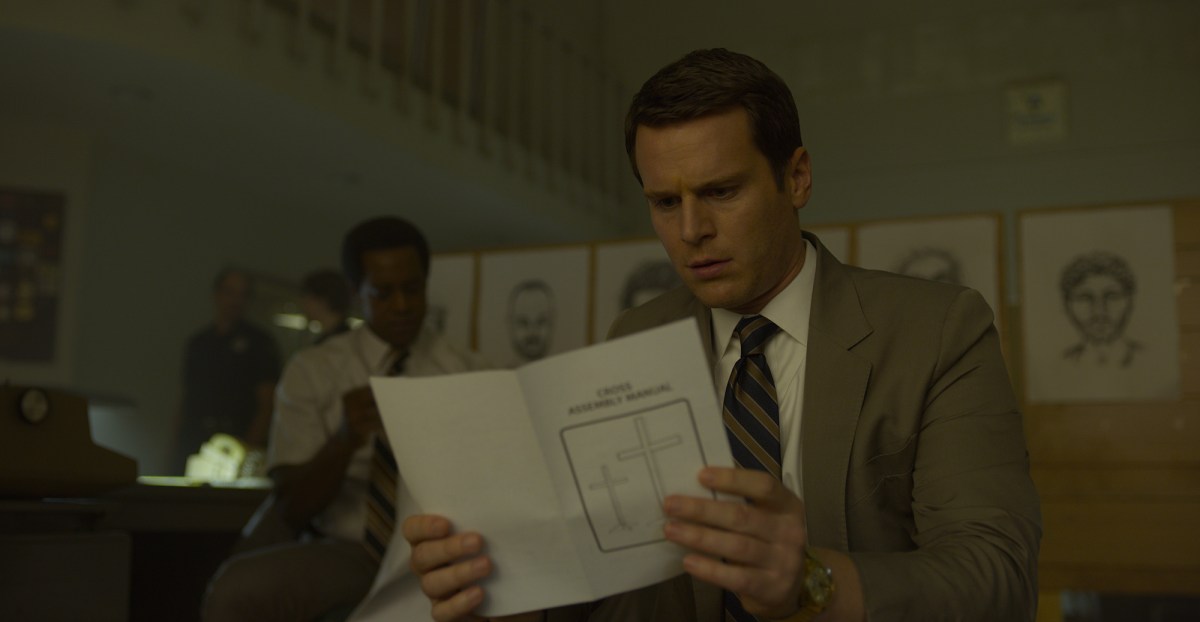
I was late in discovering David Fincher’s gripping series on serial killers, Mindhunter. But last summer, I noticed the Netflix original lurking in my suggested titles and decided to give it a whirl. I burned through both seasons within a week. The show is both thrilling and chilling, but the majority of these moments are not achieved through blazing guns, jump scares and pyrotechnics. It instead focuses on the inner lives of multiple murderers and the FBI agents whose job it is to understand them through subtle but detail-rich conversation.
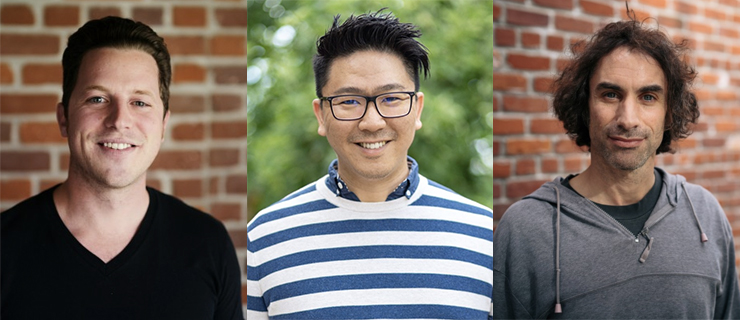
Sound plays a crucial role in setting the tone of the series and heightening tension through each narrative arc. I recently spoke to rerecording mixersScott Lewis and Stephen Urata as well as supervising sound editorJeremy Molod — all from Skywalker Sound — about their process creating a haunting and detail-laden soundtrack. Let’s start with Lewis and Urata and then work our way to Molod.
Scott Lewis, Stephen Urata, and Jeremy Molod
How is working with David Fincher? Does he have any directorial preferences when it comes to sound? I know he’s been big on loud backgrounds in crowded spaces since The Social Network.
Scott Lewis: David is extremely detail-oriented and knowledgeable about sound. So he would give us very indepth notes about the mix… down to the decibel.
Stephen Urata: That level of attention to detail is one of the more challenging parts of working on a show like Mindhunter.
Working with a director who is so involved in the audio, does that limit your freedom at all?
Lewis: No. It doesn’t curtail your freedom, because when a director has a really clear vision, it’s more about crafting the track to be what he’s looking for. Ultimately, it’s the director’s show, and he has a way of bringing the best work out of people. I’m sure you heard about how he does hundreds of takes with actors to get many options. He takes a similar approach with sound in that we might give him multiple options for a certain scene or give him many different flavors of something to choose from. And he’ll push us to deliver the goods. For example, you might deliver a technically perfect mix but he’ll dig in until it’s exactly what he wants it to be.
Urata: Exactly. It’s not that he’s curtailing or handcuffing us from doing something creative. This project has been one of my favorites because it was just the editorial team and sound design, and then it would come to the mix stage. That’s where it would be just Scott and me in a mix room just the two of us and we’d get a shot at our own aesthetic and our own choice. It was really a lot of fun trying to nail down what our favorite version of the mix would be, and David really gave us that opportunity. If he wanted something else he would have just said, “I want it like this and only do it like this.”
But at the same time, we would do something maybe completely different than he was expecting, and if he liked it, he would say, “I wasn’t thinking that, but if you’re going to go that direction, try this also.” So he wasn’t handcuffing us, he was pushing us.
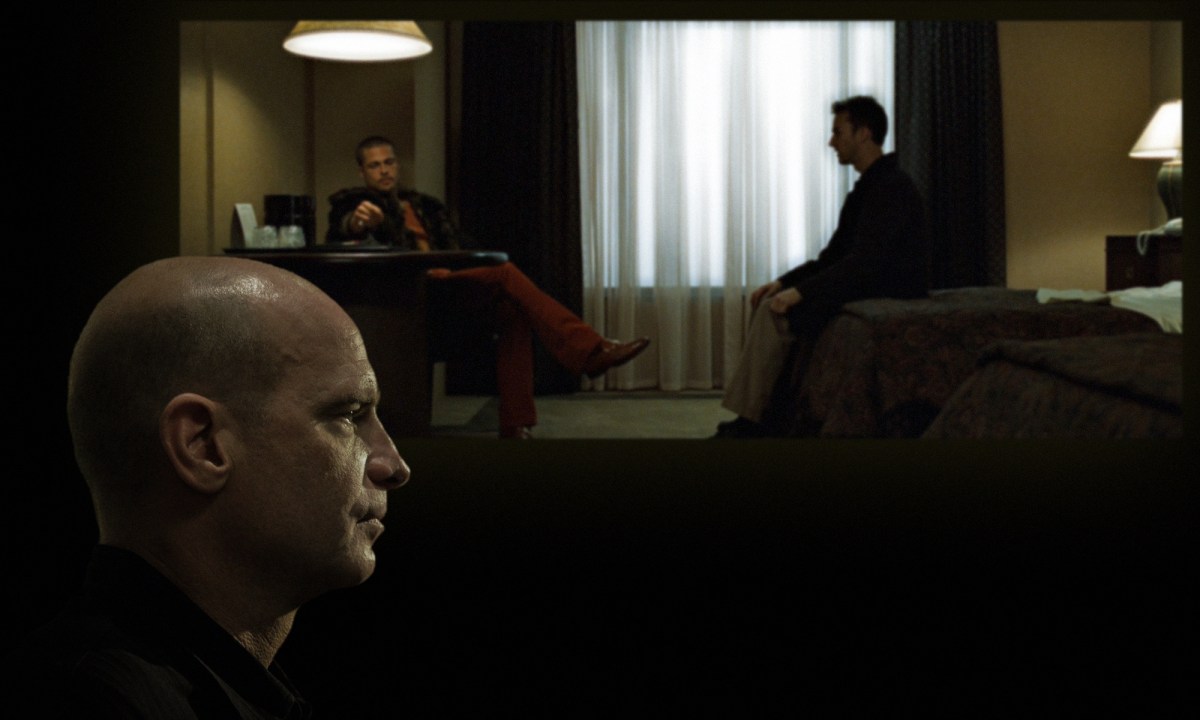
Fight Club cinematographer Jeff Cronenweth talks us through this iconic shot and many others in David Fincher‘s masterpiece. We also discuss how the relative naturalism of The Social Network was just as difficult to achieve, and whether something is lost with VFX even when it looks perfect.
Roger Durling’s wildly successful Santa Barbara International Film Festival is underway with tributes and with honors being handed out for the next week or so. Last night, Brad Pitt was honored with the Leonard Maltin Modern Master award.
After a lengthy interview with Maltin, which covered all of Pitt’s work with directors like both Ridley and Tony Scott, the Coen brothers, Tarantino, and beyond, Pitt’s frequent collaborator David Fincher made a rare appearance to hand Pitt his Modern Master award. They have made three films together, if you didn’t know (which of course would be insane to not know). Pitt is a muse of sorts for Fincher, starting with Se7en (1995), then Fight Club (1999), and finally Benjamin Button (2008). Pitt said when accepting his award that he hoped the two get to do five more collaborations together. Wouldn’t that be something?
Brad Pitt is having quite a season. It’s as though we’ve never seen a movie star. Movie stars of his stature are “as rare as albino pandas, and here’s one of them,” said Fincher. What that means is that it’s rare indeed for an actor to possess that thing — that movie star thing. Charisma that could power an entire planet. You can’t teach it. You can’t learn it. It’s there or it isn’t. And with Pitt, it was there from his first appearance onscreen.
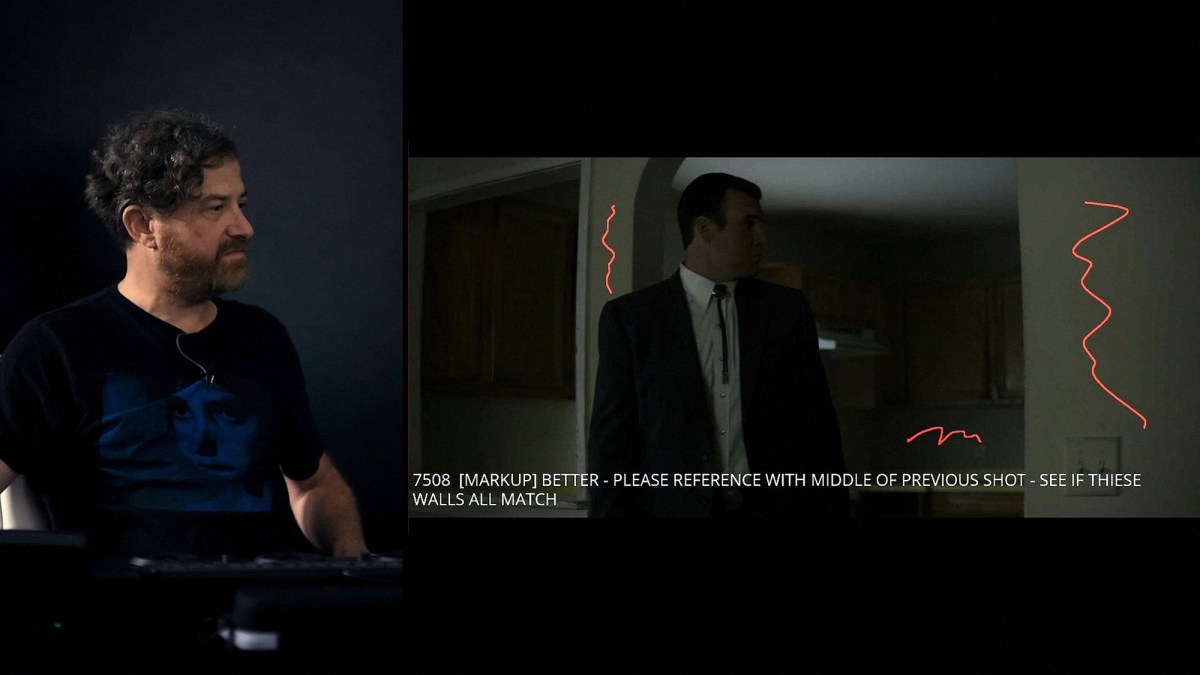
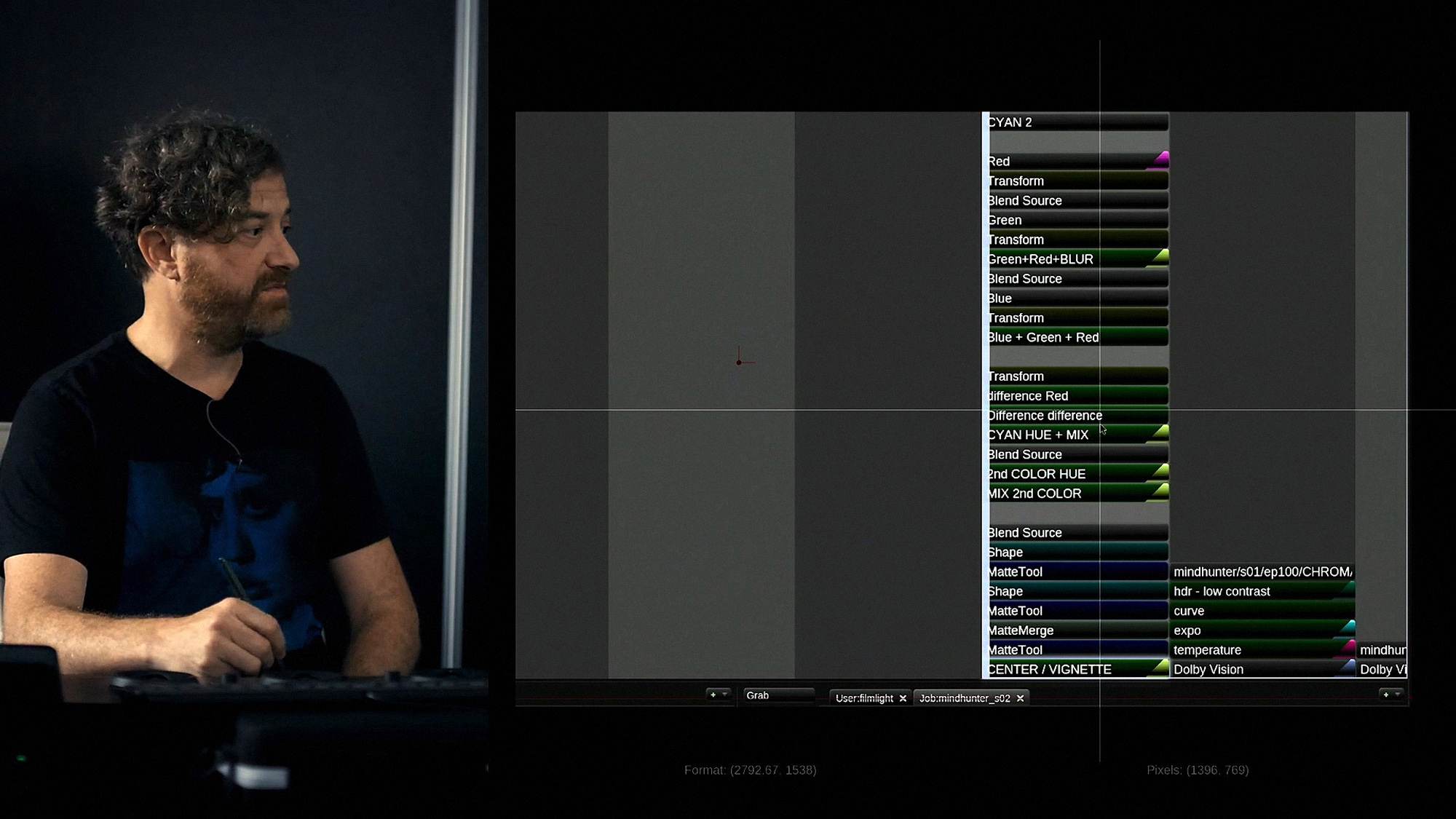
Eric Weidt talks about his collaboration with director David Fincher – from defining the workflow to creating the look and feel of Mindhunter. He breaks down scenes and runs through colour grading details of the masterful crime thriller.
Eric Weidt spent years in Paris working with fashion photographers transitioning from traditional film to digital capture workflows. He created custom film-emulation ICC profiles, and mastered color work and compositing techniques for print stills and fashion films.
Clients included Mario Testino, David Sims, Patrick Demarchelier, Mert Alas and Markus Piggot, Steven Meisel, Hedi Slimane, Karl Lagerfeld. His motion picture work for David Fincher includes responsibilies as VFX artist (Gone Girl), and Digital Intermediate Colorist (Videosyncracy and Mindhunter).
He holds a BA in Theater Arts from the University of California at Santa Cruz and is both an American and French citizen.
This month, Fight Club turns twenty. David Fincher’s adaptation of Chuck Palahniuk’s novel, written for the screen by Jim Uhls and starring Brad Pitt, Edward Norton, and Helena Bonham Carter, became a movie classic that has generated every form of cultural reference, from memes to research papers. Ranking #10 on IMDb’s Top 250 best-movie list and lending “The first rule of Fight Club” catchphrase to teen chats and corporate meetings alike, the film has come to occupy a unique niche in modern culture.
On the anniversary of the movie’s release, Fight Club’s screenwriter Jim Uhls spoke with Storius, reflecting on the film’s journey and lasting influence, adaptation challenges, fan theories, and his screenwriting techniques.
STORIUS: Today, twenty years after its release, Fight Club seems surprisingly contemporary, especially considering how many changes our society has gone through since 1999. It has entered the cultural lexicon, is often referenced even by people who haven’t seen it, and doesn’t seem to age much. What do you attribute the movie’s endurance to?
It hits a nerve with each generation that discovers it, seemingly because the basic life circumstances of the viewer, whether in 1999 or 2019, are the same. Part of that nerve is the idea of how self-worth is defined — both by society and in one’s mind — which are usually the same.
But, in this film, they become different. Men in their twenties, still puzzled about what they should do with their lives, are discovering a different way to define self-worth. A group of them meet to experience something that is outside the parameters of civilization. Each fight is one-on-one violence between two men who have no animosity towards each other, might not even know each other. They’re doing it because it’s a ritual, a primal ritual, in which they take part both by doing it and by watching others do it. It’s physical combat, wordless, and true — i.e., the fights are actually happening, so they are true. Other things all around these men can be lies, with or without words, but the fight cannot be a lie.
Another part of that nerve is Tyler Durden’s contempt for materialism, consumerism, the impossible ideals invented by advertising, and in effect — everything that is fake, or a lie, or a pathway to soullessness — all constantly bombarding us, in our “civilized” world. I’ve been repeatedly surprised by females, from teenage to senior citizens, telling me they love the film. It’s clearly aimed at a form of emancipation for young men, but part of the nerve it hits must resonate for women.
STORIUS: It’s hard to believe now that the movie was considered a failure when it was released, and that it took a few years and a DVD release to turn it into a financial success and a cultural phenomenon. Why do you think the film had such a bumpy road to recognition?
The bumpy road, the period of initial domestic release, was largely due to the vexing challenge of how to make a trailer for the film that promotes what the film is. It wasn’t an easy task. And it wasn’t achieved.
I ran into a friend about two weeks after the initial release, and he said he hadn’t gotten to the film yet, but he would; he just wasn’t a big fan of boxing movies.
“Boxing movies.” That’s a solid example of someone not having any idea of what the film was about during the time when it was vital to get that across to the public.
Season 2 Episode 16 | Jeff Beal got fired from Monk, then won an Emmy for it
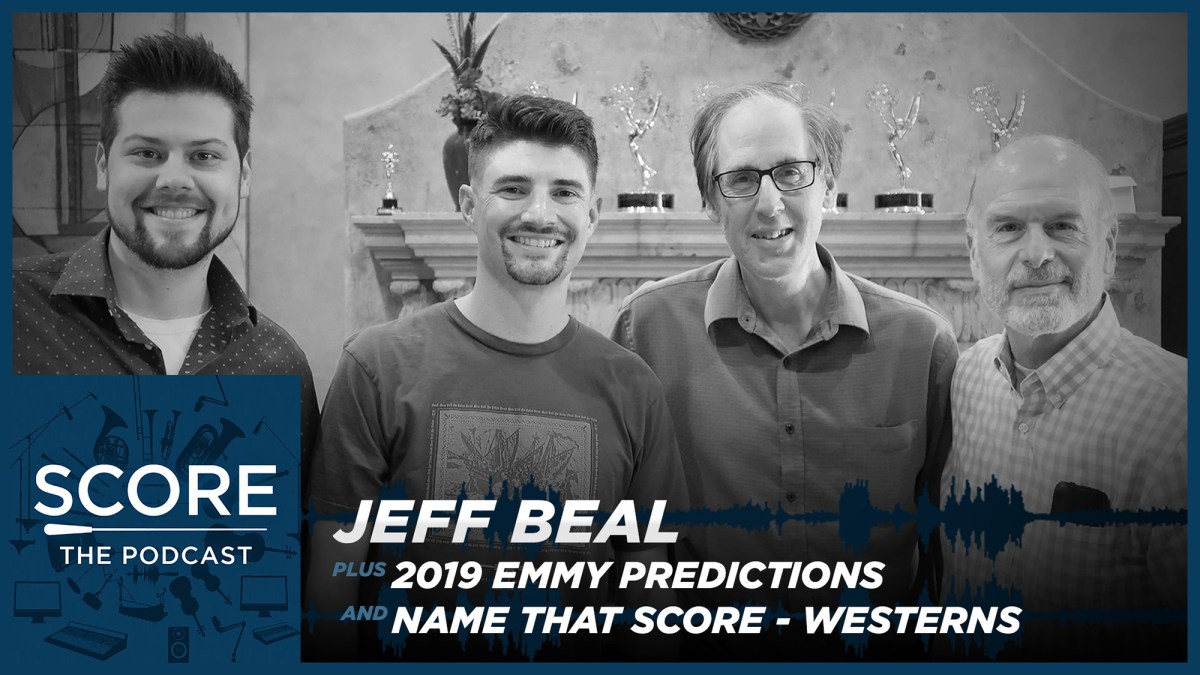
Robert and Kenny begin the show joined by Matt Schrader and Carol Kuswanto for the show’s annual Emmy predictions. The group makes predictions for seven categories: Drama Series, Comedy Series, Limited Series, Original Main Title Theme Music, Music – Limited Series, Music – Documentary Series, Music – Series.
Then 5x Emmy-winning composer and current Emmy nominee Jeff Beal joins the show telling the story of getting fired on his first TV show Monk, winning the Emmy for main title theme, then getting rehired. Jeff also discusses his working relationship with David Fincher on the Netflix hit series House of Cards and exclusively reveals his first sketch of the main title theme.
Lastly, Jeff join the guys for a special round of #NameThatScore with a “westerns” theme.
Jazz/Classical hybrid composer Jeff Beal speaks to us about the musical inspiration behind his game changing soundtrack/opening to the award winning House of Cards series.
Jason Hill is the hypnotic composer, producer, recording artist, songwriter, and multi-instrumentalist, admired for his arcane musical stylings and idiosyncratic approach. He is the frontman and thought leader of controversial post-punk band, Louis XIV, member of alternative supergroup, Vicky Cryer, and founder of The Department of Recording and Power, a voluminous vintage studio in Glendale, California. A contrarian musical nomad, Jason has thrived in myriad roles within the music business, working with David Bowie, The Killers, Robbie Williams, New York Dolls, Jet, Sky Ferreira, Macy Gray, The Virgins, Richard Butler of The Psychedelic Furs, and many others. After being tapped to fulfill the official trailer and teaser for Gone Girl, legendary director, David Fincher invited Jason to conjure a musical macrocosm for Netflix’s gripping criminal psychology thriller series, Mindhunter. Over two critically acclaimed seasons, Jason’s score negotiates the liminal space between masks of normalcy and unbridled savagery, masterfully evoking unseen traumas. In our sprawling discussion, Jason details his lifelong rejection of sonic mores and how he made Netflix history with his haunting re-imagining of the Mindhunter theme for the season two finale.
Before becoming a composer for media, you explored many artistic avenues in the music industry — Louis XIV, Vicky Cryer, and beyond. Could you describe some of your most fulfilling pursuits before you changed your professional trajectory? What are the advantages of having a strong pre-existing relationship to storytelling through music?
Well, it’s an interesting thought about the storytelling aspect. With songwriting, you’re trying to tell these mini stories, but I’ve had many, many fulfilling artistic projects. Louis XIV, I absolutely loved doing, and in fact, for the first time in 10 years, we’re in the middle of making another record. We’ve got a few songs so far, and it’s fun to come back around to it after we went pretty hard, toured the world, and made records. “The Best Little Secrets are Kept” is one of the records I’m very, very proud of. I just loved making it.
Looking back, I lived in this little, tiny…it wasn’t even an apartment, and it overlooked a Shell gas station. It didn’t have a shower or anything. I would literally connect a hose to the faucet and drag it out on the balcony that overlooked the gas station. In the middle of the night, I would hose myself to take a shower unless I was staying at girlfriends’ houses. I had a futon in the corner, but the rest of the place was just my recording gear. I was broke, but I was happy to be making music. That’s where all the Louis XIV material came about. It was essentially from those late nights, and that was a really great experience.
I’ve actually had so many great experiences related to music. There were times when me and my past bandmates moved to a place called Jamul up in the mountains, about an hour outside of downtown San Diego. We lived in this old adobe house on forty-six acres that an artist built. That was one of the places where we learned to sing harmonies and write together. That was also where I really learned how to record. We just had reel-to-reels, and I figured out how to do it. I’ve always lived in pursuit of trying to figure out how to do things by myself. If I signed a record deal, instead of giving another producer a bunch of money in the studio to make a record, it was like, “No. Let’s just buy a bunch of gear ourselves, and now, we can make records for the rest of our lives.” That’s why I have the arsenal of stuff I have to this day.
There are so many incarnations of my life in music, starting from the moment I first fell in love with it. I remember as a little kid; I was actually plagued by these things in my head, which later I learned were melodies. It would drive me nuts. To be honest with you, as a nine-year-old kid, I would have all these tiny, weird symphonies playing in my mind, but I didn’t know what they were until I started figuring out what music really was. Of course, I knew what music “was,” and I even wrote a song around age five, but at that point, I didn’t know how to make these melodies I was hearing come to life. It was like, “How do I get this out of my head and into the cosmos? How do I play it on a guitar or a piano?”. Oh god, it was so tough. That was a thing like, “I gotta figure this out because otherwise, it’s going to kill me.”
I think it’s always been a pursuit of the fog. It’s like a foggy mirror after a hot shower. Little by little, the fog comes clear, and you are able to see your reflection. That’s what music has been, for me, for my entire life, and now, I just have a lot more control over it. That said, it’s still this elusive thing, and I love that elusive thing. I love the feeling of not knowing, so I still dance in that realm.
The Glass Armonica, invented by Benjamin Franklin.
Taking place in the late ’70s through the early ’80s, Mindhunter charts the origin of the FBI’s Behavioral Science Unit and the practice of criminal profiling. Together, agents, Holden Ford and Bill Tench, alongside psychologist, Wendy Carr interview and analyze incarcerated serial killers across the nation, applying this groundbreaking knowledge to solve cases. In your collaboration with David Fincher, what concepts and musical references does he bring to the table, and how does that inform your approach?
[David Fincher] is so articulate. He’s a brilliant man. I can’t stress that enough, really. He gives you these prompts, but they’re rarely specific. Nowhere in there is he saying, “Do this,” or “Make this piece exactly like this.” He just gives you these open-ended questions.
This time around, one of his prompts was ‘the death of disco’ and what that sounded like. It was a very interesting thing to consider when you think of our score and where it ended up. How does finding out what the death of disco sounds like translate to season two of Mindhunter? I still don’t know, but it led me in a place of trying to figure it out, which was a bit of a mind fuck.




 The Fincher Analyst