The Boy in the Iron Box is making his way to the screen.
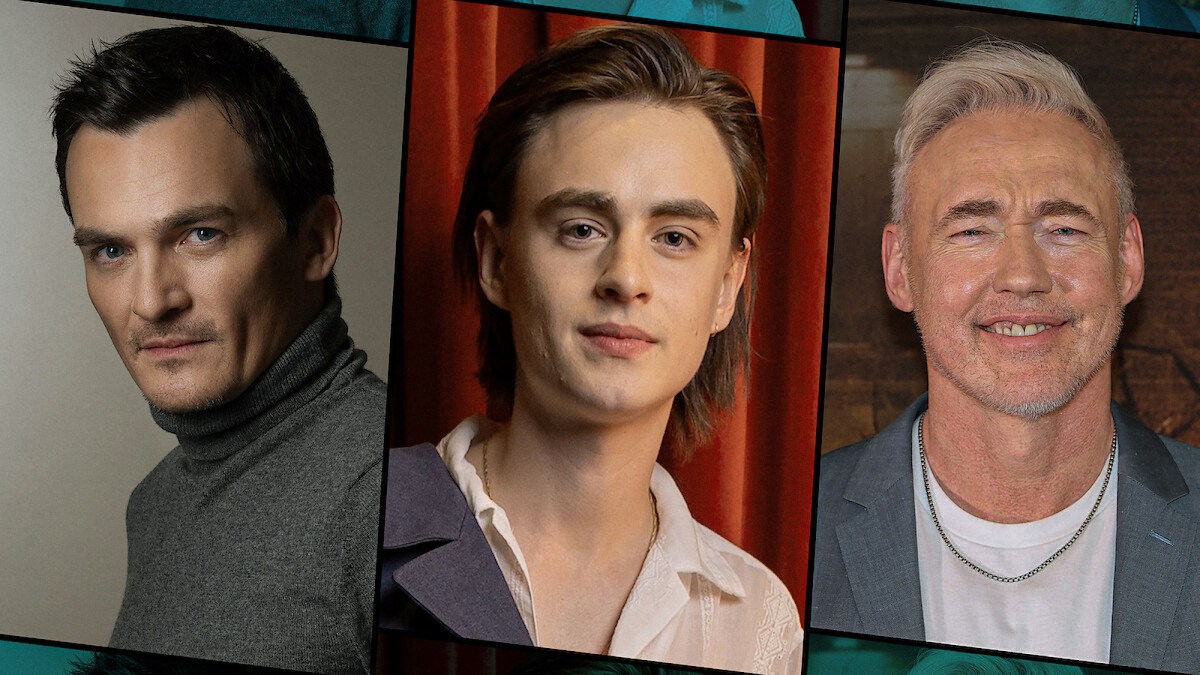
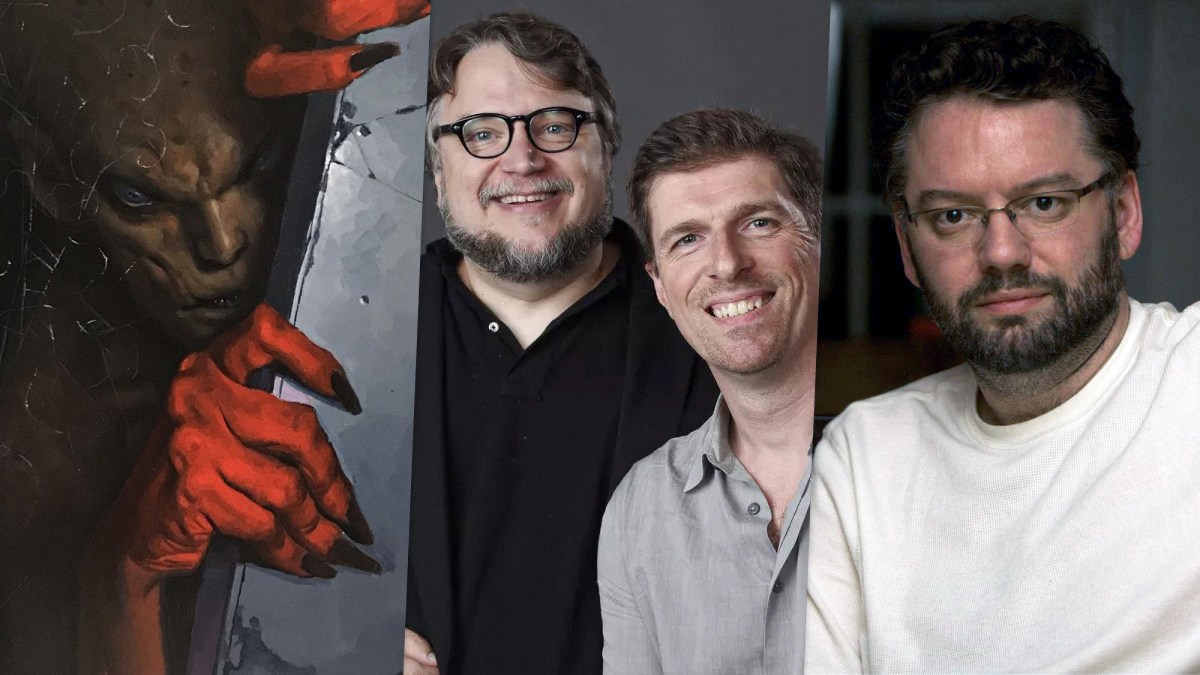
Guillermo del Toro and Chuck Hogan’s serialized novel is getting a feature film adaptation from writer-director David Prior (Guillermo del Toro’s Cabinet of Curiosities, The Empty Man). Starring Rupert Friend, Kevin Durand, and Jaeden Martell, The Boy in the Iron Box is the pulse-pounding tale of a team of mercenaries who find themselves out of their depth on a remote summit. What they encounter there will give you nightmares.
This is a story about my friend Aubrey, who died. It is also, inevitably, about me. This is possibly – definitely – self-involved, but the loss of someone is not abstract, or simply about someone’s inherent human worth, it is also about how stricken we are not to have them around, about what they meant to us, the part they played in our story.
Aubrey Day died a year ago, October 2, 2024. We had known each other 20 years, having met when I joined Total Film magazine, at Future Publishing. He was overseeing a few publications, but his passion was clearly movies and TV. He was a few years older than me, which in your 20s feels like a generation, and seemed debonair and certain, insanely confident and very, very clever. A few colleagues disliked him, not least because as well as being the smartest guy in the room, he was never especially shy about letting you know he was the smartest guy in the room. I just felt I had a lot to learn. And he was more than happy to teach. Not that he had a curriculum, or talked down to you (well, he didn’t always talk down to you), but he would present a problem and push you to solve it. It was a little sink or swim – he’d worked a bit in tabloids and had a tougher approach than the pally magazine world I was used to – but if he believed you could swim, that belief would buoy you.
The Fall Will Probably Kill You is a reader-supported publication. To receive new posts and support Nev Pierce‘s work, consider becoming a free or paid subscriber.
Watch the shorts by Nev Pierce, including Bricks, an Edgar Allan Poe adaptation starring Jason Flemyng and Blake Ritson, which David Fincher said about: “A morbid yet classy take on a morbid classic.”
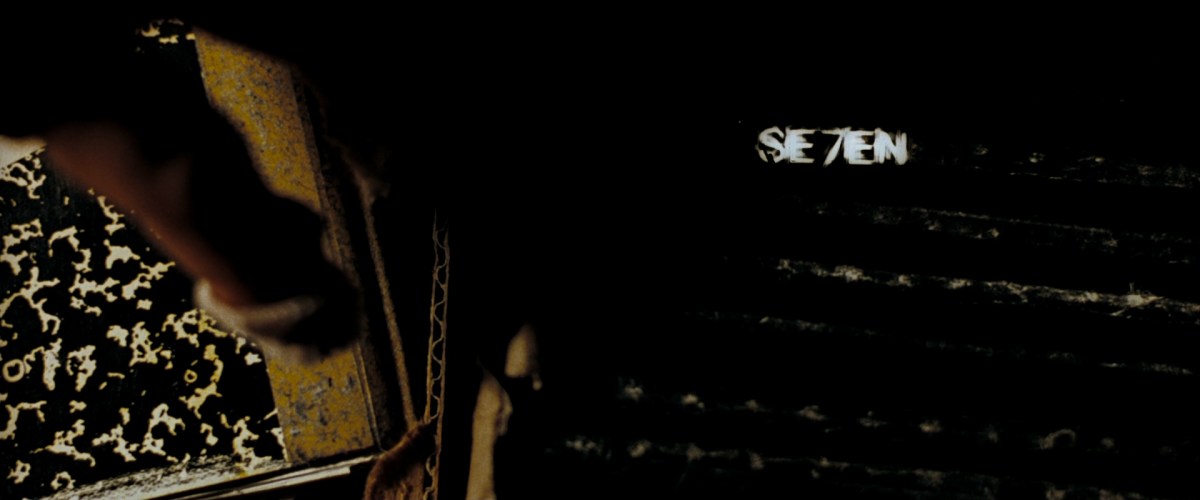
On September 22, 1995, David Fincher’s SE7EN introduced audiences to a darkness unlike anything seen before, accompanied by an opening title sequence from Kyle Cooper that has since become one of the most influential in film history.
For this classic title sequence, David Fincher tasked Kyle Cooper, founder of Prologue Films, to get inside the mind of a serial killer, immediately setting an ominous tone. Typography was scrawled into scratch board and shot on film, and Cooper shot tabletop photography representing the preparation of the killer’s obsessive sketchbooks. This dark yet spirited sequence was called a “masterpiece of dementia” and was credited with the resurgence of a generation’s interest in film title design.
The audio of this video is pulled from Kyle’s interview on the 2010 Blu-ray Special Edition of SE7EN, where he discussed the making of the sequence in detail.
In Part 1, Kyle reflects on his early conversations with Fincher. The two bounced ideas back and forth, shaping a vision that would forever change the way opening credits were made. This reel pairs finished titles with original process photographs, every frame shot on film, every prop (from John Doe’s notebooks to the hand model) photographed and tested.
“People think there’s computer graphics in there, but we assembled the majority of the sequence by hand… it takes on a life of its own.” In Part 2, he explains how he created the unsettling typography. Every letter was scratched, smeared, and distorted through the camera itself, analogue from start to finish. This reel pairs final frames from the title sequence with the original process photography of John Doe’s notebooks, props, and hands, showing how the haunting visuals took shape long before digital tools.
“This is John Doe’s job: he gets up, makes his books, plans his murders, drinks his tea.” In part 3, he reveals how the titles were designed to immerse viewers directly into the fractured psyche of the killer. To capture the killer’s mindset, Kyle went beyond typography. He gathered real objects from his surroundings, fish hooks, razor blades, sewing needles, twine, even clumps of hair from his shower drain, and filmed them in-camera alongside hand-crafted journals. These raw analogue elements were photographed, tested, and layered into the sequence, blurring the line between prop and pathology.
Kyle has recalled in interviews that during the premiere, when the title sequence finished, the audience actually clapped, something almost unheard of for opening credits. Thirty years later, that impact still reverberates across cinema and design.
The SE7EN End Credits Crawl
The unease of SE7EN doesn’t end with the final scene. Even the closing crawl was designed to keep audiences trapped in John Doe’s world.
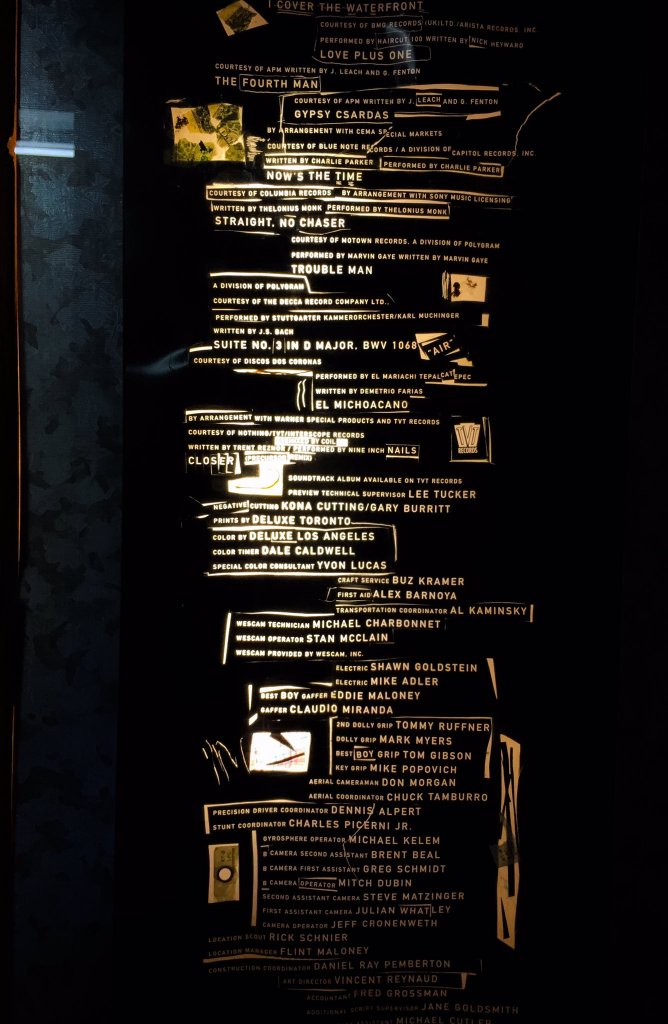
Kyle and Kim Cooper crafted the end credits entirely by hand. Each name was cut out and taped together into a single, massive scroll, almost like a tapestry. The piece was then shot with a video camera and lit from behind so the light bled through the lettering.
To deepen the sense of obsession, the crawl was embellished with objects John Doe might have owned: razor blades, fishing hooks, twine, screws, wire, flies, even hair pulled from a shower drain. Every detail was assembled practically, frame by frame, just like the opening titles.
We first show the original handmade scroll, now preserved in five long backlit panels at Prologue Films. Continue watching to see the crawl as it appeared in 1995. Instead of rolling upward like a traditional credit sequence, Fincher had it roll downward, a subtle inversion that mirrored the sick, twisted psychology at the heart of the film.
SE7EN end credits crawl panel, displayed at Prologue Films, photographed by Hideo Kojima.
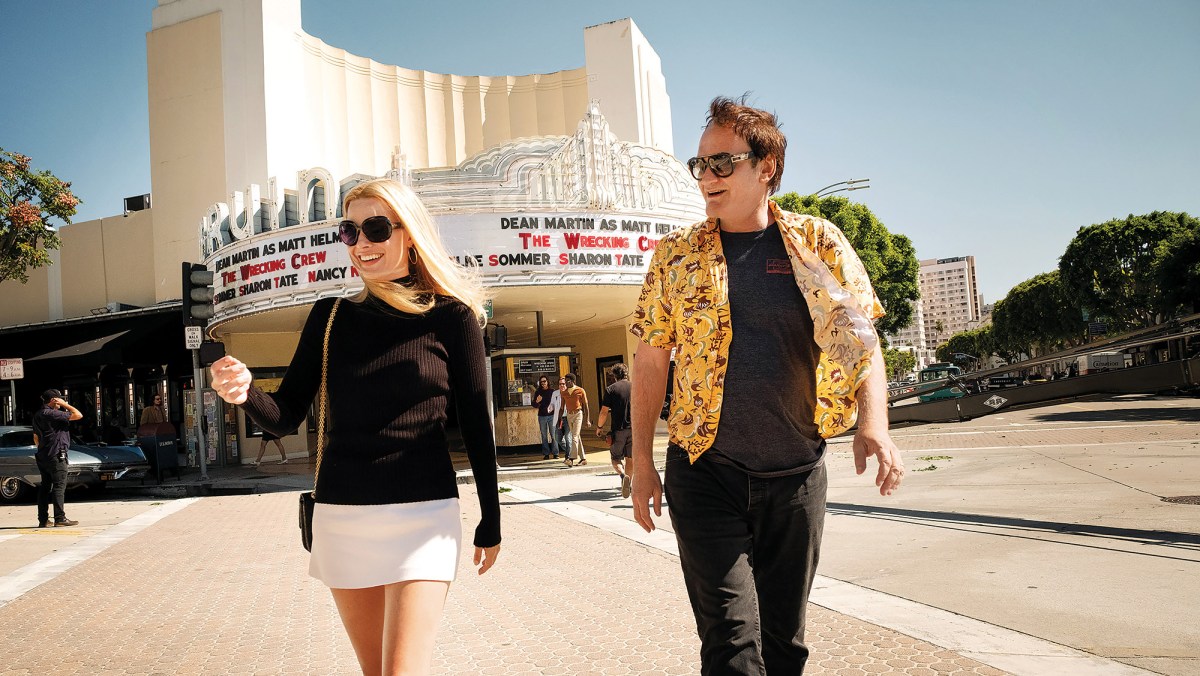
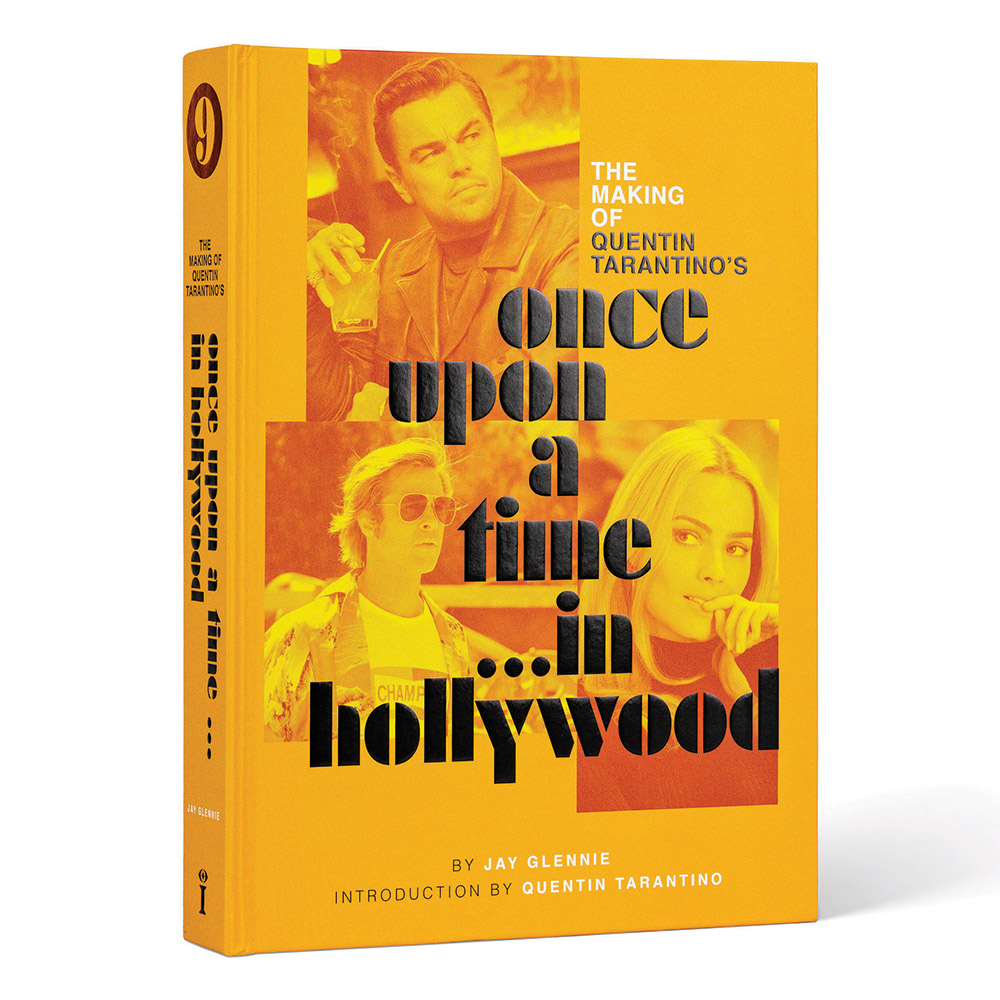
In an exclusive excerpt from the revealing new book ‘The Making of Quentin Tarantino’s Once Upon a Time… in Hollywood,’ the film’s director and stars Leonardo DiCaprio, Brad Pitt and Margot Robbie explain how they took L.A. back to the summer of ’69.
“Rick, how are you doing with getting Hollywood Boulevard for me?” Quentin asked his location manager, Rick Schuler. “I’m doing well,” Schuler replied.
Quentin looked at his first assistant director, Bill Clark, and looked at Schuler. “Doing well” was not going to cut it. Once Upon a Time in Hollywood was a Los Angeles story, a Hollywood story, and it needed to be filmed in Los Angeles. It needed Hollywood as a backdrop. He wanted to convert Los Angeles back to 1969 — “You know, literally street by street, block by block.”
Schuler had been in discussion with the California Film Commission for weeks. Under Quentin’s gaze, he admitted, “Well, I think I’m 80 percent there.”
“Rick, if there’s anything I can do to help you out, I’ll be willing to do that,” Quentin replied.
Production designer Barbara Ling was also anxious to know what it was she was going to be working with. Schuler had been asking the Hollywood powers that be, responsible for the economic success of their city, to shut down eight blocks.
“They had been, like, ‘Eight blocks? No way!’ and had said no a hundred times,” Ling recalls. “I also remember, eight blocks was freaking out the producers budget-wise.”
Schuler had an idea how he could utilize the filmmaker’s extraordinary enthusiasm and will to best use. He had an idea he wanted to run by Bill Clark: Schuler had a meeting with the Hollywood neighborhood council. Would Quentin be willing to address them — just talk about the project? Talk about the movie, what Hollywood meant to him? It could help get things over the line.
The day of the meeting, Schuler sprung it on Quentin and Clark that he wanted to make the filmmaker the surprise star act of his pitch and have him come in at the end. Nobody on the council would know he was there beforehand.
“For whatever reason, Rick thought it would be best if he kept Quentin a surprise to the council members,” Clark says.
After being optioned for an adaptation, things are moving quickly with Netflix’s adaptation of Guillermo del Toro and Chuck Hogan’s Audible series The Boy in the Iron Box, which is scheduled to begin filming in October 2025. David Prior, who has worked with GDT before, will be writing and directing the project, it has now been revealed.
Netflix has officially confirmed that The Boy in the Iron Box will be making its way onto our screens via a new feature film and has added three cast members ahead of filming commencing next month in Canada.
Frame & Reference is a conversation between Cinematographers hosted by Kenny McMillan. Each episode dives into the respective DP’s current and past work, as well as what influences and inspires them. These discussions are an entertaining and informative look into the world of making films through the lens of the people who shoot them.
Miles Perkins, Industry Manager, Epic Games July 28, 2025 Unreal Engine
Join Tim Miller, co-founder of Blur Studio and winner of multiple Emmy Awards, for a candid chat on his origins as an animator and visual effects artist, his “story first” philosophy, and his views on creativity. Tim’s curiosity and drive has led him to branch out from traditional visual effects to direct live-action features and explore real-time animation with Blur’s Secret Level series and the LOVE DEATH & ROBOTS anthology series.
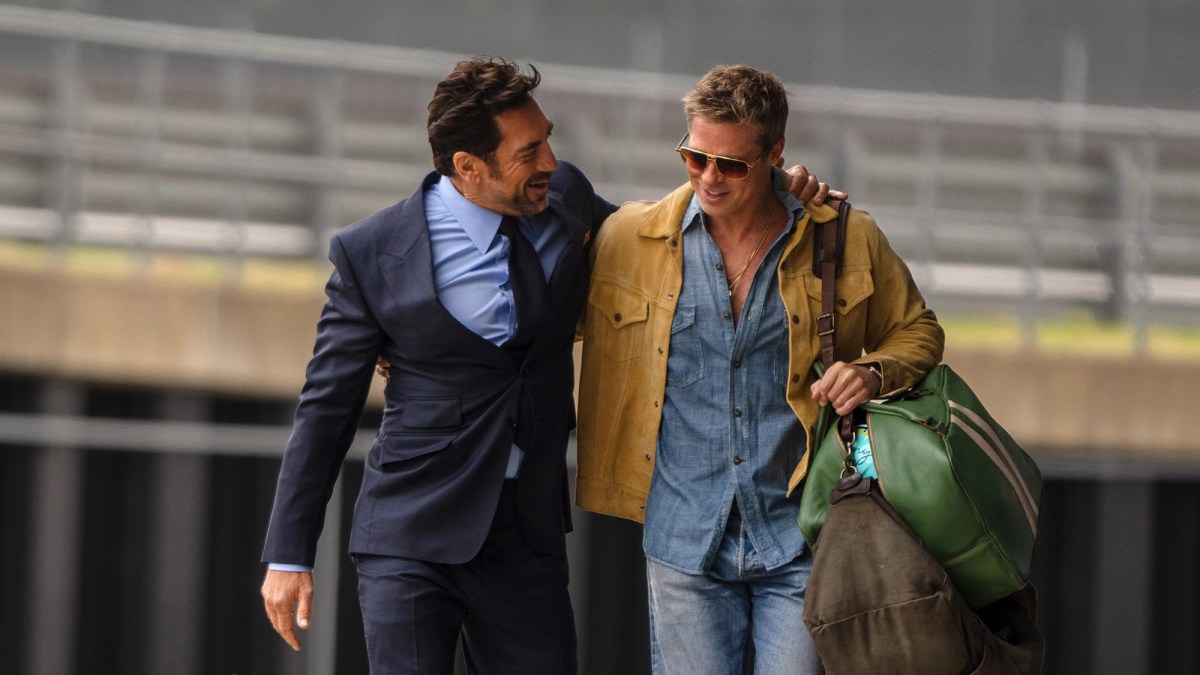
To create the new movie F1—which director Joseph Kosinski describes as “the most authentic, realistic, and grounded racing movie ever made”—no shortcuts were taken. Stars Brad Pitt and Damon Idris both drove their own cars, and the film’s crew integrated themselves into the actual Formula 1 season. That painstaking attention to detail also extended to the watch Pitt wears as the racer Sonny Hayes. The actor was extremely exacting about the timepiece he wanted to wear, its backstory, and many of the technical details, including the movement and thickness.
Our story begins, oddly enough, with David Fincher. The Oscar-nominated director and Pitt are longtime collaborators and pals who share a love of making awesome movies—Fight Club and Se7en, anyone?—and, apparently, equally awesome watches.
With the critical success of MINDHUNTER, the Irish-born actor graduated from supporting tough guy parts in films like Fight Club to leading his own shows. As he prepares for the release of The Waterfront, he speaks to Annabel Nugent about his traditional parents, how he almost turned down Alien3 – and why for him, ‘chivalry is not dead’.
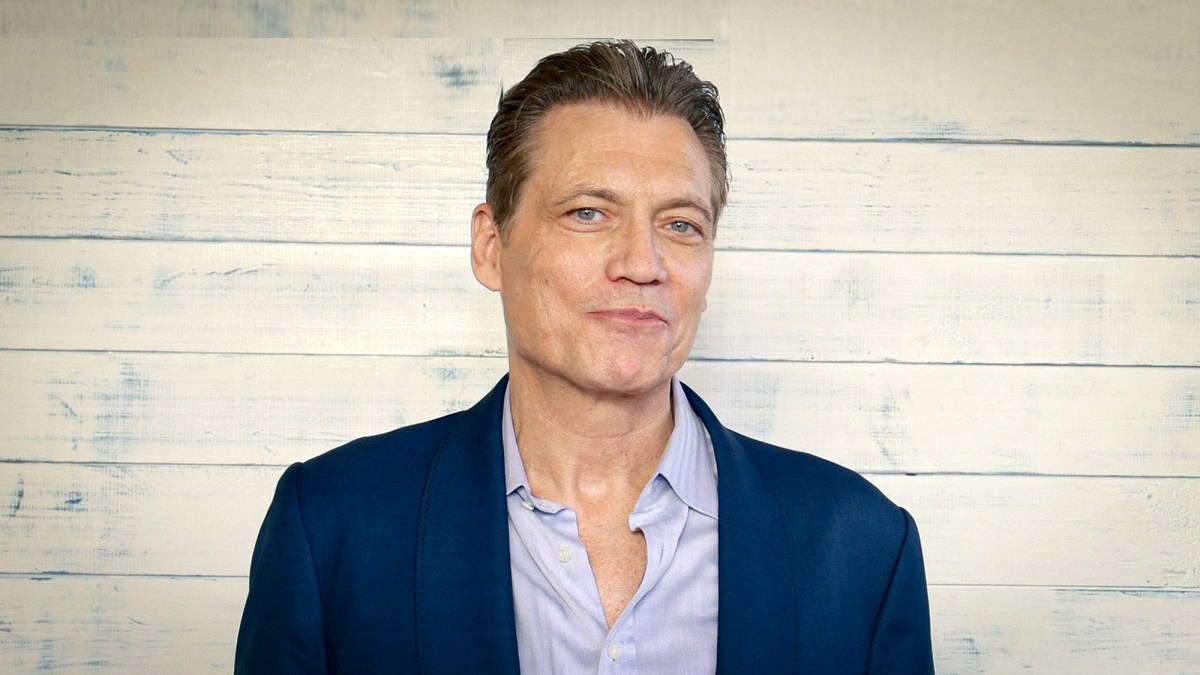
To hear Holt McCallany reel off his childhood heroes is to understand him a little better. “Steve McQueen, Burt Lancaster, Bob Mitchum, Gene Hackman, Jack Palance,” the actor says. “I loved Jack Palance. Lee Marvin. Charles Bronson.” He recites each name with cinematic gravitas and through semi-pursed lips as though he’s balancing an invisible cigarette out the corner of his mouth. “Those guys, they had this classic American… masculinity.”
The same can and has been said of McCallany, who at 61 has carved a career out of that same strong, silent archetype. He’s played parts on both sides of the law, including one tough guy unironically named Bullet. Bit parts in early David Fincher films like Alien3 and Fight Club introduced him as an excellent character actor, “that guy!” audiences are always happy to see, even if they may not know his name.
Fincher not only had his name, he had McCallany’s number, believing from the get-go that he was destined for bigger things, and eventually casting him as a lead in MINDHUNTER – the critically acclaimed Netflix neo-noir series about the FBI and serial killers. His performance as the straight-shooting, flat-top agent Bill Tench was so lauded, it inspired a think piece in Vulture titled: “Why MINDHUNTER’s Bill Tench Is So Lovable.” That article got to the crux also of what makes McCallany so, if not lovable, then watchable, because hand-in-hand with that stone-cold hardiness is an unexpected sensitivity. Flashes of openness where you’d expected a door slammed shut.
But McCallany downplays his part in the show’s success, attributing it instead to “the creative genius” behind the camera. He compares his role to that of a guest at a lavish dinner party: “There’s gorgeous tablecloths, beautiful crystal glasses, and delicious food. You just have to not spill food down your shirt and everybody goes, bravo!” It may sound like false humility, but in truth, there is a steely confidence to McCallany’s words: give him a good part, and he’ll do the rest.
In a world where so much entertainment is afraid to take risks, LOVE DEATH + ROBOTS is the iconoclastic brainchild of one man’s enigmatic yet expansive tastes. While a dedicated team of artists craft the (mostly) animated shorts comprising the 35 episodes of LDR, the basis for almost all of them are short stories that Tim Miller loves. Miller, the series co-creator and executive producer keeps a catalog of material on his computer, ready for the right moment to pair a story with a visionary team and unleash the results on unsuspecting audiences.
Now that we’ve arrived at Volume 4, the audience may suspect that they’re going to get something unexpected, yet the show still surprises. From hard-edged, serious sci-fi to explosively violent, unapologetically puerile action, the show contains multitudes.
Among the most ardent fans of LDR are the episode directors themselves, who have trouble picking their favorites among the first three volumes.
“I love seeing people’s LDR tier lists,” says Emily Dean, director of two episodes — the Volume 3 award winner The Very Pulse of the Machine and the fourth’s devilish cat caper For He Can Creep. She has been “very inspired” by a number of installments including Zima Blue, Bad Travelling, Pop Squad, The Drowned Giant, and Jibaro.
Three of these are on the list below, although LDR is the kind of show where your favorites may change according to the day of the week or the mood you’re in. Director and animator Diego Porral had a hand in two of the episodes below and sees the diversity of voices and styles as a major strength. “The fun thing is that whoever I talk to, in or out of the animation industry, everyone has their favorite, and I think that’s what makes LDR so special,” says Porral, helmer of this volume’s action-packed How Zeke Got Religion and lead animator on the Volume 3 classic Kill Team Kill.
Miller dreamed for decades of an animated anthology exploring stories that had stuck in his subconscious. And now he — along with fellow executive producers David Fincher and Josh Donen and supervising director Jennifer Yuh Nelson — relishes seeing disparate filmmakers and animation studios come together to generate these distinct shorts. “Netflix, just like the internet, allows all these strange people, that would never find each other ordinarily, to connect,” says Miller. “Sometimes for good, sometimes for evil, but certainly in the case of LOVE DEATH + ROBOTS, I feel it’s a force for good.”
Below you can find 13 episodes to match your highly specific tastes, whether you’re in the mood for cats, carnage, concerts, or comfort.


 The Fincher Analyst