Movies We Like: Cinematographer Jeff Cronenweth on Blade Runner

A Legacy of Light and Shadow

Andy Nelson and Pete Wright
October 27, 2025
Movies We Like (TruStory FM)

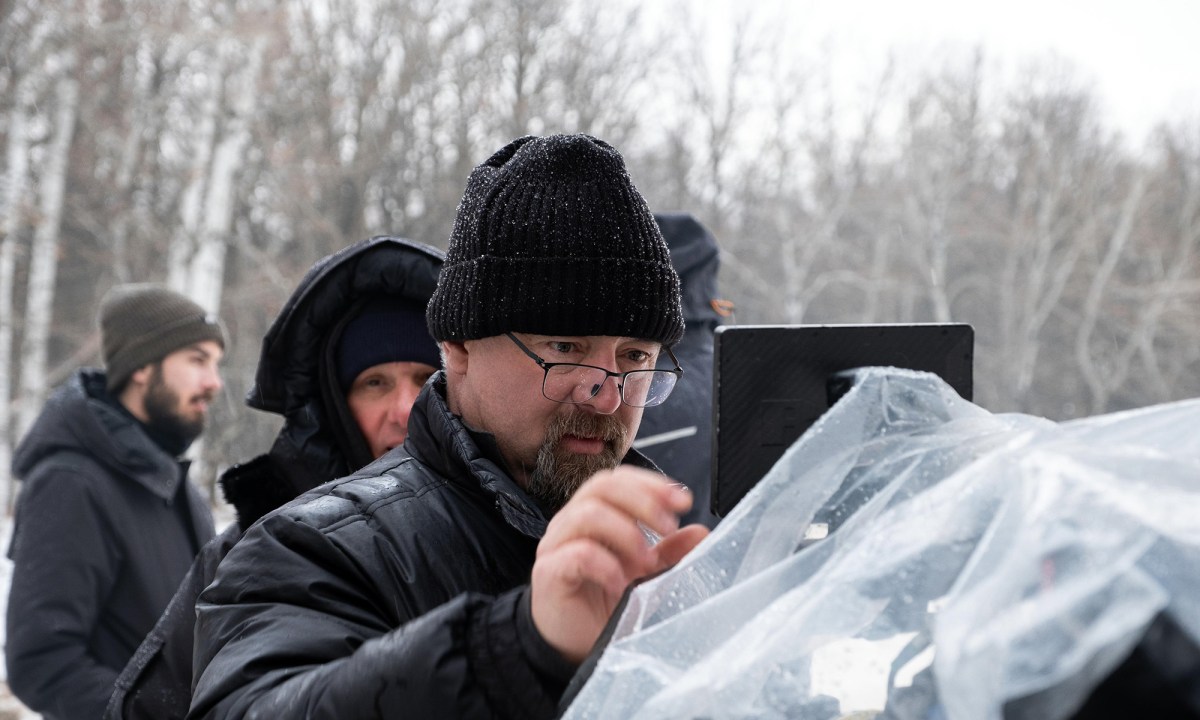
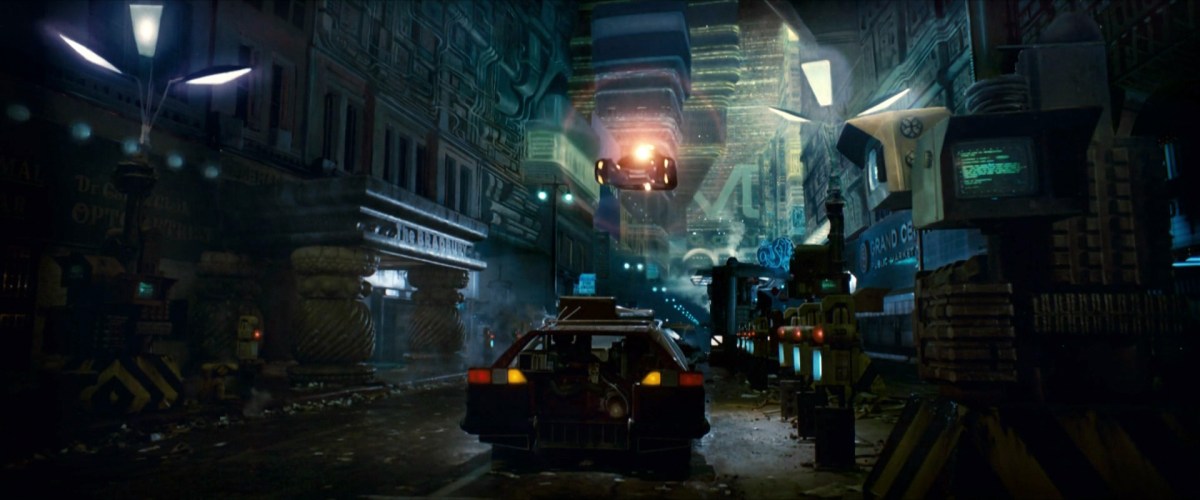
Cinematographer Jeff Cronenweth joins Movies We Like hosts Andy Nelson and Pete Wright to explore Ridley Scott’s groundbreaking 1982 film Blade Runner. As the son of the film’s original cinematographer, Jordan Cronenweth, Jeff brings a unique perspective on both the technical achievements and lasting influence of this sci-fi noir masterpiece. With his recent work on Tron: Ares hitting theaters, Cronenweth reflects on how Blade Runner continues to inspire filmmakers and cinematographers four decades later.

From early experiences on film sets with his father to becoming David Fincher’s go-to cinematographer on films like Fight Club, The Social Network, and The Girl with the Dragon Tattoo, Cronenweth has built a career focused on visual storytelling that serves character and narrative. He describes his approach as seeking human stories within any genre, whether period drama or science fiction. His transition from film to digital cinematography reflects broader industry changes, while maintaining his commitment to thoughtful, story-driven imagery.

The conversation explores how Blade Runner created its influential neo-noir aesthetic with remarkably limited technical resources, including just three xenon lights for its iconic beam effects and borrowed neon lights from Francis Ford Coppola’s One from the Heart set. Cronenweth shares insights into the film’s production challenges and creative solutions, from practical lighting techniques to Ridley Scott’s visionary production design. The discussion examines how the film balances its high-concept science fiction premise with intimate character moments, creating a template for genre storytelling that continues to resonate. Cronenweth also offers a perspective on the various cuts of the film and its 2017 sequel.

Through this engaging conversation, Cronenweth illuminates not just the technical mastery behind Blade Runner, but its enduring impact on cinema. His unique connection to the film through his father, combined with his own distinguished career, offers viewers fresh insights into this landmark work of science fiction and its continuing influence on visual storytelling.

Listen to the podcast:
Apple Podcasts
Spotify
YouTube (Audio Only)

When the Movie Looks Insane: Jeff Cronenweth, ASC

Patrick Tomasso
October 19, 2025
patrick 2masso (YouTube)

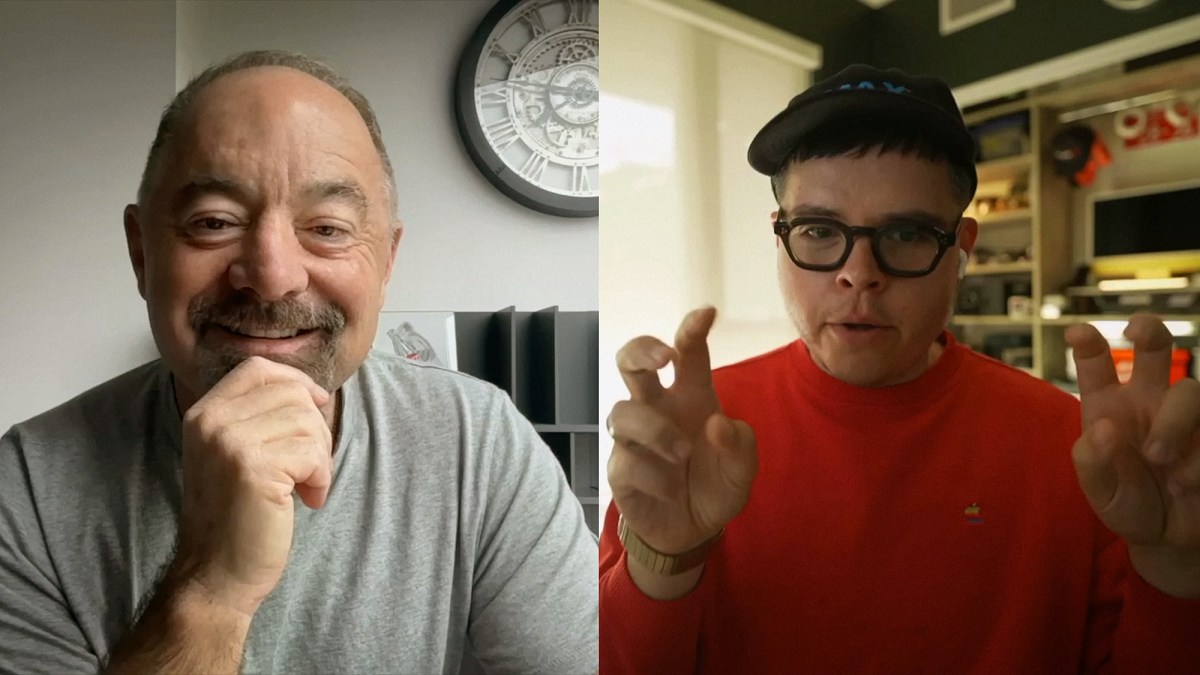
Go behind the visuals of TRON: ARES with cinematographer Jeff Cronenweth, ASC – the mind behind the camera for films like The Social Network, The Girl with the Dragon Tattoo, and Gone Girl. We talk about the look of the new TRON film, his collaboration with director Joachim Rønning, shooting digitally on RED cameras, and how his decades-long partnership with David Fincher shaped his approach to modern cinematography.

If you’re into camera tech, lighting, or just want to know why TRON: ARES looks so good, this one’s for you.

Special thanks to RED Digital Cinema for setting this up.

Follow Patrick Tomasso on:

YouTube 1, YouTube 2, Instagram, Threads, X, TikTok, Letterboxd, LinkedIn

30 Years of Kyle Cooper’s Classic Title Sequence for SE7EN

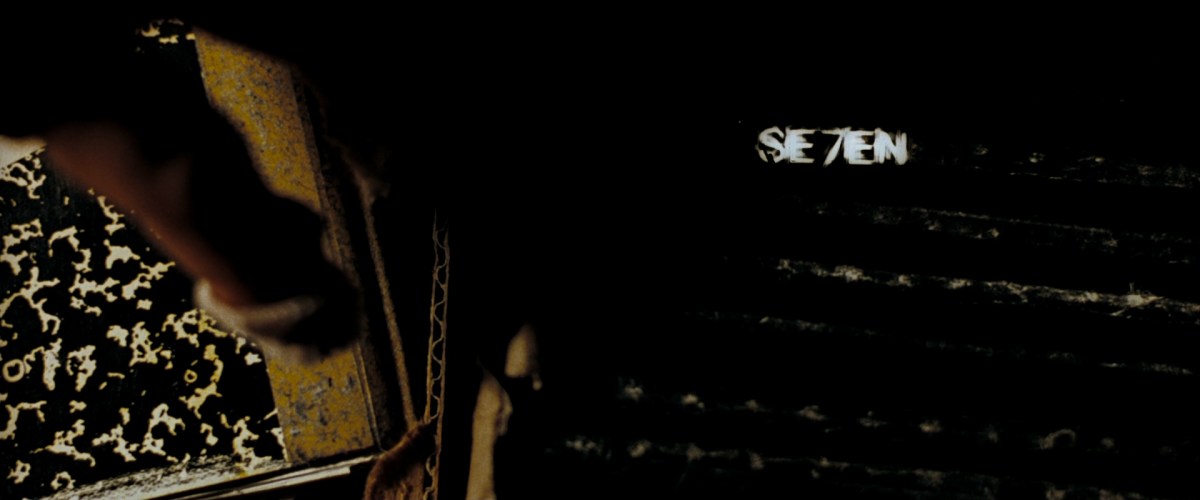
On September 22, 1995, David Fincher’s SE7EN introduced audiences to a darkness unlike anything seen before, accompanied by an opening title sequence from Kyle Cooper that has since become one of the most influential in film history.

September 26, 2025
Prologue Films (Instagram: 1, 2, 3, 4)

For this classic title sequence, David Fincher tasked Kyle Cooper, founder of Prologue Films, to get inside the mind of a serial killer, immediately setting an ominous tone. Typography was scrawled into scratch board and shot on film, and Cooper shot tabletop photography representing the preparation of the killer’s obsessive sketchbooks. This dark yet spirited sequence was called a “masterpiece of dementia” and was credited with the resurgence of a generation’s interest in film title design.

The audio of this video is pulled from Kyle’s interview on the 2010 Blu-ray Special Edition of SE7EN, where he discussed the making of the sequence in detail.

In Part 1, Kyle reflects on his early conversations with Fincher. The two bounced ideas back and forth, shaping a vision that would forever change the way opening credits were made. This reel pairs finished titles with original process photographs, every frame shot on film, every prop (from John Doe’s notebooks to the hand model) photographed and tested.

“People think there’s computer graphics in there, but we assembled the majority of the sequence by hand… it takes on a life of its own.” In Part 2, he explains how he created the unsettling typography. Every letter was scratched, smeared, and distorted through the camera itself, analogue from start to finish. This reel pairs final frames from the title sequence with the original process photography of John Doe’s notebooks, props, and hands, showing how the haunting visuals took shape long before digital tools.

“This is John Doe’s job: he gets up, makes his books, plans his murders, drinks his tea.” In part 3, he reveals how the titles were designed to immerse viewers directly into the fractured psyche of the killer. To capture the killer’s mindset, Kyle went beyond typography. He gathered real objects from his surroundings, fish hooks, razor blades, sewing needles, twine, even clumps of hair from his shower drain, and filmed them in-camera alongside hand-crafted journals. These raw analogue elements were photographed, tested, and layered into the sequence, blurring the line between prop and pathology.

Kyle has recalled in interviews that during the premiere, when the title sequence finished, the audience actually clapped, something almost unheard of for opening credits. Thirty years later, that impact still reverberates across cinema and design.

The SE7EN End Credits Crawl

The unease of SE7EN doesn’t end with the final scene. Even the closing crawl was designed to keep audiences trapped in John Doe’s world.

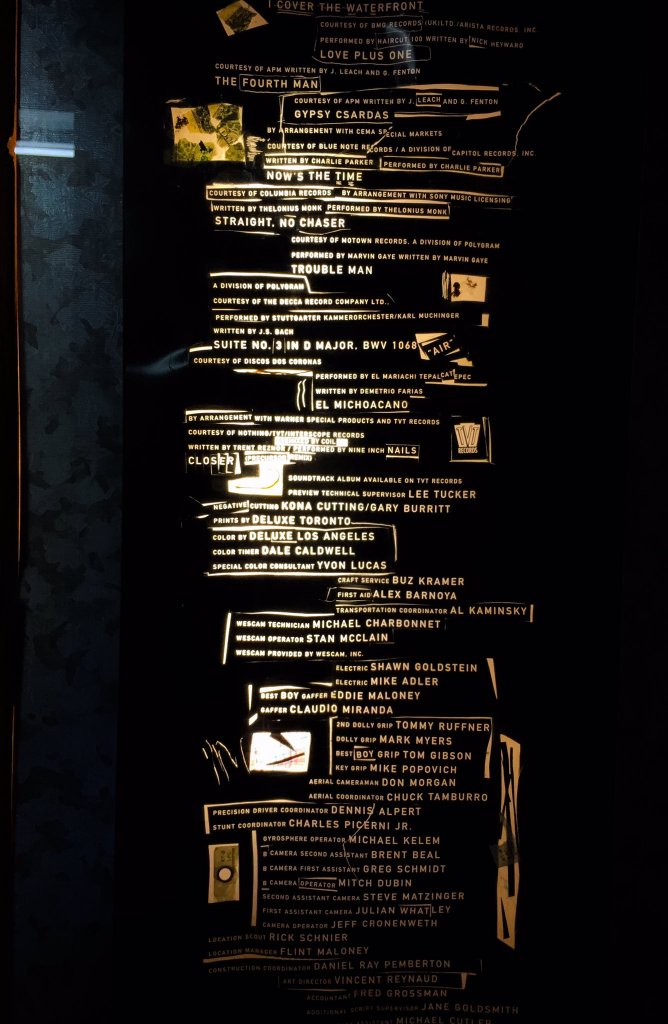
Kyle and Kim Cooper crafted the end credits entirely by hand. Each name was cut out and taped together into a single, massive scroll, almost like a tapestry. The piece was then shot with a video camera and lit from behind so the light bled through the lettering.

To deepen the sense of obsession, the crawl was embellished with objects John Doe might have owned: razor blades, fishing hooks, twine, screws, wire, flies, even hair pulled from a shower drain. Every detail was assembled practically, frame by frame, just like the opening titles.

We first show the original handmade scroll, now preserved in five long backlit panels at Prologue Films. Continue watching to see the crawl as it appeared in 1995. Instead of rolling upward like a traditional credit sequence, Fincher had it roll downward, a subtle inversion that mirrored the sick, twisted psychology at the heart of the film.

SE7EN end credits crawl panel, displayed at Prologue Films, photographed by Hideo Kojima.

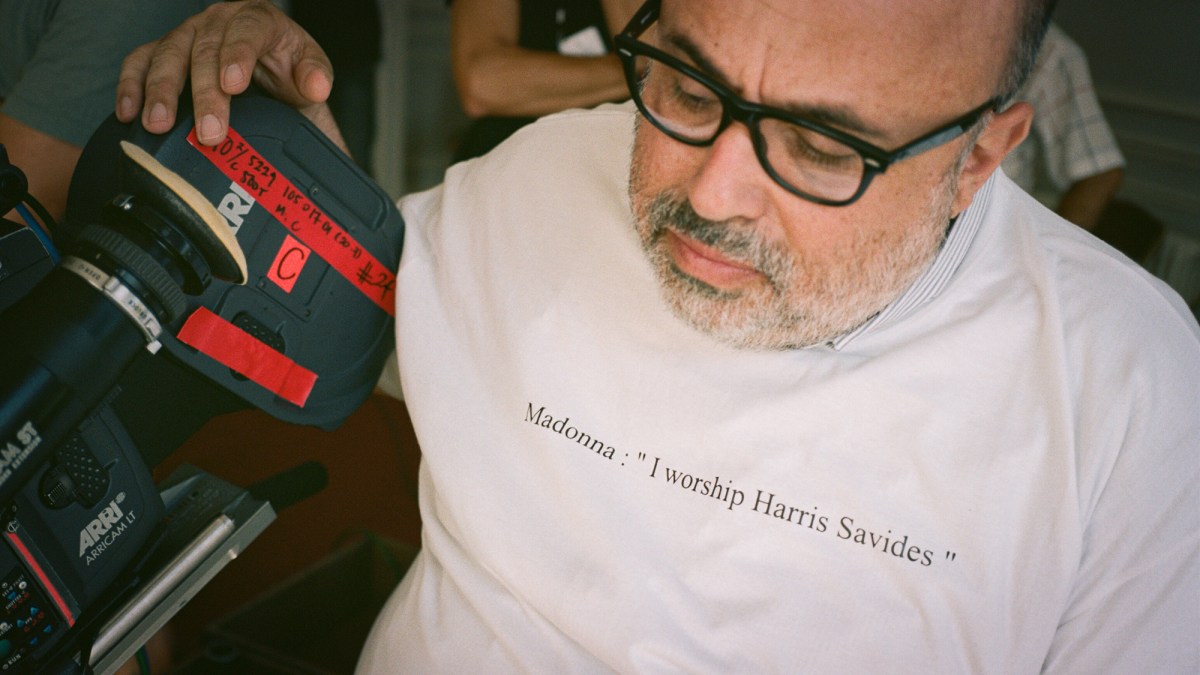
‘The Best of the Best’: Honoring the Magic, Guts, and Generational Talent of Cinematographer Harris Savides

Sofia Coppola, Gus Van Sant, Noah Baumbach, Jonathan Glazer, David Fincher, and today’s best cinematographers reflect on the giant hole in the heart of cinema that was left when Harris Savides died in 2012.  

Chris O’Falt
August 15, 2024
IndieWire

This article is part of IndieWire’s 2000s Week celebration. Click here for a whole lot more.

When cinematographer Bradford Young was fresh out of Howard University, he would have done anything to get near the set of his idol Harris Savides. He eventually found a way to shoot behind-the-scenes footage for the French director Fabian Barron, who hired Savides to shoot an Armani fragrance commercial in Hawaii. When Young got to the forest set, with shafts of light streaming through the trees, he became confused when he flipped on his DV camera to capture the scene.

“The model came on set, and I was like, ‘How’s he going to light her face?,’” recalled Young, who couldn’t believe what happened next: Savides walked on to set with a flashlight in hand and shined it at the model. “He was completely secure with this little flashlight on this million-dollar set. With my eye on the day, I didn’t understand what was happening, ‘How’s he still getting exposure?’ And then I saw the commercial. It was that God particle thing that Harris had. This was complete technical mastery and a complete mystery to observe.”

There was a sense of magic surrounding what Savides was able to do. When discussing what his go-to cinematographer was using to light a scene, director David Fincher used to joke, “I don’t know, Harris’ got a jar of fireflies.”

“Beyond the technical process, there was always something else going on in the picture that I couldn’t account for, something that was only him,” writer/director Noah Baumbach told IndieWire. “Something that I guess we call genius.”

Read the full profile

Why “Shot On iPhone” Commercials Look So Good! Ft. Claudio Miranda

Gene Nagata
February 5, 2024
Potato Jet

Huge Shoutout to Claudio Miranda & the Crew.

Claudio Miranda, Director of Photography, ASC ACC: Instagram
Josh Davis, Gaffer
Yong Ok Lee, Production Designer
Robert Smathers, 1st AC
Angie Su, Director

Phone rigged by TILTA Khronos (still in development) but will be available publicly soon.

David Fincher at The Cinémathèque Française: “Zodiac” Screening and Q&A

Frédéric Bonnaud, Director of the Cinémathèque française
Anaïs Duchet, Interpreter
October 14, 2023
Cinémathèque Française

The Cinémathèque Française (French Cinematheque) hosted a David Fincher Retrospective from October 13 to 22, 2023, in Paris (France).

Supported by Netflix, Patron of the Cinémathèque, it opened with a preview screening of The Killer followed by a Q&A with Director David Fincher, and Director of Photography Erik Messerschmidt, ASC.

The next day, a screening of Zodiac was followed by a discussion with the director about the film and his career, “David Fincher par David Fincher, une leçon de cinéma” (“David Fincher by David Fincher, a lesson in cinema”).

Not Many People Have Basements in California …

To celebrate the 25th anniversary of Se7en and the 10th anniversary of The Social NetworkThe Ringer hereby dubs September 21-25 David Fincher Week. Join us all throughout the week as we celebrate and examine the man, the myth, and his impeccable body of work.

Robert Graysmith visiting the home of Bob Vaughn in ‘Zodiac’ is David Fincher’s most purely terrifying scene. Here’s how it came together—and came to stay in the movie.

Jake Kring-Schreifels 
Jake Kring-Schreifels is a sports and entertainment writer based in New York.
September 24, 2020
The Ringer

On a wet September night in 1978, Robert Graysmith couldn’t resist his curiosity.

A month earlier, the San Francisco Chronicle cartoonist had received an anonymous phone call regarding the identity of the Zodiac, the notorious Bay Area serial killer. “He’s a guy named Rick Marshall,” the mysterious voice told him at the start of an hourlong conversation. The killer’s string of murders in 1969 had gone unsolved, but Graysmith suddenly had a new lead. According to the tipster, Marshall—a former projectionist at The Avenue Theater—had hidden evidence from his five victims inside movie canisters, which he’d rigged to explode. Before hanging up, the nameless caller told Graysmith to find Bob Vaughn, a silent film organist who worked with Marshall. The booby-trapped canisters, Graysmith learned, had recently been moved to Vaughn’s home. “Get to Vaughn,” the voice told him. “See if he tells you to stay away from part of his film collection.”

After years spent independently entrenched in the open case, Graysmith dug into Marshall’s history and found several coincidences. His new suspect liked The Red Spectre, an early-century movie referenced in a 1974 Zodiac letter, and had used a teletype machine just like the killer. Outside The Avenue Theater, Marshall’s felt-pen posters even had handwriting similar to the Zodiac’s obscure, cursive strokes. On occasional visits to the upscale movie house, Graysmith observed Vaughn playing the Wurlitzer and noticed the Zodiac’s crosshair symbol plastered to the theater’s ceiling. There were too many overlapping clues. He had to make a trip to Vaughn’s house. “We knew there was some link,” Graysmith tells me. “I was scared to death.”

Almost three decades later, director David Fincher turned Graysmith’s nightmarish visit into one of the creepiest movie scenes of all time. It takes place near the end of Zodiac, after Graysmith (Jake Gyllenhaal) follows Vaughn (Charles Fleischer) to his home through the rain in his conspicuous, bright-orange Volkswagen Rabbit. Once inside, the mood quickly becomes unnerving. After disclosing that he, not Marshall, is responsible for the movie poster handwriting, Vaughn leads a spooked Graysmith down to his dimly lit basement. As the organist sorts through his nitrate film records, the floorboards above Graysmith creak, insinuating another’s presence. After Vaughn assures his guest that he lives alone, Graysmith sprints upstairs to the locked front door, rattling the handle, before Vaughn slowly pulls out his key and opens it from behind. Graysmith bolts into the rain as though he’s just escaped the Zodiac’s clutches.

Ultimately, the third-act encounter is a red herring. Vaughn was never considered a credible suspect. But in a movie filled with rote police work and dead ends, those five minutes of kettle-whistling tension turn a procedural into true horror. The scene is a culmination of Graysmith’s paranoid obsession with the Zodiac’s identity—a window into the life-threatening lengths and depths he’ll go to solve the case—and a brief rejection of the movie’s otherwise objective lens. “It’s actually so different from the rest of the movie,” says James VanderbiltZodiac’s screenwriter. “It does kind of give you that jolt that a lot of the movie is working hard not to [give].”

Most simply, the basement scene is a signature Fincher adrenaline rush—a moment buttressed by years of intensive research, attention to accuracy, and last-minute studio foresight. Thirteen years after the movie’s release, it still sends shivers down Graysmith’s spine.

Read the full article

Art of the Shot: Jeff Cronenweth, ASC on Tales from the Loop & How Story Drives the Visuals

Derek Stettler
April 27, 2020
Art of the Shot

Welcome to the Art of the Shot podcast! Join writer and filmmaker Derek Stettler for conversations with the artists behind the camera on strikingly-shot films, series, music videos and commercials. Discover how they made their careers happen, hear about their creative process, and learn how they make the shots that make us say: wait, how did they do that?

For the third episode, Derek speaks with none other than Jeff Cronenweth, ASC!

Jeff is the two-time Oscar-nominated cinematographer behind many of David Fincher’s films, including The Social Network, The Girl with the Dragon Tattoo, and their first film together–and Jeff’s first feature film–Fight Club.

(And if you’re worried, no, they don’t talk about Fight Club… much.)

Jeff has also shot numerous commercials and music videos for some of the biggest artists, including Madonna, David Bowie, Shakira, Taylor Swift and Katy Perry.

And this month marked the release of Jeff’s first foray into television, with the pilot to the Amazon Prime original series, Tales from the Loop: a sci-fi anthology adapted from the paintings of Swedish artist Simon Stålenhag.

What you may not know is that Jeff Cronenweth is the son of legendary cinematographer Jordan Cronenweth, the eye behind the era-defining look of Blade Runner. Enjoy this in-depth conversation about everything from how Jeff forged his own path while following in his father’s footsteps, and his approach to lighting based on story, to working with David Fincher, his work on Tales from the Loop (including how he achieved a never-before-seen lighting effect), and his trick for making sure eye lights look more natural.

Note, due to the COVID-19 pandemic, this conversation was recorded remotely, but all efforts were made to ensure quality audio.

The Art of the Shot podcast is brought to you by Evidence Cameras, an outstanding rental house in Echo Park specializing in high-end digital cinema camera packages, lenses, support, and accessories.

If you like what you hear, please subscribe to be notified of future episodes, and share this podcast with others to help grow the show!

Listen to the podcast:

Apple Podcasts
Spotify
Google Podcasts

Follow Art of the Shot: Instagram
Follow Derek Stettler: Instagram, Twitter

Tales from the Loop trailer audio copyright Amazon.com, Inc. Used with permission courtesy of Amazon Studios.

Follow Jeff Cronenweth, ASC Archives on Twitter

Fincher’s ‘Zodiac’: A Suspenseful and Thrilling Combination of Police Procedural and Newspaper Film That Masterfully Chronicles the Progression of Obsession

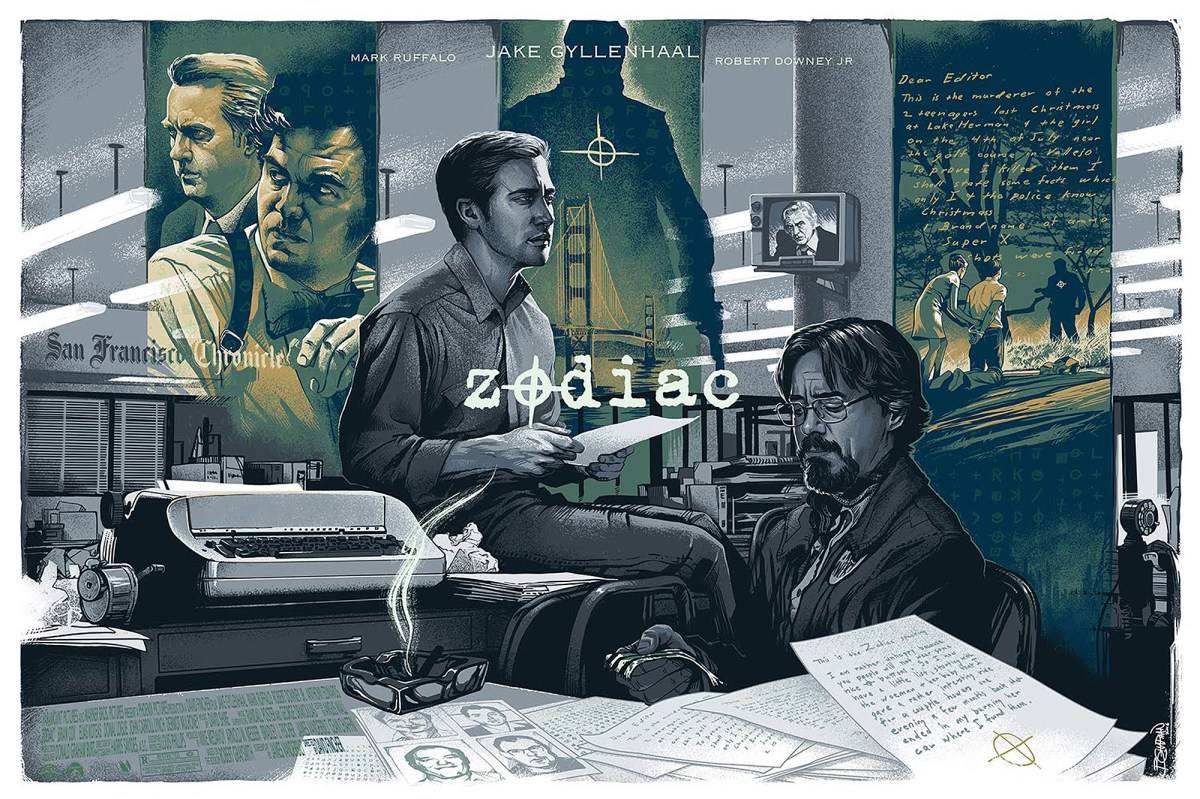
Zodiac poster by Barret Chapman

Koraljka Suton
January 24, 2020

If you asked David Fincher about the childhood years he spent in San Anselmo in Marin County during the 1960s, the topic that would undoubtedly pop up would be that of an infamous serial killer who, in the director’s eyes, was “the ultimate boogeyman.” For it was precisely that time and that general area that saw the rise of the Zodiac, a murderer who frequently wrote letters and sent coded messages to local newspapers, gleefully taking credit for the gruesome killing sprees that would inevitably trigger waves of paranoia across the West Coast. As Fincher recalls: “I remember coming home and saying the highway patrol had been following our school buses for a couple weeks now. And my dad, who worked from home, and who was very dry, not one to soft-pedal things, turned slowly in his chair and said: ‘Oh yeah. There’s a serial killer who has killed four or five people, who calls himself Zodiac, who’s threatened to take a high-powered rifle and shoot out the tires of a school bus, and then shoot the children as they come off the bus.’” Fincher’s fascination with the mystery man who wreaked havoc in Northern California during the late 60s and early 70s, claiming to have taken the lives of thirty-seven people (out of which only five were confirmed as being his victims), ultimately resulted in the director gladly accepting to work on Zodiac, a 2007 movie written by James Vanderbilt. The screenwriter had read a 1986 non-fiction book of the same name while he was still in high school, years before pursuing his eventual career. After getting into screenwriting, he had the chance to meet Zodiac author Robert Graysmith, a cartoonist who had been working for one of the newspapers the killer wrote to during the 1960s, and decided to make a screenplay based on the information-packed book. Having creative control over the material was of the utmost importance to Vanderbilt, given the fact that the endings of his previous scripts had been altered. Together with producers from Phoenix Pictures, Vanderbilt bought the rights to both Zodiac and its follow-up, entitled Zodiac Unmasked, after which the Seven director was asked to come on board.

Apart from having a personal attachment to the story of the notorious serial killer who was never brought to justice, what drew Fincher to work on the project was also the fact that the ending of Vanderbilt’s script was left unresolved, thereby staying true to real-life events. But Fincher’s perfectionism and his wish to depict the open case as accurately as possible led to him asking that the screenplay be rewritten, for the wanted to research the original police reports from scratch. He also decided that he, Vanderbilt and producer Bradley J. Fischer should personally interview the people who were involved in the case so that they could discern for themselves whether the testimonies were to be believed or not. The people they spent months interviewing were family members of suspects, the Zodiac killer’s two surviving victims, witnesses, investigators both current and retired, as well as the mayors of Vallejo and San Francisco. As Fincher elaborated: “Even when we did our own interviews, we would talk to two people. One would confirm some aspects of it and another would deny it. Plus, so much time had passed, memories are affected and the different telling of the stories would change perception. So when there was any doubt we always went with the police reports.” They also hired a forensic linguistics expert to analyze the killer’s letters, with the expert’s focus being on how the Zodiac spelled words and structured sentences, as opposed to the emphasis that was put on the Zodiac’s handwriting by document examiners in the 1970s.

Read the full article

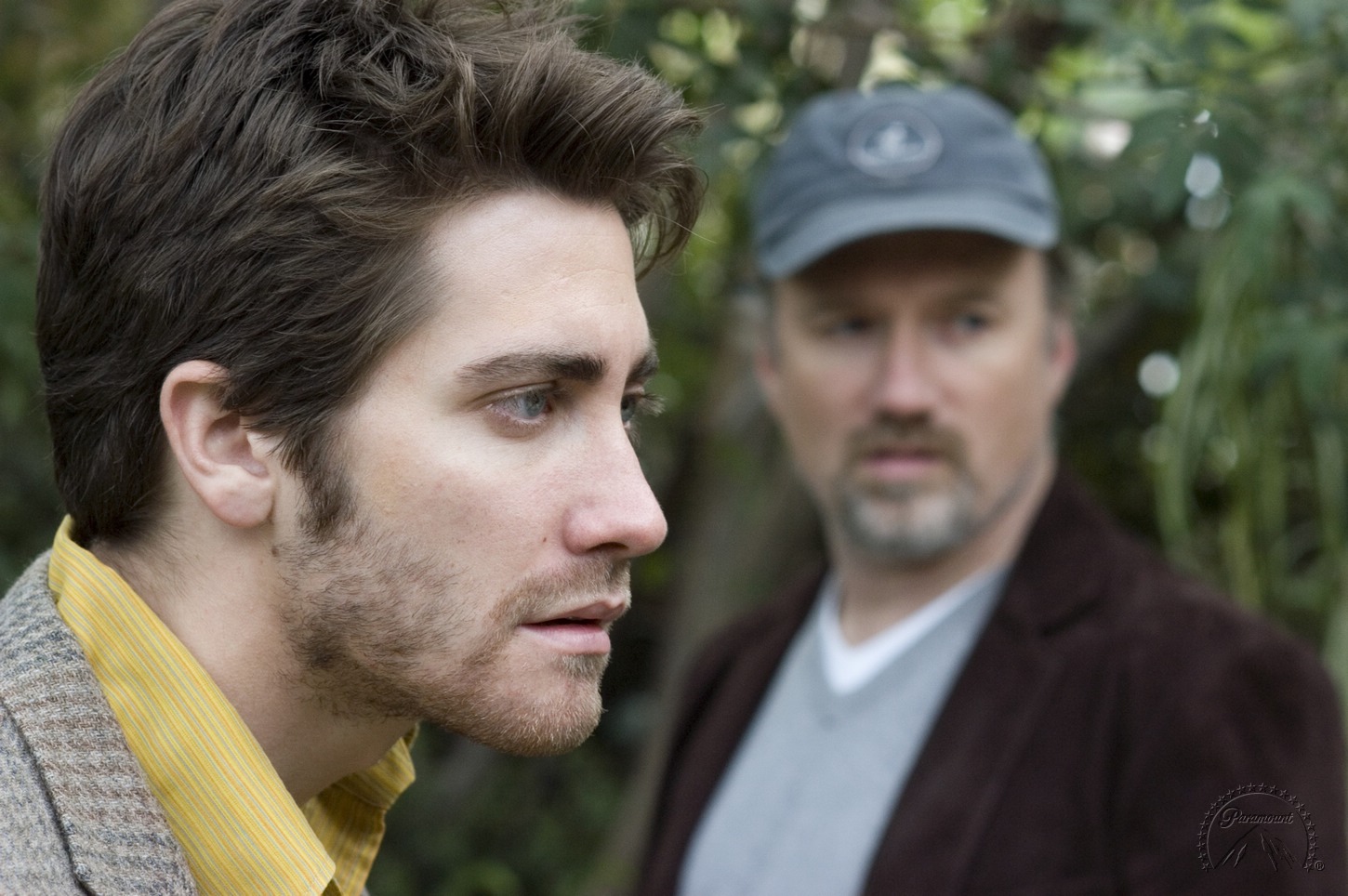
Film stills by Merrick Morton (Paramount Pictures)

Other in-depth articles on films by David Fincher on Cinephilia & Beyond:

Alien3: “Take all of the responsibility, because you’re going to get all of the blame”

Se7en: A Rain-Drenched, Somber, Gut-Wrenching Thriller that Restored David Fincher’s Faith in Filmmaking

Downwards Is the Only Way Forwards: Welcome to David Fincher’s The Game

Fight Club’: David Fincher’s Stylish Exploration of Modern-Day Man’s Estrangement and Disillusionment

Fincher’s Zodiac As Easily One Of The Best Thrillers Of The Millennium So Far

From Facebook to ‘Fuck-You Flip-Flops’: How Aaron Sorkin and David Fincher Made ‘The Social Network’ a Fiery Word-Off

Harmonica Cinema: Zodiac

Another comprehensive article by Spanish DP, Producer and cinematography scholar Ignacio Aguilar, this time on the cinematography of Zodiac. Time to practice your rusty Spanish or get help from a good web translator.

Harmonica Cinema - Logo

Excepcional adaptación cinematográfica del libro de Robert Graysmith, basado en su propia investigación sobre los asesinatos cometidos en la zona de San Francisco a finales de la década de los 60 y comienzos de los 70, por un asesino que además enviaba cartas a los períodicos, anunciando sus planes y próximas víctimas. El film está protagonizado, además de por el propio Graysmith (interpretado por Jake Gyllenhaal), por su compañero en el San Francisco Chronicle, Paul Avery (Robert Downey, Jr.) y por el detective de homicidios Dave Toschi (Mark Ruffalo), los cuales uno a uno, se van obsesionando por el caso que les ocupa a medida que profundizan en el mismo y creen encontrarse cerca de resolverlo. Se trata quizá del mejor y más sólido trabajo de David Fincher detrás de las cámaras, quien deja de lado su conocida solvencia técnica y se lanza a narrar minuciosamente todo lo concerniente al caso que inspiró películas como “Dirty Harry” (1971), tomando una estructura y formas muy parecidas a las de una de sus películas de referencia: “All The President’s Men” (Alan J. Pakula, 1976), escrita por William Goldman y protagonizada por Dustin Hoffman y Robert Redford. Anthony Edwards, Chloe Sevigny, Elias Koteas, John Carroll Lynch y Brian Cox, entre otros, completan el reparto de un film absolutamente modélico.

Ignacio Aguilar
1 agosto 2018
Harmonica Cinema

El director de fotografía fue Harris Savides [ASC], un hombre cuya carrera en cine, entre su tardía llegada y su prematuro fallecimiento por un cáncer cerebral a los 55 años de edad en el año 2012, desgraciadamente fue demasiado corta. Procedente de los videoclips y de los anuncios publicitarios, debutó en 1996 con “Heaven’s Prisoners” a las órdenes de Phil Joanou. Ya el año anterior había rodado metraje adicional para David Fincher en “Se7en” (1995), quien le contrató para su siguiente film, “The Game” (1997), la película que puso a Savides en el mapa. Posteriormente destacó mucho con “The Yards” (James Gray, 2000) y con varios trabajos para Gus Van Sant: “Finding Forrester”, “Gerry”, “Elephant”, “The Last Days” y “Milk”, además de por su trabajo para Jonathan Glazer en “Birth”. Además tuvo tiempo para colaborar con Ridley Scott en “American Gangster”, con Woody Allen en “Whatever Works” o con Sofia Coppola en “Somewhere”. Su estilo, muy sencillo y poco recargado, a menudo estaba dominado por la subexposición y la luz cenital, a veces asumiendo grandes riesgos, siguiendo en muchos aspectos la línea de Gordon Willis durante la década de los 70.

Savides por lo tanto era el director de fotografía ideal para Fincher en este proyecto, ya que el citado modelo “All The President’s Men” precisamente fue fotografiado por el autor de “The Godfather”. Ambientada desde finales de los años 60 hasta principios de los 80, “Zodiac” sorprendió mucho porque fue el primer proyecto de David Fincher rodado en formato digital y porque hasta aquél momento, dicha forma de adquisición se había empleado principalmente en películas como “Attack of the Clones” (2002) y “Revenge of the Sith” (2005), “Collateral” (2004) y “Miami Vice” (2006) o incluso “Apocalypto” y “Superman Returns” (2006), sin que ninguna de ellas (dejando de lado del film de Gibson) fueran películas de época. Savides (ante la insistencia de Fincher) recurrió a la cámara Thomson Viper Filmstream, la misma usada por Michael Mann en las dos películas citadas anteriormente, pero a diferencia del director de “The Last of the Mohicans”, en el caso de “Zodiac” los cineastas no lo hicieron para rodar con niveles de luz muy bajos o luz disponible, sino que rodaron en HD iluminándolo de forma muy parecida a como lo hubiesen hecho rodando en 35mm. Por ello, el efecto vídeo de las películas de Mann, tanto por la textura de la imagen como por emplear el obturador abierto, no está presente en absoluto en “Zodiac”, que en muchas ocasiones es mencionada como un hito precisamente porque su estética digital fue la primera que demostró que en este formato podían seguir obteniéndose imágenes de parecida calidad a las que se conseguían con el celuloide. Y aunque la Viper era una cámara limitada (con un sensor pequeño y no tanta latitud como las modernas) lo cierto es que prácticamente nunca se perciben dichas limitaciones.

Lee el artículo completo

Harmonica Rental - LogoHarmonica Films - Logo