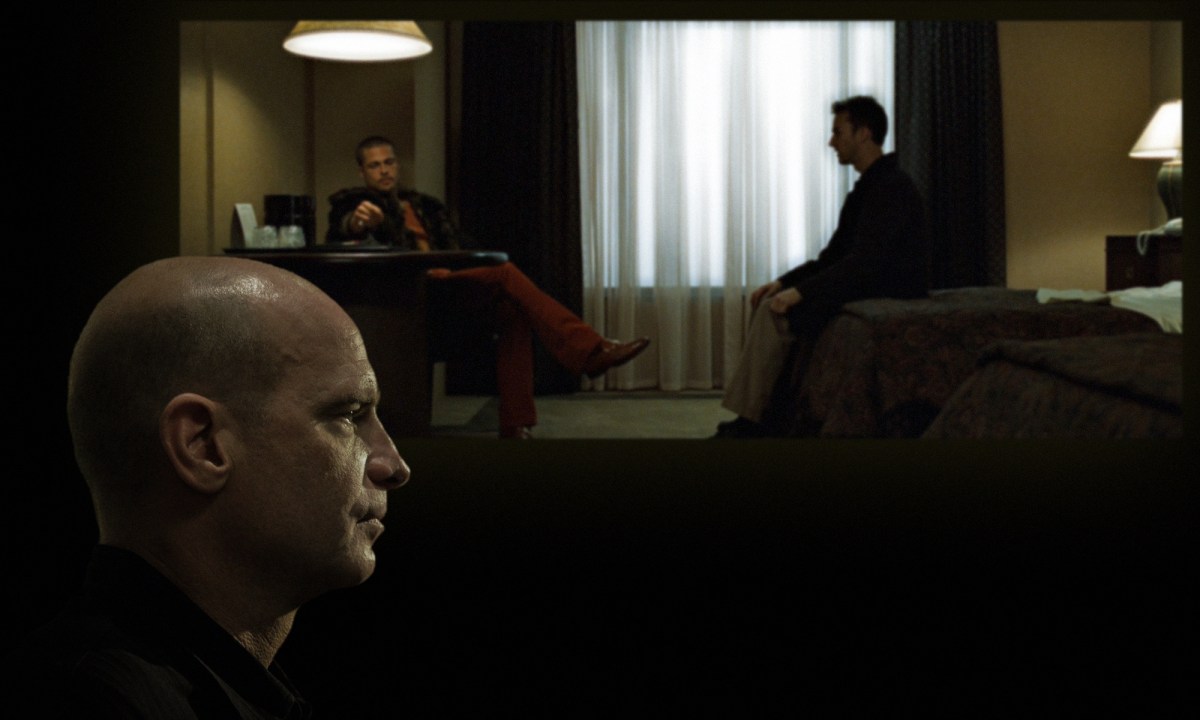
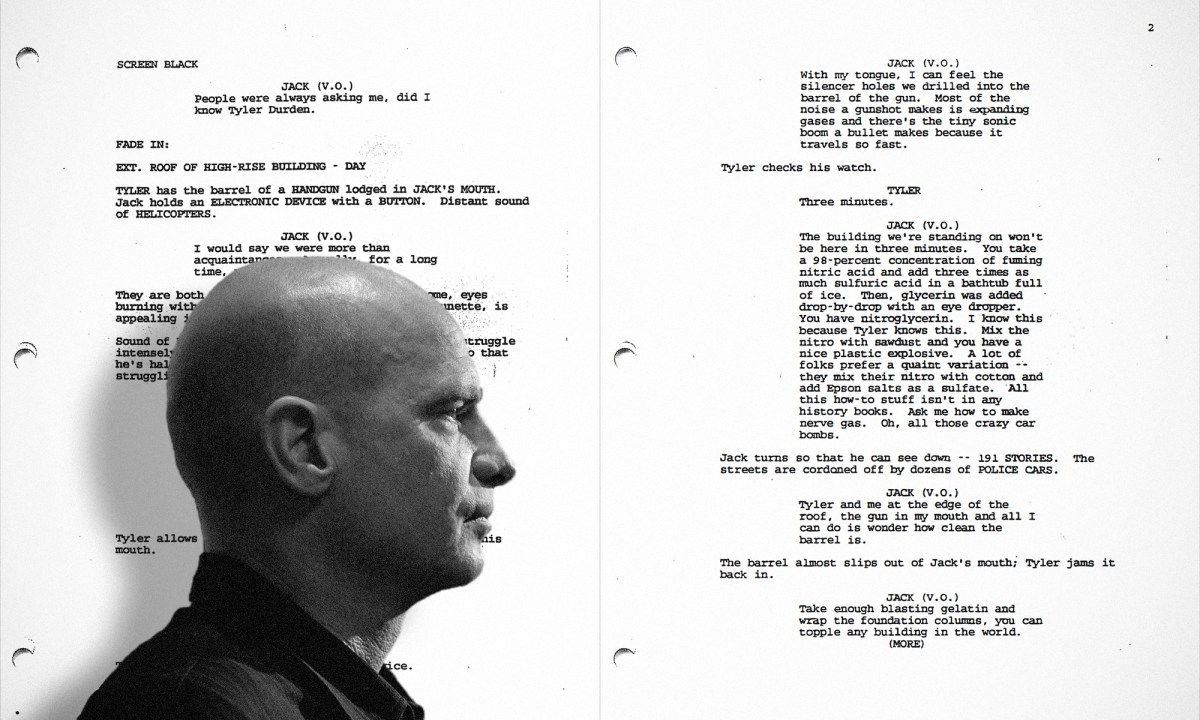
This month, Fight Club turns twenty. David Fincher’s adaptation of Chuck Palahniuk’s novel, written for the screen by Jim Uhls and starring Brad Pitt, Edward Norton, and Helena Bonham Carter, became a movie classic that has generated every form of cultural reference, from memes to research papers. Ranking #10 on IMDb’s Top 250 best-movie list and lending “The first rule of Fight Club” catchphrase to teen chats and corporate meetings alike, the film has come to occupy a unique niche in modern culture.
On the anniversary of the movie’s release, Fight Club’s screenwriter Jim Uhls spoke with Storius, reflecting on the film’s journey and lasting influence, adaptation challenges, fan theories, and his screenwriting techniques.
STORIUS: Today, twenty years after its release, Fight Club seems surprisingly contemporary, especially considering how many changes our society has gone through since 1999. It has entered the cultural lexicon, is often referenced even by people who haven’t seen it, and doesn’t seem to age much. What do you attribute the movie’s endurance to?
It hits a nerve with each generation that discovers it, seemingly because the basic life circumstances of the viewer, whether in 1999 or 2019, are the same. Part of that nerve is the idea of how self-worth is defined — both by society and in one’s mind — which are usually the same.
But, in this film, they become different. Men in their twenties, still puzzled about what they should do with their lives, are discovering a different way to define self-worth. A group of them meet to experience something that is outside the parameters of civilization. Each fight is one-on-one violence between two men who have no animosity towards each other, might not even know each other. They’re doing it because it’s a ritual, a primal ritual, in which they take part both by doing it and by watching others do it. It’s physical combat, wordless, and true — i.e., the fights are actually happening, so they are true. Other things all around these men can be lies, with or without words, but the fight cannot be a lie.
Another part of that nerve is Tyler Durden’s contempt for materialism, consumerism, the impossible ideals invented by advertising, and in effect — everything that is fake, or a lie, or a pathway to soullessness — all constantly bombarding us, in our “civilized” world. I’ve been repeatedly surprised by females, from teenage to senior citizens, telling me they love the film. It’s clearly aimed at a form of emancipation for young men, but part of the nerve it hits must resonate for women.
STORIUS: It’s hard to believe now that the movie was considered a failure when it was released, and that it took a few years and a DVD release to turn it into a financial success and a cultural phenomenon. Why do you think the film had such a bumpy road to recognition?
The bumpy road, the period of initial domestic release, was largely due to the vexing challenge of how to make a trailer for the film that promotes what the film is. It wasn’t an easy task. And it wasn’t achieved.
I ran into a friend about two weeks after the initial release, and he said he hadn’t gotten to the film yet, but he would; he just wasn’t a big fan of boxing movies.
“Boxing movies.” That’s a solid example of someone not having any idea of what the film was about during the time when it was vital to get that across to the public.
A guide to Netflix, Disney+, HBO Max, Apple TV+, Amazon Prime Video and Hulu as they compete in the ongoing streaming wars and what it means for the stuff you actually watch.
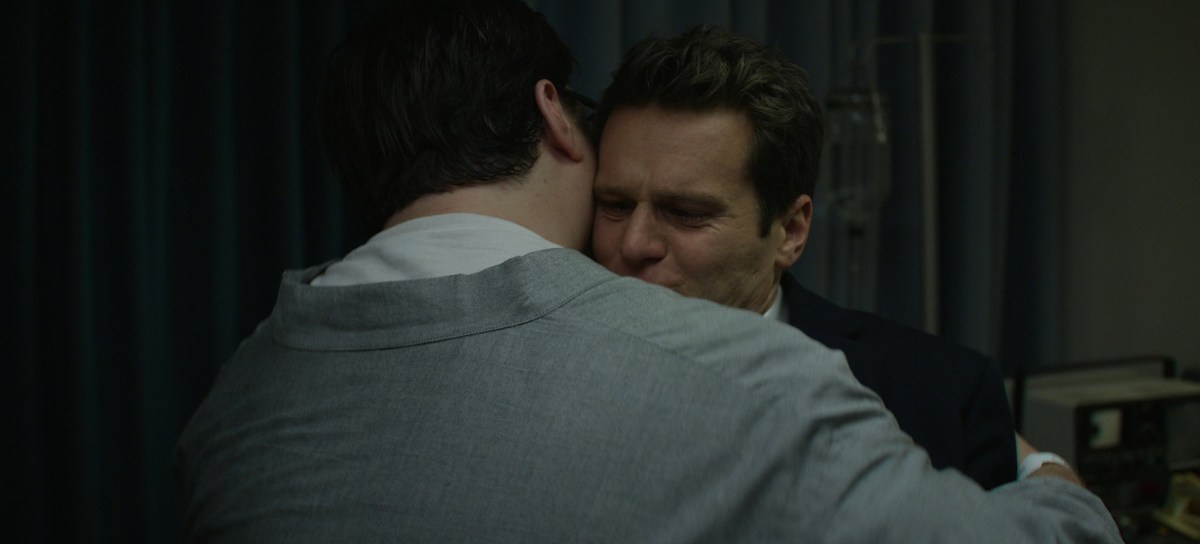
Mindhunter is not like other crime shows. In this video essay, Thomas Flight explores some of the inventive techniques creators Joe Penhall and David Fincher employ to inject drama and conflict into the show.
This is a detailed analysis of the ways in which Mindhunter pulls the audience into the lives of its characters as they explore the minds of some of the worst criminals on earth.
This week on Pop Culture Confidential we are thrilled to have screenwriter Liz Hannah in conversation about the incredible new season of Mindhunter, as well as working with Steven Spielberg on The Post and more!
Liz Hannah burst onto the scene a couple of years ago when her first screenplay, a spec script about Washington Post owner Kay Graham and her decision to publish the Pentagon Papers, was picked up none other than Steven Spielberg. That became The Post starring Meryl Streep and Tom Hanks. Liz Hannah went on the write the critically acclaimed comedy Long Shot starring Charlize Theron and Seth Rogen.
Now she is onboard Mindhunter season two as a writer and producer. Liz Hannah talks to us about her career, working with David Fincher (exec producer and director on Mindhunter), writing and staging one of the most intense episodes of TV this year, the Charles Manson episode, getting into the heads of serial killers and much more.
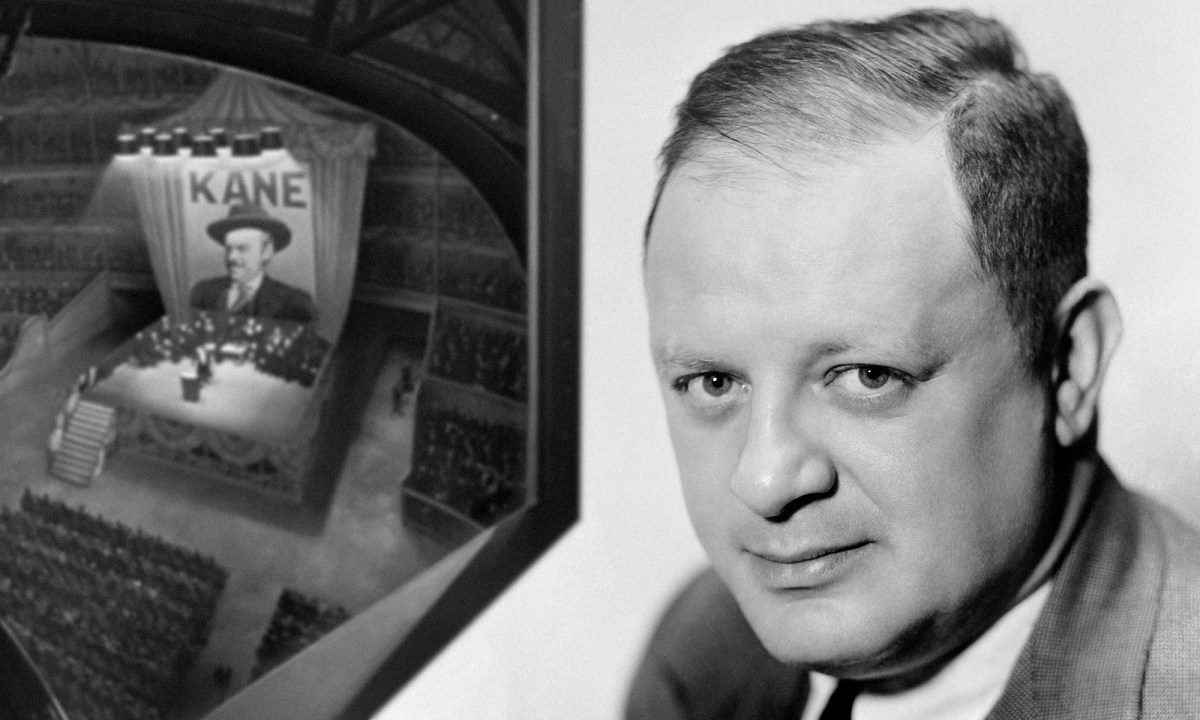
David Fincher has reportedly signed on to direct his first feature film since Gone Girl in 2014, a biopic about the contentious development of the script for Citizen Kane, one of Fincher’s favorite films, by the brilliant and prolific but troubled screenwriter Herman J. Mankiewiczand legendary director Orson Welles. They both shared the Academy Award for Best Original Screenplay.
And he is doing it for Netflix, the streaming service and production company that has granted him artistic freedom and for whom he has developed and produced the series House of Cards and Mindhunter, and executive produced the animated series Love, Death, and Robots.
Master Actor Gary Oldman will play the titular role, Mankiewicz, or “Mank“, as he was nicknamed.
The film project inception dates back to 1993 and is based on a script by Fincher’s late father, Howard “Jack” Fincher. Jack Fincher was a journalist, writer and essayist specialized in science, a former San Francisco bureau chief for LIFE magazine, and a devoted cinephile. In 1997, he was commissioned to draft a screenplay for a Howard Hughes biopic, with Kevin Spacey attached to direct. But this project was later absorbed by The Aviator project scripted by John Logan, which ended up being directed by Martin Scorsese.
Mank will be shot in black and white, as Fincher always intended. This caused the project to stall in the past, but Alfonso Cuarón’s recent success with Roma, also for Netflix, has reinforced the limited commercial appeal of this aesthetic option.
The film will be produced by the traditional power couple David Fincher & producer Ceán Chaffin, this time alongside Oldman’s business partner and producer Douglas Urbanski. Urbanski is an occasional actor who played President of Harvard University Lawrence Summers in The Social Network.
Production is scheduled to begin in November in Los Angeles.
As far back as 1997, this biographical story of Herman J. Mankiewicz, the writer of Orson Welles‘ epic motion picture Citizen Kane, was rumored as a pet project for David Fincher. From a script written by his father, Howard Fincher, the director’s black and white biopic targeted Seven star Kevin Spacey as the lead, with Panic Room‘s Jodie Foster in a co-starring role as movie actress Marion Davies. In production at the same time was HBO‘s telemovie RKO 281, which also covered the backstory of Citizen Kane (casting John Malkovich in the Mankiewicz role and Melanie Griffith as Davies). Still, the true story behind the creation of this mould-shattering movie and the writer behind it has enough scope for the production of a further feature by Fincher and his father.
Mankiewicz was a cynical but extremely talented scriptwriter, a former theatre critic for the New Yorker and the New York Times who left his job for the glitter of early Hollywood. Dropping out of the elite circle of New York’s high society, specifically the so-called “Algonquin Round Table“, Mankiewicz began with scripts for silent films, starting with The Road to Mandalay in 1926, working on more than 70 features during his lifetime. He once famously described Hollywood to a fellow writer in NYC by saying: “Millions are to be grabbed out here and your only competition is idiots. Don’t let this get around”. As film technology evolved in the late twenties, Mankiewicz changed gears and moved seamlessly into talkies, continuing to write stories or dialogue for films like Man of the World (1942), The Lost Squadron (1932), Dinner at Eight (1933) and It’s a Wonderful World (1939), as well as an uncredited rewrite on The Wizard of Oz; he also worked with the Marx Brothers as an executive producer on movies like Horse Feathers (1932) and Duck Soup (1933).
With his career flagging as the thirties ended and with his comedic hits behind him, Mankiewicz’s Oscar-winning success with Welles’ Citizen Kane in 1942 gave him a brief respite. However, his alcoholism and large gambling debts eventually got the better of him and he died, penniless, of uremic poisoning in 1953. Remembered for Welles’ powerfully directed feature about a ruthless newspaper mogul, Mankiewicz no doubt drew on his personal experiences as a former associate of real-life magnate William Randolph Hearst and as a partygoer at Hearst’s huge Hollywood mansion. Although Mankiewicz was forced to share Citizen Kane‘s Academy Award for Best Writing with Welles, the great majority of the script was the writer’s own work, and it was not only a source of friction between the two men but of debate among film critics to this day.
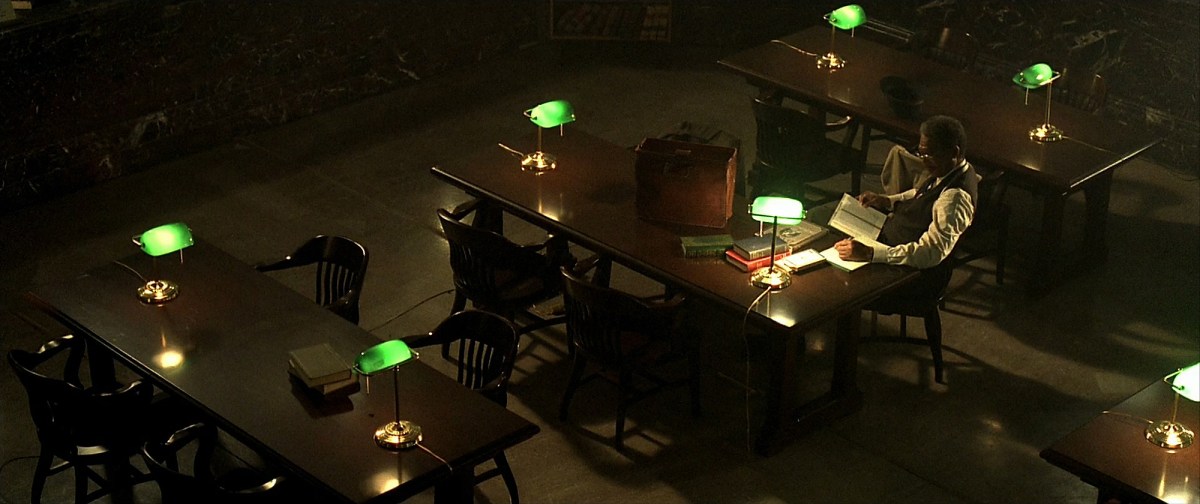
Last mooted as a Propaganda Films movie, Howard and David Fincher’s Mank may yet be produced as a project at Indelible Pictures. Fincher has previously spoken of his intent to use a special film stock to shoot Mank, a black and white negative type no longer used in the contemporary industry that would have to be recreated from the original “recipe”. For the director, this feature represents an opportunity to produce a fundamentally different film from his earlier works in a genre he has yet to explore; at the same time, the life of Herman J Mankiewicz retains the streak of darkness that has always appealed to Fincher’s sensibilities. “Mank is a script that I’ve been working to get exactly right for ten years”, said Fincher, “and I hope, some day, to make it as one of the definitive ‘writer in Hollywood’ stories”.
Pierce: Your dad was a journalist and a writer. He wrote a script called Mank, about the Citizen Kane screenwriter Herman J. Mankiewicz. Did you consider making that?
Fincher: We tried. It was too expensive. Because if you’re going to make a Hollywood insider movie—it’s nothing to do with Hollywood really, it’s Hollywood in the late thirties, early forties—you’ve got to make it really cheaply. We had a chance to make the movie for, like, $13 million, back in 1998 and, um, [guiltily] I wanted to make it in black and white. [Laughs] And that fucked up all those home video and video sellthrough and cable deals. I haven’t read it in a while. I probably should.
Pierce: Did your dad write a few screenplays?
Fincher: Yeah, he wrote a couple. That was the best of them, I think. He wrote a screenplay once about a divorce case. It was kind of based on the Keanes. Remember in the sixties, the guy who painted those pictures of the children with the giant eyes? They were in this bitter divorce. It was a very, very sardonic screenplay about two parents trying to prove what bad parents they are, so the other will get stuck with the kids! It was pretty funny! [Laughs] But it had an awful sentiment! But it was funny. It was a good script.
Pierce: There’s an element of your work—in Se7en, The Game, Zodiac— that is about professionalism and obsession. Is that something you think you got from your dad?
Fincher: My dad wasn’t very obsessive. Slightly compulsive, but not obsessive. You know, my dad did used to say, “Learn your craft; it will never stop you from being a genius.” It’s like, “Do the hard work, figure out how it works…” My dad worked a lot, but he paced himself. He paced himself a lot more than I think I probably do. […] My dad… he was an intellect and sort of a Monday-morning quarterback.
The Hero’s Journey is a monthly podcast which examines classic and contemporary books and films through the lens of The Hero’s Journey. Pioneered by renowned mythologist and teacher Joseph Campbell, and refined for the context of modern storytelling by Disney veteran Christopher Vogler, The Hero’s Journey is a series of motifs and archetypes that pervade myths, folklore, and stories across all cultures and eras. Your hosts, author Jeff Garvin and book blogger Dan Zarzana, will discuss a new book or film each month. And probably, there will be some drinking.
Lose your heads with Dan and Jeff as they open the box on David Fincher’s serial killer masterpiece, Se7en.
What is the meaning of Fight Club? Instead of giving you my theory, let’s learn straight from the source! Listen to Chuck Palahniuk (author), Jim Uhls (screenwriter), David Fincher (director), and more talk about how they created this film and book!
Fight Club is a 1999 film based on the 1996 novel by Chuck Palahniuk. It was directed by David Fincher and stars Brad Pitt, Edward Norton, and Helena Bonham Carter. Norton plays the unnamed narrator, who is discontent with his white-collar job. He forms a “fight club” with soap salesman Tyler Durden, and becomes embroiled in a relationship with him and a destitute woman, Marla Singer.
I’ve been Mark Zuckerberg—there are times in my life where I’ve acted that way. There are times in my life where I’ve been Eduardo Saverin—where I’ve gone and made a scene and regretted it and where I’ve been emotional and felt silly and stupid. And there are times when I’ve felt self-righteous and I’ve acted out in this other way… Look, what Mark does is no different than directing a movie—it’s what I do for a living every day. You grow something, and your job is to grow it well and to make sure it gets enhanced and to take care of it. That’s the subject of the movie. And if you have to hurt people’s feelings in order to protect that thing, that’s what you have to do. It’s a responsibility. You want to love every character in the movie. You want to be able to understand them. You want to be able to relate to them. But, as a director, the characters’ behaviors are inevitably related to facets of moments in your own life. You look at the work and say, Maybe I do know what that is. I’ve been the angry young man. I’ve been Elvis Costello. I know what that’s like. The anger is certainly something I felt that I could relate to—the notion of being twenty-one and having a fairly clear notion of what it is you want to do or what it is you want to say and having all these people go, well, we’d love to, we’d love you to try. Show us what it is that you want to do. It’s that whole condescending thing of having to ask adults for permission because the perception is that you’re too young to do it for yourself. And that’s why I understood Mark’s frustration. You have a vision of what this thing should be. And everyone wants to tell you, Oh, well, you’re young. You’ll see soon enough. —David Fincher
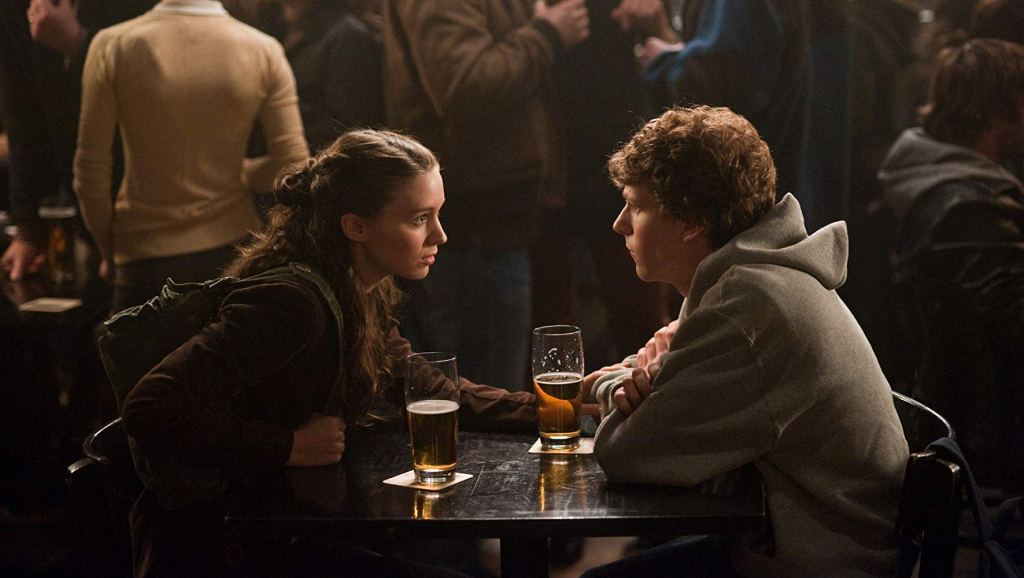
The 21st century computer-scribes who work behind the scenes behind the screens, creating culture and beauty with code, got an anti-hero to remember on the silver-screen in 2010 with David Fincher’s 8th feature film. From a once-in-a-generation, “holy shit” screenplay by Aaron Sorkin, The Social Network is a movie about a 19-year-old Harvard student creating Facebook while losing the relationships in his life. It is an examination of a social outsider who built one of the biggest “clubs” the world’s ever seen, and it’s about the new age zooming past the old. It’s about ignorance in high places, that awkward moment when powerful hired officials prove they have no concept of what simple features on Facebook are in a hearing on Facebook security. It’s about a new language of coding that’s sweeping and running the globe, and about treating coding with the respect it deserves. It’s about coders being taken as seriously as writers, musicians, filmmakers, film producers, painters, costume-designers, photographers, and all other artists and creators. It’s about attaining power even though you’re socially anxious or awkward, and about finding that inner drive that helps you accomplish your goals. It’s about what happens when you lose your humility in your thirst for greatness, and about the fragility of the line between “passionate” and “ass-hole.” The Social Network is simultaneously about a seismic shift in the zeitgeist and your best friend getting your company in trouble for feeding his fraternity chicken a piece of chicken. It’s about creating and solidifying one’s identity, and everything and anything else that goes with what Fincher once jokingly referred to as “the Citizen Kane of John Hughes movies.”
Jim Uhls is a screenwriter and producer. Jim’s sceenwriting credits include, Fight Club, the feature-film Jumper, the NBC television film Semper Fi, and the SyFy miniseries Spin.
0:02:39 – How did Jim get his first (credited) writing gig as Fight Club? 0:04:19 – Chuck Palahniuk 0:10:36 – The Meeting 0:14:03 – The Narrator 0:18:50 – Screenwriting Rules 0:31:14 – Jim’s Screenwriting Advice 0:38:58 – The Scent of Blood 0:50:13 – Jim, if he’ll ever direct 0:52:57 – David Fincher Directing Style 1:05:17 – My Fight Club house story
The Social Network is one of the best films of the 2010s. Aaron Sorkin, a screenwriter famous for his dialogue, teamed up with visual director David Fincher to create a modern film with themes as old as story itself. Watch and learn how they did it!
The Social Network is a 2010 American biographical drama film directed by David Fincher and written by Aaron Sorkin. Adapted from Ben Mezrich‘s 2009 book The Accidental Billionaires: The Founding of Facebook, a Tale of Sex, Money, Genius and Betrayal, the film portrays the founding of social networking website Facebook and the resulting lawsuits.