“I thoroughly enjoyed the visual sensibilities and filmmaking techniques used in the first season of Mindhunter on Netflix. Here are 5 of my favorite cinematography and film editing techniques that I feel made it a very distinctive show. Created and directed by David Fincher, he used many of the stylistic choices from his feature films such as dark cinematography and glass-like camera movement but also added some new tools to his arsenal as well.”
David Fincher‘s knuckle-biting Mindhunter series for Netflix is based on the true-crime book, Mind Hunter: Inside the FBI’s Elite Serial Crime Unit, an autobiography centered around the establishment of the FBI Investigative Support Unit, the foundation of which would become modern day criminal psychological profiling.
Each hour-long show (from the 10-episode run) was graded by colorist Eric Weidt, who navigated between ultra-modern capture technology, the time and place of late 70s cinema and the very specific needs of Fincher. Weidt started with Fincher as a visual effects beauty artist for the 2014 film, Gone Girl. Before that, he had worked in post production in the world of Parisian fashion.
With considerable experience in Photoshop and the Adobe infrastructure, Weidt brought his retouching talents to motion as photography and filmmaking began to bleed together. Weidt even created custom film-emulation ICC profiles and scanned grains for photographers transitioning from film to digital capture.
Colorist Eric Weidt.
Meanwhile, Fincher and his team had been working with FilmLight‘s Baselight color grading tools and plug-ins since The Curious Case of Benjamin Button, and on the Netflix series, House of Cards. Adding an editorial and visual effects team at his facility in Hollywood, Mindhunter was the first time that the auteur established his own in-house DI. Weidt was brought on to lead color.
“It’s important to note, we had a lot more time to work on this show than most grades,” Weidt pointed out during a special HDR presentation by FilmLight, Dolby, and Red Digital Cinema at the Dolby Cinema Old Vine theatre in Hollywood. He was given a simple brief: The show was set in the late 70s, centered on the FBI interviews of serial killers.
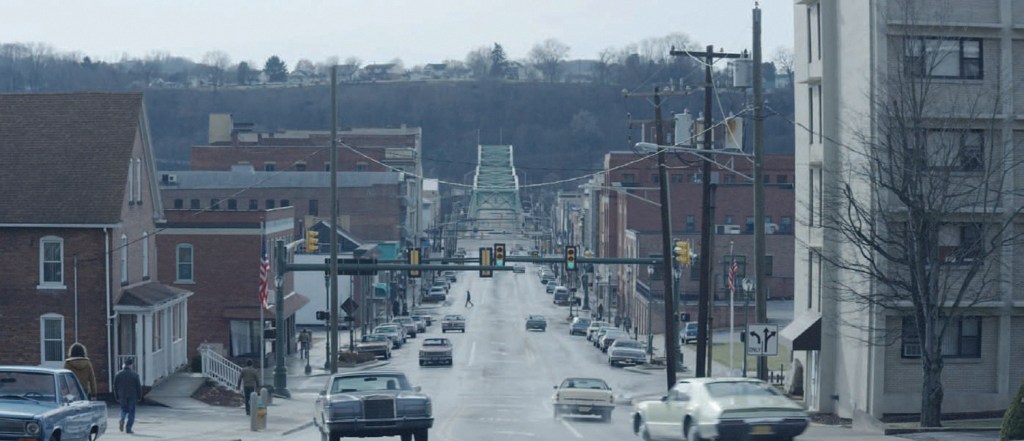
“The 70’s and serial killers backdrop brought to mind David Fincher’s Zodiac, which is an absolutely brilliant movie; a masterpiece in terms of both content and color,” he says. “The 70s has a distinct color palette. You say 70’s’ and everyone already has an image” he continues. Street photographers William Eggleston and Stephen Shore are personal sources of inspiration for initial color grading.
Post and edit began as production rolled in Pittsburgh. Dailies were usually available to Fincher by the following day. The production used FotoKem‘s nextLAB dailies system and the PIX asset and data management and delivery platform.
Due to overlapping shoot and post production schedules, “David looked at things on his iPad for two-thirds of the season,” says Weidt, explaining that he had a complex rendering process that allowed him to manage new HDR footage as well as sending regular corrections from Fincher to view in SDR. The Baselight workflow file was separated into two timelines, one for any creative color adjustments, and another that had stabilizations and lens emulations applied. Weidt would daisy-chain them, run it through the Dolby Vision HDR professional tools, which automatically take his XML trims, and using that, create offline files to view on an iPad or monitor.
“All you really need to do is add a trim pass layer to each shot, then hit analyze. It might take 40 minutes to analyze the whole hour’s episode. You come back, and you have your SDR version. It’s done, except that you are able to then do lift/gamma/gain, or some saturation adjustments on the trim pass. I found that maybe 85 percent of the time it looked like there wasn’t really anything to do. Out of the box, it’s pretty amazing.”
He continues that, “You don’t want to grade with both monitors, because you’ll go nuts. You have to learn to accept that the REC 709 compared to the HDR is going to look more dull.” Weidt says that Fincher’s color design for Mindhunter was heavily influenced by the organic palette of several classic films, such as McCabe and Mrs. Miller, All the President’s Men and the more chromatic yet grittier look of The French Connection. They also wanted a low contrast, information-rich picture, and had first experimented with low contrast optical filtration on set but preferred in the end to “set up the digital chain in a way that Fincher was getting the type of image that he wanted.”
The RED Xenomorph custom camera for Fincher.
“Low contrast does not mean low detail,” Weidt carefully points out. That required a camera with outstanding capabilities for the production. Cinematographers Erik Messerschmidt and Christopher Probst, ASC, employed a one-of-a-kind Red camera with a 6K Dragon sensor called Xenomorph, developed by Red to Fincher’s specifications. Weidt’s starting point for dailies, as well as any color work on the master, began with a low-contrast log curve based on REDgamma3 that maintained as much of the dynamic range provided by the Red Xenomorph as possible, and gave the SDR monitoring on set an approximation of Weidt’s HDR workflows.
“When you grade something, the tone curve can be your initial contrast,” says Weidt. “It’s a bit like choosing a film stock. With Red, at that time, the most current tone curve was REDgamma4. It’s a nice, contrast-y curve, but David wanted to go back to a previous tone curve, which was REDgamma3. It’s a softer curve, and it rolls off quicker and easier in the highlights and also in the shadows.”
With the Dolby Vision HDR toolset, custom color transforms helped manage the monitoring during production. From 6K .R3D files to linear OpenEXR files, they were able to go straight to grade in Weidt’s and Messerschmidt’s preferred ‘flat’ log. For Dolby Vision HDR mastering, Weidt used the Dolby Pulsar 4000-nit professional reference display, while the Rec709 passes were done with automated mapping to SDR from Baselight. For SDR, they used a Dolby PRM monitor at 120-nits.
The HDR look was developed in post production: “In HDR, we initially came across a lot of scenes where the light sources were taking too much prominence,” Weidt says. “David and his post supervisor Peter Mavromates really wanted an elegant balance. Mindhunter‘s HDR is not trying to strike you or slap you in the face. Just like the sound mixing, or cutting, it is not trying to blow your mind, but rather convey the story content. The latter is really what’s going to punch you.”
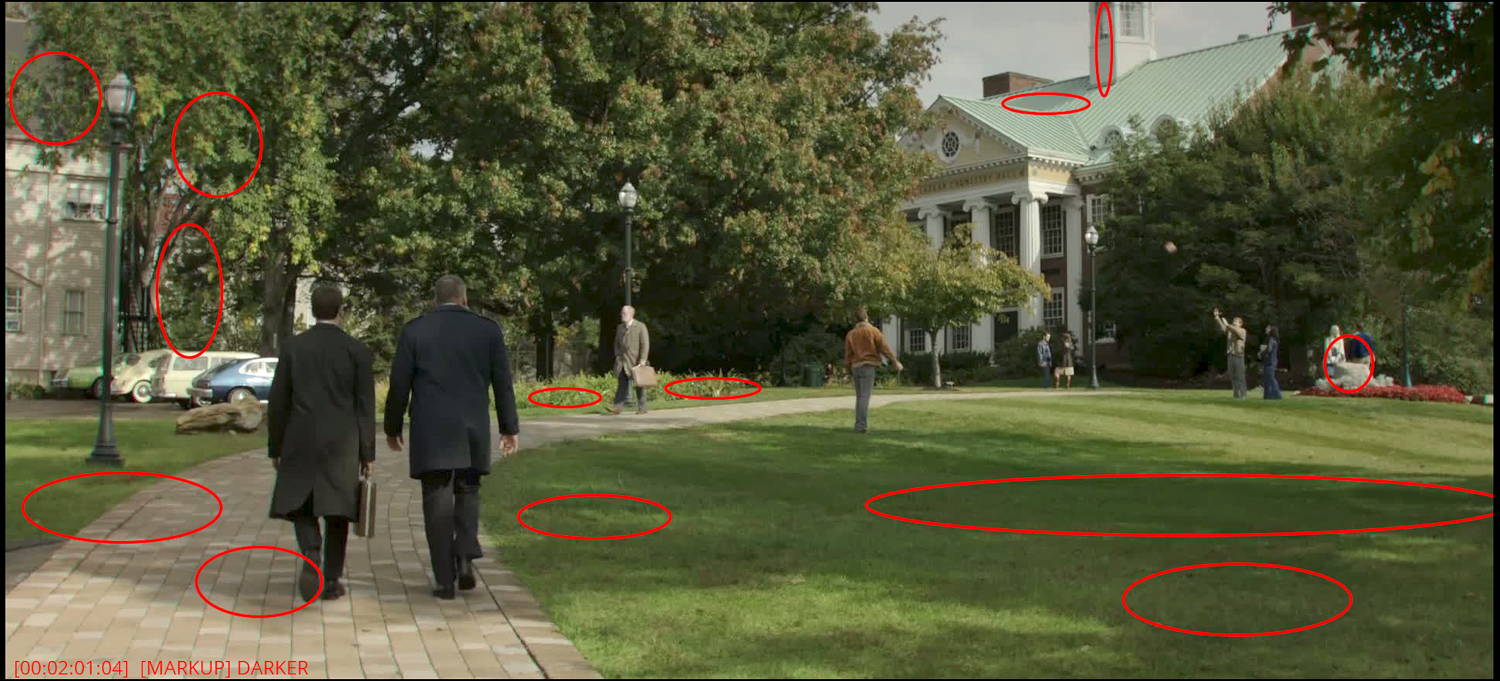
Areas of focus circled using PIX.
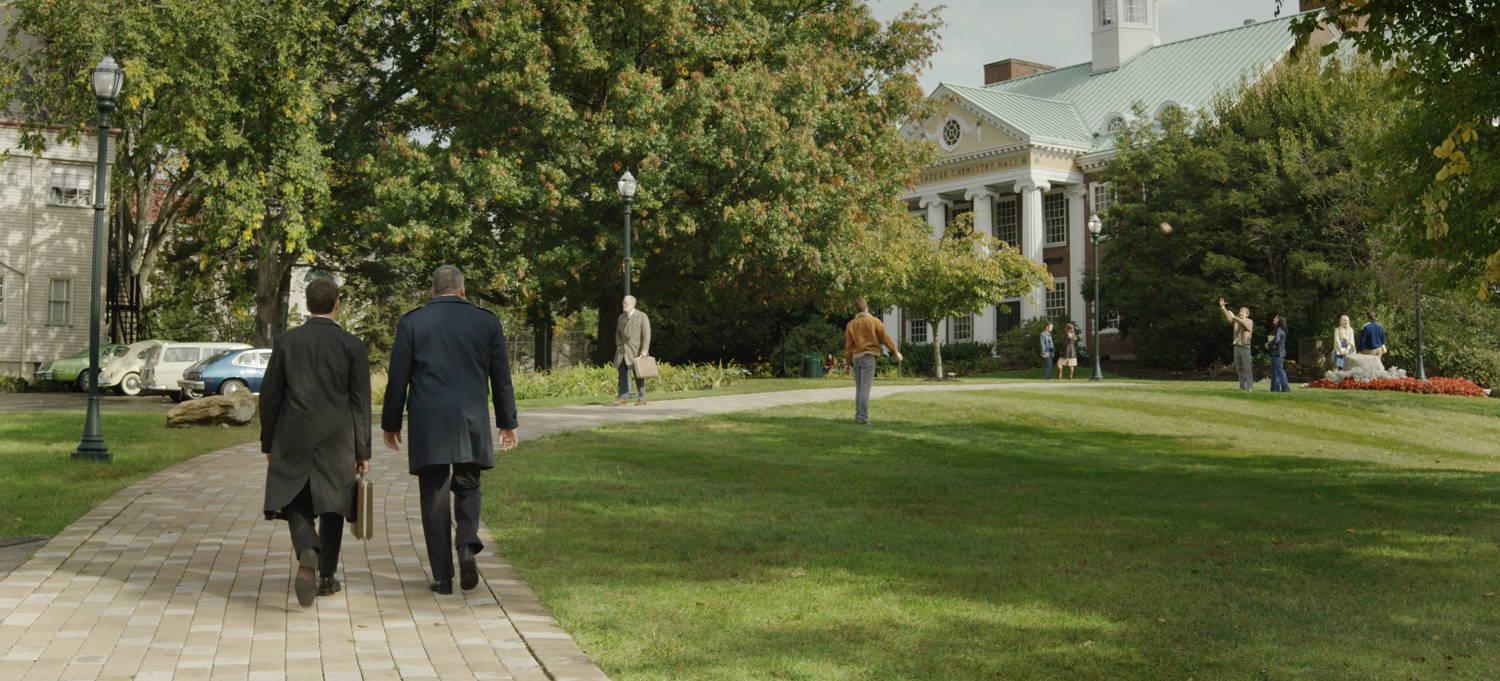
After the grade.
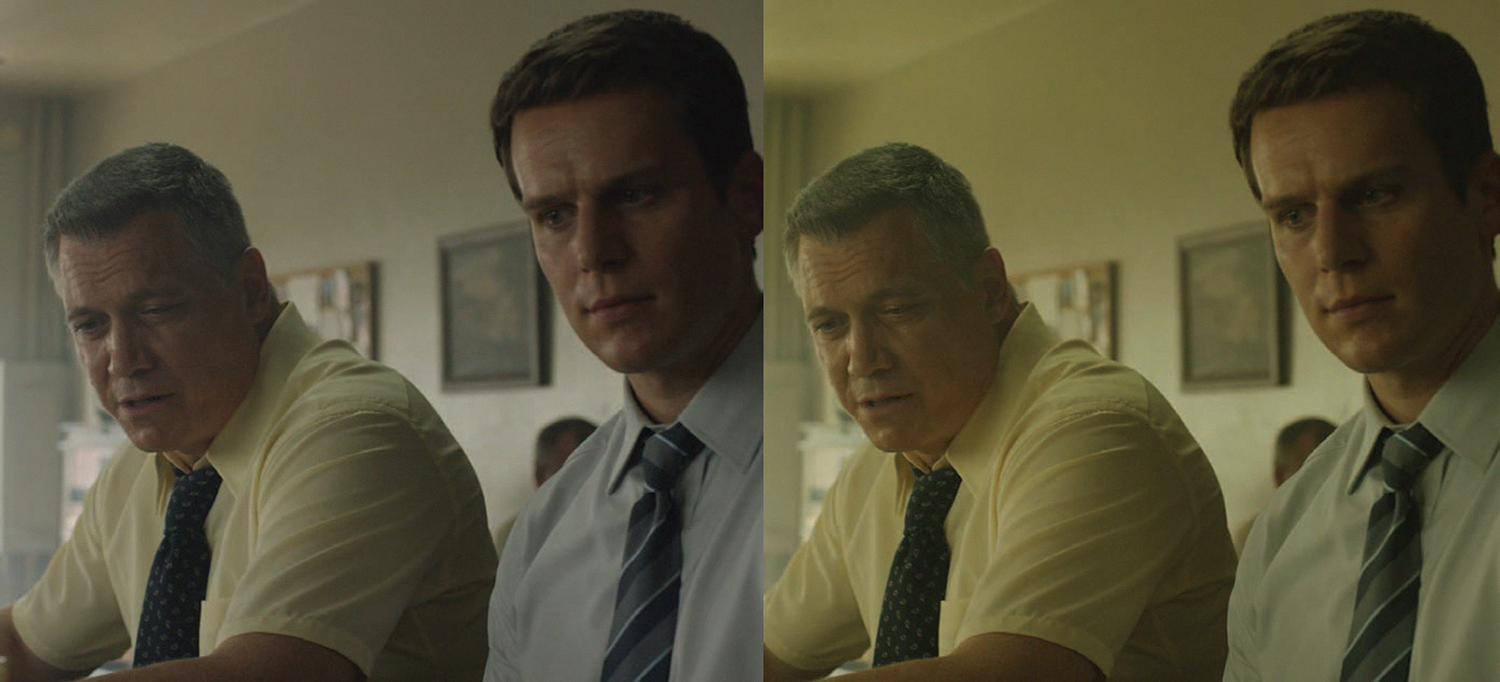
Many of Fincher’s notes require simple dodging and burning, performed primarily through Weidt’s use of shapes, masking and tracking in Baselight. Using PIX, Fincher would circle subjects or areas of a frame, giving suggestive chromatic terms like ‘sallow’ or ‘ruddy,’ and ‘equidistant’ or ‘symmetrical’ in regard to reframing. Mindhunter used a 5K working area extracted from the full 6K frame, ultimately downconverted to a 4K deliverable, a Netflix requirement. As a 2.2:1 center extraction, the editors were able to reposition the image subtly, as needed. The image was stabilized further as necessary by using sophisticated tracking for repositioning and resizing without loss of resolution upon deliverable at 4K.
“David is famous for having a visual style where he is going to stabilize two-thirds of the shots in an episode, or in a movie, so that everything is absolutely perfect,” says Weidt. “What he wants is that the camera, the gaze into the image, is totally unconscious, and you’re really in there without distractions that most people take for granted.” After Fincher returned to Los Angeles, their standard workflow on a scene together would start with a master shot that incorporated the characters as well as background, timing color and light levels for other shots and angles in scenes to be timed from that reference.
Fincher’s eye for detail goes far beyond that, though, and Weidt noted several corrected items that would have escaped his attention, like plants outside a prison that were too vibrantly green, or highlights in reflections that needed to be turned down to match light sources. “There are certain colors that David needs to suppress, and that’s mostly pink,” he continues. “Pink appears in people’s skin tones, and if you get it wrong in the grading suite and ends up on a monitor outside of that environment, it’s going to appear like they have pink faces and it looks really bad. David wants to control that.”
Before / After
Using Summilux-C primes from CW Sonderoptic, XML information was created for every focal length. This was a requirement on Mindhunter as simulations of grain, lens barreling and chromatic aberration in Baselight were tailored to the specific focal length throughout the show. Weidt even created anamorphic effects for the spherical lenses.
“David wanted to refer to 70’s in what could be called ‘the anamorphic wide-screen era,'” he says . “Unfortunately, that focal length is not something that’s carried through in metadata. It’s tallied by the camera assistant with name of the clip and the focal length and put into a database. I had to find a way to apply the right settings for every single clip, in the absence of metadata.”
Weidt was able to merge this information by teaching himself the Python scripting engine for asset management adding the focal length as a variable in the comment field. That enabled him to classify and organize shots by telephoto, standard and wide, then multi-paste effects into an alpha-numerically sorted timeline which came in handy throughout the production. “It worked beautifully,” he says.
He also added pseudo chromatic aberration “on every shot and every episode of Mindhunter,” which he developed himself, as the vast majority of plug-ins and filters will simply shift one of the primary color plates, stretching from center, resulting in bi-color aberrations. These created results that Fincher found lackluster, when for example given a cyan-red, he’d really only want the cyan. “I found the solution in Baselight, which essentially took 20 layers, using blending modes that are usually the purview of a compositing tool,” Weidt says.
Creating a specific ’70s look.
Mindhunter
is graded on Baselight.
“David directed four episodes of Mindhunter, but he’s the executive producer for the show, and he’s definitely the director of the DI,” he adds. “All of the color, he directed himself, with contributions from Erik.”
Weidt notes that next season will be shot using a Helium sensor, and HDR monitors will be on set along with a new ACES color space workflow. “We’ve got 20 layers just for chromatic aberration. We’ve got lens warping. We’ve got three different types of grain as well, because you couldn’t just have one,” Weidt adds, regarding the final rendering process.
“Season 2 is going to be just like a real walk in the park compared to season one. We learned so much.” Season 2 of Mindhunter is currently in production.
Another comprehensive article by Spanish DP, Producer and cinematography scholar Ignacio Aguilar, this time on the cinematography of Zodiac. Time to practice your rusty Spanish or get help from a good web translator.
Excepcional adaptación cinematográfica del libro de Robert Graysmith, basado en su propia investigación sobre los asesinatos cometidos en la zona de San Francisco a finales de la década de los 60 y comienzos de los 70, por un asesino que además enviaba cartas a los períodicos, anunciando sus planes y próximas víctimas. El film está protagonizado, además de por el propio Graysmith (interpretado por Jake Gyllenhaal), por su compañero en el San Francisco Chronicle, Paul Avery (Robert Downey, Jr.) y por el detective de homicidios Dave Toschi (Mark Ruffalo), los cuales uno a uno, se van obsesionando por el caso que les ocupa a medida que profundizan en el mismo y creen encontrarse cerca de resolverlo. Se trata quizá del mejor y más sólido trabajo de David Fincher detrás de las cámaras, quien deja de lado su conocida solvencia técnica y se lanza a narrar minuciosamente todo lo concerniente al caso que inspiró películas como “Dirty Harry” (1971), tomando una estructura y formas muy parecidas a las de una de sus películas de referencia: “All The President’s Men” (Alan J. Pakula, 1976), escrita por William Goldman y protagonizada por Dustin Hoffman y Robert Redford. Anthony Edwards, Chloe Sevigny, Elias Koteas, John Carroll Lynch y Brian Cox, entre otros, completan el reparto de un film absolutamente modélico.
El director de fotografía fue Harris Savides [ASC], un hombre cuya carrera en cine, entre su tardía llegada y su prematuro fallecimiento por un cáncer cerebral a los 55 años de edad en el año 2012, desgraciadamente fue demasiado corta. Procedente de los videoclips y de los anuncios publicitarios, debutó en 1996 con “Heaven’s Prisoners” a las órdenes de Phil Joanou. Ya el año anterior había rodado metraje adicional para David Fincher en “Se7en” (1995), quien le contrató para su siguiente film, “The Game” (1997), la película que puso a Savides en el mapa. Posteriormente destacó mucho con “The Yards” (James Gray, 2000) y con varios trabajos para Gus Van Sant: “Finding Forrester”, “Gerry”, “Elephant”, “The Last Days” y “Milk”, además de por su trabajo para Jonathan Glazer en “Birth”. Además tuvo tiempo para colaborar con Ridley Scott en “American Gangster”, con Woody Allen en “Whatever Works” o con Sofia Coppola en “Somewhere”. Su estilo, muy sencillo y poco recargado, a menudo estaba dominado por la subexposición y la luz cenital, a veces asumiendo grandes riesgos, siguiendo en muchos aspectos la línea de Gordon Willis durante la década de los 70.
Savides por lo tanto era el director de fotografía ideal para Fincher en este proyecto, ya que el citado modelo “All The President’s Men” precisamente fue fotografiado por el autor de “The Godfather”. Ambientada desde finales de los años 60 hasta principios de los 80, “Zodiac” sorprendió mucho porque fue el primer proyecto de David Fincher rodado en formato digital y porque hasta aquél momento, dicha forma de adquisición se había empleado principalmente en películas como “Attack of the Clones” (2002) y “Revenge of the Sith” (2005), “Collateral” (2004) y “Miami Vice” (2006) o incluso “Apocalypto” y “Superman Returns” (2006), sin que ninguna de ellas (dejando de lado del film de Gibson) fueran películas de época. Savides (ante la insistencia de Fincher) recurrió a la cámara Thomson Viper Filmstream, la misma usada por Michael Mann en las dos películas citadas anteriormente, pero a diferencia del director de “The Last of the Mohicans”, en el caso de “Zodiac” los cineastas no lo hicieron para rodar con niveles de luz muy bajos o luz disponible, sino que rodaron en HD iluminándolo de forma muy parecida a como lo hubiesen hecho rodando en 35mm. Por ello, el efecto vídeo de las películas de Mann, tanto por la textura de la imagen como por emplear el obturador abierto, no está presente en absoluto en “Zodiac”, que en muchas ocasiones es mencionada como un hito precisamente porque su estética digital fue la primera que demostró que en este formato podían seguir obteniéndose imágenes de parecida calidad a las que se conseguían con el celuloide. Y aunque la Viper era una cámara limitada (con un sensor pequeño y no tanta latitud como las modernas) lo cierto es que prácticamente nunca se perciben dichas limitaciones.
Over the last few years, 8K has become accepted as an acquisition format for 2K & 4K delivery. Michael Cioni, of Panavision & Light Iron, believes that it is time to start pushing 8K as a distribution format. Listen as he challenges common misconceptions about the validity of 8K exhibition.
Cioni uses Moore’s Law to explore the idea that the resolution of our capture and delivery of video will continue to grow far into the future. In the early years of Light Iron, Michael and his team faced many challenges in moving from a 2K to 4K digital intermediate for their customers. But they overcame those challenges and are now working toward supporting 8K distribution.
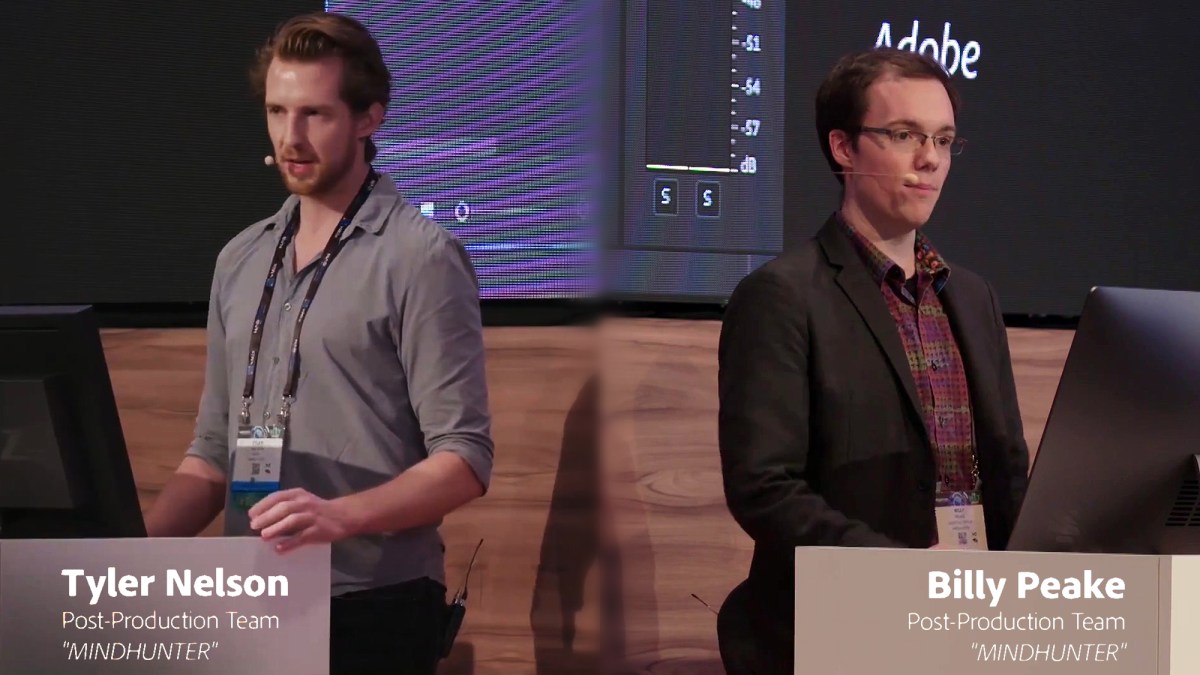
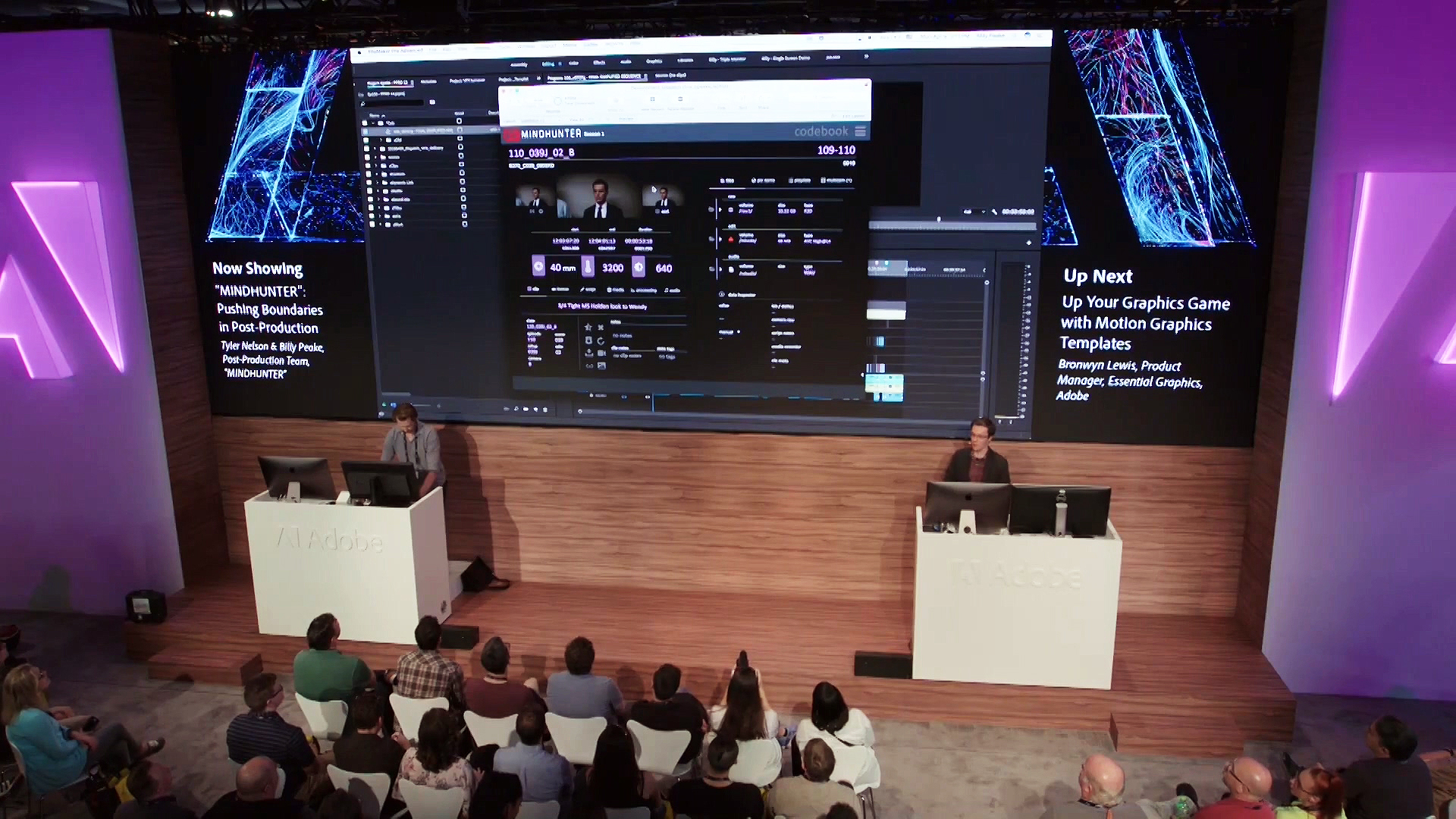
I don’t do a lot of interviews with editors, that’s the domain of Steve Hullfish and his legendary ART OF THE CUT series but when I saw that Adobe had some editors available for a chat at NAB 2018 I thought … why not. I had done some audio interviews before at NAB and I figured posting an audio interview to Soundcloud was a lot more likely to happen during a busy NAB week than trying to shoot and edit video (I did that one year with an iPad) or take a lot of photos and write up articles on what I saw.
On this episode of the colorist podcast, I talk with Ian Vertovec, Co-Founder, and Senior Colorist at Light Iron.
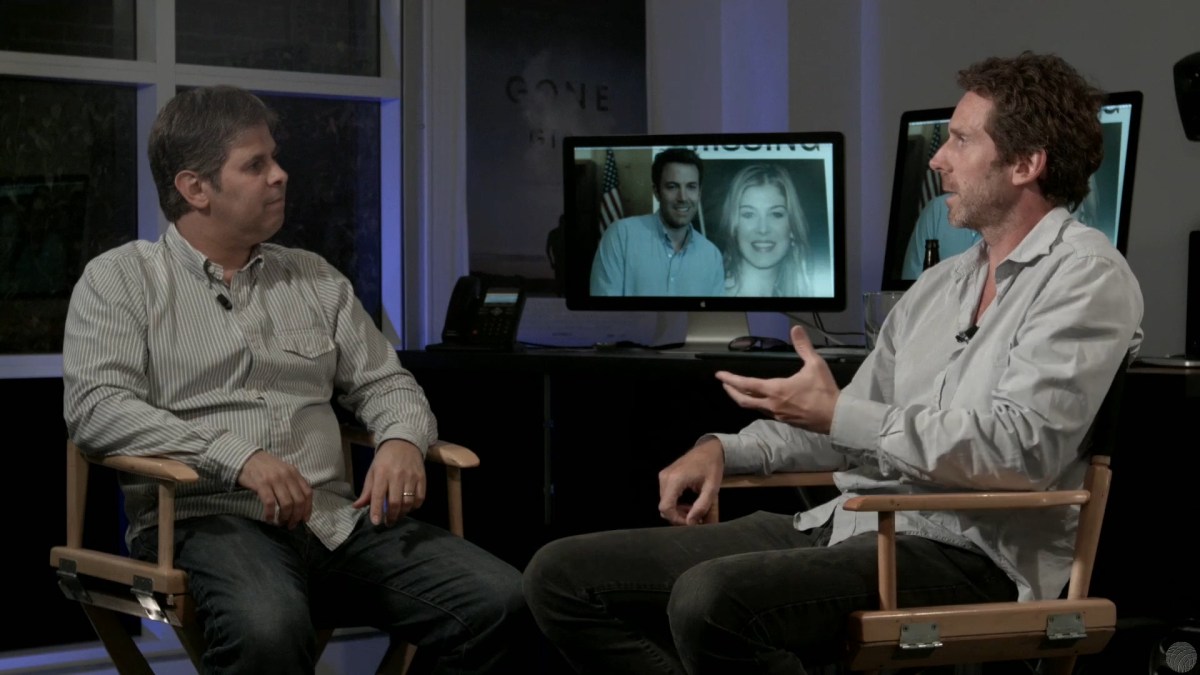
Ian has colored major films “The Social Network,” “The Girl with the Dragon Tattoo,” and “Gone Girl.” And more recently, he has colored the TV shows “Baskets” for FX and “Glow” on Netflix.
Originally from Chicago, Ian focused on photography, then moved on to digital compositing. He later co-founded two post facilities in Los Angeles: Plaster City, then Light Iron. Out of necessity, he moved on to color at his company. He found his combination of photography and compositing matched perfectly for a career as a colorist.
In this podcast, we talk about:
Coloring David Fincher films and working with extremely dark images
The challenges of working on VFX heavy projects
Making HDR look both cinematic and realistic
Advantages of working with high-end systems like Quantel Pablo
The difference between working on TV and films
How experience with compositing served him as a colorist
Colorist Ian Vertovec from Light IronDigital takes us through the ins and outs of color grading one of this year’s biggest hit films “The Social Network”.
Erik Messerschmidt and Chris Probst, ASC, also have made “smart” use of LED technology, as detailed in our cover story on Mindhunter (page 36). David Fincher, who first started using LED’s for process work on Zodiac, 11 years ago, not only customized a high-resolution RED camera for the show (dubbed the “Xenomorph”), but also devised one of the most ingenious LED-driven plate projection/interactive lighting processes for driving shots TV has ever seen. Messerschmidt’s description of Fincher’s commitment to innovation mirrors those Sundancers bending technology in the service of new ways to tell a story: “For David, the frame is sacred; what we choose to include is intrinsic to what the audience thinks is important. They are one and the same.”
David Geffner, Executive Editor
ICG Magazine
Visualizing the daring and often scary world of David Fincher requires new technologies and processes rarely attempted in series television.
Matt Hurwitz
Photos by Patrick Harbron & Merrick Morton, SMPSP
April 2018 ICG Magazine
In the season 1 finale of Netflix’s MINDHUNTER, a disturbed FBI agent, Holden Ford (Jonathan Groff), bursts wildly from a hospital room, as a handheld camera gives chase. The move begins as shaken as ford is, but, as it lands with the agent, who collapses in the hallway, it’s as if the camera has floated to a butter-smooth stop inches from the floor, the maneuver executed like it was on a perfectly balanced Jib arm, crane, or even Steadicam. But it’s none of those. What can viewers assume from this?
David Fincher has returned to television.
FOR THIS SERIES ABOUT A PAIR OF AGENTS WORKING IN THE FBI’S ELITE BEHAVIORAL SCIENCES UNIT in 1979, and attempting to understand the mind of a serial killer, Fincher used a number of leading-edge technologies – interactive LED lighting, custom built high-resolution cameras, and, as in the shot with Agent Ford, image stabilization/smoothing in postproduction – to keep the viewer visually embedded. Fincher’s aim with MINDHUNTER, which has no graphic violence, is for viewers to “access their own attics. There’s far scarier stuff up there than anything we can fabricate,” the filmmaker insists. “I wanted people to register what’s going on in [characters’] eyes and where the gear changes are taking place. At what point do I [as the viewer] feel like, ‘OK, I’ve got an insight,’ and at what point do they feel like: ‘oh, I’m being sold something. It’s all about the nuance in how the balance of power is changing.”
Fincher’s longtime postproduction supervisor, Peter Mavromates, says he creates an “experience of omniscience,” similar to Kubrick’s A Clockwork Orange, “where you’re in a straitjacket with your eyelids pinned open, and David’s forcing you to watch these horrible things.” In fact, the show’s unique visual process began more than a year before production started in Pittsburgh (on area locations and on stages at 31st Street Studios, a former steel mill), with the development of a unique RED camera system.
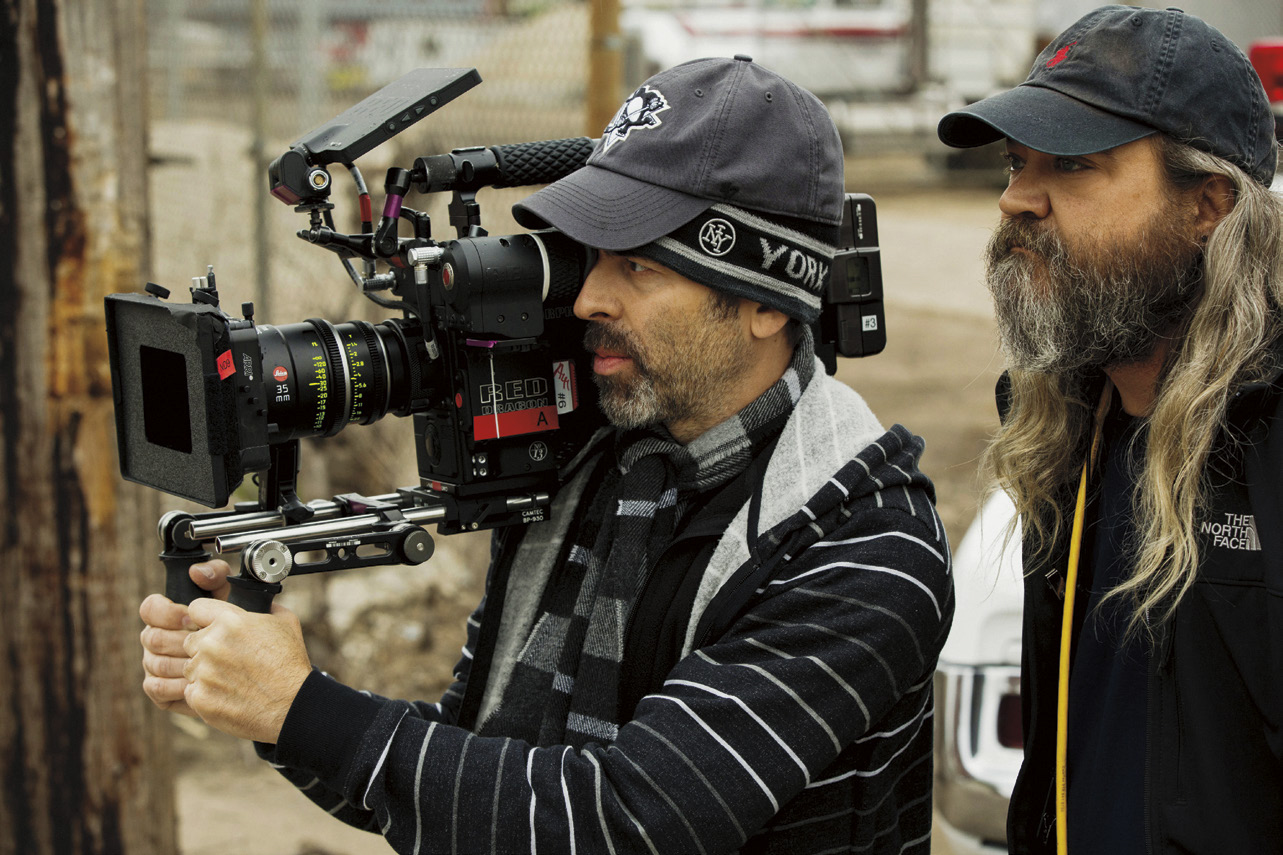
Christopher Probst, ASC – who shot MINDHUNTER’S pilot and second episode – was asked for his input on a RED prototype system, which had been designed by Jarred Land and RED’s Chief Designer Matt Tremblay according to Fincher’s specific needs. “David wanted to take all of the different exterior add-ons that create a jungle of wires, and put them inside the camera body,” Probst explains.
Fincher puts it even more directly: “It just seems insane that we’ve been bequeathed a [camera] layout [dating back to] D.W. Griffith and Charlie Chaplin that looks like some bizarre Medusa. [The camera] should be something that people want to approach, touch, and pick up.”
In fact, the custom system built for Season 1 [Land created a 2.0 version being used in Season 2] had an RTMotion MK3.1 lens-control system, Paralinx Arrow-X wireless video, and Zaxcom wireless audio (with timecode) integrated into the RED body, with the only visible cable being to control the lens. Slating was all but eliminated, with clip-number metadata being shared wirelessly between the camera and the script supervisor, who used Filemaker software to associate takes and clips. An audio scratch track from the mixer was recorded onto the REDCODE RAW R3D files and received wirelessly.
The base camera was one of RED’s DSMC2 systems, the then-new WEAPON DRAGON, with its 6K sensor. The shell design, accommodating the added gear inside, with its angular shape and heat venting fins on top, had a “Xenomorph” appearance (à la Alien), and was dubbed as such by Land and Fincher. “When the camera arrived in Pittsburgh, they had actually engraved “Xenomorph” on the side,” Probst says.
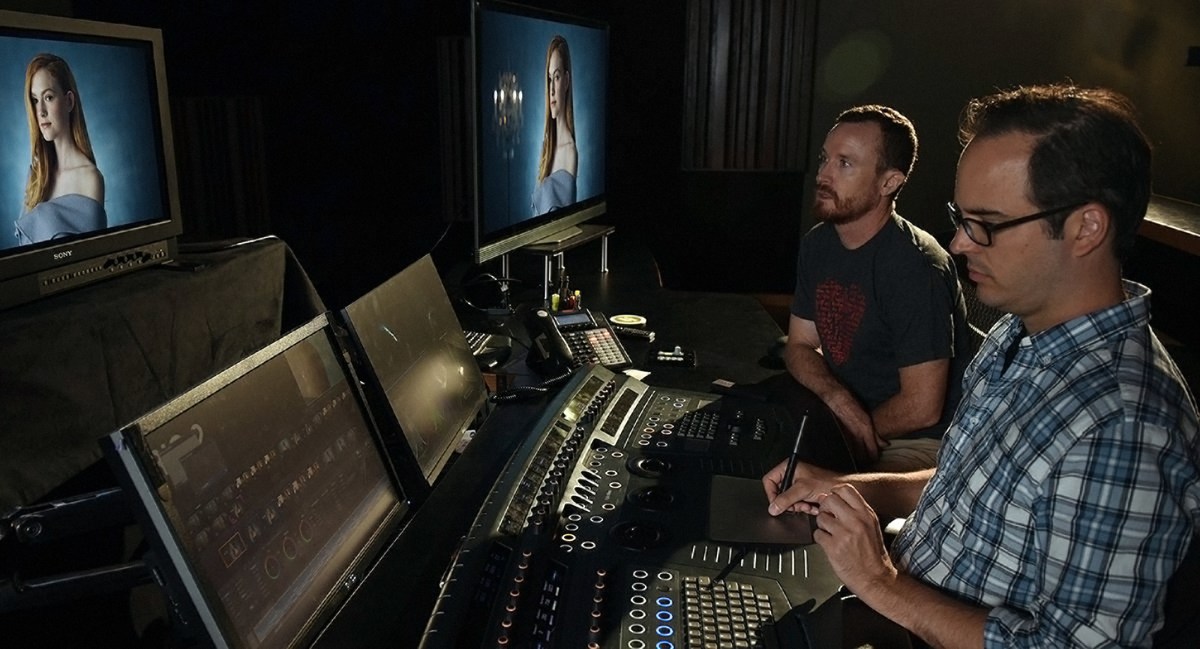
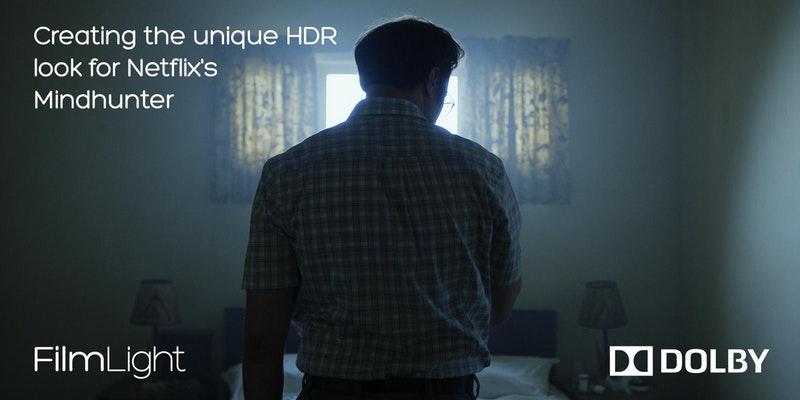
Colorist Eric Weidt shares creative insights on using Dolby Vision and Baselight to shape the look of the gripping Netflix original series.
Join us for an exclusive presentation by colorist Eric Weidt, who will demonstrate how he collaborated with producer and director David Fincher to create the look of the masterful psychological thriller Mindhunter.
Don’t miss this opportunity to explore how Eric developed the HDR color grade, which drew inspiration from films of the ’70s – demonstrated live on BaseLight.
The presentation will be followed by a technical discussion where Eric will be joined by Peter Postma, FilmLight‘s Managing Director of the Americas, Thomas Graham, Dolby‘s Sr. Manager of Imaging Content Solutions and Chris Clark, Manager – Imaging Science Technologies at Netflix who will share insights from their work with the latest tools and solutions for creating amazing HDR content.
March 28, 2018
Dolby Cinema Vine Theatre Los Angeles, CA 90028
Another week, another Oscar winner chats to Soundtracking in partnership with the EE BAFTAs.
These days, the quality and quantity of original programming on streaming services is quite astounding – with A-list talent delivering high-class drama time and time again.
One of Netflix‘s standout series of 2017 was Mindhunter. Overseen by David Fincher, it tells the story of how the FBI’s profiling unit came into being in the 1970s. By turns dark, funny, moving, cool and brutal, it also makes great use of contemporary pop & rock.
So it’s with great pleasure that we welcome Asif Kapadia to the show, who directed two episodes of the first season.
Asif has won numerous awards for The Warrior, Senna and Amy, with the latter scooping the Oscar for Best Documentary. There will, of course, be plenty of examples of Amy Winehouse‘s music throughout the course of the conversation, as well as composer Antonio Pinto‘s work on both Amy and Senna.







 Dispatch by
 ![Adobe Creative Cloud [SQUARE]](https://thefincheranalyst.com/wp-content/uploads/2018/04/adobe-creative-cloud-square.jpg)


 The Fincher Analyst