The new David Fincher movie, Mank, released on Netflix on December 4th of this year, was originally scheduled to be produced in 1999 but didn’t happen due to a number of factors. In 2007 Fincher released Zodiac which was one of the first major theatrical features to be shot in a digital environment around a completely new file-based workflow that would revolutionize the industry over the next decade.
Peter Mavromates, the post production supervisor on Zodiac and a number of other Fincher projects over the years, including a co-Producer credit on Mank, joins Critical Conversations to discuss how digital workflows have grown and evolved over the last 15 years. Peter will talk about helping to design the early workflows on Zodiac, continuing to build it with The Curious Case of Benjamin Button, the ongoing developments created for Mank, and what’s next for the future.
Peter Mavromates has worked in post production for more than 35 years. He saw the future of “film” when he walked into a high-end video facility in New York called Charlex. Working at Charlex while still in “film” school in the NYU Grad Film Program, he saw the beauty of film (read ACETATE) and the power of electronic (read ANALOG VIDEO transitioning to DIGITAL) and watched as those two processes merged and mutated throughout the ‘80s and ‘90s. Peter produced his first DI on Panic Room in 2002, and his first DI of a digitally acquired movie on Zodiac in 2007. Most of the last 25 years have been spent working on projects with David Fincher, but he has also worked with Quentin Tarantino, Stephen Gaghan, and George Clooney.
I recently had the chance to ask Territory Studio about their visual effects work for Mank, which involved the re-creation of Wilshire Blvd from the 1930s. Like those shots, so much of Mank’s VFX work was invisible, involving subtle augmentations to tell the period story.
Overseeing these visual effects shots was director David Fincher himself, alongside co-producer Peter Mavromates, and the film’s art department. Fincher and Mavromates co-ordinated an outside effort, also, led by four VFX supervisors at different studios: Artemple (Wei Zheng), Territory Studio (Simon Carr), Savage(John Pastorious) and ILM (Pablo Helman).
In this befores & afters conversation, Mavromates discusses the various VFX work—from sky replacements to matte paintings, to CG animals and what he calls ‘body-and-fender’ shots—that helped tell Mank’s tale.
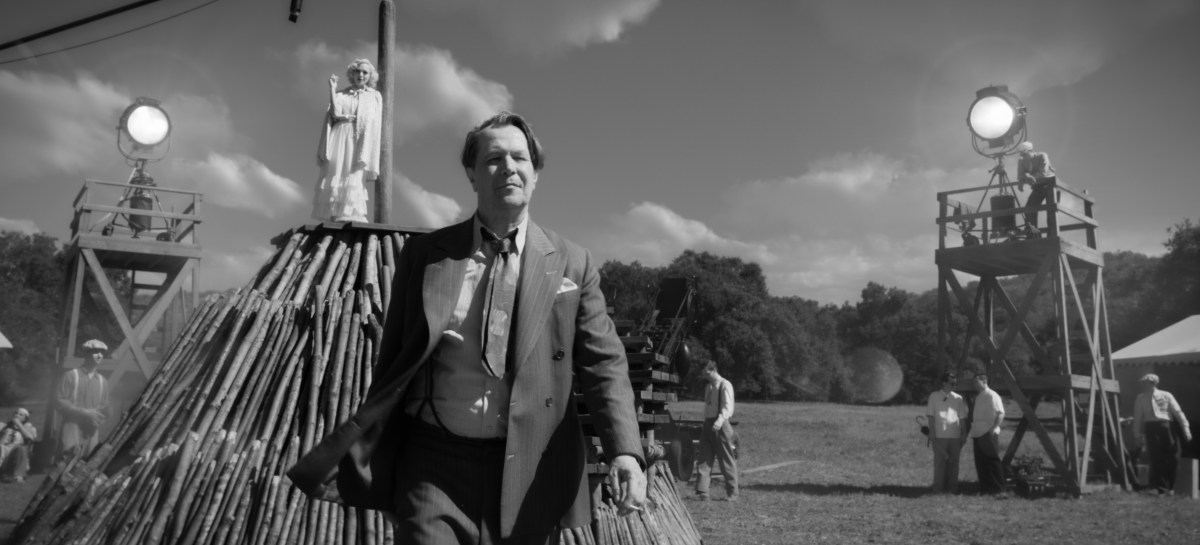
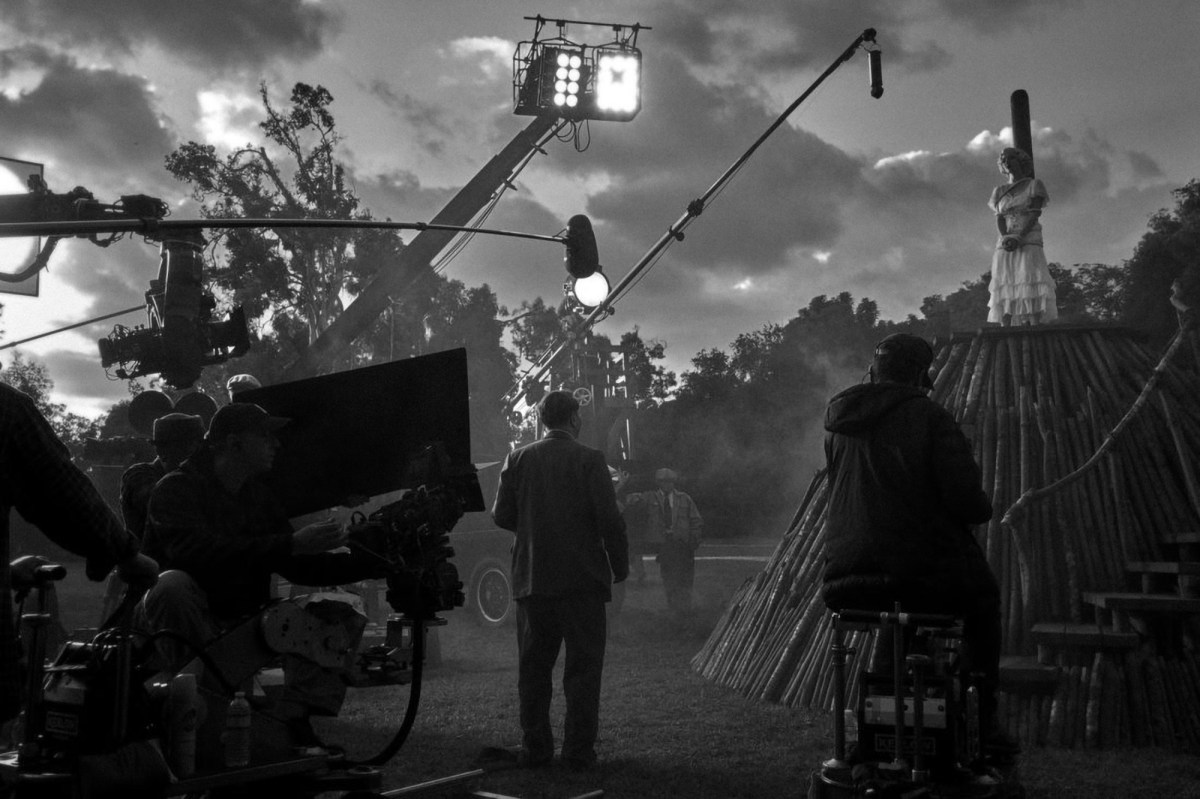
Early in Netflix’s Mank, the screenwriter Herman J. Mankiewicz (played by Gary Oldman) ambles onto an outdoor movie set, where he bumps into an array of glamorous characters. In a scene full of repartee with real-life figures such as the actor Marion Davies, the film honcho Louis B. Mayer, and the mogul William Randolph Hearst, the visual details of the environment might seem unimportant. But to Mank’s director, David Fincher, they mattered. “The grass was not to David’s liking, and the sky was not to his liking, so all that’s been replaced,” Peter Mavromates, his co-producer, told me. When making a movie, Fincher literally controls heaven and earth.
That example sums up the capricious-sounding, godlike power of a director, especially in the age of digital filmmaking, which allows for total command of every frame. But as with all of his movies, Fincher’s vision for Mank was realized by a group of dedicated collaborators, most of whom have worked with the director for many years across projects. This film, which Fincher mulled for nearly three decades, is unlike anything he has made before. An unusual-looking-and-sounding film set in the Golden Age of Hollywood, Mank reflects the aesthetic of the 1930s with its black-and-white cinematography; an echoey, old-fashioned sound mix; and a brassy, orchestral score. But Fincher also wanted it to be a distinctly modern film, which posed many unique and fascinating technical challenges to the creators charged with bringing his lofty ideas to life.
How will filmmaking adapt in the post-Covid era? A glimpse into the future is afforded by Mank, the forthcoming Netflix feature project directed by David Fincher and spearheaded by producer Ceán Chaffin. More than a love letter to a catalog title, Mank is a glimpse of the complex interplay of human creativity and the filmmaking process as practiced in Hollywood’s golden era.
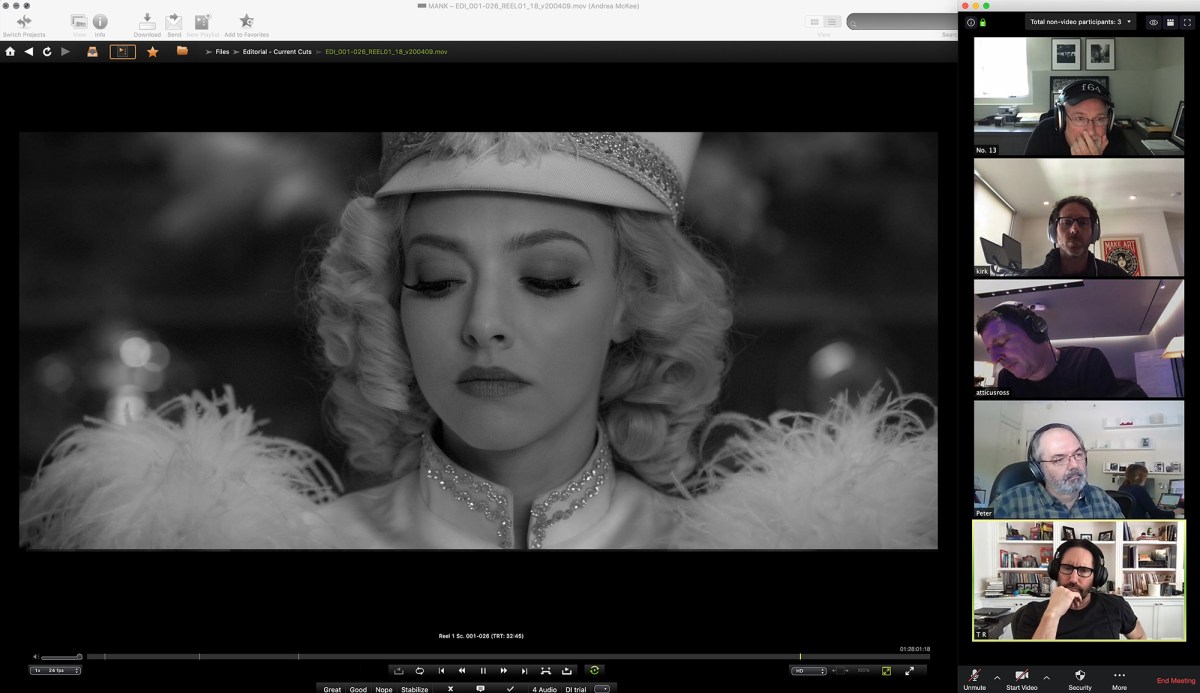
Fincher is known for working in the vanguard of filmmaking technology. Examples include a very early digital intermediate on Panic Room – the first ever in a facility designed for the purpose – and Zodiac, one of the first major features to be shot almost entirely digitally. The remote collaboration envisioned by futurists at the dawn of the internet era was already common practice for his team long before the pandemic.
“Fortunately, we have not missed a beat,” says Chaffin. “We are working now exactly how we mostly could have been working the past ten years, which is working from home during post.”
But the virus and its requirement to remain physically apart may constitute a final push for the industry at large. All the attributes of true remote connectivity – reduced travel time and its attendant benefits in terms of stress, pollution and time savings, enhanced with rapid feedback, superior organization and a centralized database – will still be applicable when health concerns subside.
A canvas of the top pros on David Fincher’s team indicates that while the pandemic naturally raises stress levels, the need to work separately has been essentially a non-factor in terms of their ability to collaborate efficiently and keep the production on track.
Fincher came to the project with a mandate that the production work with the PIX production hub. Chaffin, who has made nine films with Fincher, says that the system is an essential tool for collaboration and input.
“This is how we have worked for a long time.” says Chaffin. “David feels the team is making the film with him, sharing in the problem-solving. Even when we were in the same building, David was often responding exclusively through PIX. His preferences and concerns are there for everyone to refer to. You don’t have to go find that one email, or remember a comment someone made on their way out the door.
Jennifer Chung, Assistant Editor Ben Insler, First Assistant Editor Peter Mavromates, Post Producer
In this panel, you’ll hear Team Fincher discuss their TV and feature film workflows and see how they used the new Productions feature in Premiere Pro along with After Effects in a completely remote scenario during the pandemic.
They’ll also discuss their career paths and give advice on how to succeed as a professional editor.
Necessity is the mother of invention, and nothing proves this proverb more true than the evolution of film and television production technology in the age of COVID-19. While the field has always changed rapidly even in normal times, the pace of change and adaptation has accelerated over the past six months.
This adjustment has posed many questions. Beyond personal protective equipment, mandatory testing, on-set safety monitors, walking lunches and corona contingency fees, will the pandemic have enduring effects in the creative, collaborative endeavor that is filmmaking? The technology to work remotely has essentially been in place for some time, but will the pandemic finally push us over into a new normal?
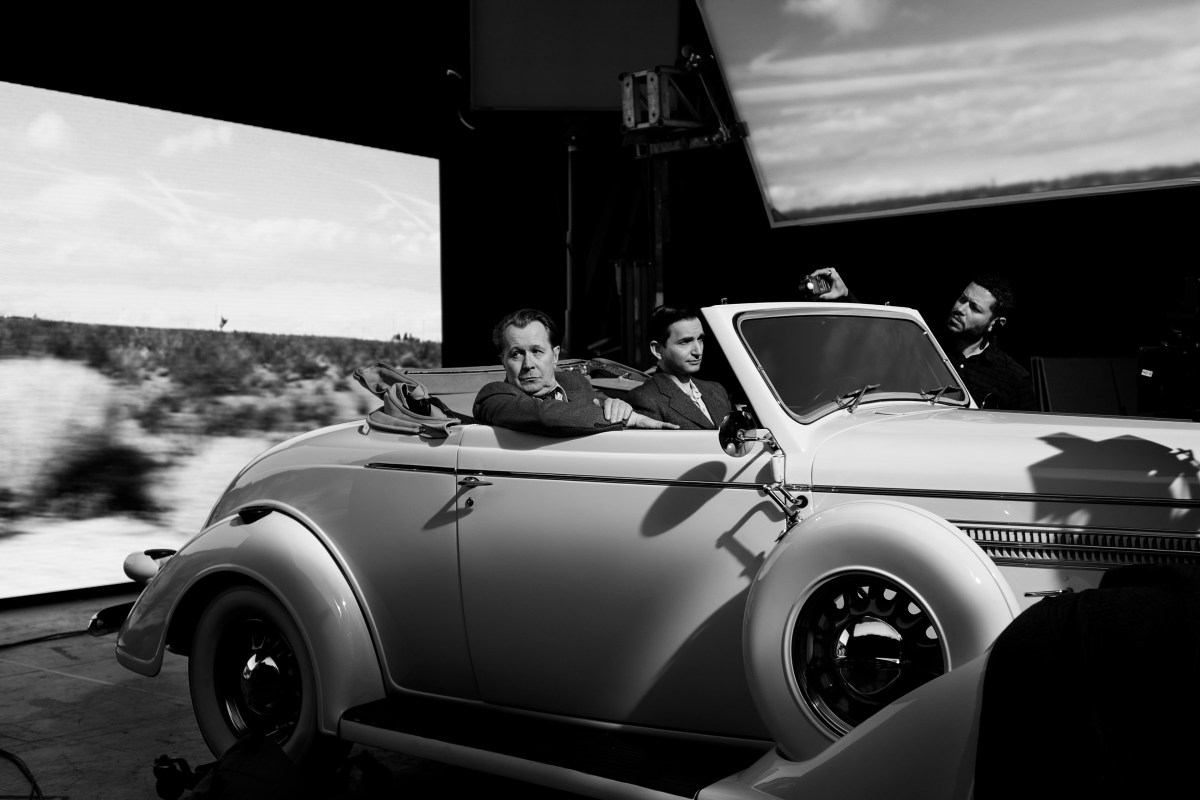
Numerous existing technology trends are being suddenly supercharged by the necessities imposed by the coronavirus. Shooting close to home has never been more appealing, and that impulse aligns neatly with ongoing advancements in LED backings and virtual production. In the world of image processing, connectivity solutions such as those offered by Moxion, Frame.io and Sohonet were already bringing immediacy and super-high resolution to a wide variety of devices without regard to location — and now those virtues are suddenly in much higher demand. And remote collaboration solutions including PIX are looking positively prescient.
Director David Fincher’s team found that the PIX production backbone, a tool they’ve helped develop over the years, facilitated safe group creativity but also enhanced efficiency on the forthcoming Mank.
Charting the development of the FBI’s behavioural science unit in late 1970’s USA, and based on the true-crime book ‘Mindhunter: Inside the FBI’s Elite Serial Crime Unit‘, Netflix‘s TV series required an effortless recreation of time and place.
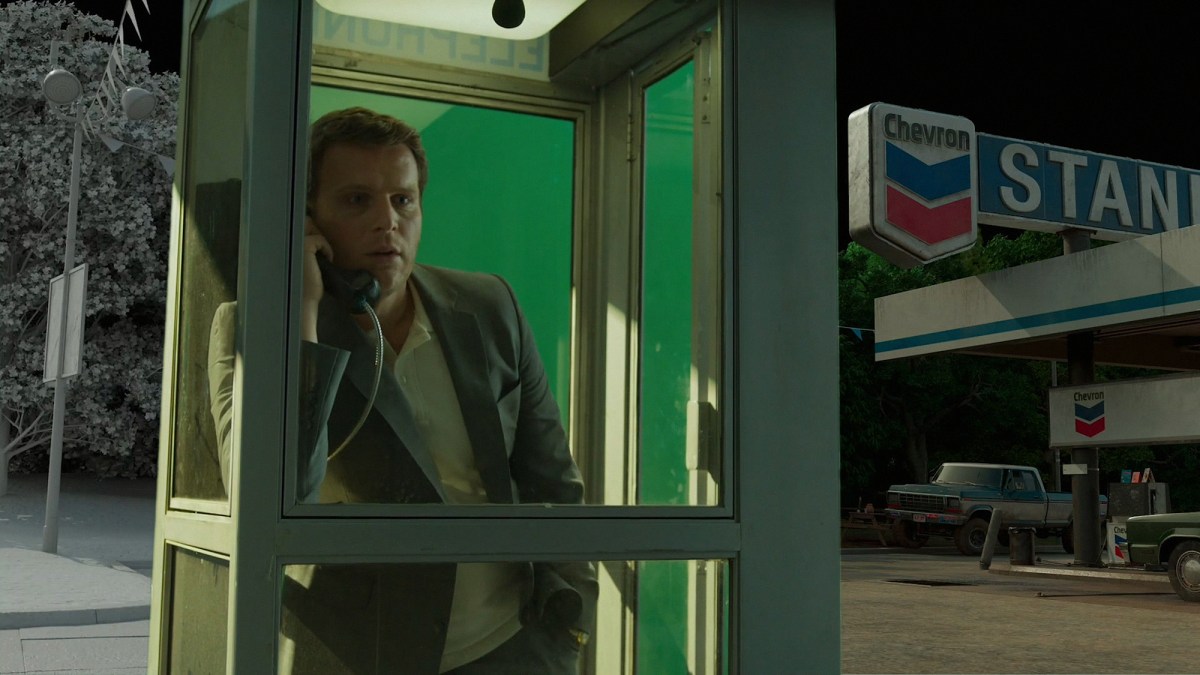
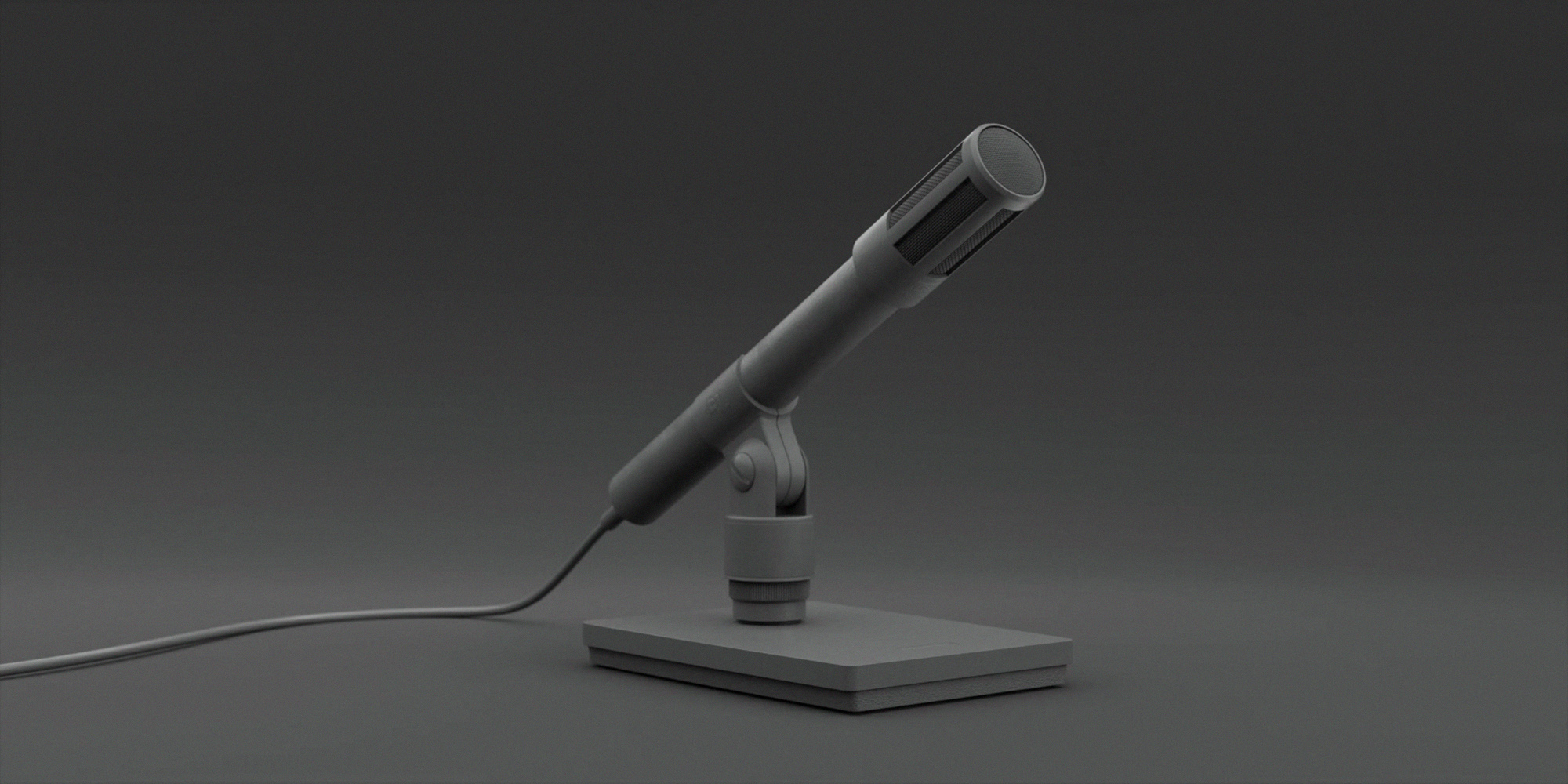
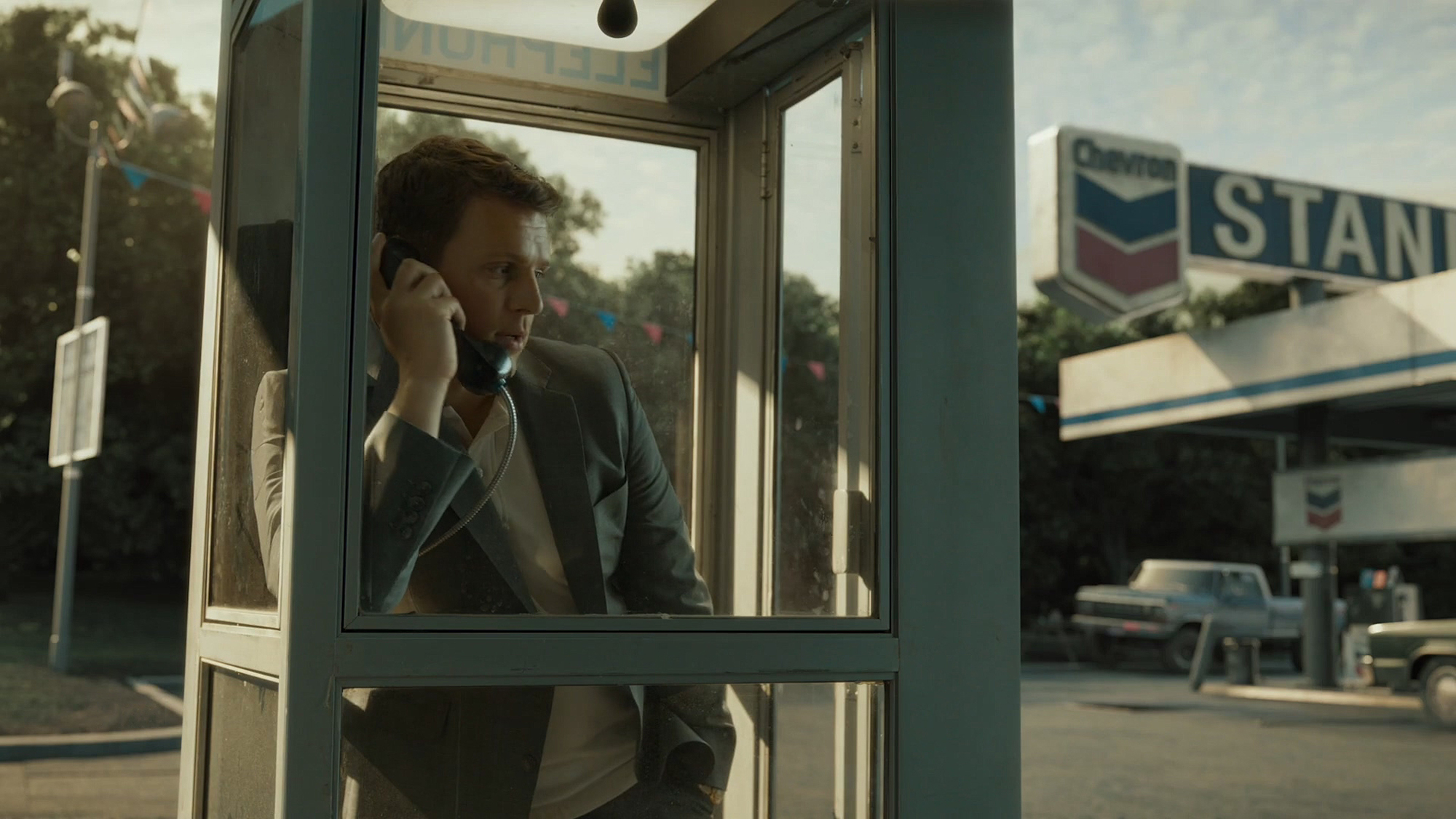
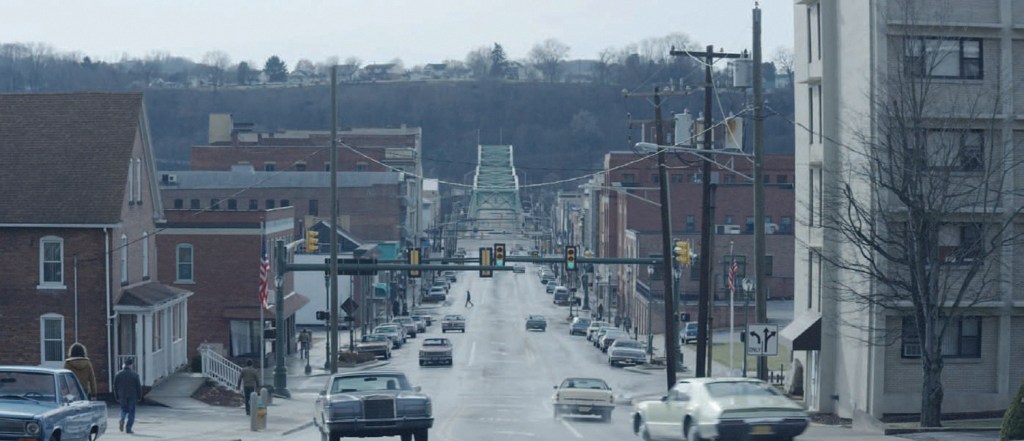
We worked with the production team behind Netflix’s second season of Mindhunter, initially to produce a promo shot which was published across their social media channels, and then to create some stand-alone VFX shots. The scene shots ranged from creating CG backdrops, torches and microphones, to recreating authentic vehicles and helicopters for search scenes. This fascinating series allowed us to become part of legendary Director, David Fincher’s world.
With microphones providing a pivotal accessory throughout both seasons, we were asked to create a teaser recreating their iconic first microphone, which also features in the opening credits, in CG. The teaser was used across their official Facebook, Twitter and Instagram channels before the launch of season 2, garnering hundreds of thousands of views.
… to final scene shots…
Providing final shots in 6K meant working in the finest of detail, at the highest quality. Working closely with Fincher, and the producer, Peter Mavromates, feedback was precise and invaluable, making for a smooth and speedy process. From researching types of trees for the woodland car scene, to playing with atmospheric lighting and weather conditions, we enjoyed this project from start to finish.
David Fincher‘s knuckle-biting Mindhunter series for Netflix is based on the true-crime book, Mind Hunter: Inside the FBI’s Elite Serial Crime Unit, an autobiography centered around the establishment of the FBI Investigative Support Unit, the foundation of which would become modern day criminal psychological profiling.
Each hour-long show (from the 10-episode run) was graded by colorist Eric Weidt, who navigated between ultra-modern capture technology, the time and place of late 70s cinema and the very specific needs of Fincher. Weidt started with Fincher as a visual effects beauty artist for the 2014 film, Gone Girl. Before that, he had worked in post production in the world of Parisian fashion.
With considerable experience in Photoshop and the Adobe infrastructure, Weidt brought his retouching talents to motion as photography and filmmaking began to bleed together. Weidt even created custom film-emulation ICC profiles and scanned grains for photographers transitioning from film to digital capture.
Colorist Eric Weidt.
Meanwhile, Fincher and his team had been working with FilmLight‘s Baselight color grading tools and plug-ins since The Curious Case of Benjamin Button, and on the Netflix series, House of Cards. Adding an editorial and visual effects team at his facility in Hollywood, Mindhunter was the first time that the auteur established his own in-house DI. Weidt was brought on to lead color.
“It’s important to note, we had a lot more time to work on this show than most grades,” Weidt pointed out during a special HDR presentation by FilmLight, Dolby, and Red Digital Cinema at the Dolby Cinema Old Vine theatre in Hollywood. He was given a simple brief: The show was set in the late 70s, centered on the FBI interviews of serial killers.
“The 70’s and serial killers backdrop brought to mind David Fincher’s Zodiac, which is an absolutely brilliant movie; a masterpiece in terms of both content and color,” he says. “The 70s has a distinct color palette. You say 70’s’ and everyone already has an image” he continues. Street photographers William Eggleston and Stephen Shore are personal sources of inspiration for initial color grading.
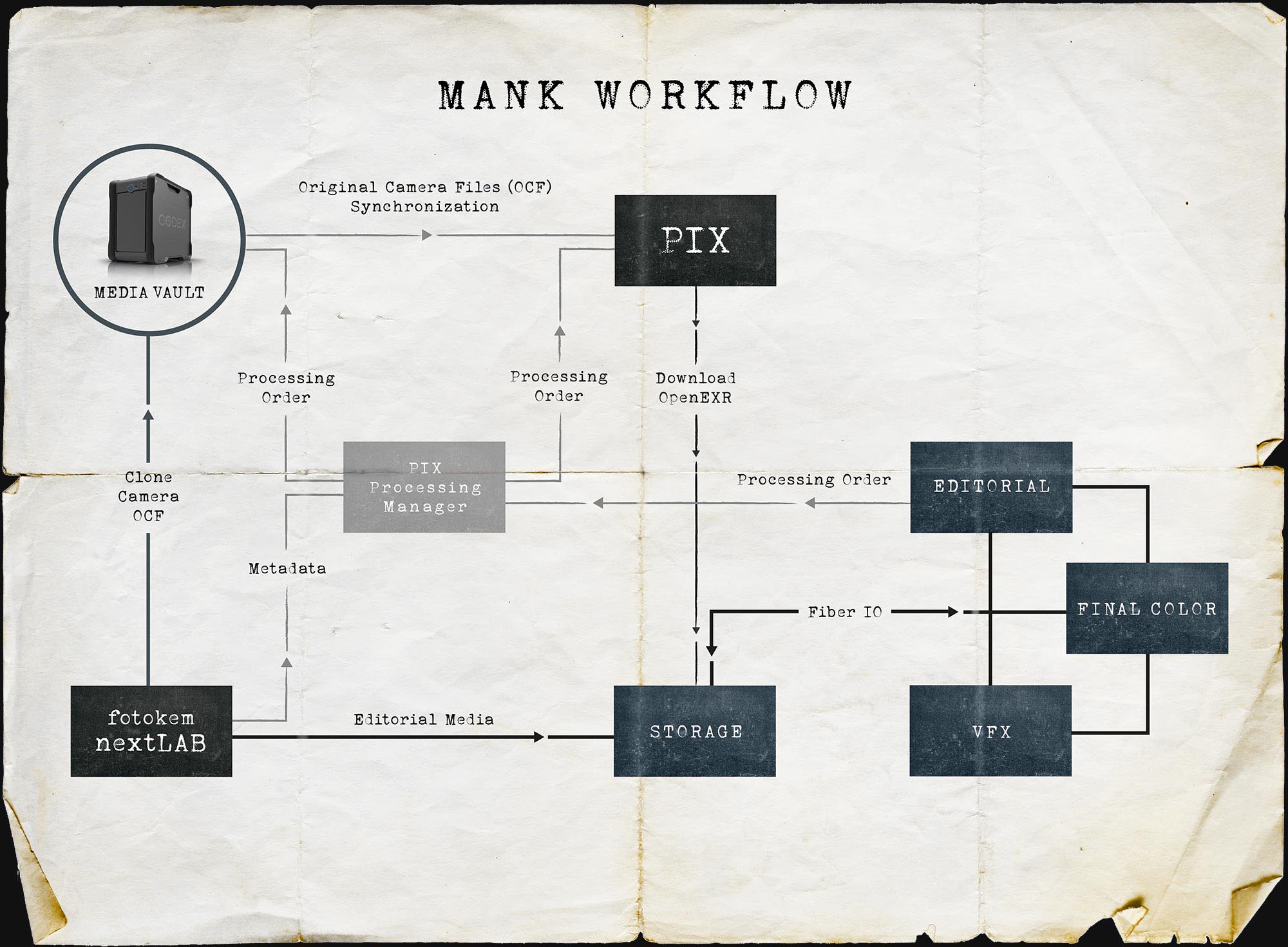
Post and edit began as production rolled in Pittsburgh. Dailies were usually available to Fincher by the following day. The production used FotoKem‘s nextLAB dailies system and the PIX asset and data management and delivery platform.
Due to overlapping shoot and post production schedules, “David looked at things on his iPad for two-thirds of the season,” says Weidt, explaining that he had a complex rendering process that allowed him to manage new HDR footage as well as sending regular corrections from Fincher to view in SDR. The Baselight workflow file was separated into two timelines, one for any creative color adjustments, and another that had stabilizations and lens emulations applied. Weidt would daisy-chain them, run it through the Dolby Vision HDR professional tools, which automatically take his XML trims, and using that, create offline files to view on an iPad or monitor.
“All you really need to do is add a trim pass layer to each shot, then hit analyze. It might take 40 minutes to analyze the whole hour’s episode. You come back, and you have your SDR version. It’s done, except that you are able to then do lift/gamma/gain, or some saturation adjustments on the trim pass. I found that maybe 85 percent of the time it looked like there wasn’t really anything to do. Out of the box, it’s pretty amazing.”
He continues that, “You don’t want to grade with both monitors, because you’ll go nuts. You have to learn to accept that the REC 709 compared to the HDR is going to look more dull.” Weidt says that Fincher’s color design for Mindhunter was heavily influenced by the organic palette of several classic films, such as McCabe and Mrs. Miller, All the President’s Men and the more chromatic yet grittier look of The French Connection. They also wanted a low contrast, information-rich picture, and had first experimented with low contrast optical filtration on set but preferred in the end to “set up the digital chain in a way that Fincher was getting the type of image that he wanted.”
The RED Xenomorph custom camera for Fincher.
“Low contrast does not mean low detail,” Weidt carefully points out. That required a camera with outstanding capabilities for the production. Cinematographers Erik Messerschmidt and Christopher Probst, ASC, employed a one-of-a-kind Red camera with a 6K Dragon sensor called Xenomorph, developed by Red to Fincher’s specifications. Weidt’s starting point for dailies, as well as any color work on the master, began with a low-contrast log curve based on REDgamma3 that maintained as much of the dynamic range provided by the Red Xenomorph as possible, and gave the SDR monitoring on set an approximation of Weidt’s HDR workflows.
“When you grade something, the tone curve can be your initial contrast,” says Weidt. “It’s a bit like choosing a film stock. With Red, at that time, the most current tone curve was REDgamma4. It’s a nice, contrast-y curve, but David wanted to go back to a previous tone curve, which was REDgamma3. It’s a softer curve, and it rolls off quicker and easier in the highlights and also in the shadows.”
With the Dolby Vision HDR toolset, custom color transforms helped manage the monitoring during production. From 6K .R3D files to linear OpenEXR files, they were able to go straight to grade in Weidt’s and Messerschmidt’s preferred ‘flat’ log. For Dolby Vision HDR mastering, Weidt used the Dolby Pulsar 4000-nit professional reference display, while the Rec709 passes were done with automated mapping to SDR from Baselight. For SDR, they used a Dolby PRM monitor at 120-nits.
The HDR look was developed in post production: “In HDR, we initially came across a lot of scenes where the light sources were taking too much prominence,” Weidt says. “David and his post supervisor Peter Mavromates really wanted an elegant balance. Mindhunter‘s HDR is not trying to strike you or slap you in the face. Just like the sound mixing, or cutting, it is not trying to blow your mind, but rather convey the story content. The latter is really what’s going to punch you.”
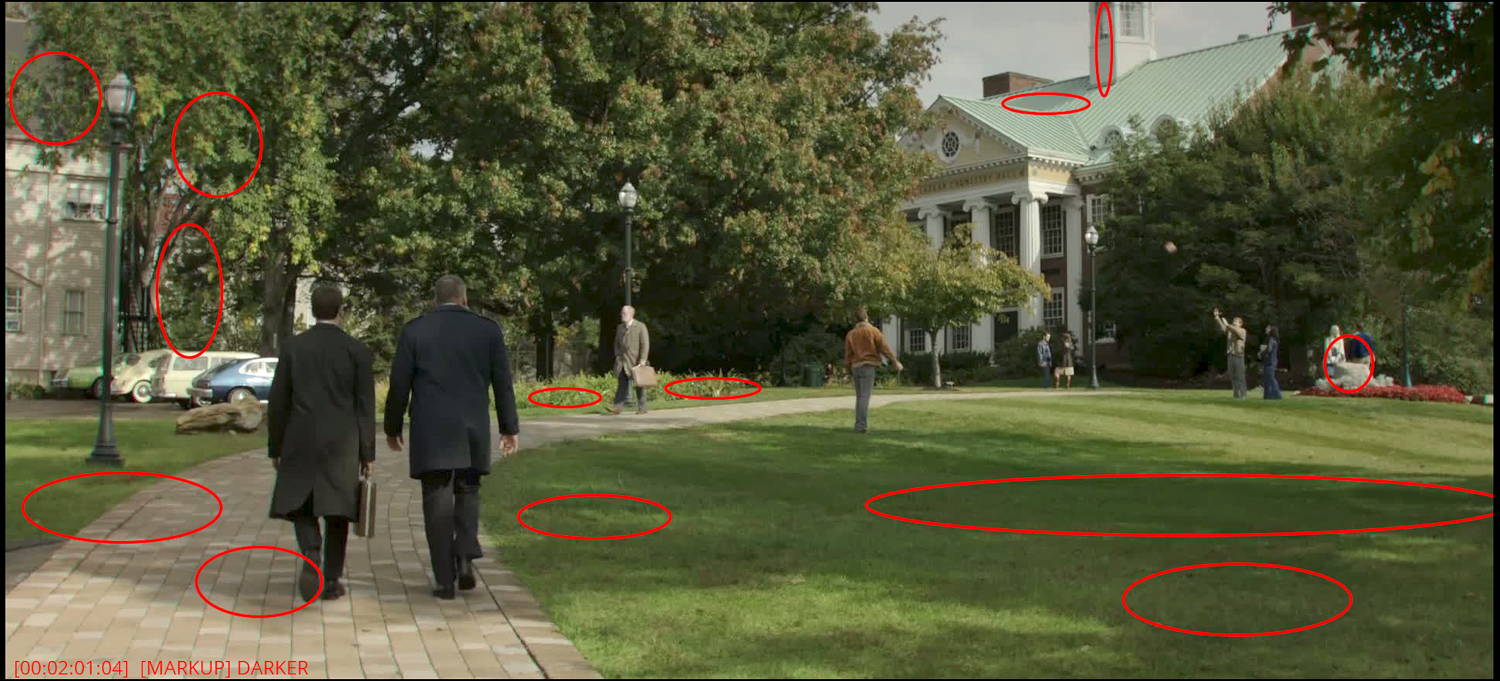
Areas of focus circled using PIX.
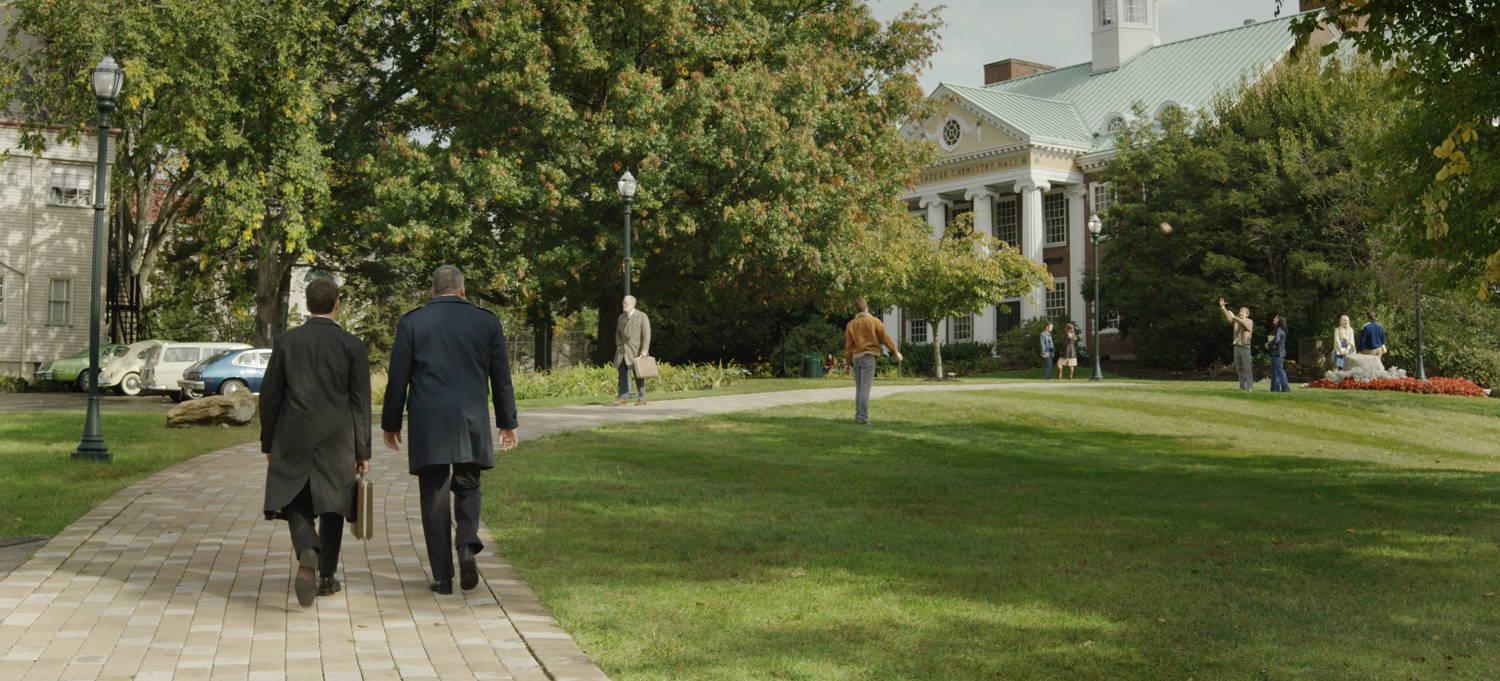
After the grade.
Many of Fincher’s notes require simple dodging and burning, performed primarily through Weidt’s use of shapes, masking and tracking in Baselight. Using PIX, Fincher would circle subjects or areas of a frame, giving suggestive chromatic terms like ‘sallow’ or ‘ruddy,’ and ‘equidistant’ or ‘symmetrical’ in regard to reframing. Mindhunter used a 5K working area extracted from the full 6K frame, ultimately downconverted to a 4K deliverable, a Netflix requirement. As a 2.2:1 center extraction, the editors were able to reposition the image subtly, as needed. The image was stabilized further as necessary by using sophisticated tracking for repositioning and resizing without loss of resolution upon deliverable at 4K.
“David is famous for having a visual style where he is going to stabilize two-thirds of the shots in an episode, or in a movie, so that everything is absolutely perfect,” says Weidt. “What he wants is that the camera, the gaze into the image, is totally unconscious, and you’re really in there without distractions that most people take for granted.” After Fincher returned to Los Angeles, their standard workflow on a scene together would start with a master shot that incorporated the characters as well as background, timing color and light levels for other shots and angles in scenes to be timed from that reference.
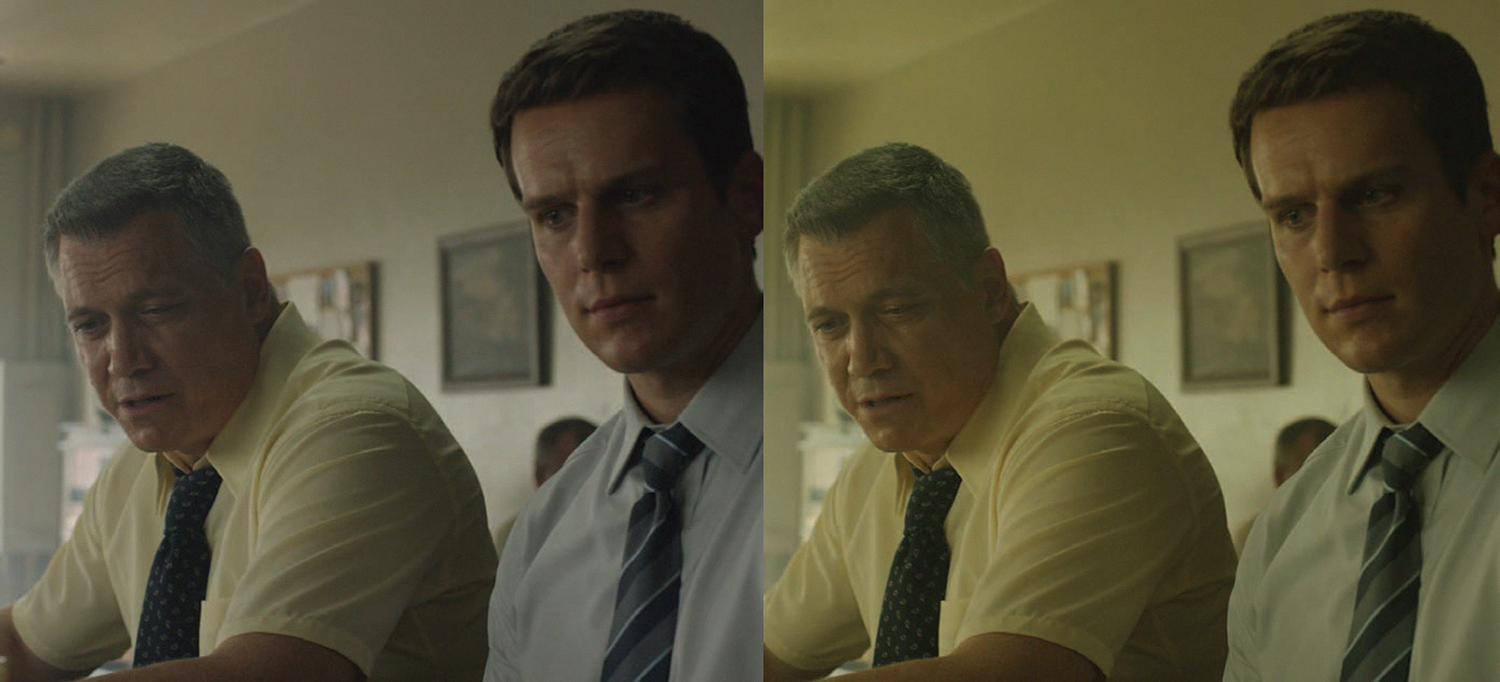
Fincher’s eye for detail goes far beyond that, though, and Weidt noted several corrected items that would have escaped his attention, like plants outside a prison that were too vibrantly green, or highlights in reflections that needed to be turned down to match light sources. “There are certain colors that David needs to suppress, and that’s mostly pink,” he continues. “Pink appears in people’s skin tones, and if you get it wrong in the grading suite and ends up on a monitor outside of that environment, it’s going to appear like they have pink faces and it looks really bad. David wants to control that.”
Before / After
Using Summilux-C primes from CW Sonderoptic, XML information was created for every focal length. This was a requirement on Mindhunter as simulations of grain, lens barreling and chromatic aberration in Baselight were tailored to the specific focal length throughout the show. Weidt even created anamorphic effects for the spherical lenses.
“David wanted to refer to 70’s in what could be called ‘the anamorphic wide-screen era,'” he says . “Unfortunately, that focal length is not something that’s carried through in metadata. It’s tallied by the camera assistant with name of the clip and the focal length and put into a database. I had to find a way to apply the right settings for every single clip, in the absence of metadata.”
Weidt was able to merge this information by teaching himself the Python scripting engine for asset management adding the focal length as a variable in the comment field. That enabled him to classify and organize shots by telephoto, standard and wide, then multi-paste effects into an alpha-numerically sorted timeline which came in handy throughout the production. “It worked beautifully,” he says.
He also added pseudo chromatic aberration “on every shot and every episode of Mindhunter,” which he developed himself, as the vast majority of plug-ins and filters will simply shift one of the primary color plates, stretching from center, resulting in bi-color aberrations. These created results that Fincher found lackluster, when for example given a cyan-red, he’d really only want the cyan. “I found the solution in Baselight, which essentially took 20 layers, using blending modes that are usually the purview of a compositing tool,” Weidt says.
Creating a specific ’70s look.
Mindhunter
is graded on Baselight.
“David directed four episodes of Mindhunter, but he’s the executive producer for the show, and he’s definitely the director of the DI,” he adds. “All of the color, he directed himself, with contributions from Erik.”
Weidt notes that next season will be shot using a Helium sensor, and HDR monitors will be on set along with a new ACES color space workflow. “We’ve got 20 layers just for chromatic aberration. We’ve got lens warping. We’ve got three different types of grain as well, because you couldn’t just have one,” Weidt adds, regarding the final rendering process.
“Season 2 is going to be just like a real walk in the park compared to season one. We learned so much.” Season 2 of Mindhunter is currently in production.
Erik Messerschmidt and Chris Probst, ASC, also have made “smart” use of LED technology, as detailed in our cover story on Mindhunter (page 36). David Fincher, who first started using LED’s for process work on Zodiac, 11 years ago, not only customized a high-resolution RED camera for the show (dubbed the “Xenomorph”), but also devised one of the most ingenious LED-driven plate projection/interactive lighting processes for driving shots TV has ever seen. Messerschmidt’s description of Fincher’s commitment to innovation mirrors those Sundancers bending technology in the service of new ways to tell a story: “For David, the frame is sacred; what we choose to include is intrinsic to what the audience thinks is important. They are one and the same.”
David Geffner, Executive Editor
ICG Magazine
Visualizing the daring and often scary world of David Fincher requires new technologies and processes rarely attempted in series television.
Matt Hurwitz
Photos by Patrick Harbron & Merrick Morton, SMPSP
April 2018 ICG Magazine
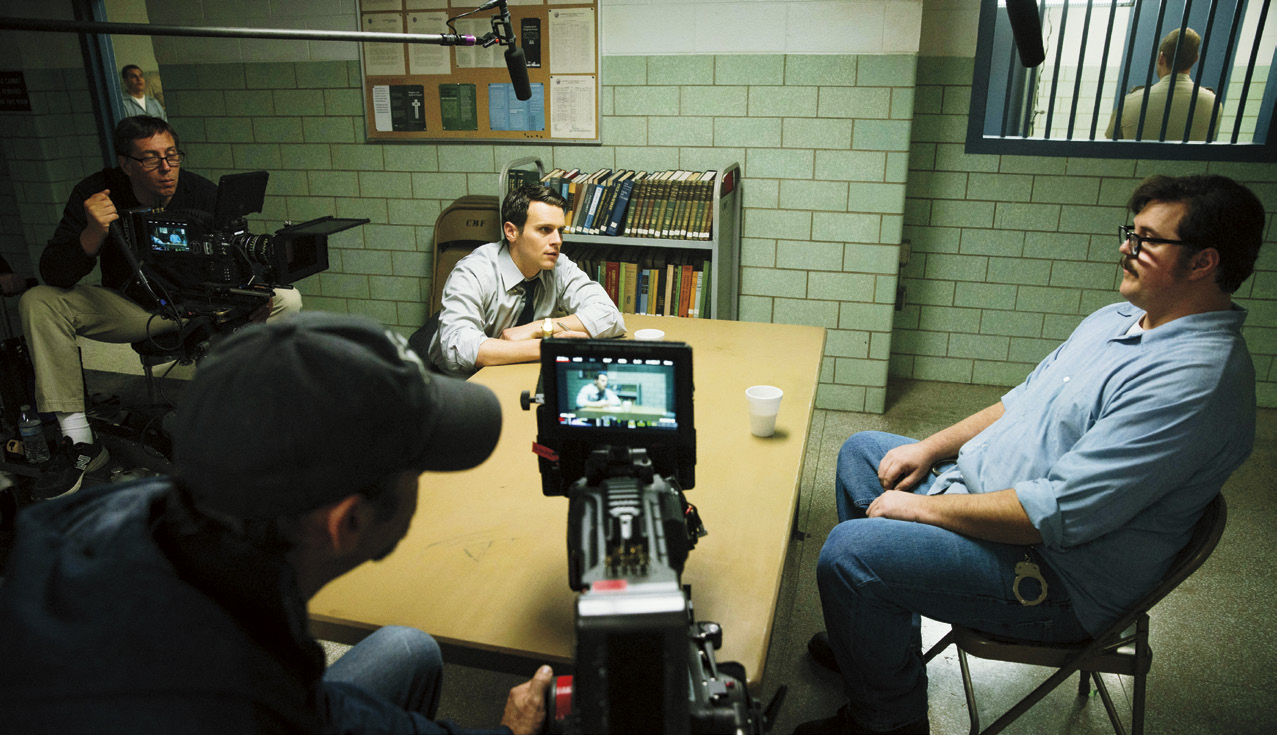
In the season 1 finale of Netflix’s MINDHUNTER, a disturbed FBI agent, Holden Ford (Jonathan Groff), bursts wildly from a hospital room, as a handheld camera gives chase. The move begins as shaken as ford is, but, as it lands with the agent, who collapses in the hallway, it’s as if the camera has floated to a butter-smooth stop inches from the floor, the maneuver executed like it was on a perfectly balanced Jib arm, crane, or even Steadicam. But it’s none of those. What can viewers assume from this?
David Fincher has returned to television.
FOR THIS SERIES ABOUT A PAIR OF AGENTS WORKING IN THE FBI’S ELITE BEHAVIORAL SCIENCES UNIT in 1979, and attempting to understand the mind of a serial killer, Fincher used a number of leading-edge technologies – interactive LED lighting, custom built high-resolution cameras, and, as in the shot with Agent Ford, image stabilization/smoothing in postproduction – to keep the viewer visually embedded. Fincher’s aim with MINDHUNTER, which has no graphic violence, is for viewers to “access their own attics. There’s far scarier stuff up there than anything we can fabricate,” the filmmaker insists. “I wanted people to register what’s going on in [characters’] eyes and where the gear changes are taking place. At what point do I [as the viewer] feel like, ‘OK, I’ve got an insight,’ and at what point do they feel like: ‘oh, I’m being sold something. It’s all about the nuance in how the balance of power is changing.”
Fincher’s longtime postproduction supervisor, Peter Mavromates, says he creates an “experience of omniscience,” similar to Kubrick’s A Clockwork Orange, “where you’re in a straitjacket with your eyelids pinned open, and David’s forcing you to watch these horrible things.” In fact, the show’s unique visual process began more than a year before production started in Pittsburgh (on area locations and on stages at 31st Street Studios, a former steel mill), with the development of a unique RED camera system.
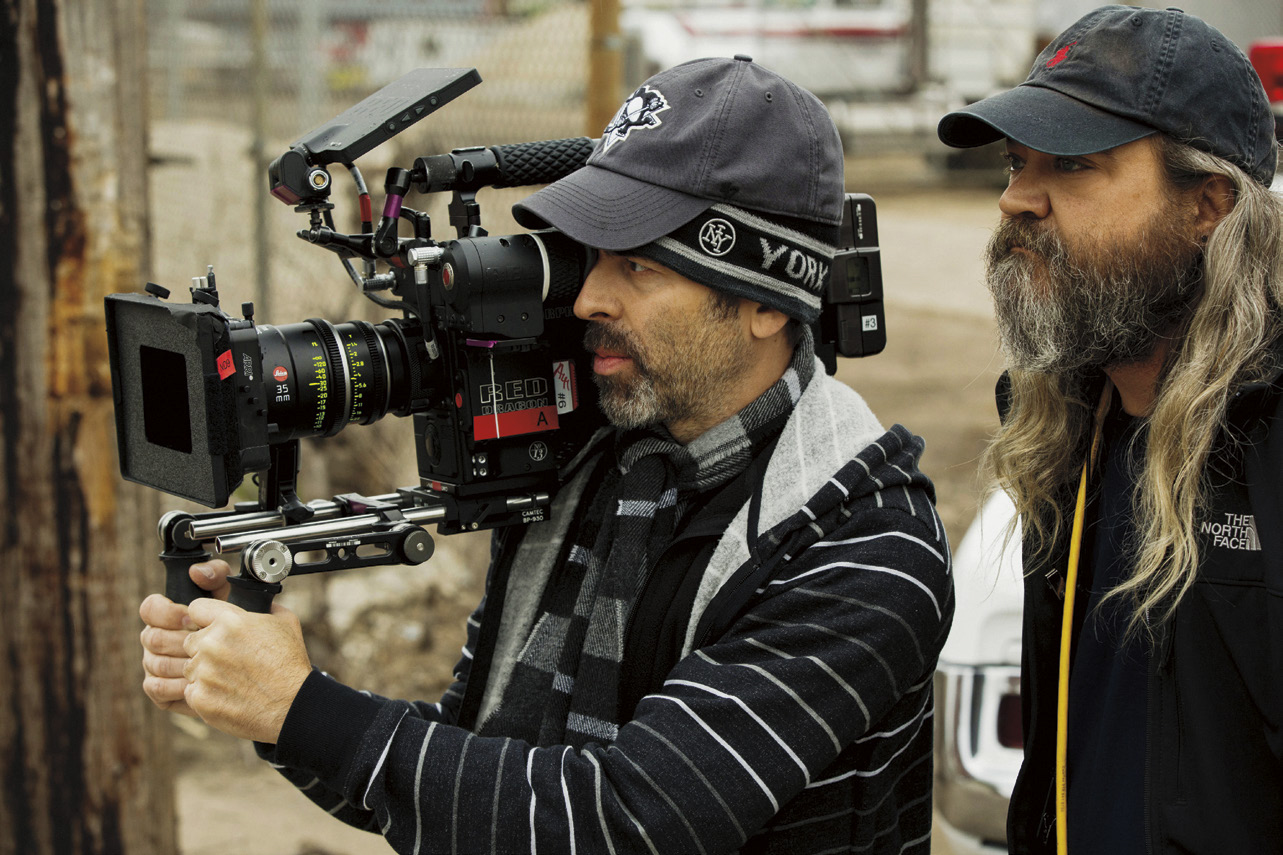
Christopher Probst, ASC – who shot MINDHUNTER’S pilot and second episode – was asked for his input on a RED prototype system, which had been designed by Jarred Land and RED’s Chief Designer Matt Tremblay according to Fincher’s specific needs. “David wanted to take all of the different exterior add-ons that create a jungle of wires, and put them inside the camera body,” Probst explains.
Fincher puts it even more directly: “It just seems insane that we’ve been bequeathed a [camera] layout [dating back to] D.W. Griffith and Charlie Chaplin that looks like some bizarre Medusa. [The camera] should be something that people want to approach, touch, and pick up.”
In fact, the custom system built for Season 1 [Land created a 2.0 version being used in Season 2] had an RTMotion MK3.1 lens-control system, Paralinx Arrow-X wireless video, and Zaxcom wireless audio (with timecode) integrated into the RED body, with the only visible cable being to control the lens. Slating was all but eliminated, with clip-number metadata being shared wirelessly between the camera and the script supervisor, who used Filemaker software to associate takes and clips. An audio scratch track from the mixer was recorded onto the REDCODE RAW R3D files and received wirelessly.
The base camera was one of RED’s DSMC2 systems, the then-new WEAPON DRAGON, with its 6K sensor. The shell design, accommodating the added gear inside, with its angular shape and heat venting fins on top, had a “Xenomorph” appearance (à la Alien), and was dubbed as such by Land and Fincher. “When the camera arrived in Pittsburgh, they had actually engraved “Xenomorph” on the side,” Probst says.







 The Fincher Analyst