Family Story

Director David Fincher looks back on how Mank made it to the screen.

Nev Pierce
February 19, 2021
Netflix Queue

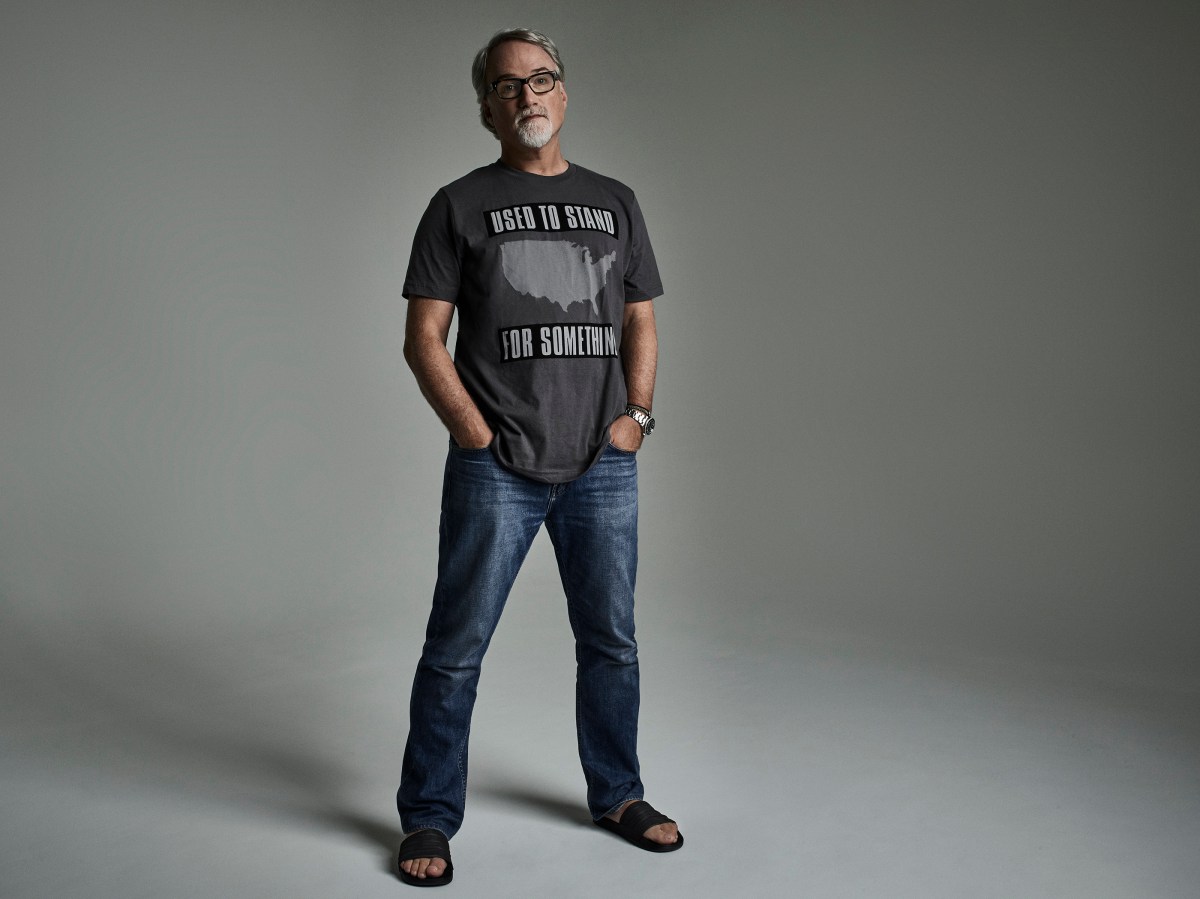
Portraits by Michael Avedon

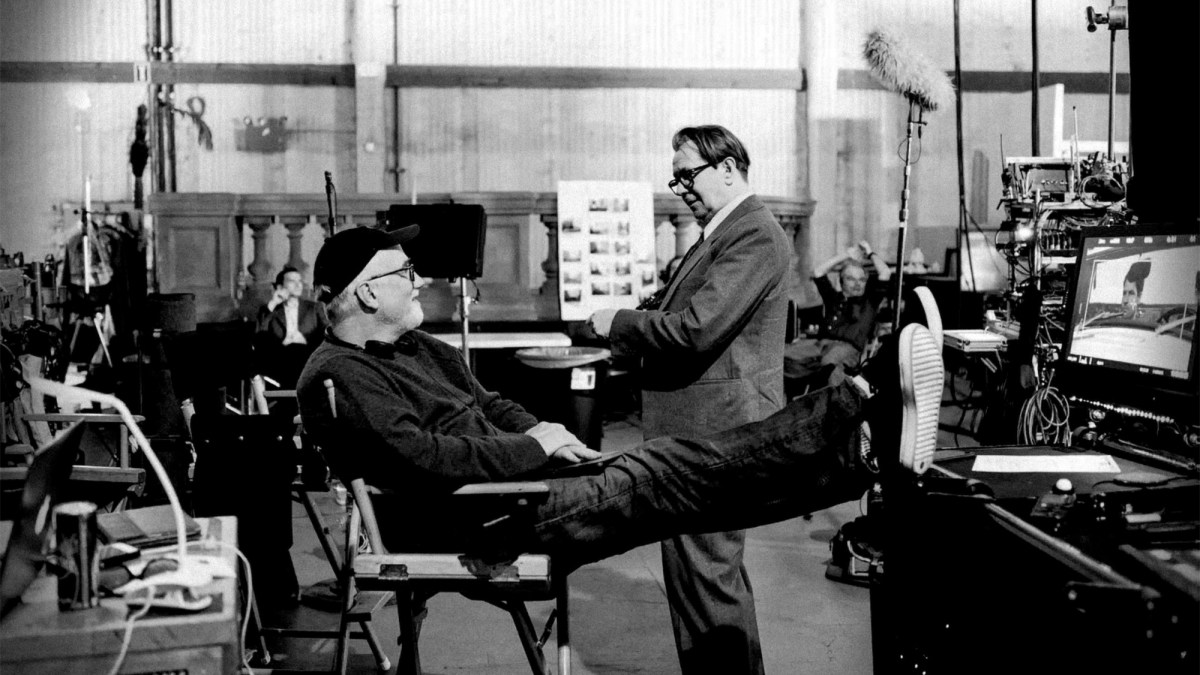
When Jack Fincher became a parent, he shared his lifelong love of cinema, and his regard for screenwriters in particular, with his son, David. “Jack felt this was a really difficult kind of writing, and something he had great respect for,” David Fincher says, looking back. “He also believed that the beleaguered writer was not a cliché due to personality type, but because they often had to bite their tongues as they watched idiots take their ideas and mangle them.” (On that point, the Oscar-nominated director begs to differ.)

Eventually, David encouraged Jack — who was by that time retired from his journalism career — to try his own hand at screenwriting. Those efforts have now solidified into one of David Fincher’s most acclaimed films to date, a project that also serves as an homage to his father, who died from pancreatic cancer in 2003.

Mank chronicles how screenwriter Herman J. Mankiewicz came to pen the first draft of what would one day be Orson Welles’s Citizen Kane. Like so many films, Mank was years in the making, and it long loomed in David’s consciousness. Father and son initially discussed the idea in the 1990s, when David was graduating from music-video director to rising-star filmmaker. As Jack completed various revisions, they had many fruitful clashes over the direction of the screenplay.

Over the years, it became clear that the project was unlikely to see the light of day. It fell by the wayside and Jack fell ill. “He ended up having chemo to worry about, and not so much the rewrites,” David recalls. “We would talk about it from time to time. I would take him to his chemo — he was in therapy a little bit in the last couple of months of his life — and we would talk about it in the car, shoot the shit. But it was understood that this would not be something that would ever get made. And that was O.K.”

David Fincher moved forward, building an acclaimed body of work that includes Zodiac, The Curious Case of Benjamin Button, The Social Network, The Girl with the Dragon Tattoo, and Gone Girl. Ultimately he arrived at a place where he could turn his focus to that elusive project from his past. Suddenly, Mank was something that could get made, and made the way he wanted: in dazzling black and white, with a superior cast carrying it forward.

Nev Pierce spoke to David Fincher in this edited excerpt from the book Mank, The Unmaking

Read Mank, The Unmaking
‘Mank’: Read The Screenplay For David Fincher’s Movie About The Writing Of ‘Citizen Kane’ Penned By His Father

Patrick Hipes
February 19, 2021
Deadline

EXCLUSIVE: David Fincher’s Mank has been near the top of the heap this awards season, scoring the most nominations at the Golden Globes and Critics Choice Awards and a place on the AFI Top 10 movies of 2020 for the take on the relationship of screenwriter Herman J. Mankiewicz and Orson Welles during the writing of the iconic Citizen Kane.

Those noms include posthumous recognition for the screenplay, written by Fincher’s father Jack, who died in 2003. It was David who encouraged his dad to explore the story between the two men, along with it the idea of taking responsibility for one’s ideas put into the world, and the reality-altering power that creates.

Read the Mank script

Ben Affleck Reunites With ‘Gone Girl’ Director David Fincher, Accuses Him of Making a Movie With Heart

Meredith Woerner
February 11, 2021
Variety

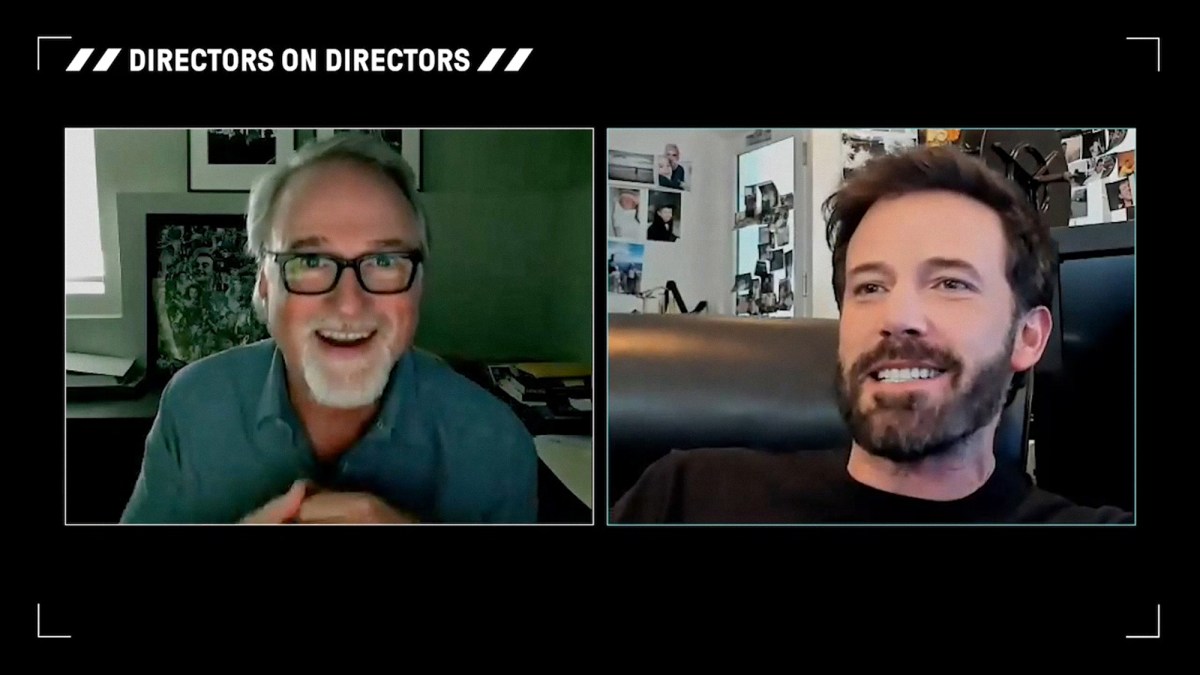
For once, Ben Affleck gets to ask the questions.

That’s how the actor-director framed his duty of leading a conversation with longtime friend and “Gone Girl” boss David Fincher, the esteemed director whose Netflix film “Mank” has emerged as a top awards contender for 2021.

“This is a real role reversal from having to just be Fincher bitch, having to go over and over again,” Affleck teased the director, alluding to Fincher’s notorious preference for many consecutive takes of the same scene.

Appearing in Variety‘s “Directors on Directors” conversation series, the pair recently held a virtual reunion where Affleck dug into the decades-long process of bringing the story of famed screenwriter Herman J. Mankiewicz to screen.

In perhaps the broadest conversation Fincher has had about the film’s themes, Affleck gets to the heart of the original script from the director’s father, the value of creative credit at the dawn of Hollywood’s golden age, and the rare glimmer of heart and hope in a David Fincher film.

Read the conversation and watch the interview

‘Gone Girl’ Duo David Fincher & Ben Affleck Reunite to Dissect ‘Mank’ | Directors on Directors

Variety (YouTube)

American Cinematographer Clubhouse Conversations: Mank

Caleb Deschanel, ASC
February 10, 2021
American Cinematographer

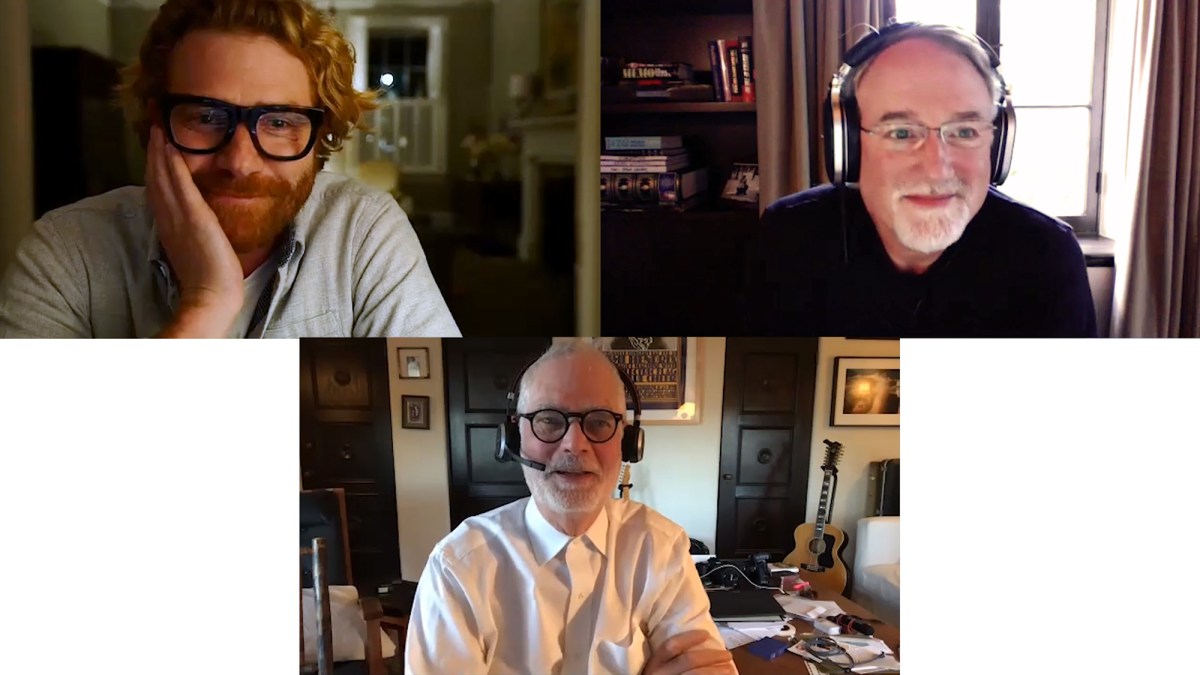
In this 85-minute episode, interviewer Caleb Deschanel, ASC talks to cinematographer Erik Messerschmidt, ASC and director David Fincher about their stylish black-and-white period drama.

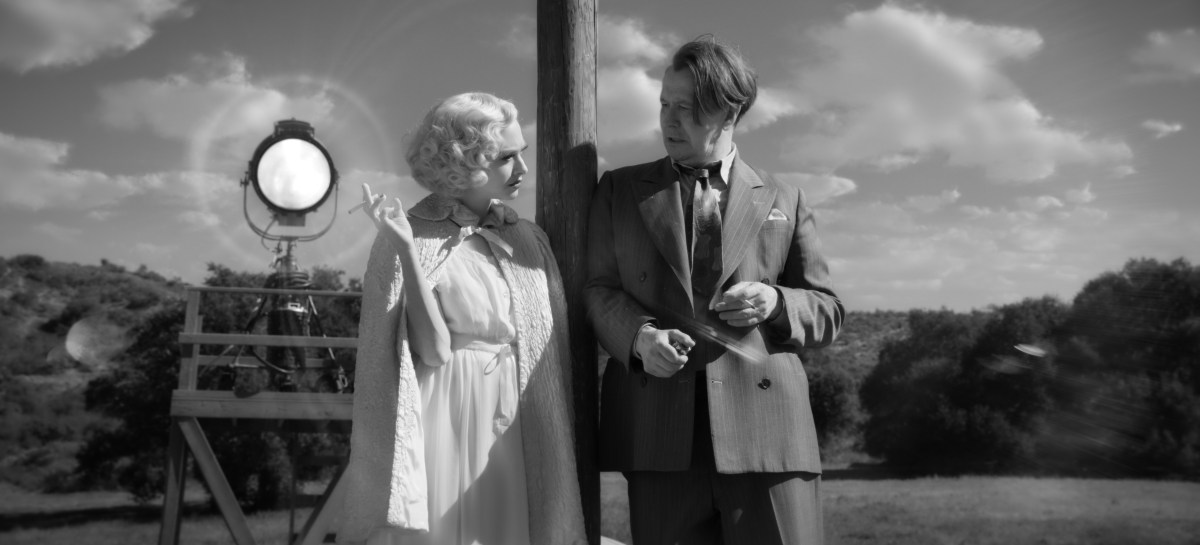
Written by Fincher’s father, Jack, Mank depicts the turbulent life and career of self-destructive Hollywood screenwriter Herman J. Mankiewicz (played by Gary Oldman) — focusing on his writing of the script for the iconic 1941 drama Citizen Kane. He and director Orson Welles shared an Academy Award for Best Original Screenplay. 

While the filmmakers sought a period look and feel contemporary to their story — in part inspired by Gregg Toland, ASC’s Oscar-nominated camerawork in Citizen Kane and The Grapes of Wrath — they embraced every modern tool to accomplish their creative goal, shooting with Red Ranger monochrome Helium cameras and Leitz Summilux-C lenses while employing virtual production techniques to facilitate recreating a vintage Los Angeles and other locations.

Read the full article and watch the conversation

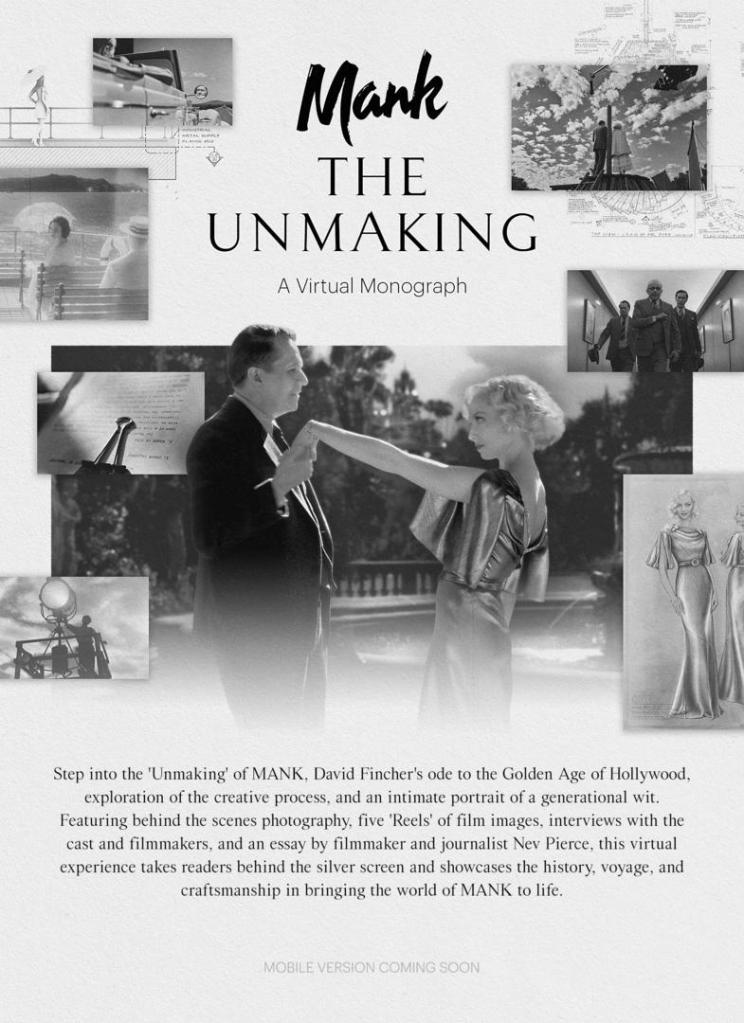
Mank, The Unmaking

January 28, 2021
Netflix

manktheunmaking.com [Old Domain]

mank.aristidebenoist.com

Text by:

Nev Pierce

Photography by:

Erik Messerschmidt
Miles Crist
Gisele Schmidt-Oldman
Gary Oldman
Ceán Chaffin
Nikolai Loveikis

Design and development by:

Watson Design Group, Inc.
Aristide Benoist

David Fincher on ‘Mank’: ‘ I Don’t Want Sympathy for Mankiewicz, I Want Empathy’

Tim Gray
January 15, 2021
Variety

There are a lot of reasons to like “Mank.” 1. It’s great filmmaking. 2. It has an irresistible backstory: David Fincher wanted to pay tribute to his late father, Jack, by directing his screenplay; 3. It tackles a well-known topic (Hollywood in the 1930s-‘40s) from an unusual angle. 4. It’s not what people expected, always a good thing in a film.

It’s not about the making of the 1941 classic. “I hope this movie exists as more than just an addendum or footnote to ‘Citizen Kane,’ ” Fincher tells Variety. “I hope there is enough human behavior and an interesting enough look at humanity that it doesn’t require a master’s degree in film theory.”

Among other things, it is a character study of Herman J. Mankiewicz, including his risky decision to write “Citizen Kane.” It’s also about the times he lived in, and how events fed into his creativity.

Fincher says Gary Oldman doesn’t look like Mankiewicz, but has the writer’s disarming charm. “I needed  an actor’s actor, to play someone who walks into a room and everyone would say ‘That’s the guy.’

Read the full profile

The Man in the Wings: David Fincher on the Shadowy Life of Herman Mankiewicz

Sydney Ladensohn Stern
January 14, 2021
Criterion

Herman Mankiewicz—a washed-up Hollywood screenwriter writing the first draft of Orson Welles’s 1941 biopic about William Randolph Hearst—may seem an unlikely hero for a 2020 biopic. He is rarely remembered today outside of cinephile circles, but in telling his story, David Fincher’s Mank delivers a loving tribute to Golden Age Hollywood films, a clear-eyed dissection of a company town, an unexpectedly timely depiction of 1930s fake-news shenanigans, and an unabashed homage to Citizen Kane, all wrapped up in a snappy, stylishly retro package.

Welles is rightly revered as the twenty-five-year-old wunderkind behind Citizen Kane, but when Herman Mankiewicz went to Hollywood in 1926, he, too, was a promising young man. At twenty-eight, he was not only the New York Times’ assistant theater editor under George S. Kaufman and the New Yorker’s first theater critic, he was an aspiring playwright collaborating with both Kaufman and Marc Connelly. Unfortunately, Herman was also an alcoholic with a gambling problem and a penchant for getting himself fired. So, despite despising the movie business, his periodic attempts to escape back to his native New York and his friends in the Algonquin Round Table writers’ group failed, and he remained in Hollywood for the rest of his life.

At first he was successful. As head of Paramount’s writing department, he recruited journalist friends who created the wisecracking, irreverent sensibility of many 1930s movies. He produced the Marx Brothers’ Monkey Business and Horse Feathers. At Metro-Goldwyn-Mayer, David O. Selznick had Herman write an all-star adaptation of George Kaufman and Edna Ferber’s hit play Dinner at Eight. As the first writer assigned to The Wizard of Oz, he objected to adapting the book, then said that if the studio insisted, they should film Oz in color and shoot the Kansas sequences in black and white, a suggestion that led to the movie’s iconic use of sepia.

Mank begins soon after that, with Herman on his way east to take one more stab at rekindling his newspaper career when fate intervenes in the form of Orson Welles. Citizen Kane revitalized Herman’s career in the 1940s, but he spiraled down again, dying in 1953 at the age of fifty-five.

After that, he was largely forgotten until February 1971, when the New Yorker published a two-part, 50,000-word piece by Pauline Kael, in which she wrested away screenplay credit from Orson Welles and handed it almost entirely to Herman. Kael’s inaccurate and unfair account was actually an attempt to rebut auteur theory critics by arguing that Citizen Kane was not the product of one man’s singular genius and vision, but rather an example of the studio system at its best. Kael’s claims on Herman’s behalf were so hyperbolic and her dismissal of Welles so outrageous that although her arguments were effectively debunked at the time, Welles’s defenders have been attacking Herman ever since.

In October 2019, I published a biography of Herman and his younger, more successful brother, writer-director Joseph L. Mankiewicz (All About Eve, Cleopatra), and after living with Herman in my head for a decade or so, I had mixed feelings about the prospect of a David Fincher biopic. Like most biographers, I had become proprietary about my subjects, and though I imagined a movie would raise Herman’s profile, film is such a powerful medium that I knew no matter how inaccurate it might be, Fincher’s concept and Gary Oldman’s portrayal would become the prevailing version of Herman for the foreseeable future. To my immense relief, they cared very much about accuracy. So much so, in fact, that the first time I saw Herman, Joe, and Herman’s wife, Sara, up on the screen and heard them saying many of the same things they say in my book was an incredibly moving experience. They were the Herman, Joe, and Sara I had imagined. It was surreal in a good way.

David Fincher has actually been thinking about Herman decades longer than I have. He acquired his love of movies from his late father, journalist Jack Fincher, and because the two revered Citizen Kane above all, David was interested enough to seek out Kael’s piece while he was still in junior high school. The notion that Herman’s Marx Brothers sensibility and newspaper background fed into Citizen Kane intrigued him, so when Jack retired around 1991 and wanted to write a screenplay, David suggested he consider Herman as a subject. Jack liked the idea, and over the years, he wrote draft after draft while David tried to get it made. It took almost three decades to find a producer, mostly because of David’s insistence that he shoot in black and white. By the time Netflix assented, Jack, who died in 2003, did not live to see the final result. David dedicated Mank to his father.

Read the full interview

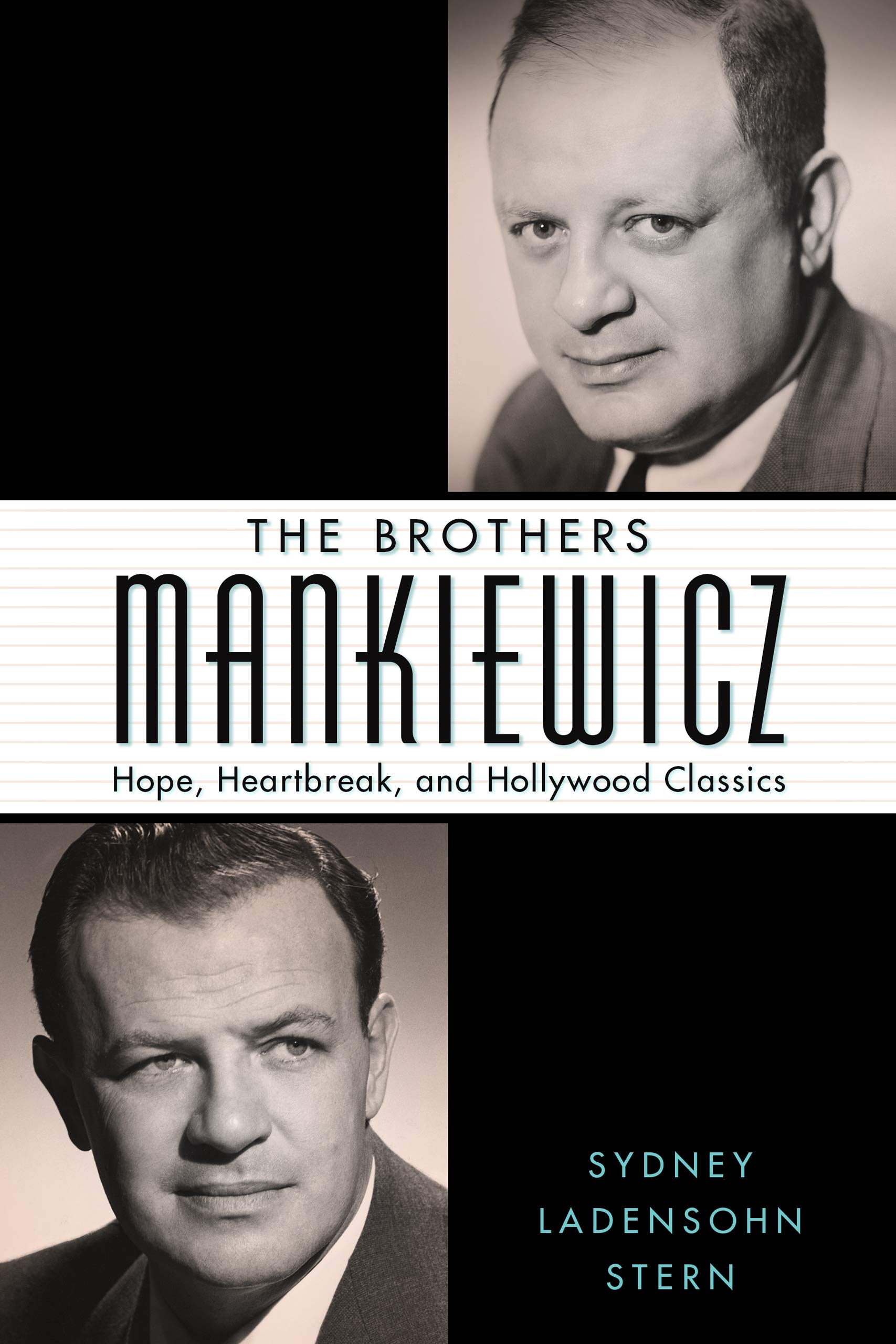
The Brothers Mankiewicz: Hope, Heartbreak, and Hollywood Classics.
By Sydney Ladensohn Stern:

David Fincher: The Rolling Stone Interview

The boundary-pushing filmmaker behind ‘Mank’ reflects on his career, his journey into Hollywood’s past and the industry’s uncertain future

David Fear
January 12, 2021
Rolling Stone

When David Fincher sat down with Netflix executives in the spring of 2019, he did not expect to be handed the equivalent of a blank check. Sure, the 58-year-old filmmaker — a former music-video wunderkind best known for pushing the envelope with baroque serial-killer thrillers (Seven), toxic-masculinity satires (Fight Club) and social-media origin stories (The Social Network) — was a name-brand director, and had helped kick off the golden age of streaming with the outlet’s first original series, House of Cards. But Fincher was used to resistance. You can’t have this budget. You can’t tell that story. What do you mean, you’re doing a TV show, for a mail-order DVD company, and all the episodes come out at once?!

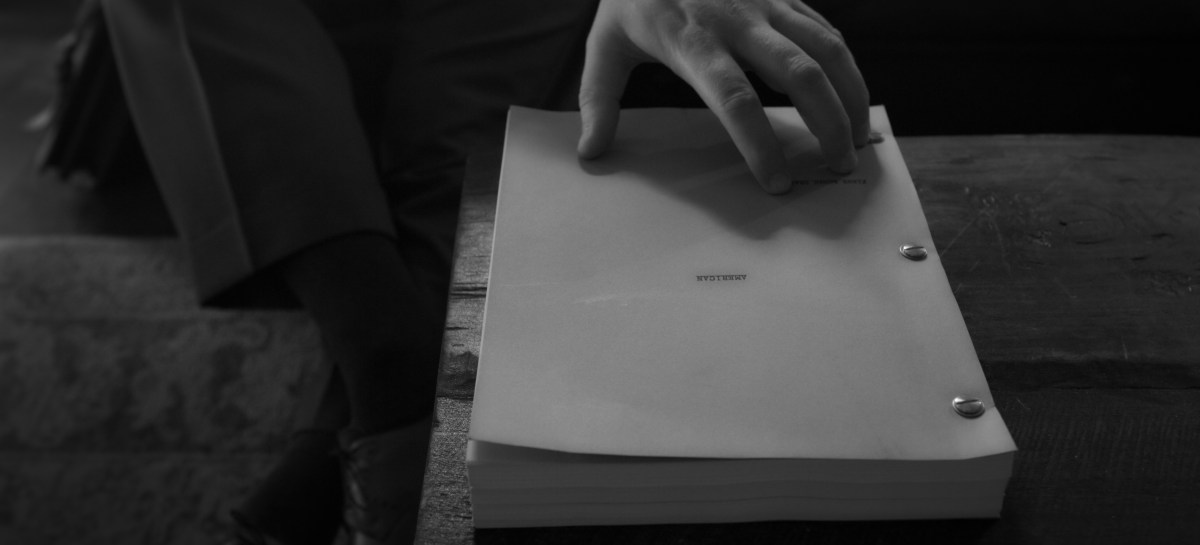
So when Fincher was told by his patrons at the company that they were interested in helping him make anything he wanted, he thought of a long-dormant labor of love: a script his late father, Jack Fincher, had written about the making of Citizen Kane. Not the tale of the brilliant director, producer, star and co-writer who, at a precociously young age, took Hollywood by storm with his rise-and-fall drama. This was the story of the alcoholic screenwriter who was hired to pen the script, originally titled American, and then inserted a personal grudge against the powers that be into the greatest movie of all time.

Fincher wanted to shoot it in black-and-white. He wanted to use a lot of old-fashioned stylistic nods to Hollywood movies of the ‘40s, as if the film had just been discovered in a vault after 80 years of gathering dust. Also it would involve an obscure chapter in California’s political history concerning Upton Sinclair’s 1934 run for governor and a disinformation campaign allegedly masterminded by studio execs. It was a shot in the dark. By his own admission, Fincher couldn’t believe it when Netflix said yes.

To see Mank, Fincher’s throwback ode to the Golden Age of Tinseltown USA, however, is to know why they did. Chronicling how the broken-down writer Herman J. Mankiewicz (played by Gary Oldman) helped permanently change film as an art form, his movie is an audacious, complicated, stylistically daring and thoroughly entertaining yarn — the kind of retro nod to a bygone era that makes you feel like you’ve injected a day’s worth of TCM programming into your veins. But it’s also a challenging drama about complicity, the price of speaking truth to power and the manipulation of modern media, which couldn’t make the film feel more urgent.

Over a two separate two-hour conversations from his home in Los Angeles, Fincher discussed bringing this tribute to his father (who died in 2003) to the screen, his reputation as a taskmaster on set, why he’s sorry Fight Club pissed off a fellow filmmaker, and more.

Read the full interview

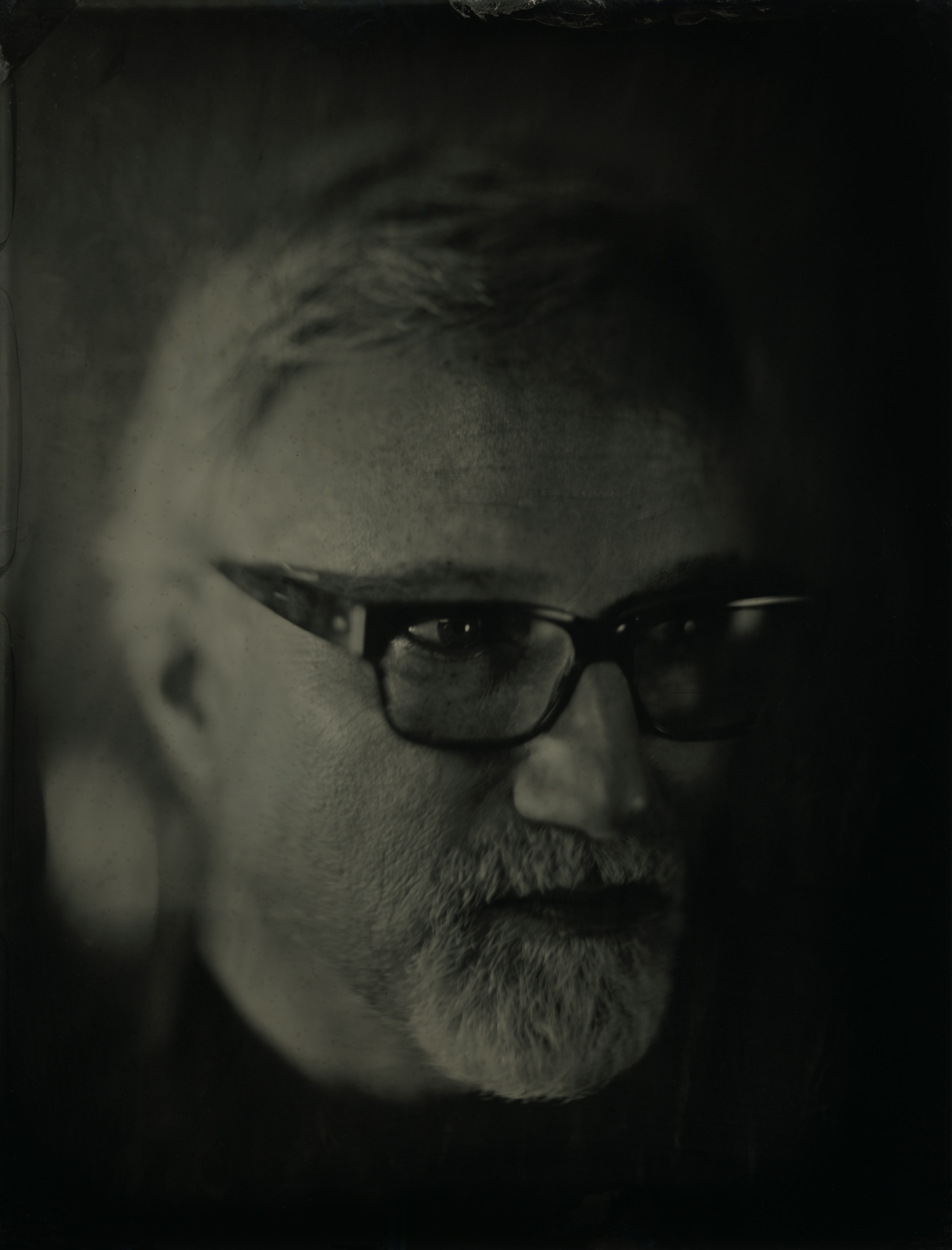
Wet plate ptotograph by Gary Oldman

Front Row: David Fincher

John Wilson
December 17, 2020
Front Row (BBC, Radio 4)

Visionary director David Fincher on Mank, his new film about 1930s Hollywood, as seen through the eyes of screenwriter Herman J. Mankiewicz (Gary Oldman) as he races to finish Citizen Kane with Orson Welles.

Mank‘s screenplay is by Fincher’s father Jack Fincher, who started writing it in the early 1990s and died in 2003.

David Fincher’s other films, which have earned thirty Oscar nominations, include Fight Club, Se7en, The Zodiac, The Social Network, The Curious Case of Benjamin Button, Gone Girl, and Panic Room.

Fincher also talks about the future of cinema, streaming, and his early career as a director of iconic music videos such as Madonna‘s Vogue and George Michael‘s Freedom.

Mank is released on Netflix.

Presenter: John Wilson
Producer: Timothy Prosser
Studio Manager: Emma Harth

Listen to the podcast:

Front Row (BBC, Radio 4)
BBC Sounds

David Fincher Has Had Plenty of Hugs. Thank You

David Fincher (Frank Ockenfels / Netflix)

Glenn Whipp, Entertainment Columnist
December 4, 2020
Los Angeles Times

Jack Fincher retired from journalism right around the time his son, David, was moving from directing music videos for the likes of Madonna and George Michael to making his first feature film, “Alien 3.” Jack, a lifelong movie fan, told David he’d like to try writing a screenplay. David encouraged him to delve into the story of Herman Mankiewicz, the co-writer (or, perhaps, sole writer) of Orson Welles’ 1941 landmark “Citizen Kane.” Jack wrote eight drafts of the screenplay, homing in on the journey of the self-sabotaging Mankiewicz as he stops betraying his talents and paints his one masterpiece (relatively) late in life.

Father and son could never quite crack the script, and Jack died in 2003 of pancreatic cancer. Those eight drafts of “Mank” sat on a shelf in David’s office for years until Netflix executives Ted Sarandos and Cindy Holland asked Fincher about his dream unmade project. That was two years ago, and “Mank” has consumed most of Fincher’s waking hours since.

The black-and-white movie, starring Gary Oldman in the title role, premiered in a handful of theaters last month and arrives on Netflix today. It figures to be a force in this year’s awards season, such as it is. It’s certainly the warmest movie Fincher has made in a career founded on the notion that “people are perverts.”

Fincher called the other morning. He was disarmingly polite, by turns generous and evasive, and full of the sardonic humor that courses through his films. “I’m a little groggy,” he said, noting that he didn’t get much sleep the previous night, “but hopefully I know the answers to these questions.”

Read the full interview