The Weird, Analog Delights of Foley Sound Effects

E.T. was jello in a T-shirt. The Mummy was scratchy potpourri. For Foley artists, deception is an essential part of the enterprise.

Anna Wiener
June 27, 2022
The New Yorker

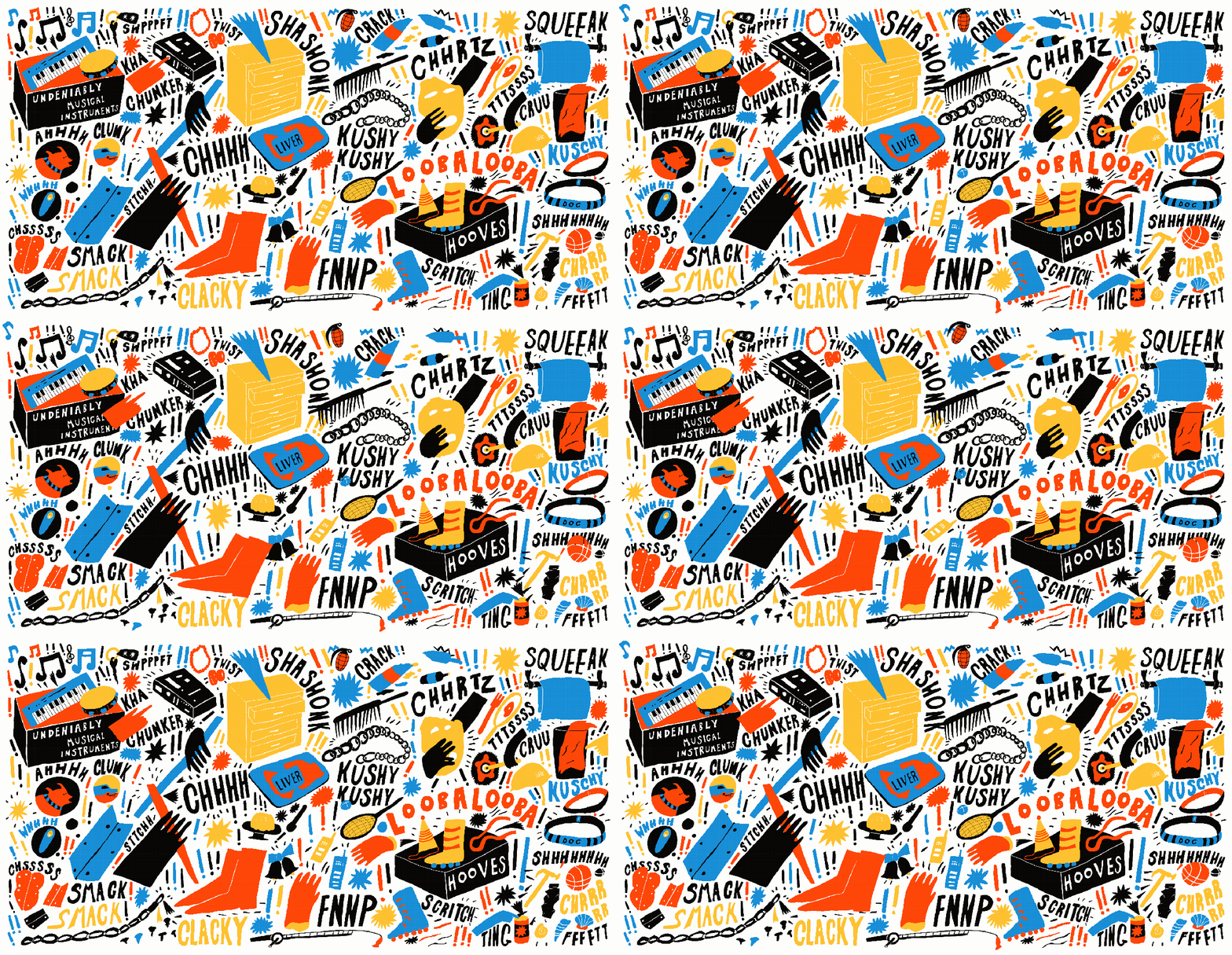
The salvage yard at M. Maselli & Sons, in Petaluma, California, is made up of six acres of angle irons, block pulleys, doorplates, digging tools, motors, fencing, tubing, reels, spools, and rusted machinery. To the untrained eye, the place is a testament to the enduring power of American detritus, but to Foley artists—craftspeople who create custom sound effects for film, television, and video games—it’s a trove of potential props. On a recent morning, Shelley Roden and John Roesch, Foley artists who work at Skywalker Sound, the postproduction audio division of Lucasfilm, stood in the parking lot, considering the sonic properties of an enormous industrial hopper. “I’m looking for a resonator, and I need more ka-chunkers,” Roden, who is blond and in her late forties, said. A lazy Susan was also on the checklist—something to produce a smooth, swivelling sound. Roesch, a puffer-clad sexagenarian with white hair, had brought his truck, in the event of a large haul. The pair was joined by Scott Curtis, their Foley mixer, a bearded fiftysomething. Curtis was in the market for a squeaky hinge. “There was a door at the Paramount stage that had the best creak,” he said. “The funny thing was, the cleaning crew discovered this hinge squeak, and they lubricated the squeak—the hinge. It was never the same.”

Petaluma is a historically agricultural town, and that afternoon was the thirty-ninth annual Butter and Egg Days Parade; the air smelled of lavender and barbecued meat. Inside the yard, Curtis immediately gravitated toward a pile of what looked like millstones, or sanding wheels. He began rotating one against another, producing a gritty, high-pitched ring, like an elementary-school fire alarm. “The texture is great,” Roden said. She suggested that one of the wheels could be used as a sweetener—a sound that is subtly layered over another sound, to add dimension—for a high-tech roll-up door, or perhaps one made of stone. “It’s kinda chimey,” she said, wavering. “It has potential.” A few yards away, Curtis had moved on to a shelf of metal filing-cabinet drawers, freckled with rust. “We have so many metal boxes,” Roden said, and walked away.

“It’s kinda the squeak I was looking for,” Curtis said softly.

“Hey, guys, remember the ‘Black Panther’ area?” Roden called out. “Wanna explore?” She led the group past a rack of hanging chains, also rusted; Curtis lightly palmed a few in sequence, producing the pleasant rings of a tintinnabulum. Roden pointed to the spot where she had found a curved crowbar to create the sound of Vibranium—a fictional rare metal unique to the Marvel universe—before zeroing in on a rack of thimbles, clamps, nuts, bolts, and washers. The trio began knocking and tapping hardware together, producing a series of chimes, tinks, and clunks. Roesch, who calls himself an “audile”—someone who processes information in a primarily auditory manner, rather than in a visual or a material one—had unearthed a sceptre-like industrial tool with a moving part, and was rapidly sliding it back and forth. “Robot,” he said.

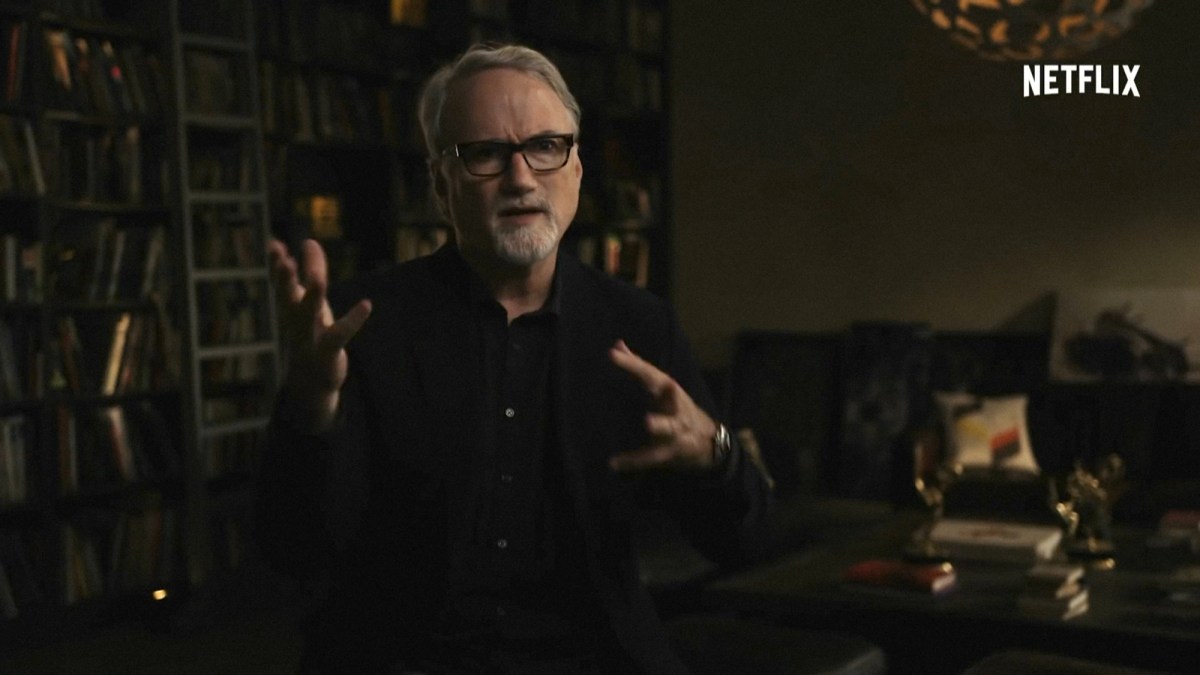
The bulk of the sound in film is typically added in postproduction. “I always say there’s sound effects, like footsteps, and then there’s music,” the director David Lynch, whose films are famous for their inventive, evocative sound design, said. “And then there’s sound effects that are like music. . . . They conjure a feeling.” Traditionally, “hard effects” cover ambient noises such as traffic or rain, or the more mechanical, combustive sounds of explosions and gunfire; they are usually pulled from libraries, or electronically produced. Foley effects are custom to a film, and are synchronized to characters’ movements. They might include the sound of someone walking across a room, rolling over in bed, stirring a pot, typing, fighting, dancing, eating, falling, or kissing. The line between the two kinds of effect is thin: Foley artists record the sound of a hand twisting a doorknob, but not the sound of the mechanism turning within. Foley is subtle but suggestive, capturing offstage bedsprings, or the shuffle of a clumsy intruder. In the past hundred years, technology has changed the process of recording, editing, and engineering sounds, but the techniques of Foley have remained stubbornly analog. Behind any given Foley effect, no matter how complex, are one or two people contorting their bodies in a soundproof room.

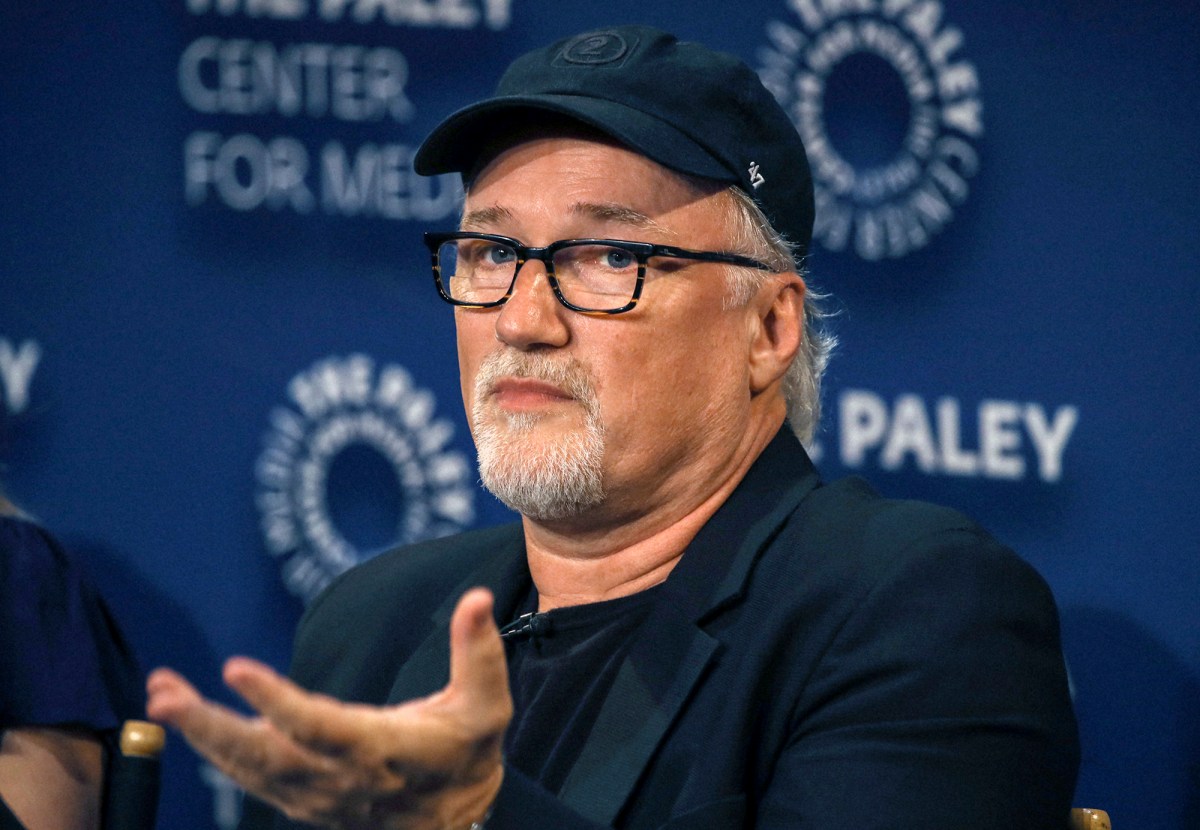
Foley artists have historically worked in pairs. (Certain sounds are so complex that they require the labor of four hands.) Roden and Roesch are two of the masters in their field. David Fincher, the director of movies including “The Social Network,” “Gone Girl,” and “Mank,” told me that Foley is “a very strange calling,” and “a dark art” foundational to filmmaking. “You’re trying to make beautiful sounds that make their point once and get the hell out of Dodge,” Fincher said. “The people who do it really, really well are few and far between.”

Read the full profile

Love, Death + Robots. Inside the Animation: Bad Travelling

June 15, 2022
Netflix (YouTube)

David Fincher, director of Bad Travelling featured in Love, Death + Robots Vol. 3 discusses how he approached directing his first animated short.

Read the LOVE DEATH + ROBOTS. Volume 3 guide

Watch LOVE DEATH + ROBOTS on Netflix

‘Love, Death + Robots’ Season 3: David Fincher Gets Animated for the First Time on ‘Bad Travelling’

The animators tell IndieWire what it was like collaborating with Fincher on the mo-cap character animation and giant, slimy crab.

Bill Desowitz
June 9, 2022
IndieWire

It’s easy to see why David Fincher chose “Bad Travelling” as his first foray into directing animation. He made his feature debut with the ill-fated “Alien 3,” after all, and the premise of this third-season episode of “Love, Death + Robots” is a bit like setting the plight of the Nostromo on the high seas: A giant, slimy crab devours the crew of a shark-hunting vessel, with only the cunning navigator surviving to battle the beast. (It also makes up for Fincher’s aborted take on “20,000 Leagues Under the Sea” at Disney.)

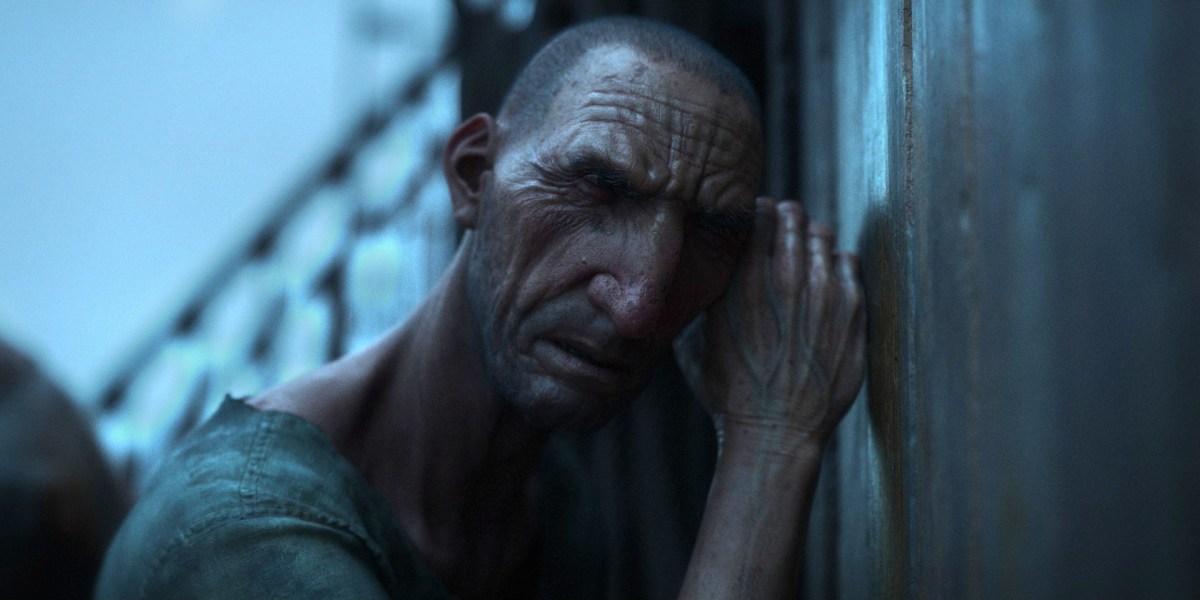
Fincher also likens “Bad Travelling” to “Ten Little Indians” meets “Deadliest Catch,” with the ship’s navigator, Torrin (Troy Baker), contending with mutiny, betrayal, and a starving Thanapod crustacean that bizarrely communicates through ventriloquism.

“You don’t necessarily want to see them come to unnatural ends,” Fincher said about the crew in the production notes. “The idea was not to make them despicable, but self-serving. That’s the thing I always loved about Harry Dean Stanton and Yaphet Kotto in ‘Alien’….”

Read the full profile

Pixel Perfection

Jarred Land / RED Digital Cinema

Adrian Pennington
April 2022
British Cinematographer

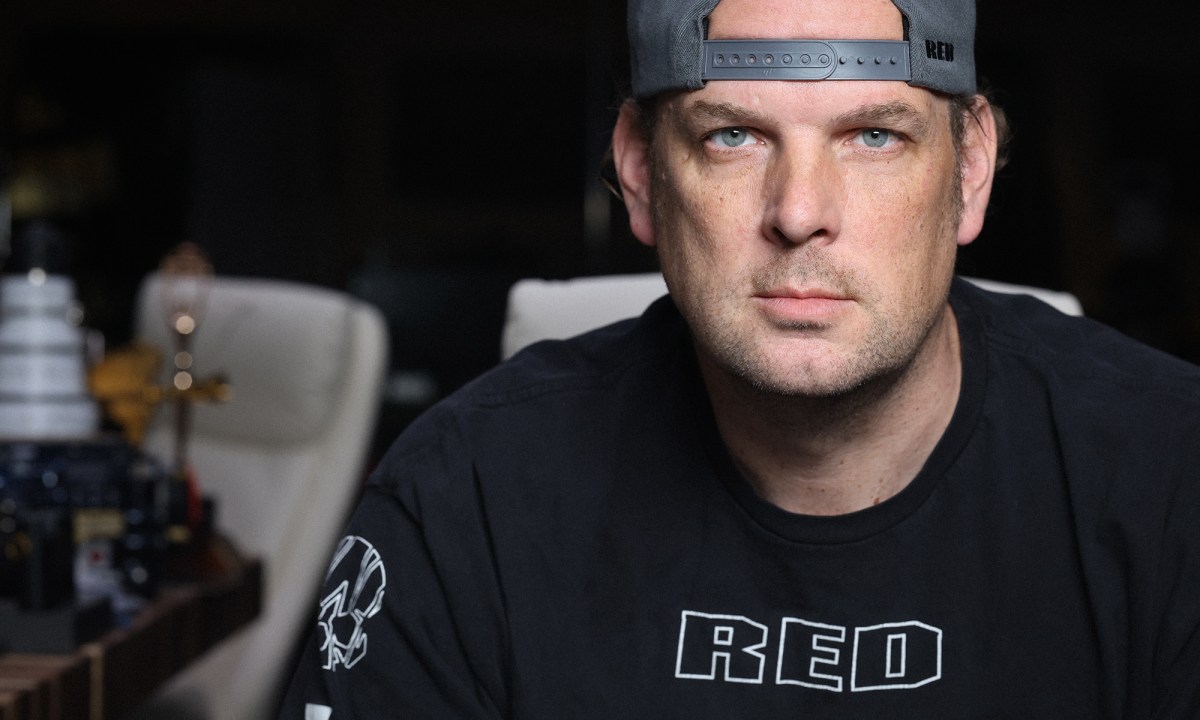
Jarred Land has spent his career in close collaboration and connection with filmmakers, supporting the execution of their vision with powerful and ground-breaking tools.

Jarred Land runs RED Digital Cinema, the company whose 4K camera went from scepticism to admiration on a run of prestige movies like David Fincher’s Oscar-winning Mank and series like The Queen’s Gambit. Since 2013, Land has led a team focused on precedent-setting technology for filmmakers.

Land didn’t found RED but joined Jim Jannard before the launch of the first camera and during the hardcore, technology banging sleepless nights part of the story, where a small group failed, learned, succeeded. From the first conversation Land had with Jannard and still today, the focus is on providing a more complete tool for filmmakers.

Born in Edmonton, Canada, Land’s father ran gas stations and shopping malls, imbuing in him an entrepreneurial spirit. The teenage Land’s passion was mountain biking which he segued into his own bike courier company in Vancouver.

A chance encounter with a client inspired him to take up videography using the Panasonic tape camcorder DVX100. “I couldn’t go to film school because I was running my company and biking 100km a day, so I set up a bulletin board for help,” he says.

Read the full profile

Siren vs. Soldier

Emmy and Oscar award-winner Alberto Mielgo’s animated short “Jibaro” thrills in Season 3 of Tim Miller and David Fincher’s groundbreaking anthology series Love, Death + Robots.

Ryan G. Smith
June 1, 2022
Netflix Queue

When Oscar and Emmy winner Alberto Mielgo was invited to pitch a story for the latest volume of the 11-time Emmy-winning series Love, Death + Robots, the Spanish director, artist, and animator decided to use a folkloric lens to examine the lengths to which some people will go to obtain what they cannot have. The resulting short, “Jibaro,” centers the battle of a deaf knight desperate to slay a golden siren and claim her as a trophy. The mythic creature grows increasingly frustrated, failing to understand why her opponent is immune to the powers of her song.

“It was inspired by those videos on National Geographic where there is an alligator fighting a jaguar for food,” Mielgo says. “It’s a crazy, toxic relationship between two characters, two predators, who both want and need each other.”

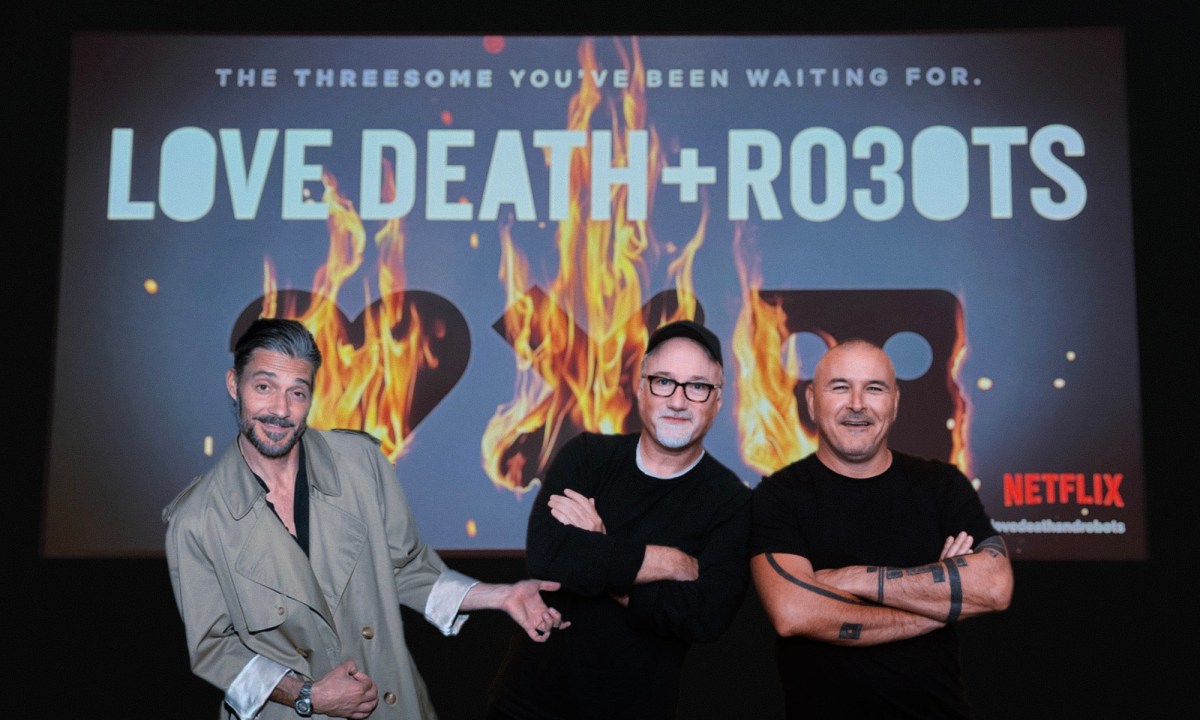
The unconventional and breathtaking episode is among nine new shorts included in the third volume of Love, Death + Robots. When executive producers Tim Miller and David Fincher first dreamed up the concept for Love, Death + Robots, they had a clear creative objective: “Let’s make a sandbox where anything’s possible,” explains Fincher, the Oscar-nominated director best known for live-action films like Mank, as well as the TV series MINDHUNTER. Fincher makes his animated directorial debut with the Volume 3 short “Bad Travelling,” a motion-capture masterpiece following a crew of degenerate sailors contending with a giant crustacean who boards their ship with an appetite for destruction. “We’re just telling stories. I think that the best of it works on a childlike level — and a naughty teenager level. As an adult looking at it, I appreciate that.”

Read the full profile

TIME 100 Most Influential People of 2022: Amanda Seyfried by David Fincher

Amanda Seyfried by Molly Matalon (The New York Times/Redux)

100 Most Influential People of 2022

David Fincher
May 23, 2022
TIME

When I lured Amanda Seyfried into Mank, her ability to be simultaneously knowing and warm opened that role to a (much) larger conversation than the script might have otherwise intimated. People may have thought of her as a rom-com-edienne, but she’s got a lot more going on under the hood. Including the rare ability to make one reassess one’s own imaginative shortcomings.

Read the full note on Amanda Seyfried by David Fincher

clubhouse: Watch Love, Death & Robots Vol. 3 with directors David Fincher, Tim Miller, and Alberto Mielgo

Moderated by Mohit Arora
May 24, 2022
clubhouse / Netflix

Install the app and listen to:

LOVE DEATH + RO3BOTS Watchalong with Director’s Commentary and Q&A

Bad Travelling, Directed by David Fincher
Swarm, Directed by Tim Miller
Jibaro, Directed by Alberto Mielgo
1 hr 18 min

Watch LOVE DEATH + ROBOTS on Netflix

Love, Death and Robots Volume 3: David Fincher Wanted His Episode to ‘Feel Like Alien’

David Fincher chats with IGN about directing his first animated episode for Love, Death and Robots Volume 3.

David Griffin
May 20, 2022
IGN

After nearly 40 years in the entertainment business, 3-time Oscar-nominee, David Fincher, has seemingly done it all. From his early years directing music videos for Madonna and Aerosmith, crafting memorable films like Seven and The Social Network, and working on acclaimed TV shows such as House of Cards and Mindhunter, Fincher’s resume appears to be complete. But what about animation?

With the launch of Volume 3 of Netflix‘s mind-bending Love, Death and Robots anthology series, Fincher can finally check animation off his bucket list with his episode, titled “Bad Travelling.” In this seafaring horror story, a group of Jable shark hunters on a far-away planet are attacked by a giant crustacean. With the sailors’ lives in jeopardy, chaos and mutiny ensue.

Although Fincher has decades of experience working behind the camera on live-action projects, we wanted to know if animation brought any new challenges to the seasoned director.

“Ultimately, directing comes down to understanding context and sculpting time, light, and behavior with that innate understanding,” Fincher told IGN. “In some cases, like in the case of motion capture, there are people in onesies with ping pong balls hanging off them, and you’re going, ‘Okay, now remember the ship is rocking and all…’ You’re there to add a little imagination sauce to all the other shit that they’re trying to keep in their heads. I mean, it does tend to look a little like Saturday Night Live. It’s a ridiculous thing to be asking somebody to do a one-act play, dressed in pajamas. So that aspect of it, it’s the same thing. You’re playing dress up, right? And you’re trying to say, ‘Look, from the audience’s standpoint, this needs to happen a little faster here, a little… This can go a little slower. Find that word.’ It’s all the same shit.”

Read the full profile

David Fincher Tells You Everything You’d Ever Want to Know About Making ‘Love, Death + Robots’ and Directing ‘Bad Travelling’

Fincher also talks about his love of director Alberto Mielgo’s ‘Jibaro’ and how he’s “never seen anything like it. I’ve never been that mesmerized.”

Steve Weintraub
May 20, 2022
Collider

If you’re a fan of David Fincher and Love, Death + Robots, you’re about to be very happy. Not only is Love, Death + Robots Volume 3 now streaming on Netflix, David Fincher directed one of the episodes, Bad Travelling, and it’s fantastic. Written by Se7en screenwriter Andrew Kevin Walker, it’s about a giant crustacean and a shark-hunting sailing vessel. I’d love to tell you more…but the best thing about Love, Death + Robots is not knowing anything about what you’re going to watch and just letting it happen.

Shortly after watching the episode, I was able to get on the phone with Fincher for a deep dive conversation about directing Bad Travelling and the making of Love, Death + Robots. During the sprawling conversation, Fincher talked about his history with animation, how he decided on the style of animation for his episode, how they decided where something should end, how everyone involved in the series is doing it for the love of the genre, and if they’ve thought about making a Love, Death + Robots feature film or doing a live-action version. In addition, he talked about his love of director Alberto Mielgo’s Jibaro (another Love, Death + Robots Volume 3 episode) and how he’s “never seen anything like it. I’ve never been that mesmerized.”

Trust me, if you’re a fan of Fincher and this amazing series, you’ll learn a lot about how it’s made.

Check out what he had to say.

Jeff Cronenweth, ASC: An Adventurous Eye

Jeff Cronenweth, ASC on the set of his most recent feature, Being the Ricardos.

The cinematographer’s career exemplifies how talent, versatility​, opportunity and collaboration can combine to result in bold camerawork.

Jon Silberg
February 25, 2022
American Cinematographer

Directors who have worked with Jeff Cronenweth, ASC observe that he is quiet, centered, and possesses a very dry sense of humor. Working in an eclectic mix of genres and styles, he quickly zeroes in on central concepts, often exceeding expectations with the results. His career as a feature cinematographer began auspiciously with David Fincher’s eye-popping Fight Club (AC Nov. ’99), and his filmography since then includes The Social Network (AC Oct. ’10), Gone Girl (AC Nov. ’14), One Hour Photo (AC Aug. ’02) and the Amazon miniseries Tales From the Loop (AC April ’20). Cronenweth has also shot stylistically bold, groundbreaking music videos for David Bowie, Taylor Swift, Janet JacksonNine Inch Nails and many other top artists.

Jeff with his father, Jordan Cronenweth, ASC.

It wouldn’t be at all hyperbolic to say Cronenweth was born into filmmaking. His great-grandfather owned and operated a photographic-equipment store in Wilkinsburg, Pa.; his grandfather Edward worked as a portrait photographer for Hollywood studios during the peak of that unique specialty, earning an Academy Award for his work; his grandmother Rosita was a Busby Berkeley dancer; and his father, renowned ASC member Jordan Cronenweth, served as director of photography on Blade Runner (AC July ’82), Peggy Sue Got Married (AC April ’87), Altered States (AC March ’81), Gardens of Stone (AC May ’87), and many classic music videos for leading artists of the 1980s and ’90s. 

Taking this lineage a step further, Jeff Cronenweth has also collaborated with his brother Tim, a successful commercial director, on more than 500 spots.

“A storyteller doesn’t want to tell the same story over and over, and I don’t want to, either. I always want to find something new and challenging to work on.”
— Jeff Cronenweth, ASC

Read the full profile