How an iPhone filter came to the rescue for ‘Mank’ set decorator Jan Pascale

Joyce Eng
January 29, 2021
Gold Derby

Mank” set decorator Jan Pascale is no stranger to black-and-white films: She received an Oscar nomination for George Clooney‘s “Good Night, and Good Luck” (2005). But those two monochrome films couldn’t be more different.

“When I first met with [‘Mank’ production designer Donald Graham Burt] about it, I said, ‘I’ve done black and white. I can do this.’ And Don said, ‘No, no, no, this is different.’ The way the images were captured was quite different,’” Pascale tells Gold Derby at our Meet the BTL Experts: Film Production Design panel. “On ‘Good Night, and Good Luck,’ we shot on film … and we had a really limited budget on that one — $7 million the whole movie — so I couldn’t paint anything or really paint anything, so everything was shot as is. But it sort of worked.”

“Mank,” however, was shot in black and white on a RED digital camera, completely changing the way images and details came off onscreen. But Pascale got some very modern assistance to help her do color-testing. “David [Fincher] and Don had done some testing with the camera that we were going to be using. And they discovered if we used our iPhones with the noir filter and photographed everything, that’s how it would appear in our movie,” she shares.

Read the full article

Film Production Design Panel: David Crank, Jan Pascale, Mark Ricker, Barry Robison

Joyce Eng
January 29, 2021
Gold Derby

The Hollywood Reporter: Producers Roundtable

Tatiana Siegel
January 22, 2021
The Hollywood Reporter

Andy Samberg, Dede Gardner, Charles D. King, Ashley Levinson, Marc Platt and Eric Roth on the Streaming Rise Amid COVID and Their Awards Contenders. They also discuss adapting to a year of seismic changes in the film industry: “We started rethinking everything.”

Shepherding a film from a nebulous idea to a locked print is fraught with interruptions and surprises. As such, no profession in Hollywood requires greater dexterity than that of a producer. And unlike any other time in cinematic history, 2020 was a year of overnight transformation amid the novel coronavirus pandemic, leaving producers with no choice but to adapt fast.

Two producers from this year’s roundtable — Judas and the Black Messiah‘s Charles D. King and The Trial of the Chicago 7‘s Marc Platt — saw their theater-bound films take a detour to a streaming platform (HBO Max and Netflix, respectively). Although Eric Roth, who produced David Fincher‘s Mank, was always poised for a streamer release via Netflix for that film, he also experienced the great sweep to HBO Max with the upcoming tentpole Dune, which he wrote. Ashley Levinson, whose Pieces of a Woman and Malcolm & Marie are both in the awards season conversation, oversaw the writing and production of the latter during the COVID-19 lockdown. Minari‘s Dede Gardner, the only female producer with two best picture Oscar wins (for 12 Years a Slave and Moonlight), and Palm SpringsAndy Samberg were the lone two of the group lucky enough to see their films premiere in a packed, mask-less theater (both films made their debuts at Sundance in January 2020).

On Jan. 8, at The Hollywood Reporter‘s invitation, Gardner, King, Levinson, Platt, Roth and Samberg converged via Zoom to discuss the great cinematic reset, this year’s awards season controversies and what they’d fix about Hollywood.

Read the full roundtable

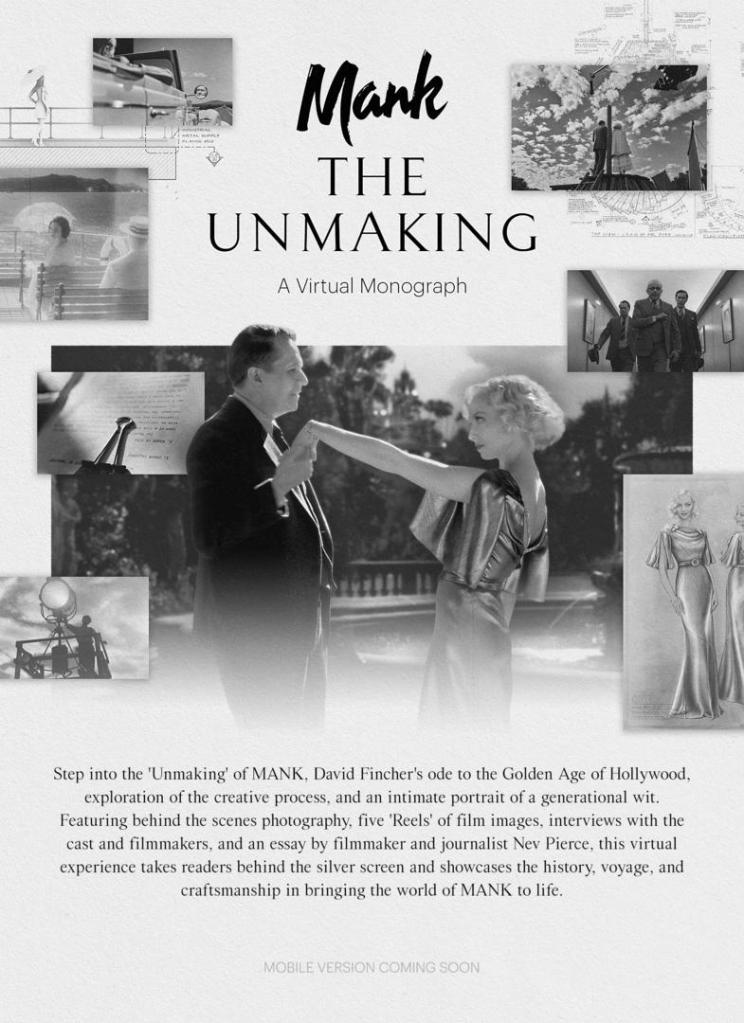
Mank, The Unmaking

January 28, 2021
Netflix

manktheunmaking.com [Old Domain]

mank.aristidebenoist.com

Text by:

Nev Pierce

Photography by:

Erik Messerschmidt
Miles Crist
Gisele Schmidt-Oldman
Gary Oldman
Ceán Chaffin
Nikolai Loveikis

Design and development by:

Watson Design Group, Inc.
Aristide Benoist

Mank: Method to the Monochrome

January 26, 2021
Netflix Film Club (YouTube)

Mank director David Fincher, cinematographer Erik Messerschmidt and costume designer Trish Summerville detail the approach to shooting the acclaimed slice of Hollywood history in black and white. How does the absence of color distill the visual storytelling? How do different colors in the costume and production design read when captured in black and white? Learn about all of that and more.

Six directors on the illusion of control and ‘the pitiless exposure of your weaknesses’

David Fincher (Frank Ockenfels/Netflix)

“The notion that any one person has control over 90 people who are playing dress-up is the greatest fallacy of our profession.”

Mark Olsen
January 26, 2021
Los Angeles Times

Control. When six film directors got together virtually for The Envelope Roundtable in December, the issue of control — both when you have it and when you don’t — came up again and again.

Regina King, the Oscar-, Emmy– and Golden Globe-winning actress who makes her feature debut as director with One Night In Miami,” a fictional telling of the real-life night that Malcom X, Cassius Clay, Jim Brown and Sam Cooke spent together in a motel room, described herself as “a control enthusiast.”

In explaining how she moved from making Nomadland,” a stripped-down road movie starring Frances McDormand, to the upcoming Marvel action ensemble “Eternals,” Chloé Zhao said she reflected on an older interview with David Fincher, where he spoke about balancing between having a plan and allowing things to happen on set.

For his part, the notoriously exacting Fincher, director of Mank,” the story of how Herman J. Mankiewicz came to write the script that would become “Citizen Kane,” spoke candidly about how control is an illusion, “the greatest fallacy of our profession,” whereas Aaron Sorkin, director of the 1960s historical drama “The Trial of the Chicago 7” and an Oscar winner for his screenplay to Fincher’s own “The Social Network,” admitted how intimidated he was to be on a panel as a director alongside his former collaborator.

The British Paul Greengrass, who made the elegiac post-Civil War-set western News of the World,” added that for him, “the pitiless exposure of your weaknesses is the essence of directing.”

When asked how he came to a particularly bold creative decision in making Da 5 Bloods,” his drama about Black soldiers who fought in Vietnam, Oscar winner Spike Lee simply referred to trusting his four decades of moviemaking experience.

All six filmmakers also shared their thoughts on the future of the film industry and how they can’t wait for audiences to return to movie theaters.

Watch and read the full roundtable

Six directors tackle the idea (or is it a myth?) of controlling a film set

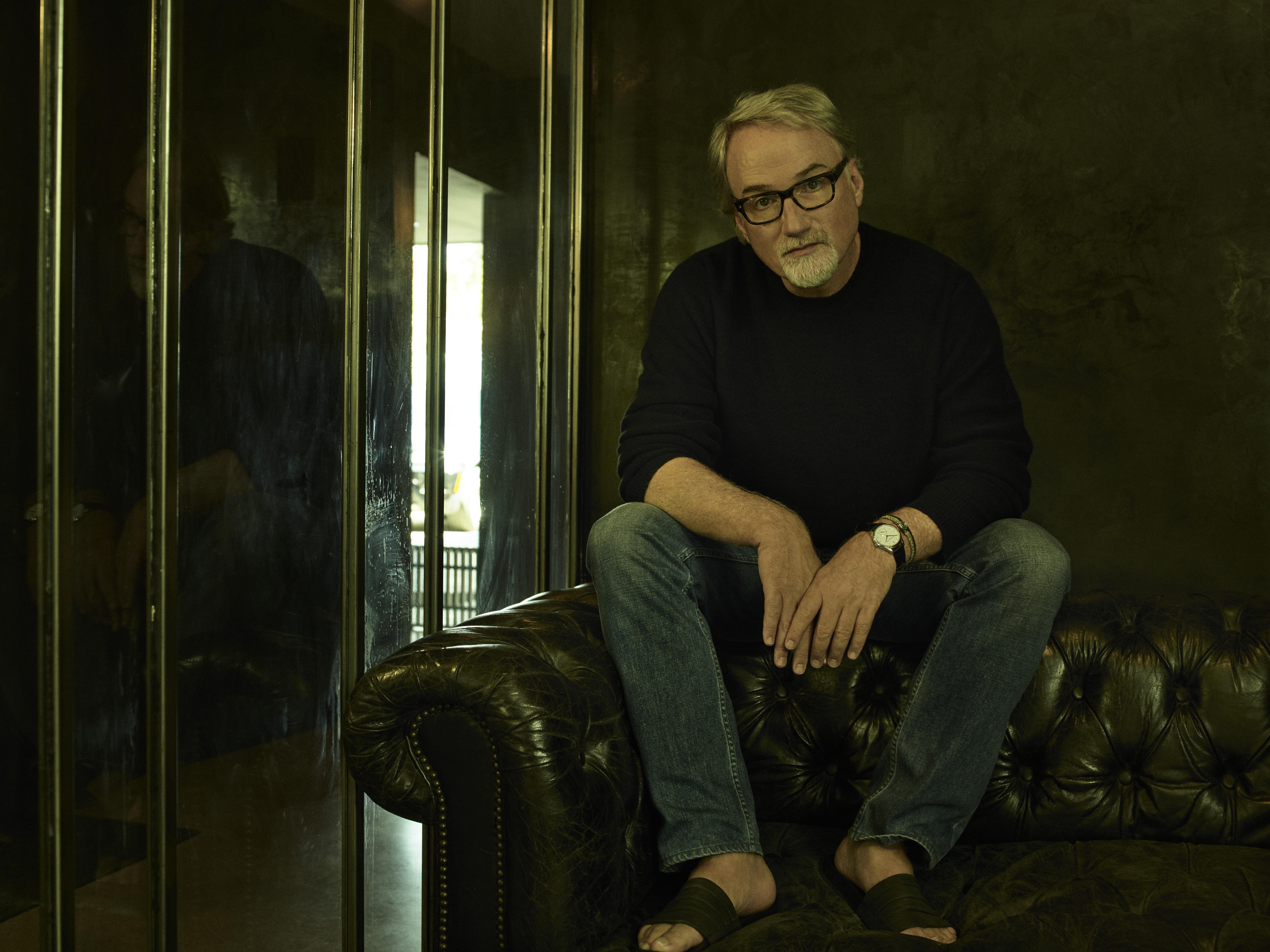
Oscar nominated director David Fincher on resurrecting his late father’s screenplay for “Mank.”

‘Mank’ costume designer Trish Summerville: It’s not just black-and-white, it’s ‘Fincher-vision’

Daniel Montgomery
January 20, 2021
Gold Derby

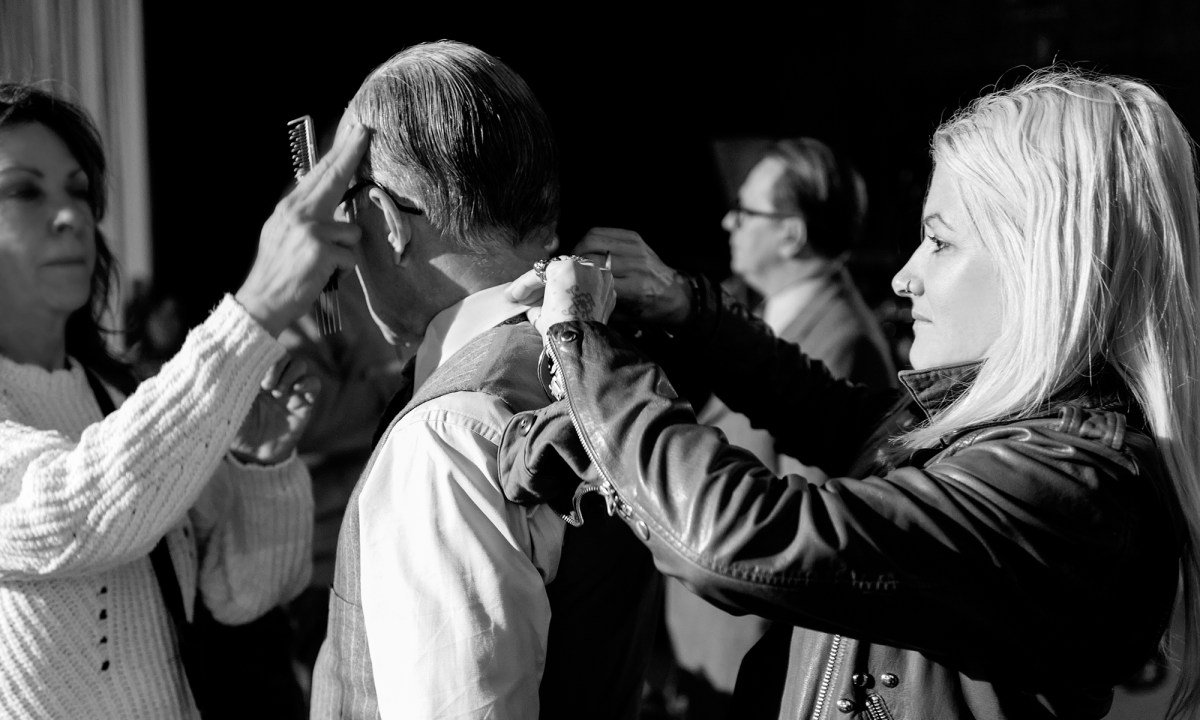
“I keep making this joke that it’s Fincher-vision because it’s not just black-and-white, it’s this really specific way that he’s going to light the film,” says costume designer Trish Summerville about the unique visual style of “Mank,” directed by David Fincher. The film tells the story of “Citizen Kane” writer Herman Mankiewicz, and it’s shot to resemble films of the 1930s and 1940s. That presented Summerville with equally unique challenges and opportunities. We spoke with her as part of our “Meet the Experts” costume designers panel. Watch our interview above.

“The black-and-white was the most challenging thing: figuring out how we wanted to make that work, doing different testing on clothing and fabrics … so we could see how it would read,” Summerville explains. “Even though you think you don’t need a color palette, you really do, because if not, when you’re looking at it with your naked eye on set, it becomes very jarring.” And understanding color was crucial for achieving the right effect in the finished product “so that when it read in black-and-white on the screen and on the monitors it didn’t just all come across as flat, it had dimension to it, sheens and tones.”

It helped that the film was portraying so many well-known figures with documented looks and styles — not just Mankiewicz, but Marion DaviesWilliam Randolph HearstLouis B. Mayer, and more. “We could find things of [Mank] at work, on sound stages, and also at home,” Summerville says. “We even at one point found these images of him at one of his kids’ bar mitzvahs, so that was great, it was a whole family photo.”

But in a film with so many male characters, it was also important “to give each one of the men their own kind of characteristics and dress them towards who those characters really were … so that not everybody read as a navy suit in a room.” That research and detail, in collaboration with Fincher’s direction, Donald Graham Burt‘s production design and Erik Messerschmidt‘s cinematography, “all of it has these special touches that make you feel you’re transported to the 1930s.”

IndieWire Influencers: David Fincher & Sound Designer Ren Klyce

Influencers: Through their decades-long partnership, the pair have constantly refined how sound can be used to shape a viewer’s emotional response.

Chris O’Falt
January 13, 2021
IndieWire

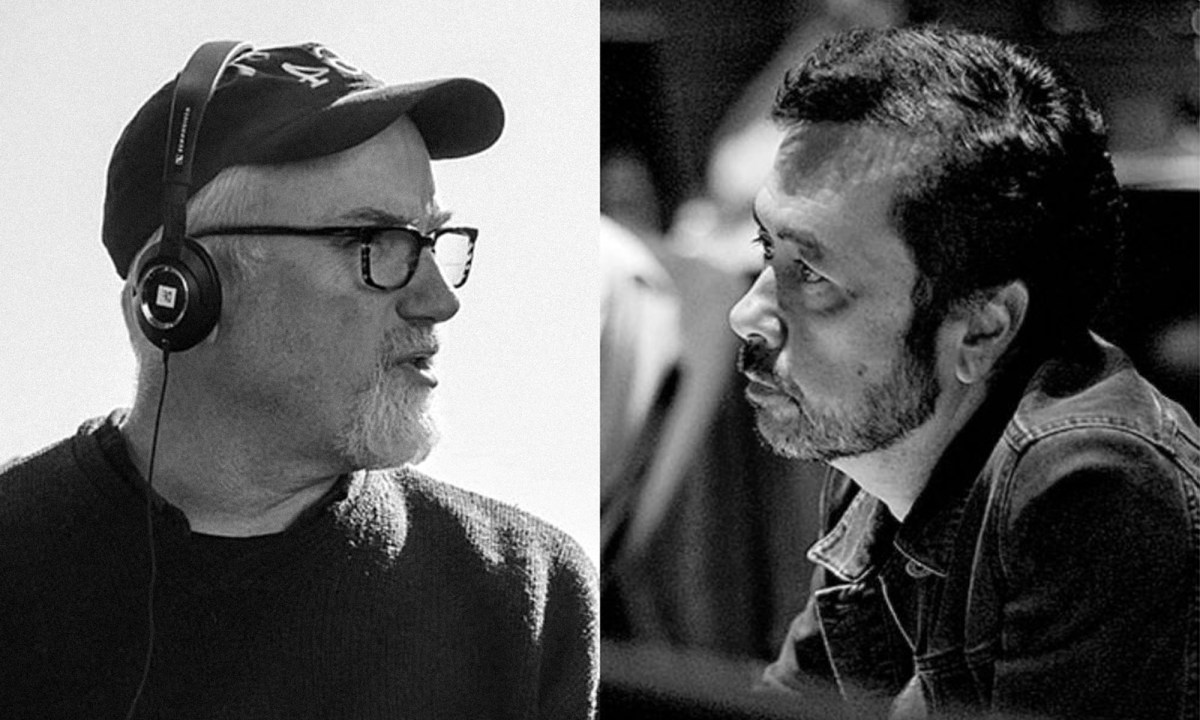
David Fincher and Ren Klyce came of age during a seminal time for Hollywood: when the pair were just kids, a group of ’70s filmmakers was reshaping what it meant to make movies, right from the pair’s native Bay Area. In a biographical detail almost too perfect to be true, George Lucas rented a house in Marin County to edit his “THX 1138,” that just so happened to be located right next door to the Klyce family’s home. A single suburban lawn is all that separated a then-9-year-old Ren from the great Walter Murch, just as he was starting to change modern movie sound forever, work he’d continue throughout the decade with another NorCal auteur, Francis Ford Coppola. And it would be on a Lucas-produced animated feature, “Twice Upon a Time,” that future sound designer Klyce would meet his Coppola, a then-19-year-old Fincher.

Over the last 25 years, as Hollywood has utilized the multi-channel surround technology pioneered by Murch to create bombastic soundtracks that all too often mask a lack of craft, Klyce has helped Fincher explore the subconscious underbelly of his own films, constantly refining how sound can be used to shape a viewer’s emotional response.

“To me, sound design is not about 96 channels all at 11, and two side cars giving you this sound pressure-gasm; to me, it’s very much about the detail and the nuance and maybe things that you wouldn’t even be aware that you heard until the second or third time you saw it,” said Fincher in an interview about his collaboration with Klyce. “I can’t talk more enthusiastically about someone [Klyce] I feel has very subtly pushed what sound designers do.”

Read the full profile and watch the 3 exclusive video essays

Cinematographer Erik Messerschmidt on Mank and Collaborating with David Fincher

J.D. Connor
January 13, 2021
Film at Lincoln Center

With his transfixing digital black-and-white cinematography, DP Erik Messerschmidt, ASC, breathes gorgeous life into the world of 1930s Hollywood in Mank, David Fincher’s vivid retelling of the genesis of Citizen Kane and the tumultuous partnership between screenwriter Herman J. Mankiewicz and director-star Orson Welles.

Messerschmidt joined us for an extended conversation to discuss the craft behind Mank, the legacy of Citizen Kane, and the work of visualizing Hollywood’s ideas of itself. The discussion will be moderated by J.D. Connor, Associate Professor of Cinematic Arts at the University of Southern California.

Film at Lincoln Center Talks are presented by HBO.

Film at Lincoln Center on: YouTube, Facebook, Twitter, Instagram

Support our work