Fight Club Cinematographer Jeff Cronenweth, ASC

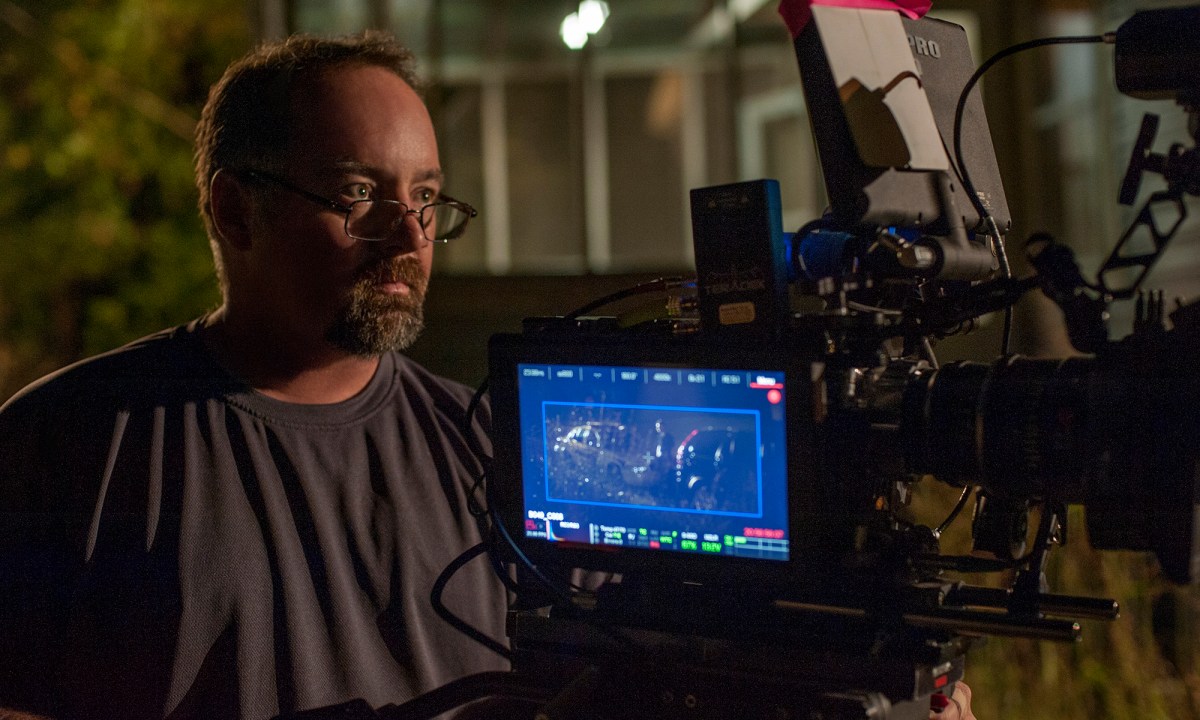
Jeff Cronenweth in the set of The Social Network (Merrick Morton, 2010)

Alan Schaller & Christopher Hooton
February 7, 2020
Candela: Photography & Cinematography masters

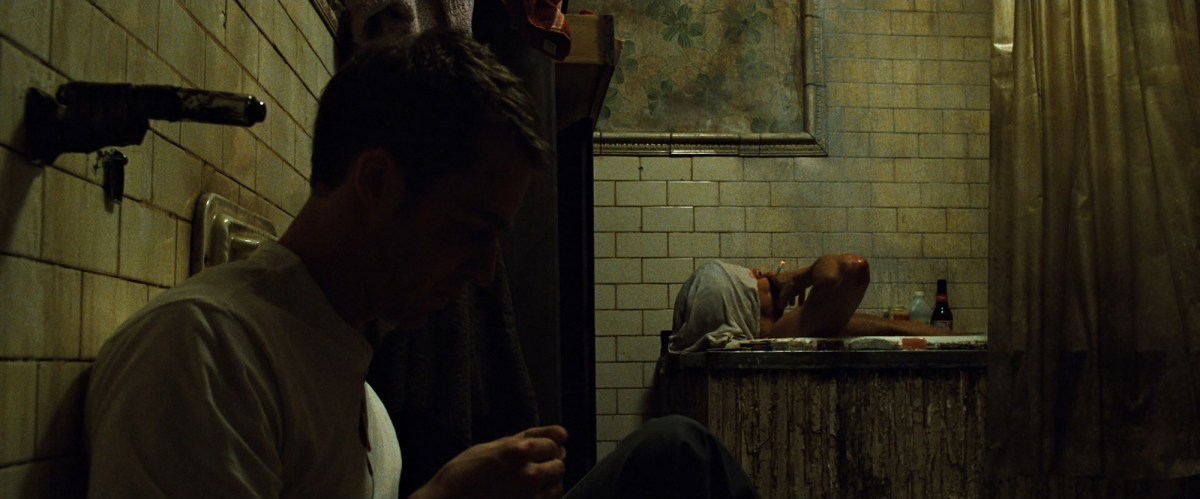
Fight Club cinematographer Jeff Cronenweth talks us through this iconic shot and many others in David Fincher‘s masterpiece. We also discuss how the relative naturalism of The Social Network was just as difficult to achieve, and whether something is lost with VFX even when it looks perfect.

Listen to the podcast

Follow Jeff Cronenweth, ASC Archives on Twitter
“David F*cking Fincher” Awards Brad Pitt His Modern Master Award at SBIFF

Sasha Stone
January 23, 2020
AwardsDaily

Roger Durling’s wildly successful Santa Barbara International Film Festival is underway with tributes and with honors being handed out for the next week or so. Last night, Brad Pitt was honored with the Leonard Maltin Modern Master award.

After a lengthy interview with Maltin, which covered all of Pitt’s work with directors like both Ridley and Tony Scott, the Coen brothers, Tarantino, and beyond, Pitt’s frequent collaborator David Fincher made a rare appearance to hand Pitt his Modern Master award. They have made three films together, if you didn’t know (which of course would be insane to not know). Pitt is a muse of sorts for Fincher, starting with Se7en (1995), then Fight Club (1999), and finally Benjamin Button (2008). Pitt said when accepting his award that he hoped the two get to do five more collaborations together. Wouldn’t that be something?

Brad Pitt is having quite a season. It’s as though we’ve never seen a movie star. Movie stars of his stature are “as rare as albino pandas, and here’s one of them,” said Fincher. What that means is that it’s rare indeed for an actor to possess that thing — that movie star thing. Charisma that could power an entire planet. You can’t teach it. You can’t learn it. It’s there or it isn’t. And with Pitt, it was there from his first appearance onscreen.

Here are the videos of the event (playlist):

January 22, 2020
officialSBIFF (YouTube)

Brad Pitt Looks Back on ‘Snatch’, ‘Oceans 12’, ‘Once Upon a Time…’ and More at SBIFF

Christina Radish
January 25, 2020
Collider

Read the highlights of the conversation

Not On Blu-ray?: Fight Club Compared

Blu-rays vs iTunes HD vs D-VHS vs DVD vs Laserdisc

Mac
April 7, 2018
Not On Blu-ray?

Caustic, nihilistic and controversial, Fight Club successfully adapted Chuck Palahniuk’s transgressive fiction novel, it’s a credit to screenwriter Jim Uhl’s excellent adaptation that the voice of the original novel is heard so clearly, and at the same time the film proved to be an enormous success. Though much credit is also due to the excellent sound and editing: so much in this film depends on hitting exactly the right tone.

Based on a reader suggestion, I decided to take a look at the various home video versions of Fight Club that are available.

Filming Fight Club

Fight club was photographed by Jeff Cronenweth, a then hot and upcoming Cinematographer who until that point hadn’t shot a major feature, but did have the advantage of being Blade Runner cinematographer Jordan Cronenweth’s son. Fincher has worked with both father and son on a number of projects culminating in ‘Alien 3’. Subsequently Jeff did camera work on a number of Fincher’s other features including ‘Se7en’ and ‘The Game’.

An Interview with Cronenweth in American cinematographer records Fincher’s preference for both natural and pre-existing lighting in locations over elaborate lighting setups. This necessitated the choice of higher speed stocks.

The film was shot using the Super35 format, and framed at 2.35:1. Daylight scenes were shot on Kodak EXR 100T and Vision 250D film, while the majority of night scenes were shot on ‘faster’, grainier Vision 500T.

Selected night scenes from the film were 5% flashed at the laboratory, which boosts contrast and enhances detail in the darker parts of the frame. Additionally a handful of release prints were treated with the Technicolor’s ENR silver retention process (bleach bypass) at the 80 IR level.

Shooting in Super35 at an aspect ratio of 2.35:1 provides considerable latitude for re-framing during the editing process, which David Fincher may have developed a taste for when working on the various home video editions of Se7en.

Read the full article

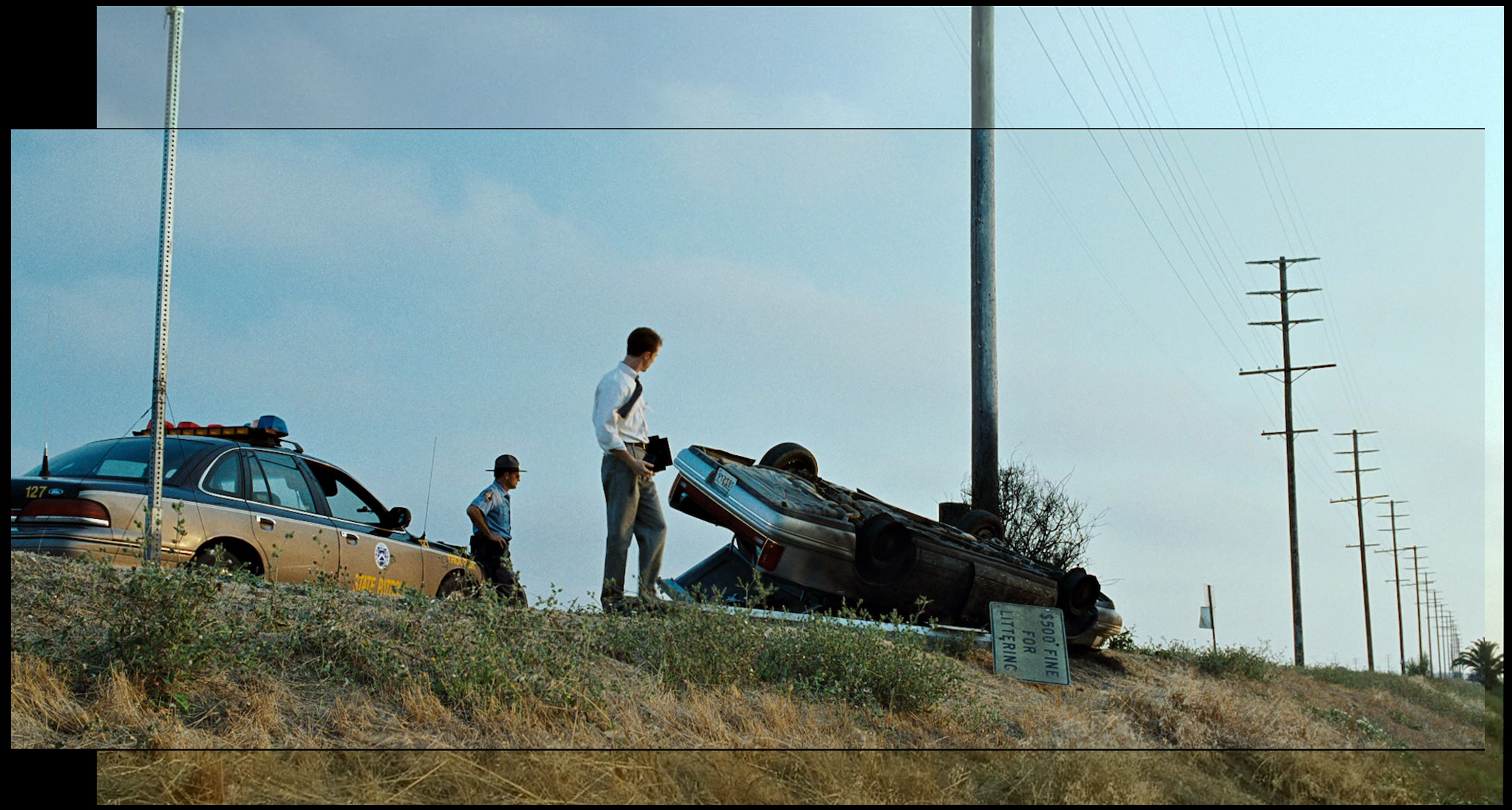
Here the composition is noticeably skewed between the 16:9 and 2.35:1 versions.

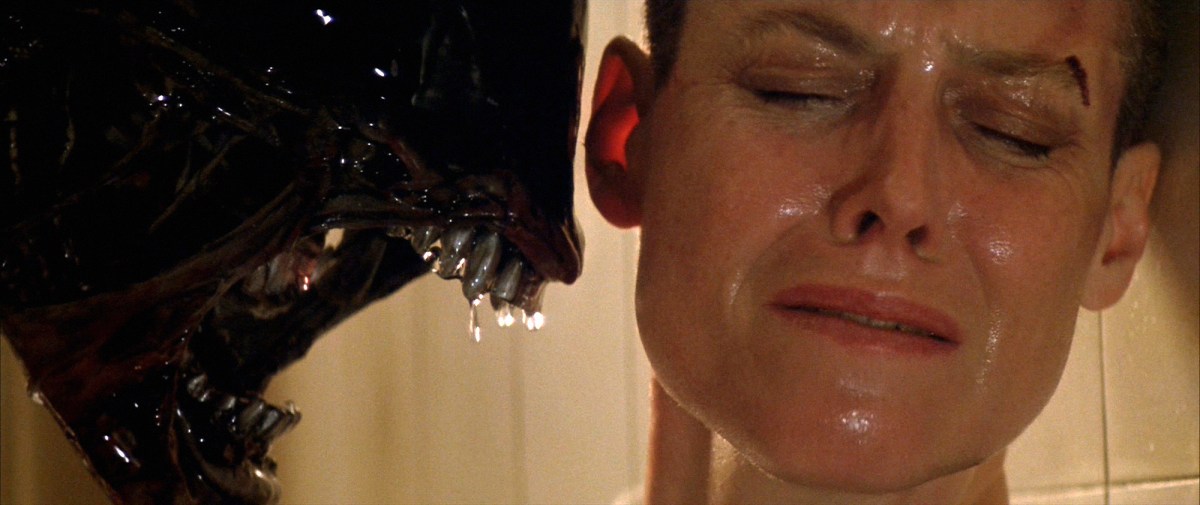
Alien3: In Space, They’re Still Screaming

Ron Magid
Unit Photography by Rolf Konow and Bob Penn, courtesy of 20th Century Fox
July, 1992
American Cinematographer

Alex Thomson, BSC — one of Britain’s premier cinematographers — creates images of dazzling perfection, richness and clarity, images which have graced some of the most exquisite-looking films in recent memory: Legend, Ridley Scott‘s epic fairytale; Eureka, Nicholas Roeg‘s influential retelling of Citizen Kane; and Excalibur, John Boorman‘s visually magnificent approach to the King Arthur legend.

Though Alien3 is ideal subject matter for Thomson’s rich photographic style, he might never have lent his expertise to the project had it not been for one of the greatest triumphs and tragedies of his career. Late in 1990, Thomson had been chosen by one of the world’s undisputed filmic masters to photograph what promised to be his final masterpiece: the director was David Lean; the project was Joseph Conrad‘s Nostromo

Unfortunately, Lean took ill and died, Nostromo shut down and a saddened Alex Thomson returned to London, wondering what he would do next. “I came back from France on a weekend and they called me on Monday to see if I could take over on Alien3,” Thomson recollects. “I started work on Tuesday, which was about a week and a half into production. I was happy to do it; it kept my mind off what might have been.” (There is a certain karmic irony to Thomson’s twist of fate. As fans of the first Alien film will recall, the spaceship in that picture was dubbed the Nostromo.)

Behind the camera, Alex Thomson, BSC watches intently as operator David Worley lines up a shot on Charles Dance as Sigorney Weaver stands by.

The production history of Alien3 is a troubled one. Before Thomson joined the film, its first director, New Zealander Vincent Ward — one of a slew of directors who had been attached to the project during its lengthy pre-production phase — had been replaced by rock video director David Fincher. Thomson was hired when the film’s original cinematographer, Jordan Cronenweth, ASC (Blade Runner) left the production.

Many cinematographers might feel stifled by a production where the original look had already been determined, but not Thomson. “I had no problem with following in Jordan’s footsteps because his approach was so right,” he enthuses. “It was marvelous to be pointed in the right direction by a man of his caliber.” 

First-time feature director Fincher, for his part, is an award-winning rock video director with a background in visual effects storyboarding at ILM. “To take something over like this at 28 must’ve been quite awe-inspiring, but he handled it as if he’d done 20 pictures,” Thomson relates.

Read the full profile

Fight Club Turns 20: Interview with the Film’s Screenwriter Jim Uhls

The fight cannot be a lie.

October 7, 2019
Storius Magazine

This month, Fight Club turns twenty. David Fincher’s adaptation of Chuck Palahniuk’s novel, written for the screen by Jim Uhls and starring Brad Pitt, Edward Norton, and Helena Bonham Carter, became a movie classic that has generated every form of cultural reference, from memes to research papers. Ranking #10 on IMDb’s Top 250 best-movie list and lending “The first rule of Fight Club” catchphrase to teen chats and corporate meetings alike, the film has come to occupy a unique niche in modern culture.

On the anniversary of the movie’s release, Fight Club’s screenwriter Jim Uhls spoke with Storius, reflecting on the film’s journey and lasting influence, adaptation challenges, fan theories, and his screenwriting techniques.

STORIUS: Today, twenty years after its release, Fight Club seems surprisingly contemporary, especially considering how many changes our society has gone through since 1999. It has entered the cultural lexicon, is often referenced even by people who haven’t seen it, and doesn’t seem to age much. What do you attribute the movie’s endurance to?

It hits a nerve with each generation that discovers it, seemingly because the basic life circumstances of the viewer, whether in 1999 or 2019, are the same. Part of that nerve is the idea of how self-worth is defined — both by society and in one’s mind — which are usually the same.

But, in this film, they become different. Men in their twenties, still puzzled about what they should do with their lives, are discovering a different way to define self-worth. A group of them meet to experience something that is outside the parameters of civilization. Each fight is one-on-one violence between two men who have no animosity towards each other, might not even know each other. They’re doing it because it’s a ritual, a primal ritual, in which they take part both by doing it and by watching others do it. It’s physical combat, wordless, and true — i.e., the fights are actually happening, so they are true. Other things all around these men can be lies, with or without words, but the fight cannot be a lie.

Another part of that nerve is Tyler Durden’s contempt for materialism, consumerism, the impossible ideals invented by advertising, and in effect — everything that is fake, or a lie, or a pathway to soullessness — all constantly bombarding us, in our “civilized” world. I’ve been repeatedly surprised by females, from teenage to senior citizens, telling me they love the film. It’s clearly aimed at a form of emancipation for young men, but part of the nerve it hits must resonate for women.

STORIUS: It’s hard to believe now that the movie was considered a failure when it was released, and that it took a few years and a DVD release to turn it into a financial success and a cultural phenomenon. Why do you think the film had such a bumpy road to recognition?

The bumpy road, the period of initial domestic release, was largely due to the vexing challenge of how to make a trailer for the film that promotes what the film is. It wasn’t an easy task. And it wasn’t achieved.

I ran into a friend about two weeks after the initial release, and he said he hadn’t gotten to the film yet, but he would; he just wasn’t a big fan of boxing movies.

“Boxing movies.” That’s a solid example of someone not having any idea of what the film was about during the time when it was vital to get that across to the public.

Read the full interview

It’s in his blood! Jeff Cronenweth, ASC Tells His Story

Jeff Cronenweth on the set of Gone Girl (2014, Merrick Morton)

Christine Bunish
October 11, 2019
Creative Content Wire

Cinematographer Jeff Cronenweth, ASC lensed his first feature, “Fight Club,” in 1998.  He earned Best Cinematography nominations from the Academy of Motion Picture Arts and Sciences and the American Society of Cinematographers for two more collaborations with director David Fincher, “The Girl With the Dragon Tattoo” (2011) and “The Social Network” (2010).  Cronenweth also shot Fincher’s “Gone Girl” (2014), Kathryn Bigelow’s “K-19: The Widowmaker” (2002) and Sasha Gervasi’s “Hitchcock” (2012).  He recently completed director Sam Taylor-Johnson’s “A Million Little Pieces,” based on the literary hit.

In addition to his feature career, Cronenweth is known for his stylish and CLIO Award-winning music videos and commercials.  In the last two years he shot music videos for Katie Perry, Jennifer Lopez, Pink, Maroon 5 and Taylor Swift.  A native Angelino, Cronenweth studied filmmaking at the University of Southern California (USC) and began his professional career apprenticing to some of the industry’s greatest cinematographers, including Sven Nykvist, ASC, John Toll, ASC, Conrad Hall, ASC and his father, the late Jordan Cronenweth, ASC.

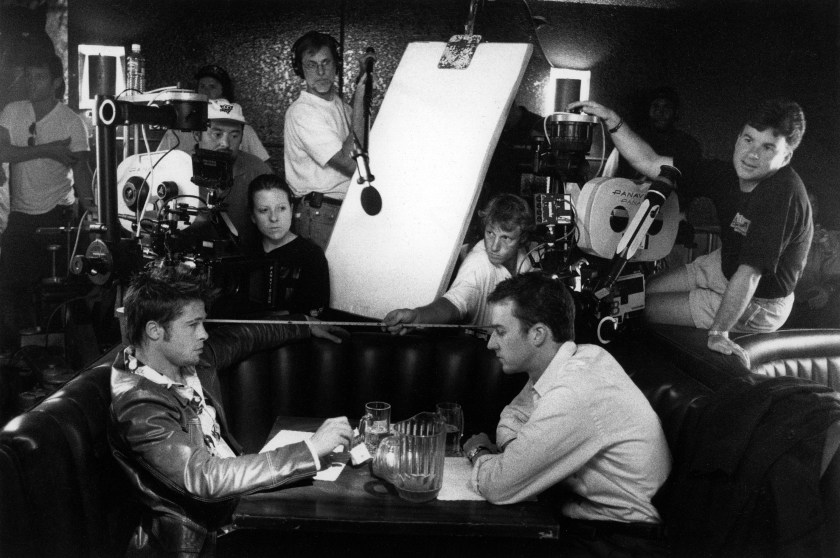
Cronenweth, behind the camera A on left, and his crew set up double coverage for a scene between Tyler Durden (Brad Pitt) and the film’s nameless narrator (Edward Norton). On the right, B camera operator (and future Panic Room cinematographer) Conrad W. Hall. (1999, Merrick Morton)

What was your pathway into this field? 

“My great-grandfather owned a photo store in Pennsylvania.  My dad’s dad won the last Oscar given for portrait photography: He was a staff photographer for Columbia [Pictures]. My grandmother was a Ziegfeld Follies dancer.  My dad [Jordan Cronenweth, ASC] won a BAFTA for ‘Blade Runner’ (1983) and got an Oscar nomination for ‘Peggy Sue Go Married’ (1987).  So as a child I often visited sets and went on location for extended stays.  I felt like I wanted to be part of that great experience, that camaraderie.  Each day was like a military unit battling to bring back great images.

“I knew I wanted to do something in the industry: I had been around it all and found it all so exciting.  I made many Super 8 films in high school and decided USC (the University of Southern California) was where I wanted to attend film school.  But two years into school Film Fair, a commercial production company my father had collaborated with, had a position open for a staff loader and that job offered the opportunity to get into the union.  I visited my dad as often as I could when he was shooting ‘Blade Runner’ and assisted him on other movies as a camera operator and on second unit.  A lot of relationships I formed then carried over when my dad retired.

“I met [director] David Fincher on a Madonna video my father photographed and I shot second unit for in the heyday of music videos – it was a very creative and innovative time, and I was grateful to be there.  I was his camera assistant on the documentary ‘U2: Rattle & Hum’ (1988) and the film ‘State of Grace’ (1990), both directed by Phil Joanou, a former USC film school classmate.  Then I got my first feature as a cinematographer, ‘Fight Club,’ with Fincher.  Not a bad credit for the first time out of the gate!”

Read the full interview

Follow Jeff Cronenweth, ASC Archives on Twitter
PIX Onset Makes Connected Set A Reality

July 9, 2019
PIX+CODEX

PIX has worked closely with David Fincher and his No. 13 production company since Panic Room in 2001, developing tools and services that have fundamentally changed how feature films and television shows are made. One of the first directors to embrace digital cameras with his use of the Thomson Viper on Zodiac, Fincher and his team are constantly redefining technology as they seek to blur the line between production and post production and strive to automate the mundane and more clearly communicate their creative vision.

On Netflix’s Mindhunter, Fincher again used the latest digital capture technology – custom RED Xenomorph cameras designed to his specifications, integrating all the usual camera components (wireless video transmitters, focus controls etc.) into the camera for a much more ergonomic design. But Fincher’s desire for innovation extended far beyond the camera, so he again turned to PIX.

CHALLENGE

Working on his current project, the second season of Mindhunter, David Fincher was looking for a way to better convey the thoughts and ideas he came up with during production via annotations attached to the image captured by the camera. In the past, a thought about the grading required for a particular shot might have been conveyed via a phone call to the dailies colorist much later in the day after shooting wrapped. David Fincher required a real-time telestration solution, rather than a delayed response later in the evening or next day. And it absolutely could not delay shooting or increase the footprint or complexity of production.

SOLUTION

PIX has built a system that makes the often-used term “Connected Set” real. PIX OnSet creates a clip of the take and immediately presents this clip to the director via a tablet, so that he or she can make annotations and notes on the image right after it has been captured. These notes are then securely uploaded via PIX to all the approved members of the production who can review them along with image files. Other approved production crew – for example, DP Erik Messerschmidt – can also add their own notes. These notes are securely conveyed through to editorial and post production along with the image files and other metadata.

PRODUCTS DEPLOYED ON MINDHUNTER

PIX for Desktop, Web, iOS
PIX OnSet
– The series also utilized the PIX Developer Program for custom integrations.

RESULT

Real-Time Creative Capture – The thoughts and ideas of the creative team are recorded in real-time immediately after the take. This ensures that their vision and ideas are communicated clearly and without change through the many lines of communication to the rest of the production team, reducing the potential for misunderstanding. For example, the editorial team can easily see any notes the director or DP have made without relying on paper, phone calls or emails sent later in the day. This might be a note that a take needs to be printed down half a stop or a note that something in the frame needs to be removed in post. Having the note linked to the image vastly reduces the opportunity for error and saves valuable time.

Patented Content Security – Along with the rest of the industry-leading PIX platform, PIX OnSet is extremely secure, built on PIX’s patented DRM with dynamic and forensic watermarking and meets the exacting standards of the MPAA.

Minimal Footprint On Set – Rather than adding to the on-set production infrastructure, PIX OnSet actually reduces it by providing immediate playback of takes to authorized devices as they are captured by the camera

No Production Delays – As authorized members of the creative team can annotate the file immediately and easily on their own tablet, there is absolutely no slowdown in the pace of production.

See how PIX can help your next big project. Call or email us to set up a demo and learn more!

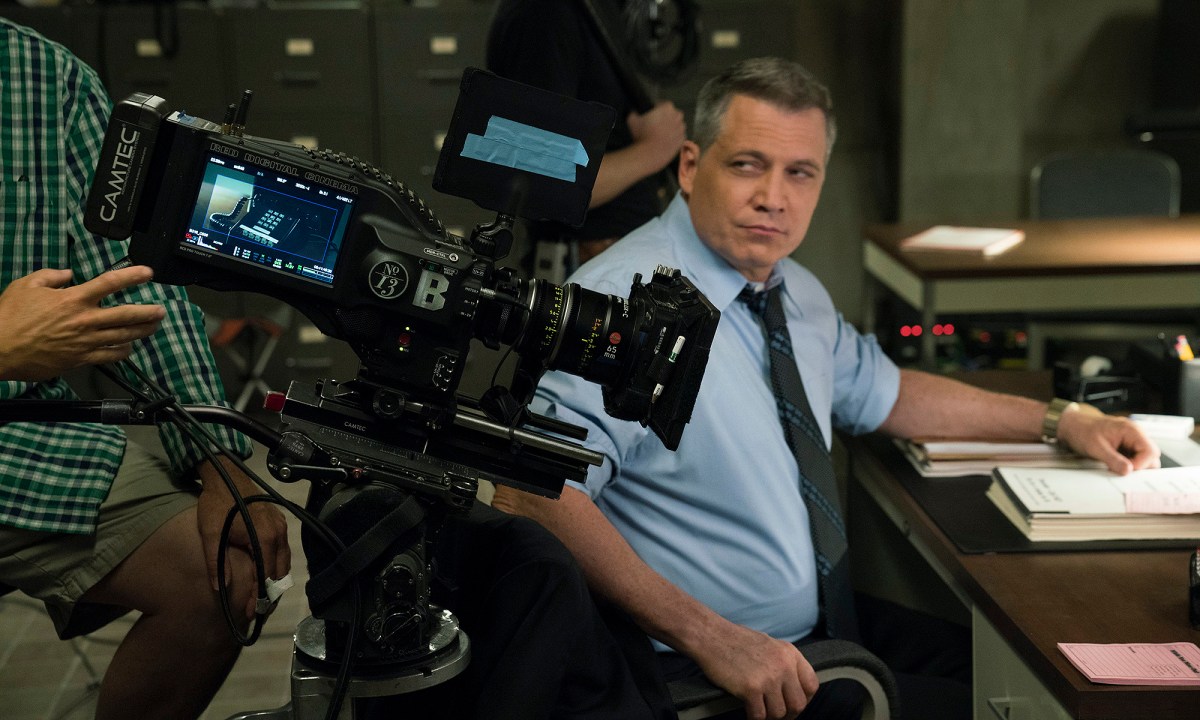
Film stills of Holt McCallany and Jonathan Groff on the set of Mindhunter, Season 1, by Patrick Harbron (Netflix).

Original Post

LOVE DEATH + ROBOTS. Volume 2

Tim Miller & David Fincher Are Joined By Oscar-Nominated Filmmaker Jennifer Yuh Nelson For Season 2 Of Animated Anthology ‘Love, Death & Robots’

Charles Barfield
June 10, 2019
The Playlist

2019. LOVE DEATH + ROBOTS. Volume 1

Interview with Fight Club Screenwriter Jim Uhls

Dave Bullis
May 11, 2019
The Dave Bullis Podcast (PodBean)

Jim Uhls is a screenwriter and producer. Jim’s sceenwriting credits include, Fight Club, the feature-film Jumper, the NBC television film Semper Fi, and the SyFy miniseries Spin

Jim’s current online class on screenwriting is available at Creative Live. And you can follow him on Twitter.

Show Notes

0:02:39 – How did Jim get his first (credited) writing gig as Fight Club?
0:04:19 – Chuck Palahniuk
0:10:36 – The Meeting
0:14:03 – The Narrator
0:18:50 – Screenwriting Rules
0:31:14 – Jim’s Screenwriting Advice
0:38:58 – The Scent of Blood
0:50:13 – Jim, if he’ll ever direct
0:52:57 – David Fincher Directing Style
1:05:17 – My Fight Club house story

Listen to the full interview

LOVE DEATH + ROBOTS. Inside the Animation

April 9, 2019
Netflix (YouTube)

Love Death + Robots creator Tim Miller discusses the process of making an animated anthology for adults and pushing creative limits.

Watch all the “LOVE DEATH + ROBOTS. Inside the Animation” clips in the Episode Guide