Because We Love Making Movies: Production Designer Donald Graham Burt

Eren Celeboglu
January 22, 2021
Because We Love Making Movies (Instagram, Facebook)

Because We Love Making Movies is an ongoing conversation with filmmakers who work behind the scenes to make the movies we love. These are the invisible warriors we don’t think of: Production & Costume Designers, Cinematographers, Editors, Producers, and the whole family of artists who make movies with their hands and hearts.

In the very first episode of my podcast, I sit down with Production Designer Donald Graham Burt. We explore the role of the Production Designer, a life in the arts, working with David Fincher, and learn to talk less and listen more.

Recommended Viewing: The Joy Luck Club, The Curious Case of Benjamin Button, Gone Girl, The Girl with Dragon Tattoo, and Mank.

Listen to the podcast:

Apple Podcasts
Spotify

David Fincher’s ‘Mank’ Production Designer on Recreating Hollywood’s Golden Era

Jazz Tangcay
February 1, 2021
Variety

David Fincher’s “Mank” is a visual feast. Shot in black and white, Fincher takes audiences back to the glorious days of Hollywood, as screenwriter Herman J. Mankiewicz pens the screenplay to Orson Welles’ “Citizen Kane.”

Production designer Donald Graham Burt is receiving awards buzz for his work on the film. Burt worked closely with costume designer Trish Summerville to translate color into black and white.

Their secret? Using iPhone filters to see how the colors worked. Burt also relied on the camera monitor a lot.

And when it came to translating wealth and recreating the big sets such as the lavish Hearst Castle home of William Randolph Hearst, Burt says, “It was about emulating instead of replicating.”

Read the full profile

Right On Hue

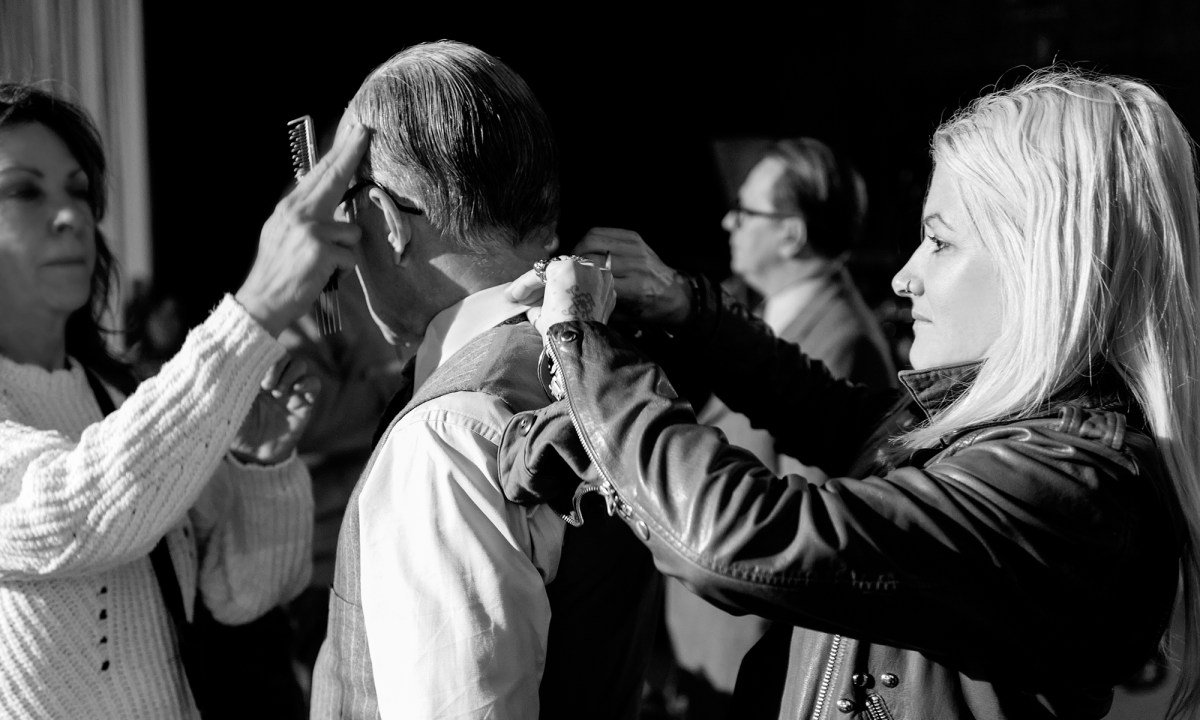
Photo by Nikolai Loveikis

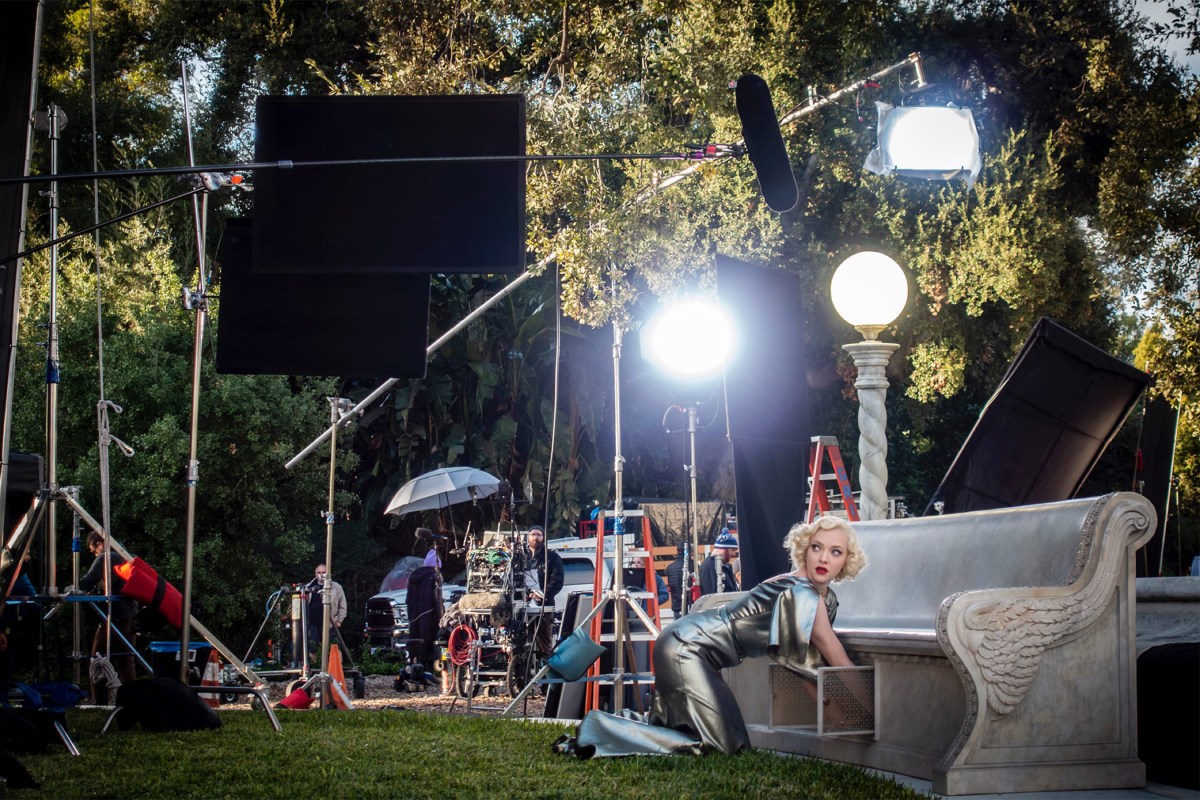
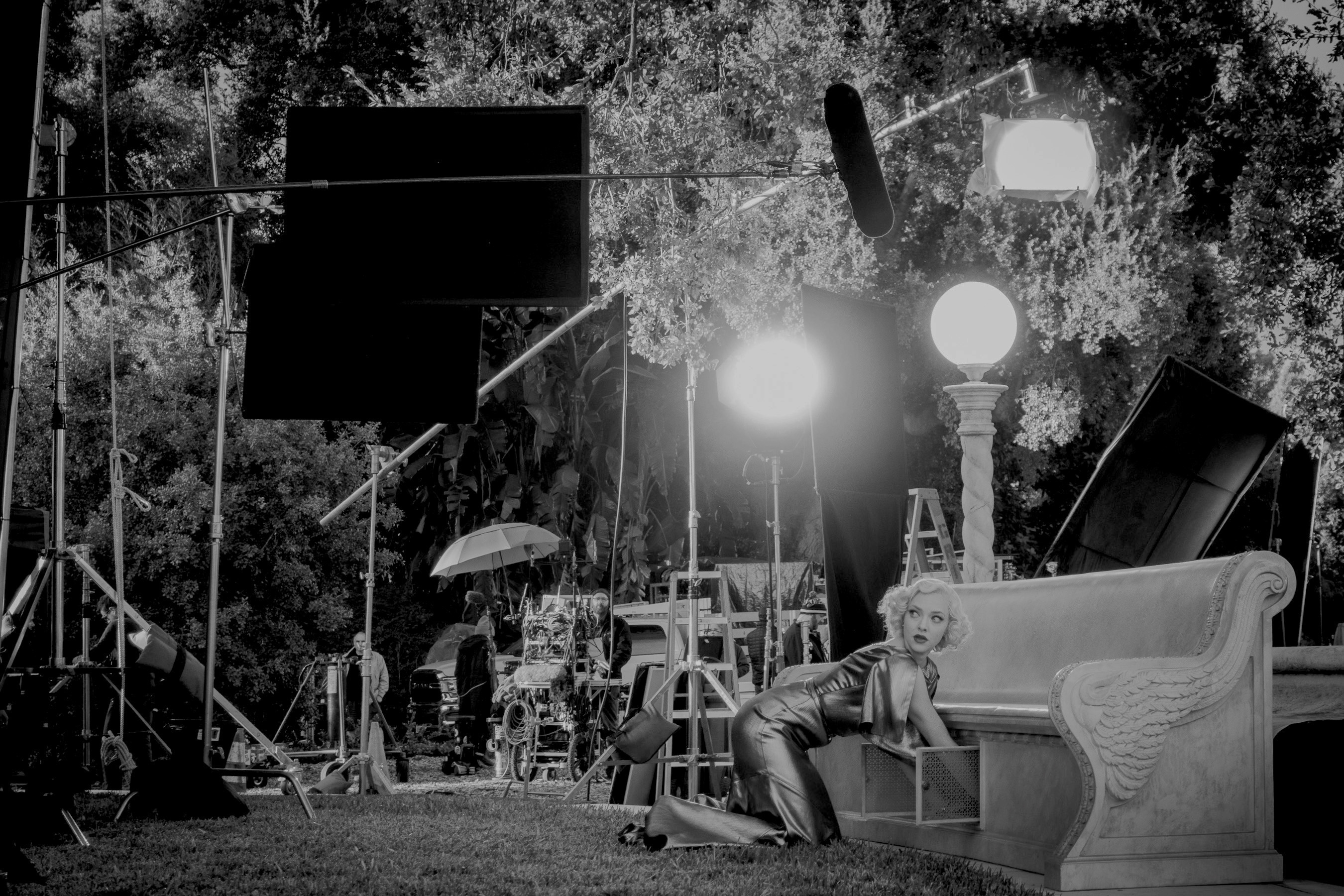
David Fincher’s black-and-white tribute to Old Hollywood took a radically different approach to the role of color in design.

January 29, 2021
Netflix Queue

In the annals of Hollywood, Herman Mankiewicz will forever be remembered as the screenwriter of Orson Welles’s towering classic Citizen Kane, but his impact on the history of cinema doesn’t stop there. Mankiewicz also served as an early, uncredited writer on The Wizard of Oz. His contribution? Suggesting that once Dorothy Gale travels over the rainbow, the film transitions from black and white to glorious Technicolor. “He walked away from that [project] saying, ‘This is all I can come up with,’” laughs director David Fincher. “It might be the greatest special effect in the history of the movies.”

For Mank, Fincher’s backstage drama about the screenwriter’s life and his work on Kane, the director and his creative team journeyed from a world of color to one rendered entirely in black and white, shooting eye-catching sets and costumes with the RED 8K Helium Monochrome camera. That created an interesting artistic puzzle for Fincher and his collaborators to solve. From cinematography and production design to costumes and hair and makeup, each department needed to determine the best way to manipulate color to achieve the proper register of lights and darks onscreen.

“We had to train our senses to see through a lens of black and white,” explains Oscar-winning production designer Donald Graham Burt (The Curious Case of Benjamin Button). “It mandated a palette based on tone and contrast.”

Fortunately, they proved more than up to the challenge.

Read the full article

How an iPhone filter came to the rescue for ‘Mank’ set decorator Jan Pascale

Joyce Eng
January 29, 2021
Gold Derby

Mank” set decorator Jan Pascale is no stranger to black-and-white films: She received an Oscar nomination for George Clooney‘s “Good Night, and Good Luck” (2005). But those two monochrome films couldn’t be more different.

“When I first met with [‘Mank’ production designer Donald Graham Burt] about it, I said, ‘I’ve done black and white. I can do this.’ And Don said, ‘No, no, no, this is different.’ The way the images were captured was quite different,’” Pascale tells Gold Derby at our Meet the BTL Experts: Film Production Design panel. “On ‘Good Night, and Good Luck,’ we shot on film … and we had a really limited budget on that one — $7 million the whole movie — so I couldn’t paint anything or really paint anything, so everything was shot as is. But it sort of worked.”

“Mank,” however, was shot in black and white on a RED digital camera, completely changing the way images and details came off onscreen. But Pascale got some very modern assistance to help her do color-testing. “David [Fincher] and Don had done some testing with the camera that we were going to be using. And they discovered if we used our iPhones with the noir filter and photographed everything, that’s how it would appear in our movie,” she shares.

Read the full article

Film Production Design Panel: David Crank, Jan Pascale, Mark Ricker, Barry Robison

Joyce Eng
January 29, 2021
Gold Derby

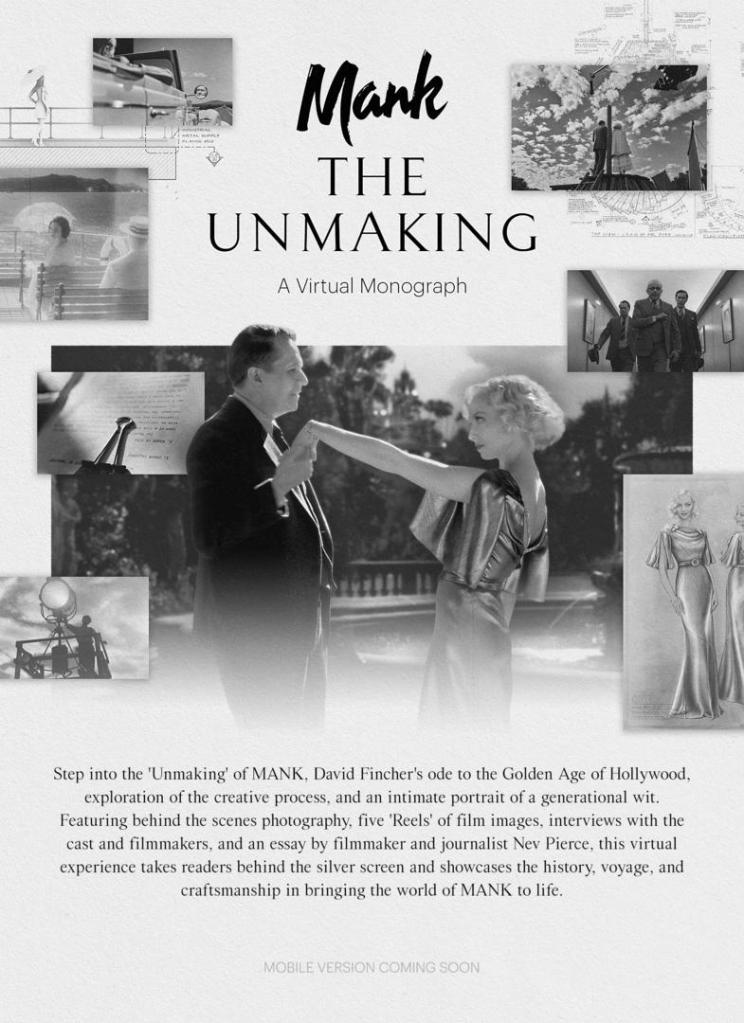
Mank, The Unmaking

January 28, 2021
Netflix

manktheunmaking.com [Old Domain]

mank.aristidebenoist.com

Text by:

Nev Pierce

Photography by:

Erik Messerschmidt
Miles Crist
Gisele Schmidt-Oldman
Gary Oldman
Ceán Chaffin
Nikolai Loveikis

Design and development by:

Watson Design Group, Inc.
Aristide Benoist

‘Mank’ costume designer Trish Summerville: It’s not just black-and-white, it’s ‘Fincher-vision’

Daniel Montgomery
January 20, 2021
Gold Derby

“I keep making this joke that it’s Fincher-vision because it’s not just black-and-white, it’s this really specific way that he’s going to light the film,” says costume designer Trish Summerville about the unique visual style of “Mank,” directed by David Fincher. The film tells the story of “Citizen Kane” writer Herman Mankiewicz, and it’s shot to resemble films of the 1930s and 1940s. That presented Summerville with equally unique challenges and opportunities. We spoke with her as part of our “Meet the Experts” costume designers panel. Watch our interview above.

“The black-and-white was the most challenging thing: figuring out how we wanted to make that work, doing different testing on clothing and fabrics … so we could see how it would read,” Summerville explains. “Even though you think you don’t need a color palette, you really do, because if not, when you’re looking at it with your naked eye on set, it becomes very jarring.” And understanding color was crucial for achieving the right effect in the finished product “so that when it read in black-and-white on the screen and on the monitors it didn’t just all come across as flat, it had dimension to it, sheens and tones.”

It helped that the film was portraying so many well-known figures with documented looks and styles — not just Mankiewicz, but Marion DaviesWilliam Randolph HearstLouis B. Mayer, and more. “We could find things of [Mank] at work, on sound stages, and also at home,” Summerville says. “We even at one point found these images of him at one of his kids’ bar mitzvahs, so that was great, it was a whole family photo.”

But in a film with so many male characters, it was also important “to give each one of the men their own kind of characteristics and dress them towards who those characters really were … so that not everybody read as a navy suit in a room.” That research and detail, in collaboration with Fincher’s direction, Donald Graham Burt‘s production design and Erik Messerschmidt‘s cinematography, “all of it has these special touches that make you feel you’re transported to the 1930s.”

Interiors: Donald Graham Burt, Mank

Mehruss Jon Ahi and Armen Karaoghlanian
January 13, 2021
Interiors

David Fincher’s Mank (2020) depicts 3 incredibly unique locations in California with a multitude of interior and exterior architectural spaces. The visual presentation of the film, combined with the Art Direction and Set Decoration, creates a masterful, multifaceted level of Production Design that is rarely seen in cinema. It is a film that warrants multiple viewings and its attention to architectural details should be commended.

In an exclusive interview with Interiors, we spoke with Donald Graham Burt, who is the Production Designer for Mank.

INT: You’re a longtime collaborator of David Fincher‘s but what was it about Mank specifically that interested you in taking on the project?

DGB: First and foremost it was an opportunity to work on a project that was a period Los Angeles project – and even more specifically a period project about the film industry.  To be able to delve into the history of the studios and the roots of the industry in its early years in Los Angeles – when portions of the city were still undeveloped – was an experience to cherish.  David’s projects are always of high caliber and there is a professional level at which he works that is rewarding to be a contributor to.  

Read the full interview

The Design of ‘Mank’: How Costumes and Sets Energized David Fincher’s Homage to Old Hollywood

TheWrap magazine: Costume designer Trish Summerville and production designer Donald Graham Burt take us behind the scenes.

Joe McGovern
January 12, 2021
The Wrap

A version of this story about “Mank” appeared in the Race Begins issue of TheWrap’s awards magazine.

“Fincher-vision” is the term that costume designer Trish Summerville uses while discussing her experience working with director David Fincher. “His mind is so clear about what he wants, but there’s still room for spontaneity,” she said. “That’s why there’s so much happiness in the craft departments on his films. And so much repeat business.” Production designer Donald Graham Burt echoed her sentiment. “When David starts telling me about a new film, he visually sees the whole thing in his head,” he said. “But there’s room for expansion creatively.”

Those qualities were essential to “Mank,” Summerville’s third project with the director and Burt’s sixth. (Burt won an Oscar for 2008’s “The Curious Case of Benjamin Button”; Summerville’s other credits include “The Hunger Games: Catching Fire” and “Red Sparrow.”) Fincher’s look at the screenwriter of “Citizen Kane” is a rich evocation of 1930s Hollywood that’s grounded in the reality of its time and place, though the film was shot in silvery black-and-white.

The two department heads talked often, ironically, about color. “There are some colors that don’t translate well,” Summerville said. “Salmon and chartreuse and acid greens are jarring in black-and-white. So Don and I talked a lot about our color palettes.” Summerville also reminded Fincher, making his first black-and-white feature, not to place too much trust in his eyes and instead view everything through the camera monitor.

Read the full profile

Making of ‘Mank’: How David Fincher Pulled Off a Modern Movie Invoking Old Hollywood

The director had to employ digital advances to achieve a vintage aesthetic in telling the tale of ‘Citizen Kane’ screenwriter Herman Mankiewicz: “If we had done it 30  years ago, it might’ve been truly a bloodletting.”

Rebecca Keegan
January 11, 2021
The Hollywood Reporter

Screenwriter Herman Mankiewicz never sought credit for conceiving one of the all-time great ideas in the history of cinema — the notion that the Kansas scenes in The Wizard of Oz should be shot in black and white and the Oz scenes in color. In fact, for much of his career in Hollywood from the late 1920s to the early ’50s, Mankiewicz seemed to view his scripts with about as much a sense of ownership as a good zinger he had landed at a cocktail party.

But what fascinated David Fincher was that when it came time to assign credit on the screenplay for Citizen Kane, which Mankiewicz wrote with Orson Welles in 1940 (or without, depending on your perspective), the journeyman screenwriter suddenly and inexplicably began to care. Precisely why that happened is the subject of Fincher’s 11th feature film, Mank.

“I wasn’t interested in a posthumous guild arbitration,” Fincher says of Mank, which takes up the Citizen Kane authorship question reinvigorated by a 1971 Pauline Kael essay in The New Yorker. “What was of interest to me was, here’s a guy who had seemingly nothing but contempt for what he did for a living. And, on almost his way out the door, having burned most of the bridges that he could … something changed.”

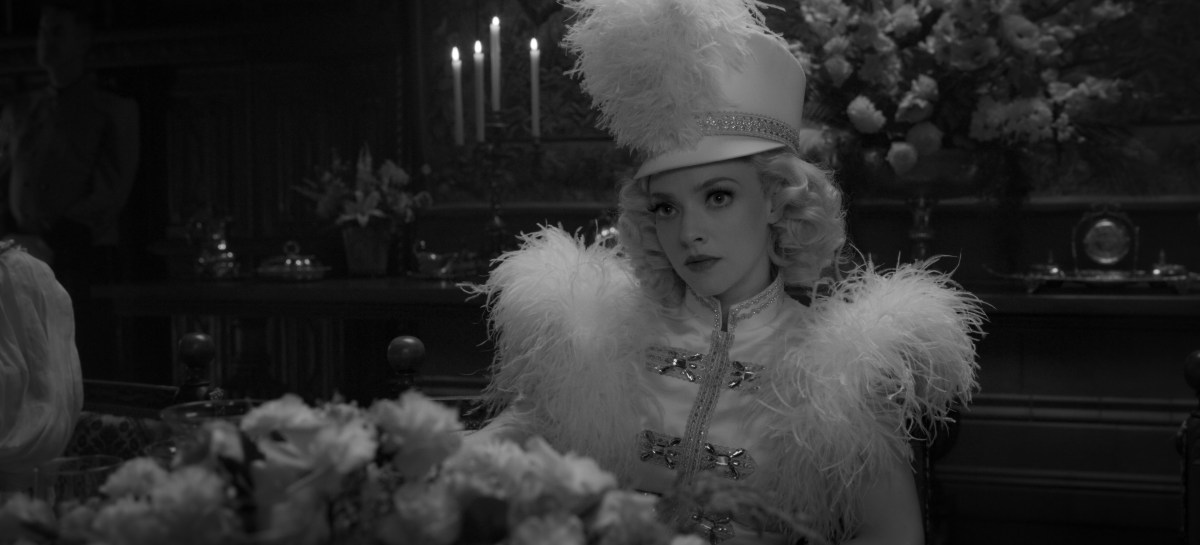
Shot in black and white and in the style of a 1930s movie, Mank toggles between Mankiewicz (Gary Oldman) writing the first draft of Citizen Kane from a remote house in the desert and flashback sequences of his life in Hollywood in the ’30s, including his friendship with newspaper tycoon William Randolph Hearst (Charles Dance), who inspired Citizen Kane, and Hearst’s mistress, actress Marion Davies (Amanda Seyfried).

A filmmaker known for his compulsive attention to detail, Fincher had even more reason than usual to treat every decision with care on Mank, as he was working from a screenplay written by his father, journalist Jack Fincher, who died in 2003. Jack had taken up the subject in retirement in 1990, just as David was on the eve of directing his first feature, Alien 3, and the two would try throughout the 1990s to get the film made, with potential financiers put off by their insistence on shooting in black and white.

Read the full profile

Mank Is a Rich Immersion Into Hollywood’s Black-and-White Glory Days

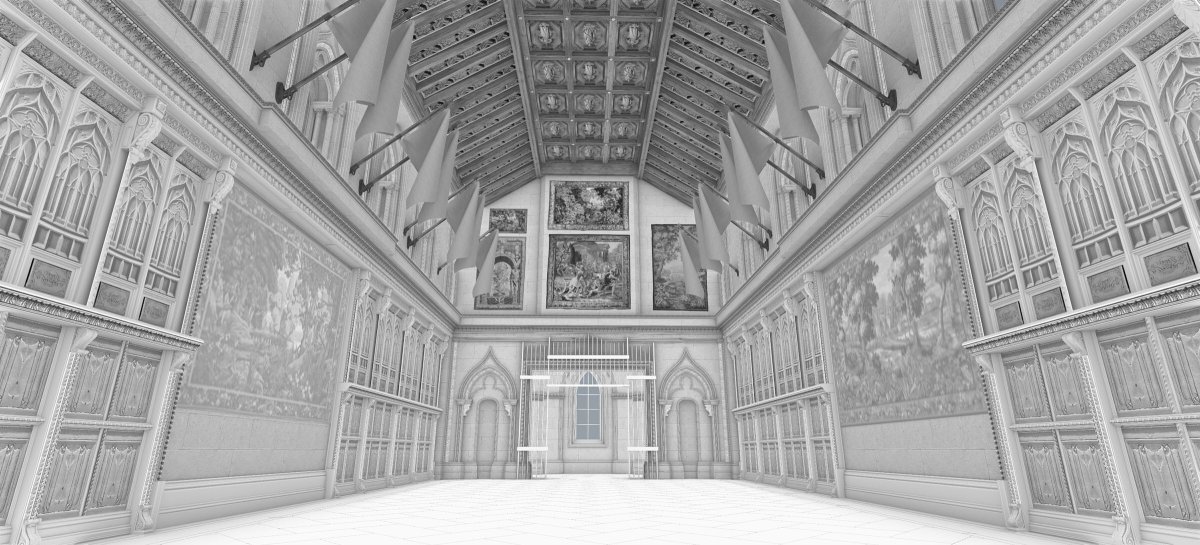
A rendering of the archway in the dining room at Hearst Castle, which features Spanish Revival details. Drawings by Daniela Medeiros

David Fincher’s new film tells the story of screenwriter Herman J. Mankiewicz as he pens the script for Citizen Kane

Mara Reinstein
December 3, 2020
Architectural Digest

Judging the film Mank just based on the story alone—cynical, heavy-drinking screenwriter Herman J. Mankiewicz evaluates his turbulent travails through Hollywood as he struggles to script Citizen Kane—doesn’t do it justice. A work of impeccable craftsmanship that unspools in crisp black-and-white, Mank, which premieres Friday, December 4, on Netflix, allows viewers to journey back in time to experience all the glamour and grit of Los Angeles during the 1930s and early ’40s. And that’s exactly how director David Fincher (Gone Girl, The Social Network) intended it.

“I remember when David first spoke to me about it,” Oscar-winning production designer Donald Graham Burt (The Curious Case of Benjamin Button) tells Architectural Digest. “He said ‘I want it to feel like you’re in a film vault and you see Citizen Kane and then you see a film next to it and it says Mank and you think, ‘Oh, I never saw that.’ He wanted it to look like a film made in that period.”

Read the full profile

An Exclusive Look at the Making of Mank

Production designer Donald Graham Burt takes AD behind the scenes of the Golden Globe–nominated film

Cathy Whitlock
February 12, 2021
Architectural Digest