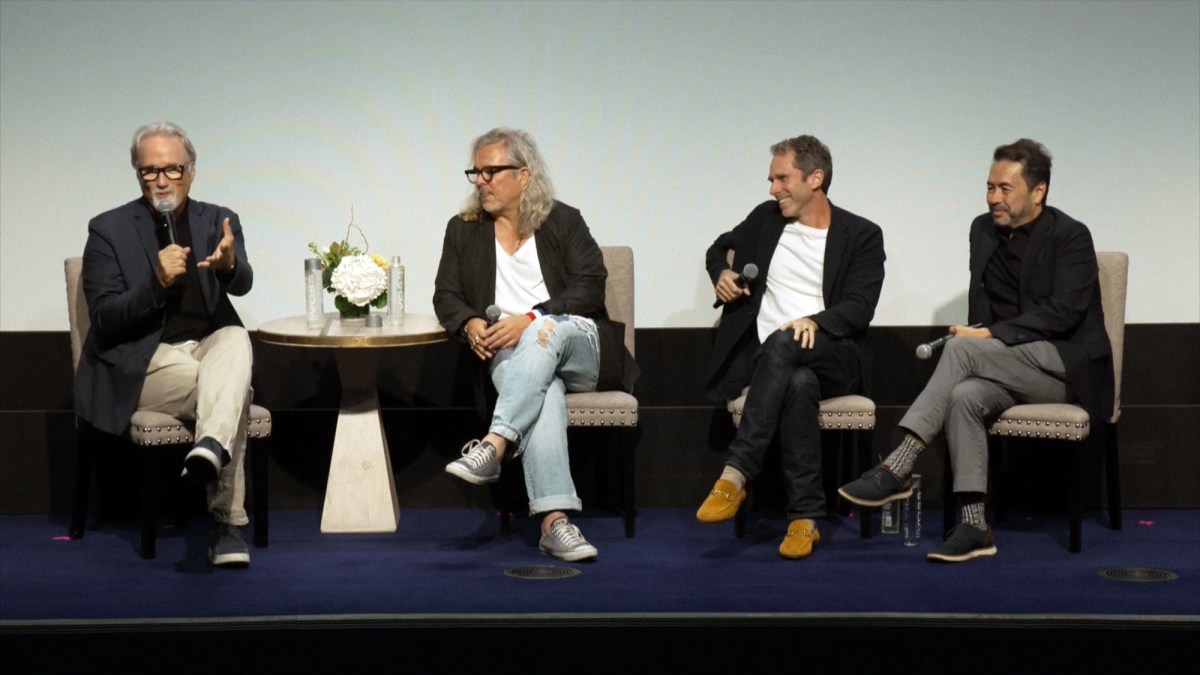
David Fincher discusses the making of The Killer with Writer Andrew Kevin Walker, Editor Kirk Baxter, and Sound Designer Ren Klyce, after the “Tastemaker” screening for The Academy at the Whitby Hotel in New York.
Wei Zheng (VFX Supervisor) began his career in visual effects in 1998 at ILM. He then worked at Digital Domain and joined Artemple Hollywood in 2012. He has worked on various shows including Minority Report, Zodiac, Mindhunter, and Mank. Today he talks to us about his new collaboration with David Fincher.
Yabin Morales (VFX Supervisor) has been with Ollin VFX for over 15 years and has worked on projects such as The Curious Case of Benjamin Button, Jumanji: Welcome to the Jungle, The Boys, and Outer Range.
With over twenty years of experience in visual effects, James Pastorius (VFX Supervisor) has worked on many films such as Gone Girl, Jumanji: The Next Level, Uncharted, and Ferrari. In 2007, he founded his own studio, Savage VFX.
How does one design a costume for a character, who does not want to be seen? Costume designer Cate Adams unveils the meticulous process behind crafting the enigmatic costumes inDavid Fincher’s‘The Killer.’ In an exclusive interview with Spencer Williams, Adams shares behind-the-scenes stories, from deciphering Fincher’s vision for a character who effortlessly blends into the background to the awe-inspiring challenge of outfitting the incomparable Tilda Swinton. Join us as Adams takes us on a journey through cities, layers, and hidden Easter eggs, providing an intimate look into her creative process and the transformative power of costumes in film.
Stick to the plan. Anticipate, don’t improvise. Trust no one. Never yield an advantage. Fight only the battle you’re paid to fight… and if you can do all that while listening to The Smiths, even better. That’s the mantra of the eponymous assassin at the heart of The Killer, directed by David Fincher and written by our guest today – the fantastic Andrew Kevin Walker.
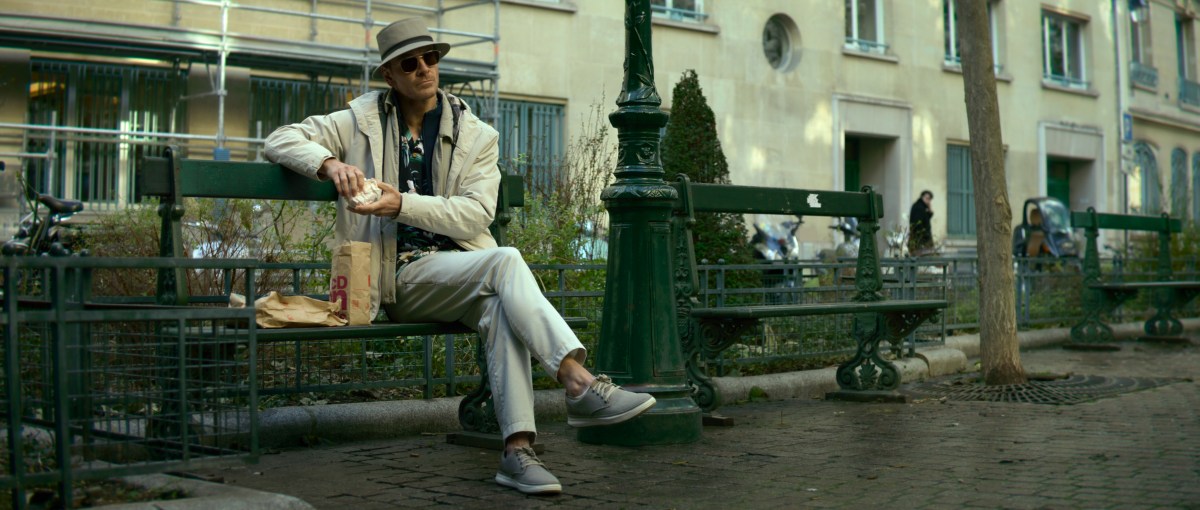
The Killer is a movie that deconstructs the hitman movie genre like Michael Fassbender’s glassy-eyed gun-for-hire deconstructing a McDonald’s sandwich on a park bench in Paris. It opens with a blaze of images that tease the explosive action typical of these films then swerves in a different direction. The result is defiantly meditative two hours in which the violence of the movie’s revenge plot following a botched assassination is almost incidental to the character’s meticulous ways and detached observations about the world.
It’s an absolutely riveting watch but then again, what did we expect? Unlike The Killer, who misses his target early on in the film, sparking the film’s descent into chaos, Andrew and Fincher rarely miss their mark whenever they work together. The pair first teamed up on 1995’s Se7en, which began life as a spec script that Andrew wrote after moving to New York from suburban Pennsylvania. Since then, Andrew’s taken passes at Fight Club and The Game for Fincher, on top of his solo adventures in Hollywood, penning films like Sleepy Hollow and 2022’s excellent Windfall.
In the spoiler conversation you’re about to hear, Andy answers our questions about the subtle commentary on materialist culture woven into the film. We get into the influence of the novelist Somerset Maugham on Andy’s work and break some of the film’s most intriguing moments, including its enigmatic ending – in which a life is spared but existential questions are left looming.
Today on Art of the Cut, we’re talking with Kirk Baxter, ACE, about editing David Fincher’s latest: The Killer, which is now on Netflix.
Kirk’s been on Art of the Cut before – for Gone Girl and for Mank. He was nominated for an Oscar, a BAFTA and an ACE Eddie for The Curious Case of Benjamin Button. He won an Oscar, a BAFTA and an ACE Eddie for The Social Network. He was nominated for an ACE Eddie and won an Oscar for The Girl with the Dragon Tattoo. Was nominated for an Emmy for House of Cards. Was nominated for an ACE Eddie for Gone Girl. Was nominated for an ACE Eddie for Mindhunter. Was nominated for an ACE Eddie for Mank and won an ACE Eddie for Love, Death and Robots.
Kirk Baxter, ACE, director David Fincher’s long-time editor, talks about the power of believing in the process, pacing, and voiceover changes on the action-packed thriller.
We have a bumper episode for you with not one, not two, but three Oscar-nominated or Oscar-winning filmmakers who work with David Fincher. We have Cinematographer Erik Messerschmidt, Editor Kirk Baxter, and Sound Designer Ren Kylce, who have all worked with Fincher multiple times. We talk about their latest collaboration, The Killer, which starring Michael Fassbender and Tilda Swinton.
Follow the podcast on Twitterand Instagram. Support it on Patreon and access bonus episodes, industry survival guides, and feedback on your film projects!
Netflix has another hit movie on its hands with David Fincher’s The Killer. We spoke to the film’s editor, Kirk Baxter, and Assistant Editor, Jennifer Chung, about how they put it together using Adobe Premiere Pro.
Kirk Baxter ACE picked up two Oscars working on previous Fincher titles you will probably have heard of, The Social Network (2010) and The Girl with the Dragon Tattoo (2011). In other words, The Killer has some serious pedigree behind it, and much like this year’s Academy Award for Editing winnerEverything Everywhere All At Once, it was cut on Adobe Premiere Pro.
Jennifer Chung ACE was one of the Assistant Editors on The Killer and represents a 14-strong editing department. Chung is currently cutting her first indie feature (“It’s a different kind of stress,” she says laughing), but looking back on The Killer, is there any particular sequence that stands out as her favorite?
“I think it has to be the fight sequence,” she says. “The fight sequence is pretty epic. And it just goes on. I think Kirk did an incredible job with that; it’s just really fun to watch.”
“I watched something on TV which had a big fight sequence two nights ago, and I couldn’t follow it,” says Kirk Baxter, who edited The Killer and put the movie’s signature fight scene together. “I knew people were fighting, but I couldn’t track who owned what fist and what thing. It was just a jumble of limbs edited quickly.”
No such failure to follow the action in The Killer’s own fight scene, which Baxter says is essentially a sequence of 18 scenes with multi-camera setups depicting a single fight all strung together in a row. He was cutting the sequence as Fincher was shooting it. The shoot would break at lunchtime when he’d start cutting the first half of the day, getting the second half later at the end, then cutting into the evening and sending it to Fincher to see if any pickups were needed.
“It was this crazy, relentless week of all of us going around the clock to know that we had the thing,” he says.
It’s probably fair to say that the 2021 Academy Awards were unlike any others. How do we count all the ways?
A global pandemic that shuttered productions and theaters. Distribution of first-run films over streaming services or with premium per-view rental prices. A raft of indie-style films made on shoestring budgets. Big-budget blockbusters pushing their release dates to 2021 and beyond, taking them out of the race. A ceremony broadcast that was not just delayed by two months, but was entirely reconceived and relocated from the Dolby Theatre to Los Angeles’s Union Station, with acceptance speeches uninterrupted by orchestras and time limits.
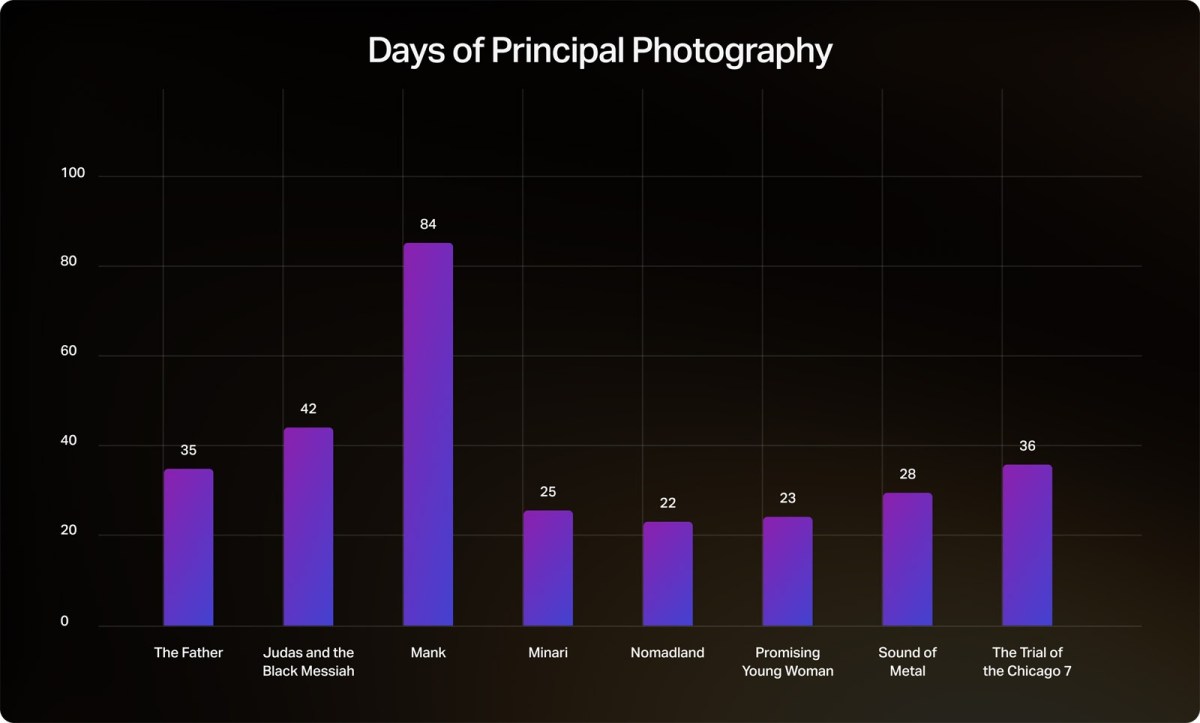
It’s also the first year that Frame.io made a big splash at the Oscars, used on three of the nominated films (including Best Film Editing and Best Sound winner Sound of Metal), as well as the broadcast show itself. And we’re even doing our own coverage a little differently, splitting the Best Picture nominees and Best Film Editing nominees into two separate articles to give you a deeper dive into the processes, both technical and creative.
And yet, there are the ways in which the spirit of the Oscars remains very much the same. First-timers and foreign films challenging established directors with an acclaimed body of work. The novelty of having a woman (never mind two) nominated for Best Picture—with Chloé Zhao as only the second woman to claim the win. The snubs of Black directors like Spike Lee, Regina King, and perhaps most pointedly, Shaka King, whose Judas and the Black Messiah was nominated for Best Picture.
But all of that aside, the Oscars are still a much-anticipated yearly tradition for those of us who love cinema.
We’re excited to present our fourth-annual Oscars Workflow Roundup! We’ll dig into the workflows of the eight films nominated for Best Picture and consider how this strange and unprecedented year has played out—and what it might mean for the future of how movies are both made and consumed.
Excerpts from the ‘Virtual Glass of Wine’ British Film Editors interview series. Kirk Baxter talks about editing Mank, directed by David Fincher (Fight Club, The Social Network).
Kirk Baxter, ACE on how he approached MANK (2020)
Kirk Baxter, ACE on MANK (2020) from script to scene
Citizen Kane has long been regarded as a movie masterpiece for its cinematography, storytelling, and ahead-of-its-time visual effects. Who better to pay homage to the 1940’s film than director David Fincher, whose films are often lauded for these same characteristics? Fincher’s most recent project, the Netflix feature film Mank, brings to life a screenplay written by his late father, journalist Jack Fincher.
Netflix describes the film as “1930s Hollywood…reevaluated through the eyes of scathing wit and alcoholic screenwriter Herman J. Mankiewicz as he races to finish Citizen Kane.” This movie about a movie showcases the unique approach to storytelling and visual style that continues to make Fincher’s work stand out.
Helping Fincher to bring his signature style to life is a talented post-production team that includes post producer Peter Mavromates, editor Kirk Baxter, first assistant editor Ben Insler, assistant editor Jennifer Chung, and a number of additional assistant editors and VFX artists. Their collective credits include MINDHUNTER, Gone Girl, The Social Network, The Girl with the Dragon Tattoo,The Curious Case of Benjamin Button, House of Cards, and other features.
As co-producer of Mank, Mavromates oversaw the timing, budget, schedule, and integration between the editorial, visual effects, and finishing departments. Insler was responsible for integrating the overall project workflows. Chung prepped dailies and supported the editorial team throughout the post-production process and liaised with the sound, color, and visual effects teams.
The team constantly looks to refine and improve their workflows. “I love the mechanics of post-production,” says Insler. “If there’s a way we can eliminate a bottleneck or figure out a more efficient way to do things, I’m all over it. It’s one of my favorite things to do.”
Insler had that opportunity while working on Mank, which was edited using Productions in Adobe Premiere Pro. Already long-time users of Premiere Pro, Productions made it even easier for the editorial team to organize projects, collaborate, and scale, while solving issues such as avoiding duplicate clips and providing the ability to break large projects into smaller segments so that they open and save faster.
How do you make a movie about the best movie ever made? With David Fincher, Gary Oldman, Netflix and Adobe Premiere Pro, Mank tells the story behind the story of Citizen Kane.


 The Fincher Analyst