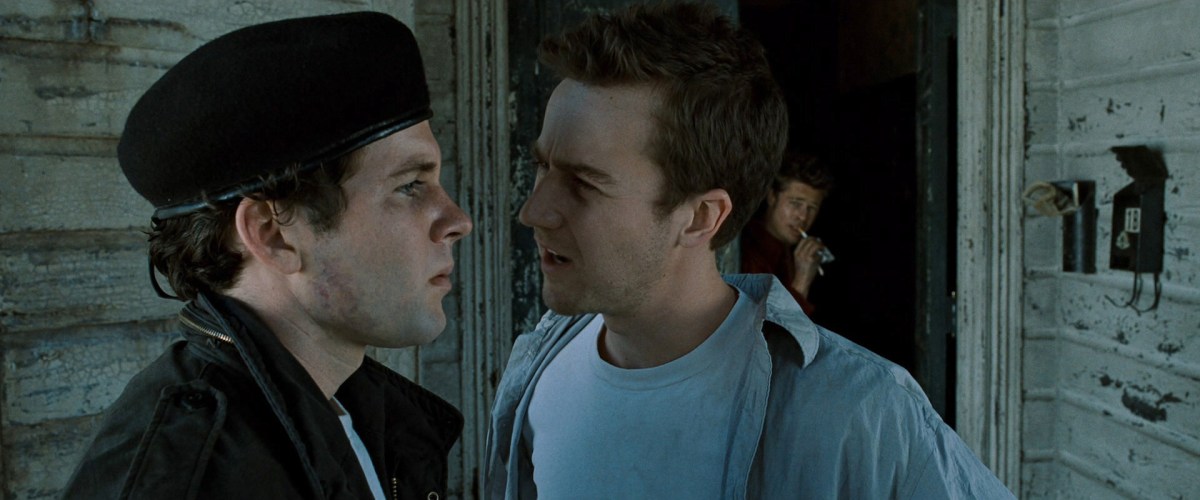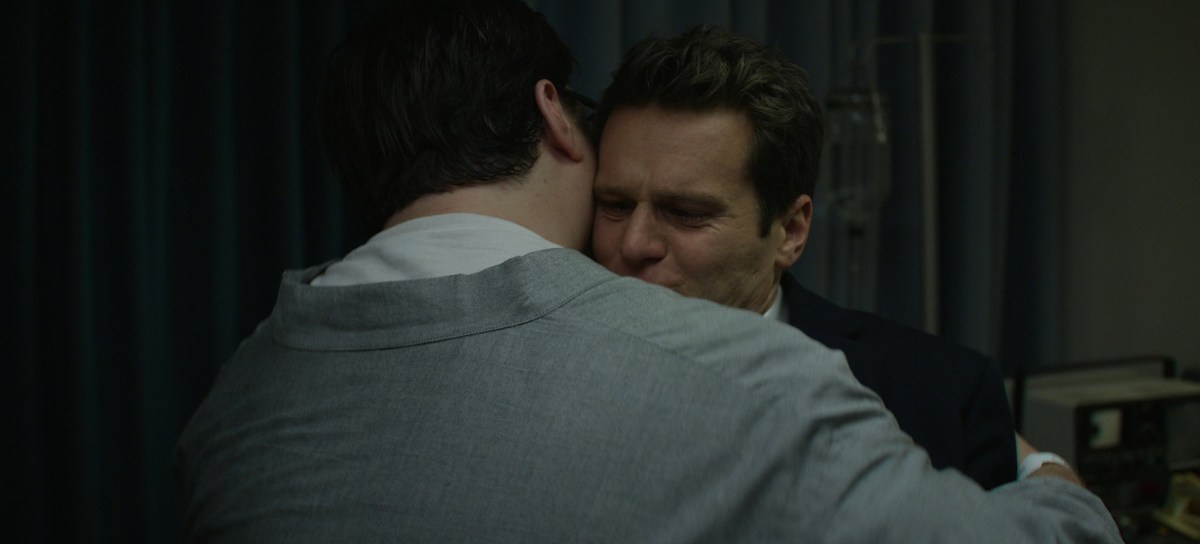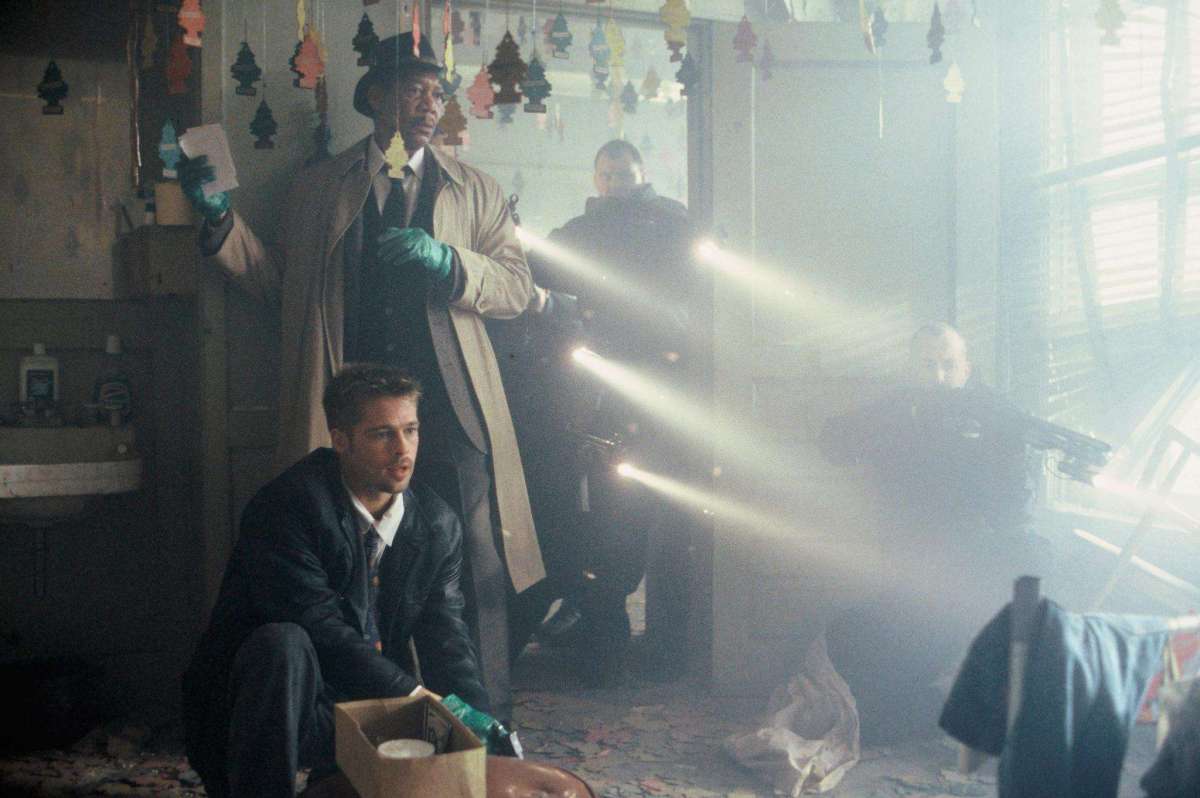
Se7en: The Serial Killer Chase as Existential Conundrum

David Fincher’s seminal serial killer procedural is more of a parable about how hope and idealism cope against evil.

James A Gill
September 6, 2025
Fanfare (Medium)

**This essay contains major spoilers for Se7en**

“If we catch John Doe and he turns out to be the devil, if he’s Satan himself, that might live up to our expectations. But he’s not the devil, he’s just a man.” — Detective William Somerset

“I don’t believe that you’re quitting because you believe these things you say. I don’t. I think you want to believe them because you’re quitting. You want me to agree with you and you want me to say ‘yeah, yeah, yeah, you’re right, it’s all f***ed up’…. but I won’t. I won’t say that. I don’t agree with you. I do not. I can’t.” — Detective David Mills

These are some of the lines exchanged between the heroes of David Fincher’s classic 1995 feature, Se7en, as they have a heart-to-heart conversation late in the film. It is a scene that contrasts considerably in tone and mood to the more memorably horrific and gory scenes in the film.

This scene may well be the most important, if not the most moving, in a film largely known for its bleak, macabre, and unforgiving atmosphere. As a moment of respite for the audience, the scene demonstrates how well detectives David Mills and William Somerset complement each other, despite their many superficial differences.

Released in September 1995, David Fincher’s Se7en proved to be a sleeper hit of 1995 (overall, and appropriately, the seventh highest-grossing film of 1995). It was a critical smash and a redemptive feature film success for Fincher (after the very mixed results of his film debut, Alien 3). Andrew Kevin Walker’s screenplay also received a BAFTA nomination for Best Original Screenplay. It is also, alongside 1991’s The Silence of the Lambs, considered the defining serial killer feature of the 1990s, forging a considerable impact on the genre going forward.

Read the full essay

Cool Girl Catharsis: box-cutting open the deep impact of the titular “Gone Girl”, Amy Dunne

As Gone Girl rings in ten years of Amazing Amy’s disappearing act, Mia Lee Vicino probes the mystery-thriller’s deep impact, from annual Valentine’s Day rewatches to the catharsis of the Cool Girl monologue.

Mia Lee Vicino
October 3, 2024
Letterboxd

This article contains spoilers for ‘Gone Girl’.

“Cool Girl is hot. Cool Girl is game. Cool Girl is fun.” With this incisive diatribe, Rosamund Pike as Amy Elliot Dunne articulates the previously inarticulable. The moment comes at the midpoint of Gone Girl, pulling the rug out from under first-time viewers, while devoted Amazing Amy acolytes mouth the sacred words along with her: “Cool Girl never gets angry at her man. She only smiles in a chagrined, loving manner and then presents her mouth for fucking.”

It’s been ten years since we were first visually exposed to the exquisite Cool Girl monologue; twelve since author Gillian Flynn initially published it across seven blistering pages of her bestselling source novel. David Fincher, Pike (who earned an Oscar nomination for her performance) and Ben Affleck as Amy’s “lazy, lying, shitting oblivious husband” Nick Dunne then brought this ice-pick sharp vision to life, crafting a simultaneous indictment and endorsement of marriage, of revenge, of feminine rage.

Read the full article

Perihelion: On Adaptation, Obsession, and The Girl With The Dragon Tattoo

Nicholas Russell
May 2024
Bright Wall/Dark RoomIssue 130: Obsession

Really, this essay is about commentary tracks.

I’d been thinking about comfort movies because I was recently bedridden with a bad cold and watching the same movie over and over. I suppose I’ve been thinking about why so many of these sorts of movies, for me at least, tend to be ones meant to make the viewer feel bad. Maybe not “why”, maybe not “meant.” Pathologizing cinematic taste can quickly turn into phrenology and, like so many artforms, one encounters works of art at various times in one’s life to vastly different effects.

I spent many solitary afternoons walking home from school while my parents were working, grabbing a box of grocery store doughnuts from our pantry, sitting on the couch, and pulling up a list of DVR’d titles I wasn’t allowed to watch, titles I hoped would be buried beneath the long column of my parents’ recorded TV shows.

Any DVD of any movie we owned that I was remotely interested in, if there was a commentary track, I’d listen to it. An increasingly rare staple of a post-theatrical release, one hears in detail how the production came together, or one hears gossip. 

The first commentary track I remember listening to accompanied Stephen Sommers’ monster romp Van Helsing, featuring Richard Roxburgh, Shuler Hensley, and Will Kemp. The second was David Fincher’s Fight ClubFincher has lived inside my ear for most of my life. Thanks to a superfan known as The Fincher Analyst, who maintains a thorough database of pretty much anything and everything related to Fincher and his work, I have the audio from the director’s available commentary tracks, plus a few of his interviews, downloaded onto my iPod. I’ve listened to the lot of them dozens of times.

Read the full essay

With Your Feet in the Air and Your Head on the Ground

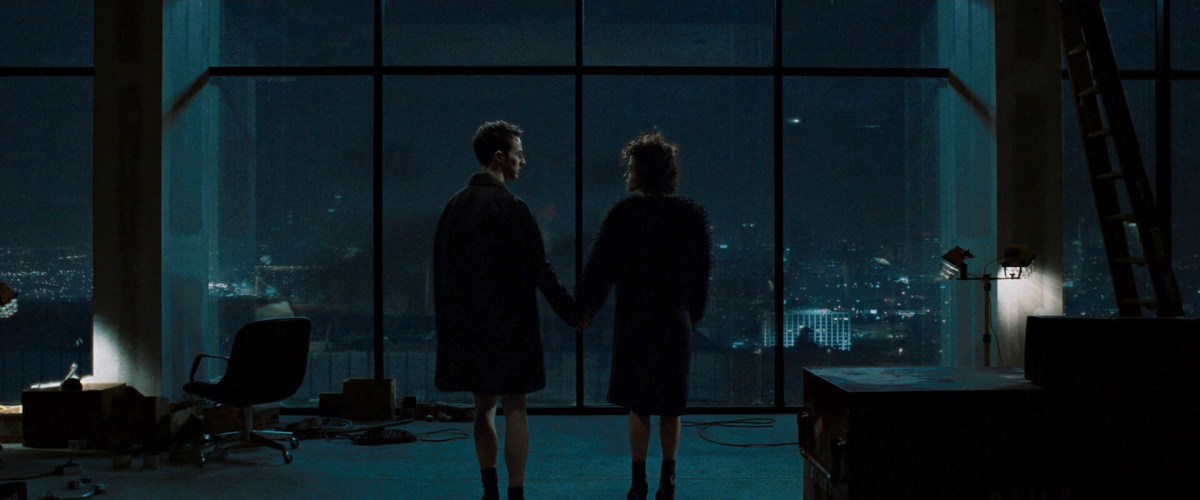
I am Travis’ Essay on Love, Sex, Masculinity, and Fight Club

Travis Woods
March 2024
Bright Wall/Dark Room: Issue 129: 1999


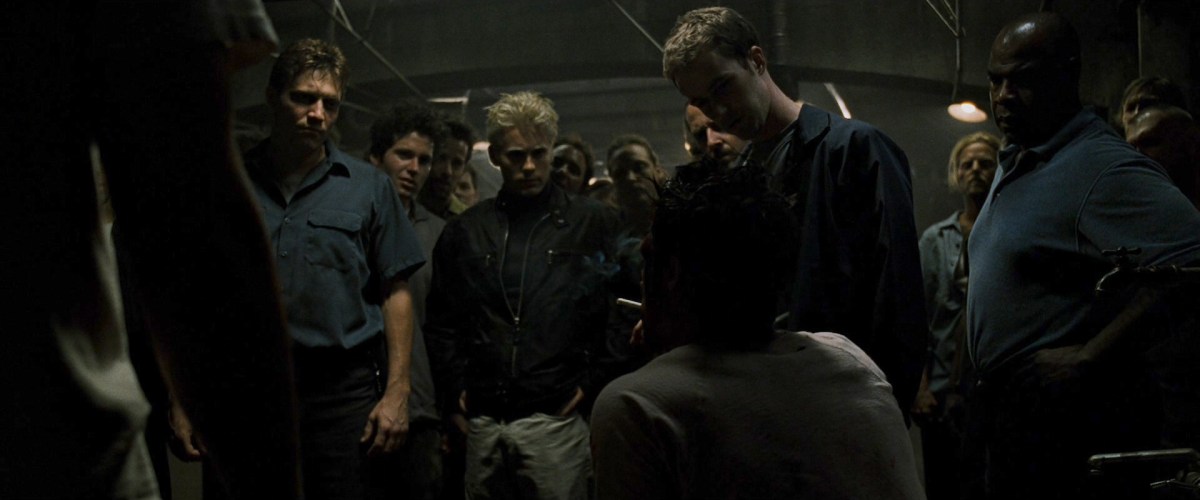
A dark room. Two bodies in the center, colliding beneath the amber haze of a single hanging light bulb.

The first rule of watching Fight Club is: the film is not misogyny-pumped propaganda for incels.

All you can hear are flat, hard packing sounds over yelling.

The second rule of watching Fight Club is: the film is NOT misogyny-pumped propaganda for incels.

Muscles ripple. Lips pull back from teeth like swollen window shades. 

Third rule of watching Fight Club: it’s not an anti-capitalist tract; it’s not really a consumer critique.

The wet choke of a gasp. Snorting bull-breath plumes of carbon dioxide exhale from one face into another.

Fourth rule: it’s not even an indictment of white-collar workplace drudgery at the end of the 20th century.

An arm wraps around a neck from behind, the crude approximation of a desperate headlock.

Fifth rule: it’s not a movie in support of anarchism, fascism, terrorism, or any other –ism.

That arm slips upward from all the sweat and the momentum, catching the other’s lip, hard.

Sixth rule: of all things, it’s a film about taking responsibility.

That lip bursts. An arc of spit, braided with a little bit of blood, sprays out into the darkness in a bubbly pink froth. For some reason, they both think of soap when they see this. And smile.

Seventh rule: it’s about a boy terrified of a girl, and of what she might mean for him. Mean to him.

The two bodies fall back down onto the sweat-softened mattress as one. This rawboned man, this bedraggled woman. She pretzels her legs around his hips, his laughing mouth is pulled to hers.

And the eighth and final rule of watching Fight Club: this is a fucking love story.

Read the full essay

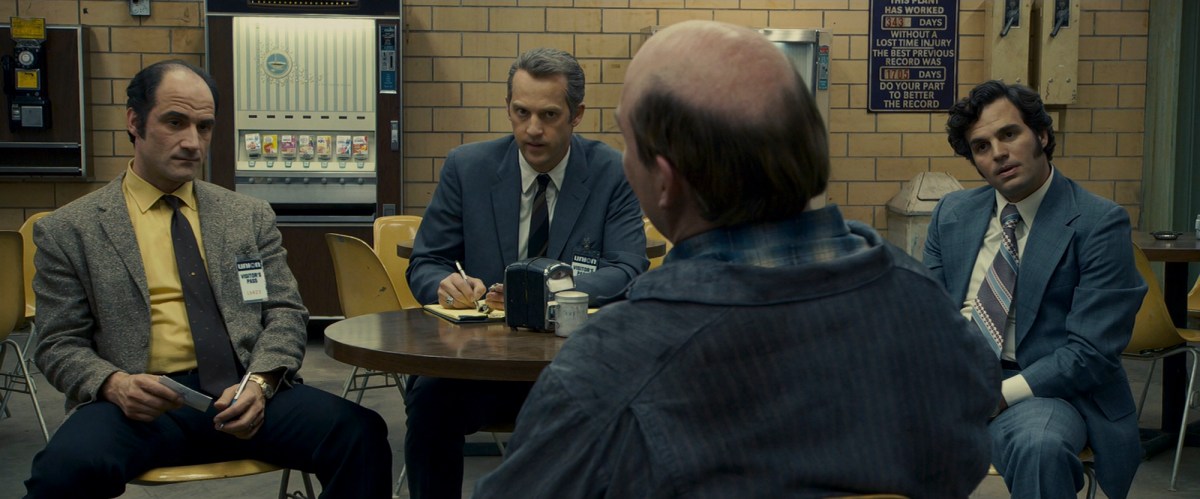
Zodiac (2007): The Human Narratives That Emerge From the Data

What starts out as a collection of data fragments in a murder case builds into a fascinating story of human and philosophical dimensions…

Andrew Sidhom
June 22, 2021

Warning: This article discusses many of the ending scenes

In my previous piece, focused on Mank (2020), I wrote about the idea that a story is essentially a lens on truth, as it joins together distinct pieces of information and events into a connected whole, and inevitably does so through the storyteller’s lens (their particular way of joining the pieces). That film, the latest in David Fincher’s filmography, was more specifically about the truth of people, and about how a storyteller gets to their truth without locking it and owning the keys to it.

Thirteen years back in the director’s work, Zodiac dived in not-too-dissimilar waters, but expanded them in many directions of its own. It remains Fincher’s top work to date.

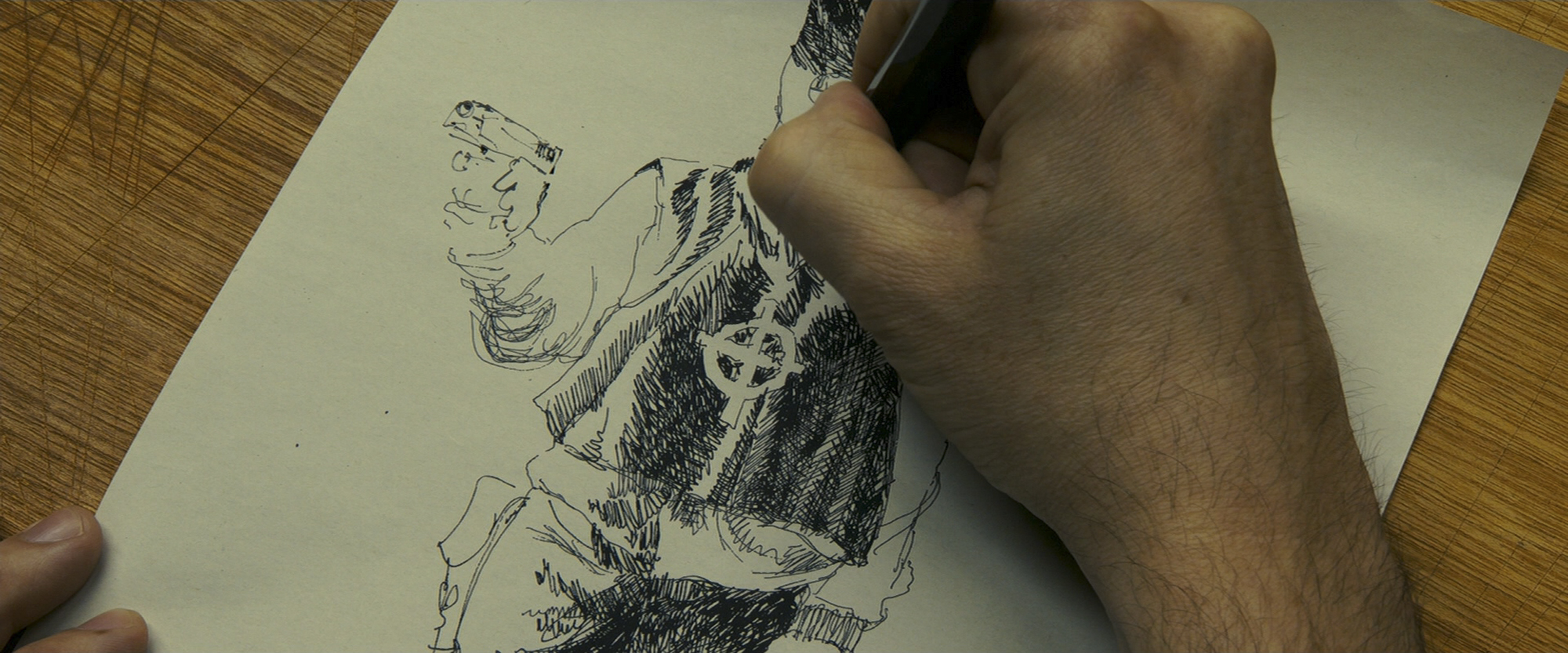
Zodiac is the story of a time and a place in which Fincher spent much of his childhood — the San Francisco Bay Area in the late 60’s and early 70’s — marked by public alertness to a murderer who used to write cryptic letters to the police and to newspapers. From the opening scene, this enigma of a man is slowly drawn.

It’s natural that any story that features at its center a mysterious serial killer who goes uncaught will always have a special aura reserved for that character. But even if Zodiac doesn’t exactly play against that idea, it’s also clear enough that the film is not in the business of drawing the archetypical picture of a God-like criminal mastermind. The titular character, who may or may not be among the ones we see onscreen at different times, can by turns come across as weak, child-like, in need of help and/or largely insignificant. He may be responsible for a small handful of crimes, but the fact is that he repeatedly claims to be much deadlier than he really is, at one point taking responsibility for as many as 37 victims without there being the least bit of evidence for it. He is a case of enigmatic broken humanity that remains beyond grasp.

But the mystery draws people in. In one sense limited by statements such as “Do you know that more people die in the East Bay commute every three months than that idiot ever killed?” and in another sense taking on a life of its own, the Zodiac enigma becomes huge in public consciousness.

Read the full essay

‘Mank’ & David Fincher: From the Quest for Truth to a Deeper Humanity

A perspective on the latest film in the director’s filmography.

Andrew Sidhom
May 8, 2021
Frame Rated

Warning: This article spoils the ending of Mank.

There’s little doubt that David Fincher and many of the characters he’s interested in — detectives, investigative journalists, screenwriters — are concerned with the search for truth. A point repeatedly raised is how attainable truth really is. What if, asks Zodiac (2007), at the end of years of research, the truth remains, and will always remain, out of reach? What if, in The Social Network (2010), we approach the truth of the main character’s motivations by way of a variety of angles, depositions, and second-hand accounts, but leave significant gaps in that truth that linger beyond the final frame? What would be the effect on audiences? The concern with truth and with the lack of it runs through so much of the director’s work.

From that concern with attainability of truth, the negative inference that might follow when watching these films is that we can’t hope to know a great deal about anything or anyone. In highlighting people who are grasping in the dark and who, as a result, see their obsessive or destructive sides come out, Fincher’s films can be troubling. But they’re also too rich to stay at that.

What I propose in this piece is a different angle through which we can approach the question of truth — one I find more interesting, that emerges with just as much clarity from Fincher’s work, and that can give rise to a more positive perspective on these issues. It’s not a question of finding easy uplift, but the wrestled and difficult kind of move towards positive meaning that I think these works warrant.

Read the full essay

Fight Club. How (Not) To Become A Space Monkey

Tom van der Linden
Like Stories of Old (YouTube)

Movies have always had a strong impact on me, they affect the way I look at the world and help make me a better person. With this channel I want to explore this boundary between film analysis and life lessons, because I believe that movies, just like the stories of old, contain valuable lessons and insights, and to better understand them is to better understand life.

In this video essay on Fight Club, I examine how charismatic leaders like Tyler Durden turn men into Space Monkeys.

Support this channel
Leave a One-Time Donation

Follow me on Facebook, Instagram, or Twitter.
Say hi: likestoriesofold@gmail.com
Business inquiries: lsoo@standard.tv

Sources:
Ernest Becker – The Denial of Death
Like Stories of Old – Complete Reading List

Featuring:
‘Where Is My Mind’ cover by Alex Voulgaris. Follow Alex on Instagram.
‘Where Is My Mind’ cover by Gattobus
Additional Music:
Skyler Lawson – Eclater
Luke Atencio – Projections
Additional music licensed from Musicbed

Sponsored by MUBI. Start your 30 DAY FREE TRIAL now.
With the support of Creative Europe – MEDIA Programme of the European Union.

LGATs and Fight Club. Dissecting a Delusion

In 1989 Chuck Palahniuk participated in a controversial type of “personal development” seminar, known generically as a large group awareness training (LGAT) and, according to Palahniuk, this seminar inspired him to become a writer.

In the two decades since Fight Club was published and released, film reviewers, academics, journalists, and the public have largely agreed about Palahniuk’s commentary on consumerism and masculinity; however, just as Tyler Durden spliced single frames of pornography into family films, it will be argued that Chuck Palahniuk, and later David Fincher, spliced numerous references to the LGAT industry into Fight Club. It will be contended that, while Fight Club touches on multiple themes, a major metaphor relates to Palahniuk’s involvement with these organisations.

Because Palahniuk and Fincher refer to various individuals, processes, criticisms, and critics associated with LGATs, this analysis will start with an overview of the LGAT industry. Evidence of Palahniuk’s participation in the most well-known LGAT of its time will then be provided, and the remainder of the paper will discuss the parallels between this industry and the book/film.

John Hunter, author of this essay, was diagnosed with bipolar I disorder in 2003 and since then has been trying to understand the illness, and its impact on belief-formation. In 2017 John completed his PhD in psychology, contending that a brutal form of “personal development” training triggers a bipolar state (hypomania/mania), that this experience contributes to a kind of religious conversion… and that Chuck Palahniuk and David Fincher were satirising these trainings in Fight Club.

Read the full essay

Deep Dive. Show, Don’t Tell: MINDHUNTER

Jackson (Twitter)
September 30, 2019
Skip Intro (YouTube) (Patreon)

“Show don’t tell” is common writing advice, but in a show with no action, how does that work?.

Stream Theory – The First One: Disney+ Pricing, CBS + Viacom Merger, Mindhunter S2

Skip Intro & Thomas Flight
September 12, 2019
Stream Theory

A guide to Netflix, Disney+, HBO Max, Apple TV+, Amazon Prime Video and Hulu as they compete in the ongoing streaming wars and what it means for the stuff you actually watch.

Listen to the podcast: Apple Podcasts, Spotify

What Makes Mindhunter So Compelling? An Analysis

Thomas Flight
August 16, 2019
Netflix UK & Ireland (YouTube)

Mindhunter is not like other crime shows. In this video essay, Thomas Flight explores some of the inventive techniques creators Joe Penhall and David Fincher employ to inject drama and conflict into the show.

This is a detailed analysis of the ways in which Mindhunter pulls the audience into the lives of its characters as they explore the minds of some of the worst criminals on earth.

Mindhunter’s Brilliant Editing. A Breakdown

Thomas Flight
September 25, 2019
Thomas Flight (YouTube)