When tackling a period-centered project like Mank, David Fincher and his assembly of below the line craftspersons create magic, fully immersing the viewer in a faithfully recreated 1930s-era California. While the project leveraged many real-world locations and built sets, changing times and the absence of an unlimited budget posed some challenges to create that immersive world Fincher and team demanded. To complete the illusion, the filmmakers looked to co-producer Peter Mavromates, who led a team of four visual effects (VFX) supervisors.
Now, Mank isn’t effects-heavy The Avengers, but that doesn’t mean VFX aren’t just as critical to the film’s storytelling and overall atmosphere.
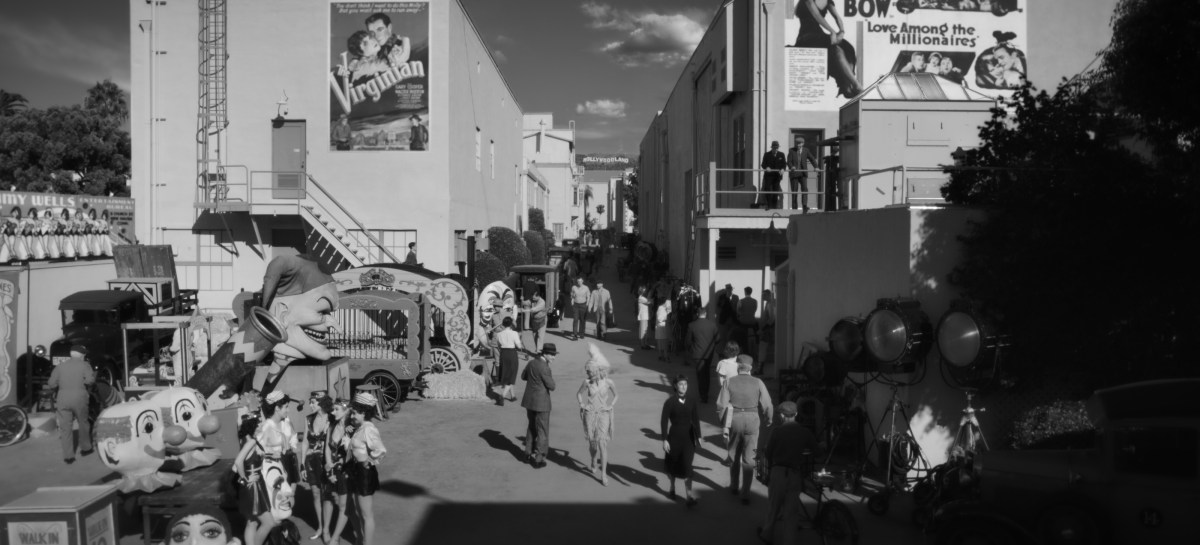
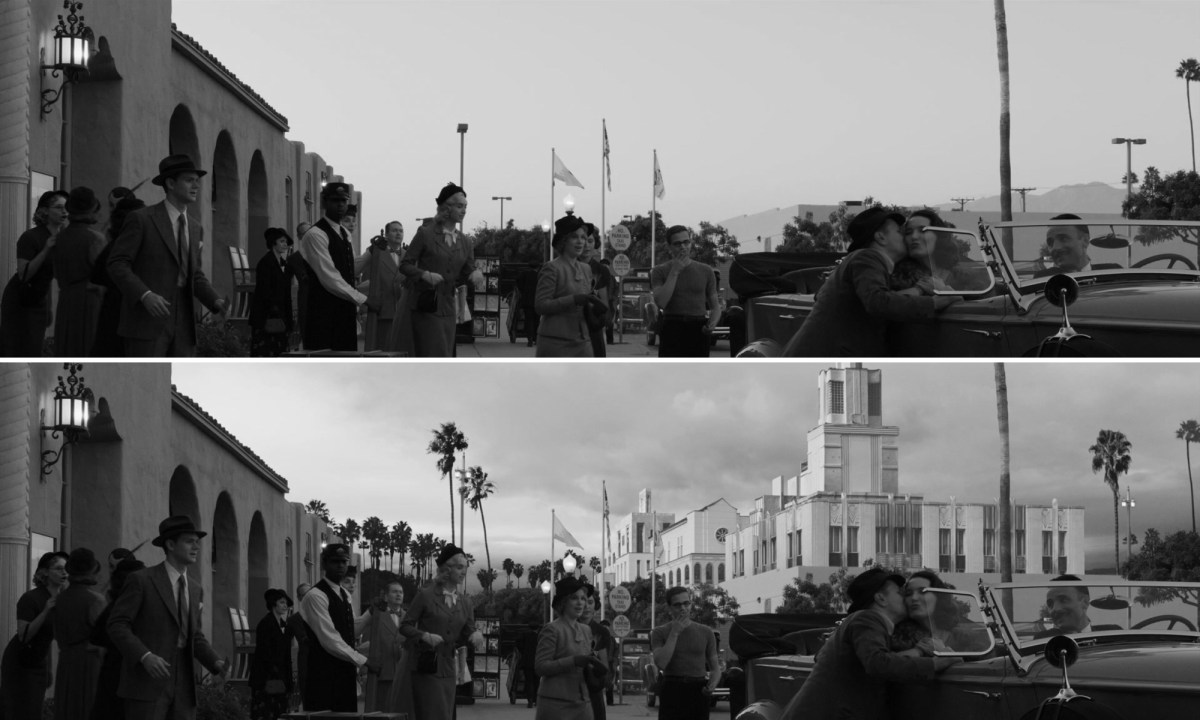
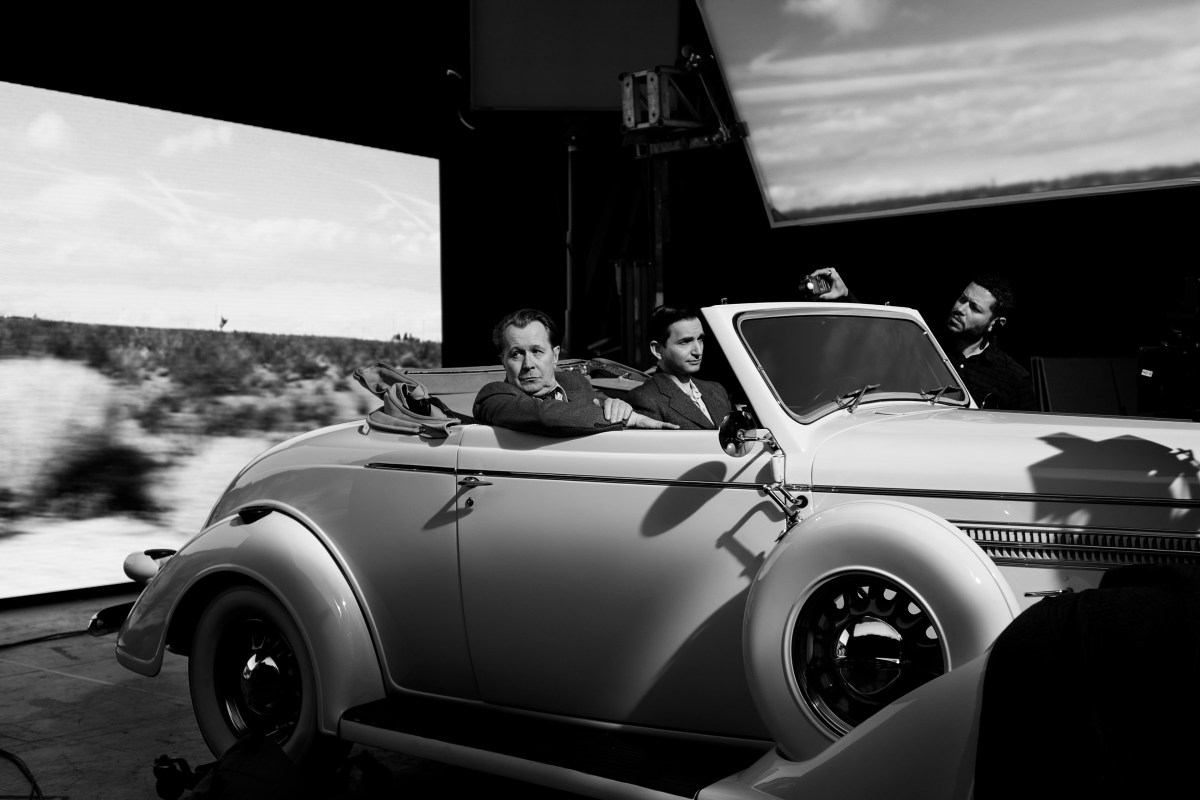
“The assumption, at minimum, is that you’re going to at least need to retouch a background to get rid of modern anachronisms,” Mavromates explained. “As in this movie, there are situations where David [Fincher] will want to actually replace the background so that period buildings are back there.”
Director David Fincher tasked the sound crew with reviving the feel of the Golden Age of Hollywood in the track. They came up with a process of combining old and new technologies to create a “patina” for playback.
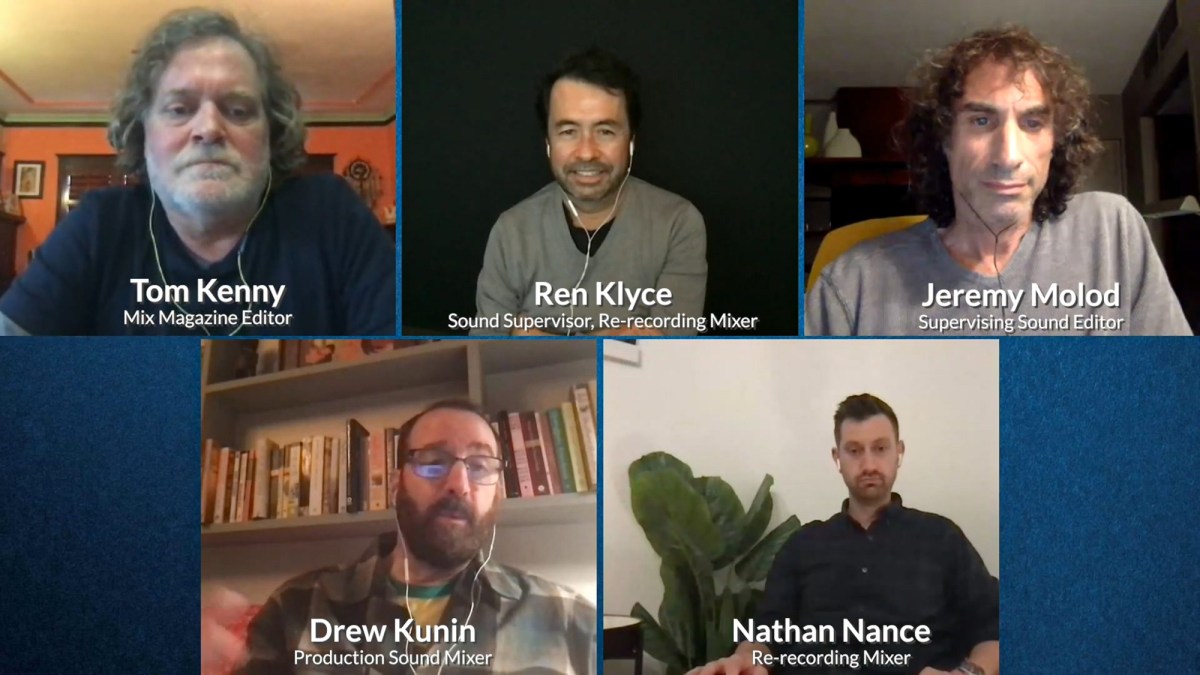
Ren Klyce, Sound Designer Drew Kunin, Production Sound Mixer Jeremy Molod, Supervising Sound Editor Nathan Nance, Re-Recording Mixer
Orson Welles’ Citizen Kane was made at the height of Hollywood’s so-called Golden Age, a time when studios controlled their stars and super-producers like Louis B Mayer reigned supreme. David Fincher’s Mank, which tells the story of how legendary screenwriter Herman J Mankiewicz wrote one of the greatest films of all time, is a faithful reconstruction of Tinseltown as it appeared in the 1930s and early ’40s.
The unmistakable air of Old Hollywood glamour that infuses every frame of Mank was the result of months of planning and preparation by production designerDon Burt, who has worked on every Fincher release since 2007’s Zodiac.
Burt walks us through the key locations from the film, some of which were scouted by himself while others were created on studio soundstages – just as Welles would have done.
There are many reasons why there’s a general wave of excitement whenever there’s a new David Fincher movie. That’s particularly been the case with Mank considering the six-year gap since Fincher’s last film Gone Girl, roughly half that time in which Fincher was making the series Mindhunter for Netflix.
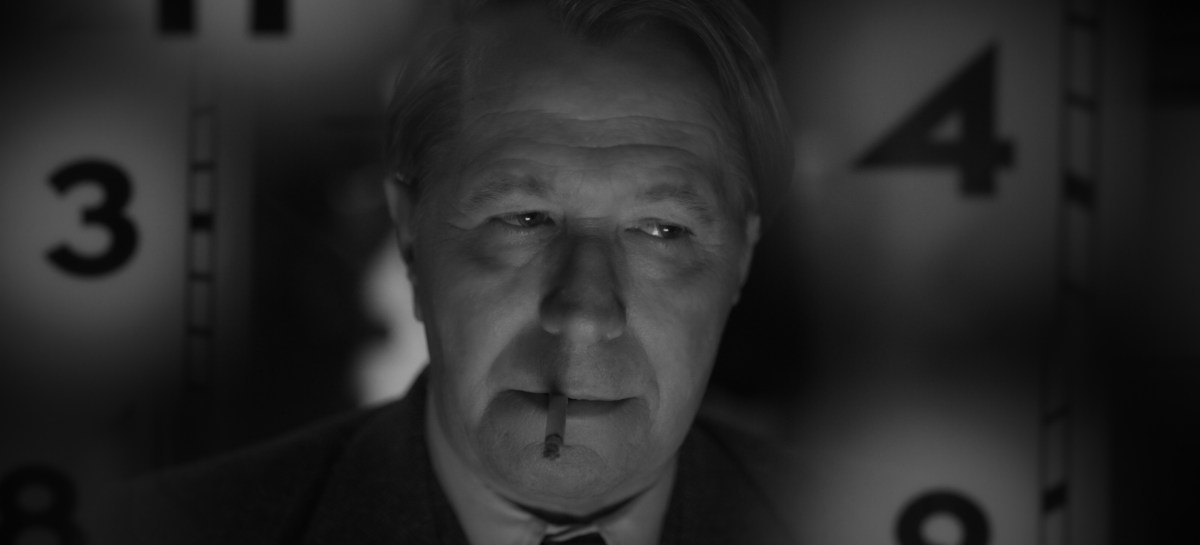
Most of Fincher’s fans within and outside the industry see the filmmaker as a modern master of the visual medium, and Mank offers further proof of this with stunning shots recreating Hollywood in the ‘30s and ‘40s, fully realized background environments in which well-known icons from the era discuss the political climate of the times, both in the country and in Tinsel Town itself. At the center of it all is Gary Oldman’s Herman Mankiewicz, the illustrious screenwriter who would win a shared Oscar for co-writing Orson Welles’ Citizen Kane.
One person who has been along for the ride watching Fincher’s rise as a visionary filmmaker is Peter Mavromates, whose first film with Fincher was 1997’s The Game, but who first met the director on a Michael Jackson video and a commercial he directed. Mavromates has worked in post for over 35 years, as one of the first to champion the benefits of combining analog film with digital post, producing his first DI (Digital Intermediary) for Fincher’s 2002 movie, Panic Room, which was shot on analog. Five years later, he did the same for Zodiac, Fincher’s first digitally-shot film.
As Fincher’s Post-Production Supervisor, Mavromates’ duties continued to expand and evolve, his duties involving all the budgeting and hiring when it comes to the post process. “I like to describe it as once the image is captured, it becomes my problem,” he told Below the Line over a Zoom call a few weeks back.
Netflix’s Mank marks editor Kirk Baxter’s fifth cinematic collaboration with director David Fincher. It’s a collaboration that proved extremely rewarding for the editor who received two Academy Awards for his work with Fincher — 2010’s The Social Network and 2011’s The Girl with the Dragon Tattoo. In fact, Baxter and then co-editor Angus Wall achieved an incredibly rare feat with their Dragon Tattoo win given its lack of a Best Picture nomination.
That successful collaborative history with Fincher stems from Baxter’s willingness to accept feedback and push his work to be the best it can be.
“I don’t seek to be finished, and I remain curious with the material. I don’t work from a defensive standpoint. I don’t have this protectionist quality about the work I’ve done,” Baxter explained when ruminating on his partnership with Fincher. “I just show the work, and if he’s into it, he’s into it. If he’s got a way that he thinks it can be improved, then I’m into that. That’s the relationship. It’s a lot of back and forth, and I’m really comfortable doing it.”
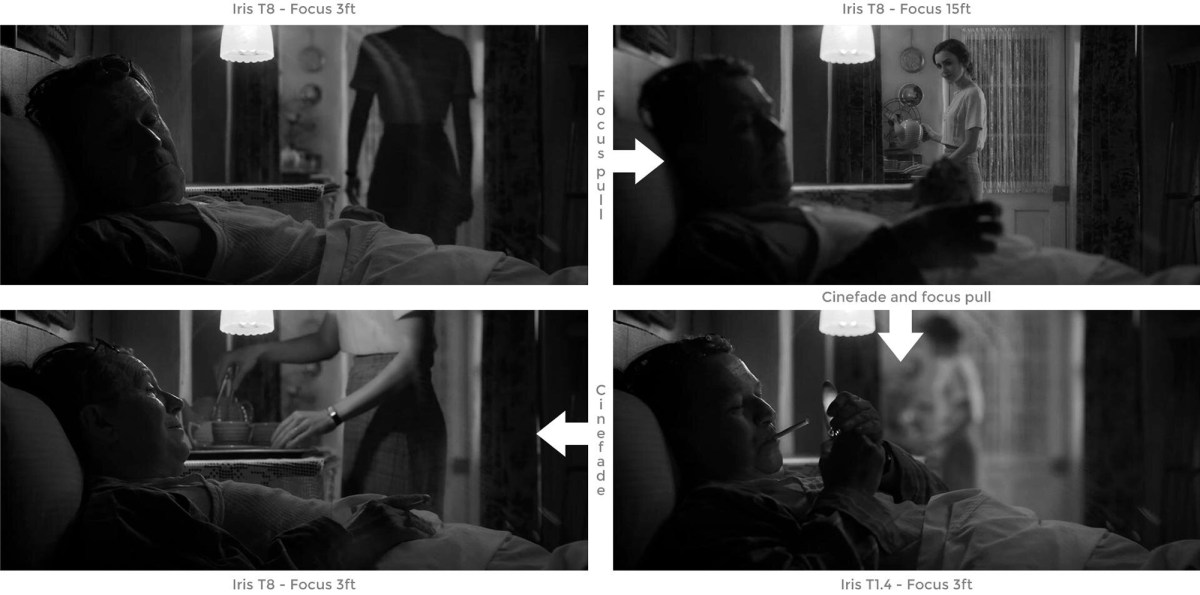
Mank (2020) was beautifully shot by Erik Messerschmidt ASC in black and white, with scattered visual references to Citizen Kane (1941) – often cited as the best film ever made. The original cinematographer for Citizen Kane,Gregg Toland was incredibly influential, according to Messerschmidt. One of the most revolutionary things about Citizen Kane was Gregg Toland’s use of deep focus and Mank pays homage to this signature technique and introduces a novel storytelling tool – the Cinefade variable depth of field effect.
Oliver from Cinefade caught up with Erik to discuss his use of the VariND on Mank and his thought process behind some of the Cinefade scenes that feature a variable depth of field.
“There’s been a loss of using focus as a storytelling tool these days. You are always sharp on whoever is talking in modern cinema and I liked the idea of taking bespoke moments in the film and isolating characters with a variable depth of field. David [Fincher] had asked for a way to do this and it became a huge part of the film. I love the product, it’s great.”
Earning your stripes as a cinematographer can be hard enough. But the prospect of shooting your first movie with a Golden Globe, Primetime Emmy and BAFTA Award-winning director, about one of the greatest films of all time, starring some of the best actors working today, and capturing it all in HDR B&W, would seem perfectly daunting.
“Yes, it was quite intimidating, but it was also unbelievably exciting,” admits DP Erik Messerschmidt ASC, as he recalls the invitation from David Fincher to capture the filmmaker’s next movie – the biographical drama Mank.
Mank takes place in Hollywood during the 1930s and early 1940s. It follows screenwriter Herman J Mankiewicz, played by Gary Oldman, and the process he undertook for Orson Welles to develop the screenplay for what would become Citizen Kane (1941, dir. Orson Welles, DP Gregg Toland ASC). Nominated in nine categories at the 1942 Academy Awards, Citizen Kane won the Oscar for Best Original Screenplay, shared by Welles and Mankiewicz.
The film, based on a screenplay by the director’s late father Jack Fincher, alternates between time periods, echoing the non-linear narrative of Citizen Kane, and revealing the trials and tribulations in Hollywood that inspired some of the characters and situations seen in the movie. These include Mankiewicz’s friendship with starlet Marion Davies, played by Amanda Seyfried, his association with newspaper tycoon William Randolph Hearst, played by Charles Dance, and his turbulent professional relationship with Welles, played by Tom Burke.
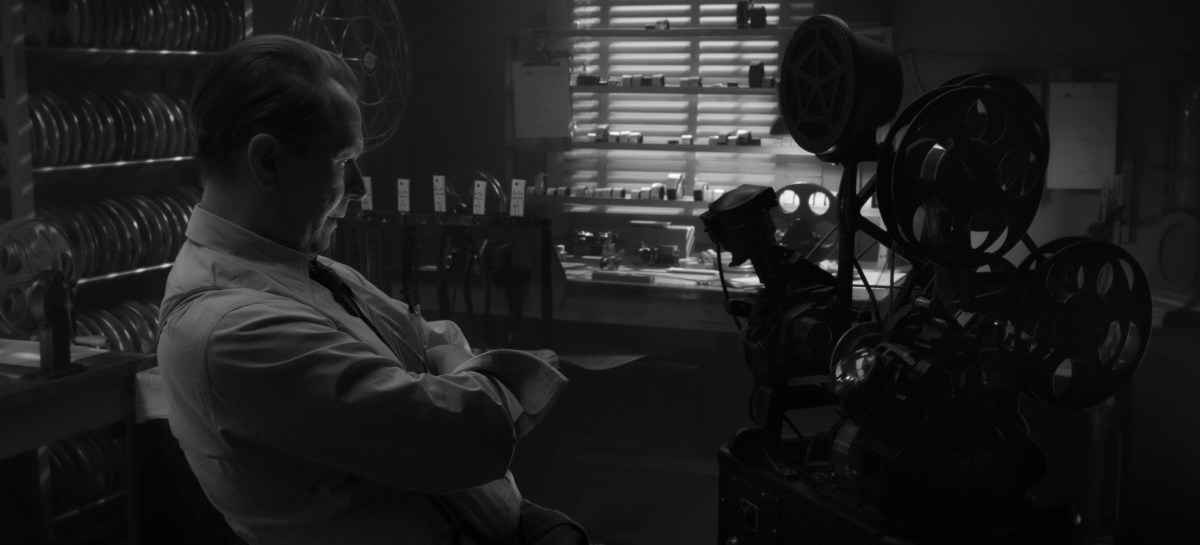
Shot entirely at 8K in High Dynamic Range monochrome, Mank also features allusions to Toland’s innovative cinematography, as well as classic day-for-night production techniques, and tips its hat to classic moments in the original film.
Mank had a limited theatrical release in November 2020, before streaming on Netflix in December. It received overwhelmingly positive reviews, with particular praise given to the direction, cinematography, production design, soundtrack and the performances, and is expected to feature strongly during the 2021 award season.
Fincher’s directorial credits include Se7en (1995, DP Dariusz Khondji AFC ASC), Fight Club (1999, DP Jeff Cronenweth ASC), Zodiac (2007,DP Harris Savides ASC) and The Social Network (2010, DP Jeff Cronenweth ASC). Messerschmidt,who came into cinematography from being agaffer, had previously lit Gone Girl (2014, DP JeffCronenweth) for Fincher, after which he immediatelymade the leap into cinematography as the leadDP on the first two season of Netflix’s Mindhunter,directed mainly by Fincher.
“I first met David on Gone Girl and got along great with him during the shoot,” says Messerschmidt. “I ended up lighting some promotional stills for that film which David shot himself. It was our first opportunity to work together creatively one-on-one. It went really well, and we stayed in touch. Both he and Cean Chaffin, his producer, knew that I had ambitions to become a DP. So, when Mindhunter came along, they offered me the opportunity to shoot it. We have been working together ever since, and I was thrilled to be asked to shoot Mank.”
For his two most recent films, Ren Klyce re-created how a 1940s movie would have sounded and then imagined the aural feel of life before birth and after death.
Seven-time Oscar-nominated sound pro Ren Klyce, who was born in Japan and moved to Northern California at a young age with his parents, traveled all the way from 1940s Hollywood to an ethereal afterlife in the course of his work as supervising sound editor and rerecording mixer on his two most recent films, Netflix‘s Mank and Pixar‘s Soul. (He’s also credited as sound designer on Soul.)
Klyce has been friends with Mank director David Fincher since they were teenagers and has worked on all of Fincher’s features. The two met working on the George Lucas-produced Twice Upon a Time and, remembers Klyce: “We kind of clung to each other because we were the youngest people on the crew. David was doing visual effects. I was an art assistant back then.”
For the director’s latest effort, about the origins of 1941’s Citizen Kane, Klyce says, “David wanted to have the look and sound of something that was made in the early ’40s.”
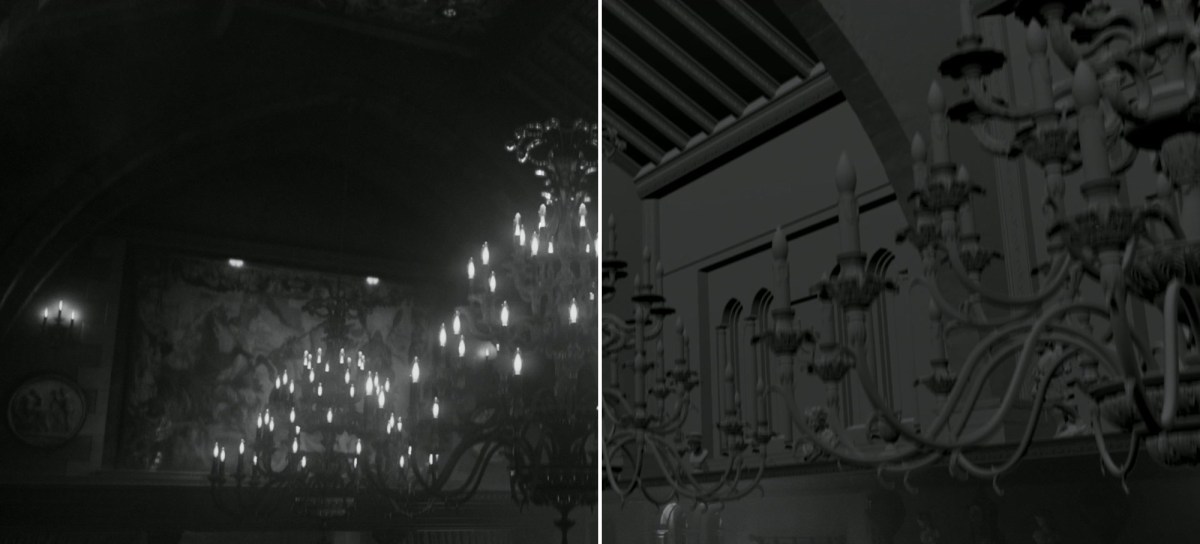
David Fincher set Mank in a world spanning 1930s and 1940s Hollywood. To tell the story of the events and relationships that led to the creation of the great Citizen Kane, Mank looks and feels as if it were made during that same period – a rare feat of technical and crafts wizardry. To re-establish this world, VFX can only get one so far (more on that another time), so Fincher and his production designer Donald Graham Burt needed to recall classic Hollywood structures as well as find a way to recreate the period experience of William Randolph Hearst’s castle located in San Simeon.
And you have to do all of that on an approximate $25 million budget.
“It’s a challenge, and that’s probably the thing that, if anything kept me up at night, then that probably did,” Burt laughed. “In the same token, if you really look at the movie and break it down, it is pretty simple. I’m sort of a minimalist at heart. If you just take it and say let’s keep it simple but let’s build complexity within that simplicity, then it serves you so well in terms of dealing with a tight budget.”
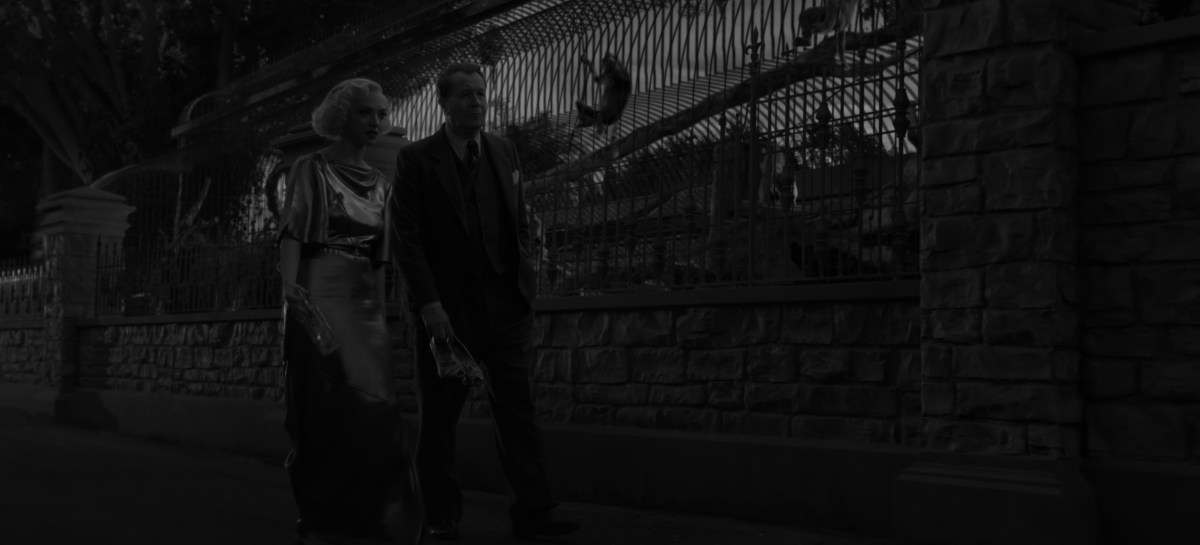
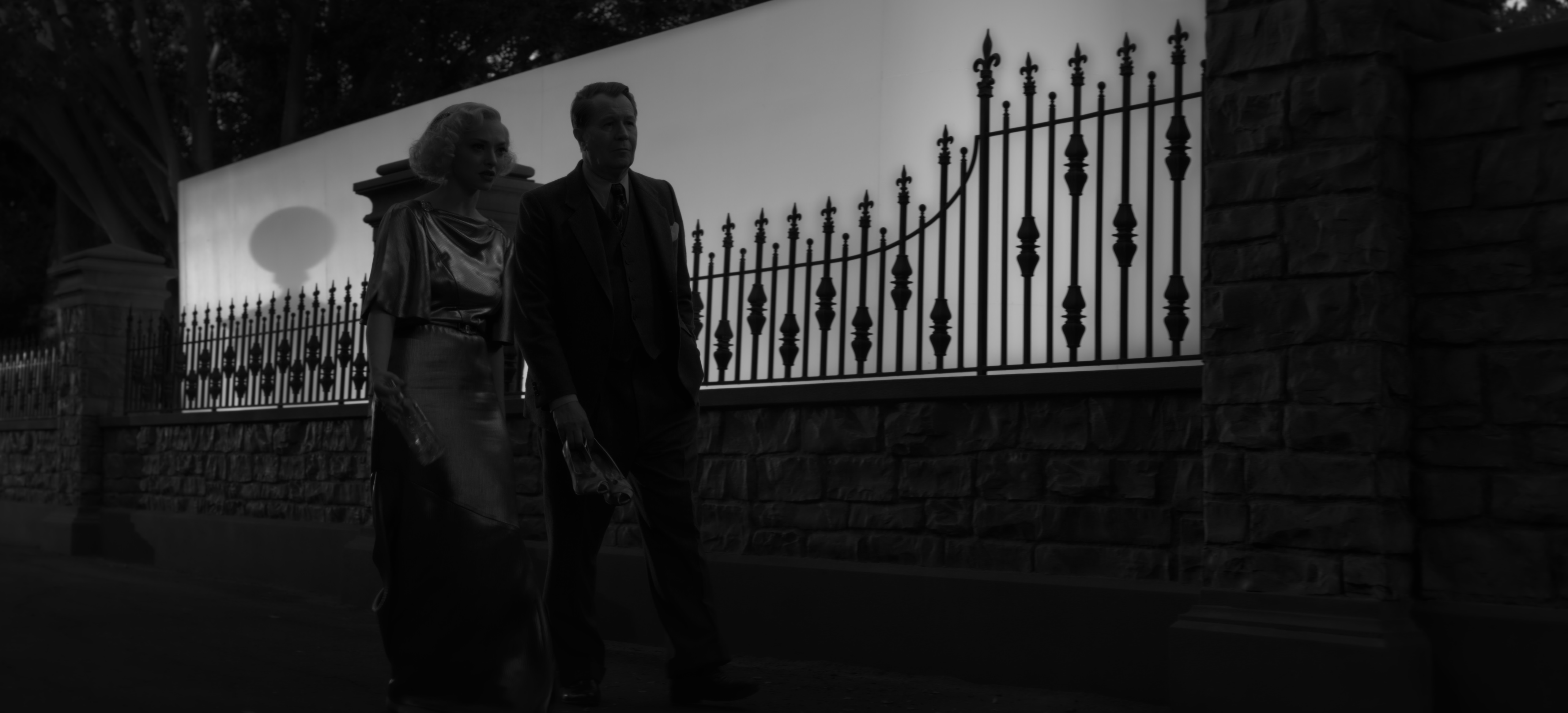
While the “Mank” visual effects team meticulously recreated ’30s-era LA in black-and-white (utilizing the matte paintings of Artemple, Territory’s LED rear screen projection, and Savage’s sky replacement with the Unreal engine), David Fincher took a special interest in directing the photo-real CG animals from Industrial Light & Magic that inhabit the Hearst Castle private zoo.
In a brief but memorable series of exchanges with the animals during their chatty moonlight stroll, Mank (Gary Oldman) and Marion Davies (Amanda Seyfried), are definitely upstaged by the scene-stealing Capuchin monkeys, elephants, and giraffes. “David wanted specific performances from all the animals,” said ILM VFX supervisor Pablo Helman (“The Irishman”). “He wanted the [four] monkeys to be agitated, the giraffes to spring in a certain way, and the elephants to have a response.”

 The Fincher Analyst