H8URS: David Fincher

H8URS

8hours [Eight – Hours] is a site dedicated to bringing film analysis to the masses through video essays, an exciting new format, sprung from the internet.

Video essays are a platform for filmmakers and film buffs to present researched but personalized film critiques, analysis, discussions and lessons to the world. They are a way of democratizing film criticism and the filmmaking process, a direct line to engaging with movie lovers like you.

We believe that you don’t need to go to film school to be a filmmaker and that breaking down the choices made by filmmakers can serve as a key to learning the craft of filmmaking.

There is a lot of contente here, but we can’t take credit for all of it. We’ve spent the better part of a year scouring the dusty corners of the Internet for the best video essays. We then archived each video to the 8hours library according to categories including film title, director, genre and a range of screenwriting and filmmaking techniques.

We know there are tons of talented people out there making videos, but it can be hard, if not impossible, to find them all. As new movies, technology and analysis emerge, our goal with 8hours is to continue to grow while making sure great videos are just a click away.

That’s where you come in:

  • If you know of an essay or creator you don’t see on our site, please Submit a Video.

  • If you have an idea for a video essay you’d like to see made, use our Pitch Box.

And as always, happy viewing:

H 8 U R S : David Fincher

Pressure and Obsession in the Films of David Fincher

Piers McCarthy
February 2012 / November 15, 2018

This dissertation aims to show the recurring themes of pressure and obsession in the work of film director David Fincher. Looking specifically at Seven (David Fincher, New Line Cinema, 1995), Zodiac (David Fincher, Paramount Pictures, 2007) and The Social Network (David Fincher, Columbia Pictures, 2010), I will show the gradual change in style and subject matter while still highlighting the resonance of the two themes under analysis. Furthermore, it will be shown how obsession and pressure link to Fincher’s working method. I will be examining critical, journalistic and academic writings to assess the themes and Fincher’s directorial position. Whereas Seven has had a great deal written about it, Zodiac and The Social Network are more recent films and thus there is less literature on them. For this reason, study on both films should garner more original analysis.

The themes of pressure and obsession differ slightly in all three films, however, there is an overriding sense in each film that the workplace and environment has a pressurizing effect on the characters. What is more, pressure can at times define the notion of obsession. Obsession is mostly shown as a mutation of characters’ personal drive, or an extension of their duties for work. The two themes can at times separate themselves in terms of aesthetic and narrative presentation yet they are mainly one and the same; at times they can even be analyzed in the context of Fincher’s filmmaking practice.

Chapter one gives an overview of contemporary Hollywood, the role of the director, Fincher in relation to both of these, the two themes under analysis and deliberations on auteurist theory – this constitutes the literature review. The second chapter examines the impetus of investigative obsession, along with the presentation of morbidity and tension in Seven. Chapter three looks at the similarity in obsessive personalities along with suspense and drama in Zodiac. Chapter four focuses on The Social Network and obsession effecting status quo. The conclusion will draw on the comparisons and contrasts from chapters two to four. It will also give an overall account of how we may regard Fincher in contemporary Hollywood and in respect to auteur theory.

Read the full dissertation

Murder by Imitation: The Influence of Se7en’s Title Sequence

Tim Groves
April 2018 (Issue 43)
Screening the Past

The serial killer film is nothing if not prolific: Robert Cettl discusses over six hundred examples in his annotated filmography, Richard Dyer argues that there are over two thousand serial killer films, and the IMDB lists more than 3500 film and television titles. [1] As with any genre, the serial killer film is marked by its typicality. Indeed, Philip Simpson criticises the serial killer film as a subgenre that is “endlessly derivative of its predecessors”. [2] The tropes of the clever, fiendish killer, his grotesque, ritualistic ‘signature’ and the gifted but damaged investigator are certainly familiar, but how does the serial killer film replicate itself on a textural level? This article will analyse the influence of Kyle Cooper’s much admired opening title sequence in Se7en (David Fincher, 1995). [3] However, rather than exploring the general influence of the sequence, I will focus on its stylistic similarities to the credit sequences of other serial killer texts such as The Bone Collector (Phillip Noyce, 1999), Red Dragon (Brett Rattner, 2002), Sanctimony (Uwe Boll, 2001), Taking Lives (D.J. Caruso, 2004) and the first season of Whitechapel (Ben Court and Caroline Ip, 2009). I will argue that their imitative or plagiaristic qualities can be interpreted in terms of Mark Seltzer’s work on the repetitive and circular discourse of serial killing.

Se7en

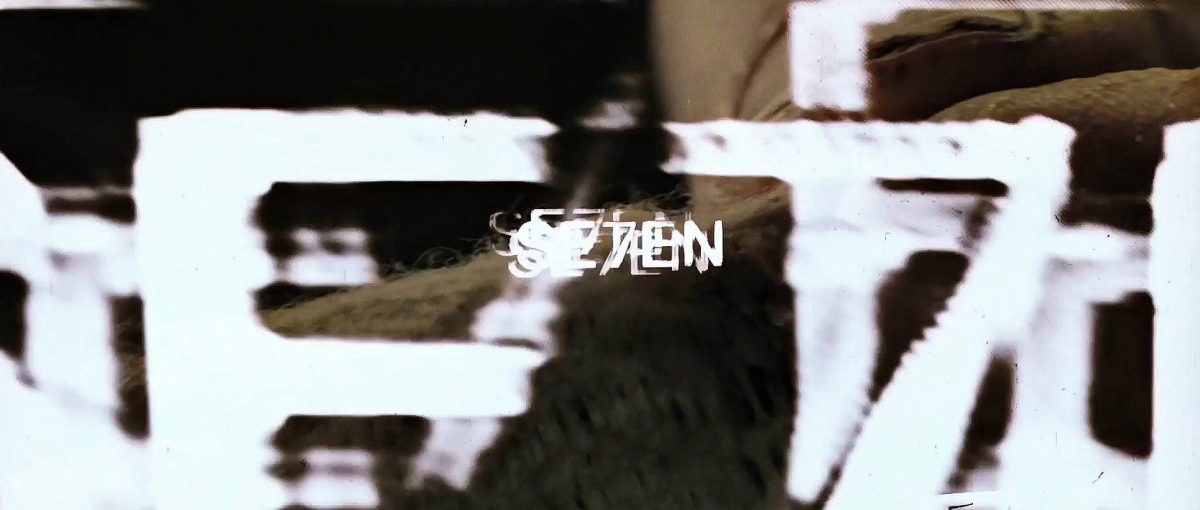
The title sequence of Se7en appears a few minutes into the film, occurring after a brusque initial encounter between Detectives William Somerset (Morgan Freeman) and David Mills (Brad Pitt) at the scene of the first murder. The sequence runs for just over two minutes and contains over a hundred shots, many in close up. It shows a person (whom we retroactively infer is the killer John Doe [Kevin Spacey]) shaving off the skin on his fingertips, and then working on a group of notebooks while wearing bandages. We see Doe writing in longhand, and highlighting and erasing portions of other texts. He also develops photographs and uses scissors to trim Polaroids and pieces of film. Doe incorporates some of these images and texts into the notebooks and then uses needle and thread to stitch the pages of his journal into a book, one of many.

The title sequence provides vital story material for the viewer about Doe’s activities. He removes his fingertips to ensure that he does not leave fingerprints behind, either in his apartment or at crime scenes. This also enables him to toy with the investigators by leaving a message composed of fingerprints on a wall at the second murder scene. Instead of this resulting in Doe’s apprehension, it points the police to his third victim, whose amputated arm was used to ‘write’ the words “help me”. After Doe surrenders, the police discover that he does not have a Social Security number, nor any banking or other official records. He is also, as Somerset states, “John Doe by choice”. His anonymity focuses police attention on to his mission or “work”. Indeed, during the final confrontation, Doe insists that he is not personally important, but that his crimes will be remembered and studied because of their shocking nature and diabolical logic (and Se7en is more memorable than many other serial killer films for precisely this reason).

Read the full essay