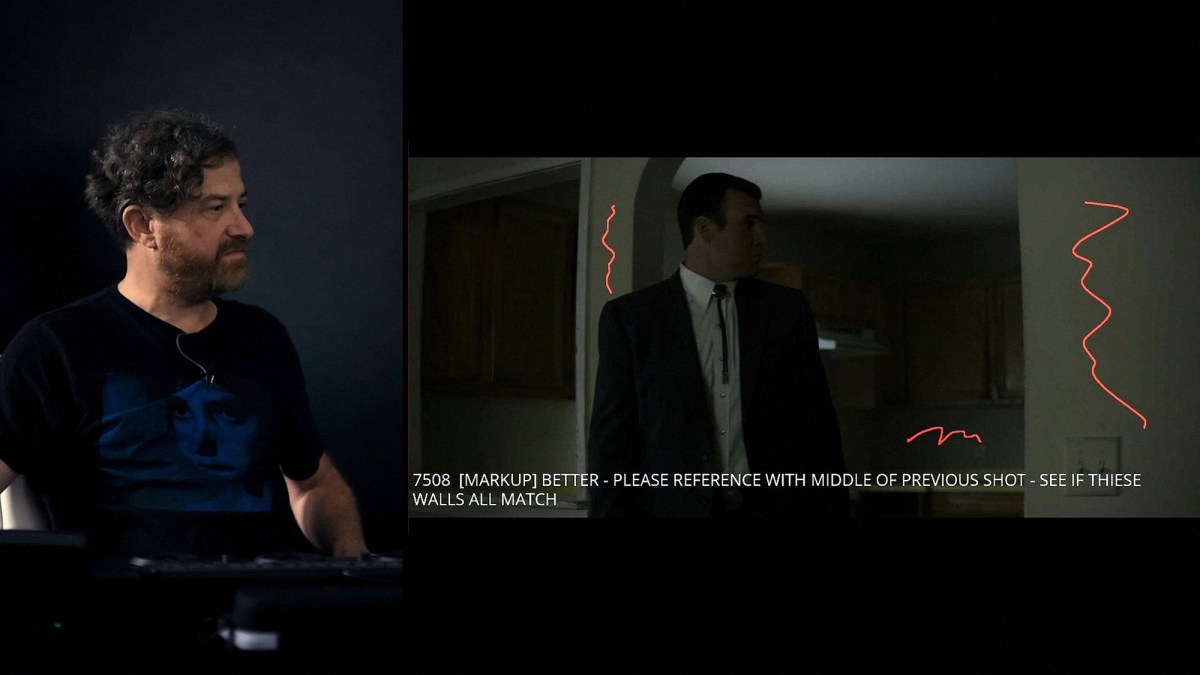
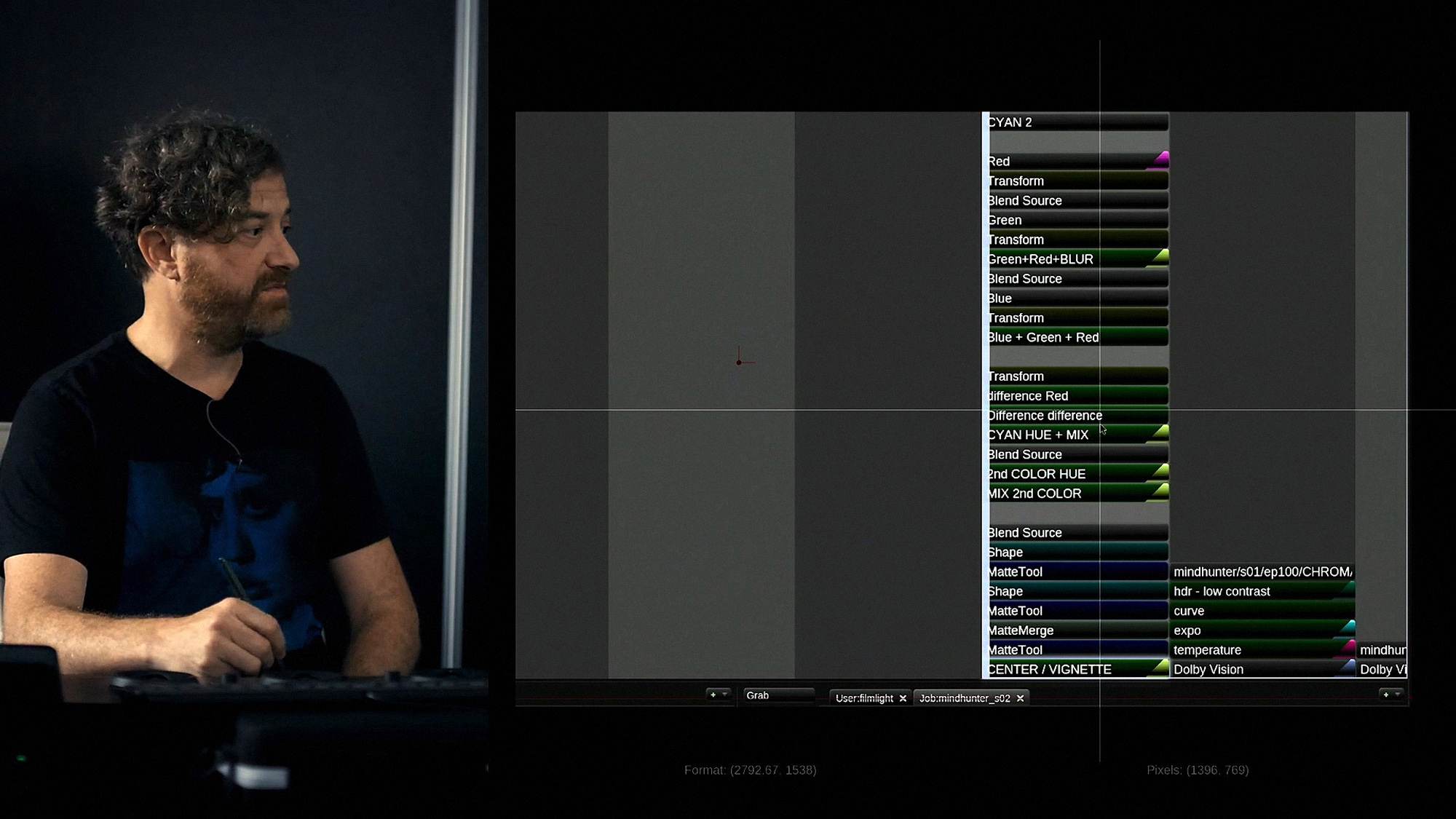
Eric Weidt talks about his collaboration with director David Fincher – from defining the workflow to creating the look and feel of Mindhunter. He breaks down scenes and runs through colour grading details of the masterful crime thriller.
Eric Weidt spent years in Paris working with fashion photographers transitioning from traditional film to digital capture workflows. He created custom film-emulation ICC profiles, and mastered color work and compositing techniques for print stills and fashion films.
Clients included Mario Testino, David Sims, Patrick Demarchelier, Mert Alas and Markus Piggot, Steven Meisel, Hedi Slimane, Karl Lagerfeld. His motion picture work for David Fincher includes responsibilies as VFX artist (Gone Girl), and Digital Intermediate Colorist (Videosyncracy and Mindhunter).
He holds a BA in Theater Arts from the University of California at Santa Cruz and is both an American and French citizen.
Charting the development of the FBI’s behavioural science unit in late 1970’s USA, and based on the true-crime book ‘Mindhunter: Inside the FBI’s Elite Serial Crime Unit‘, Netflix‘s TV series required an effortless recreation of time and place.
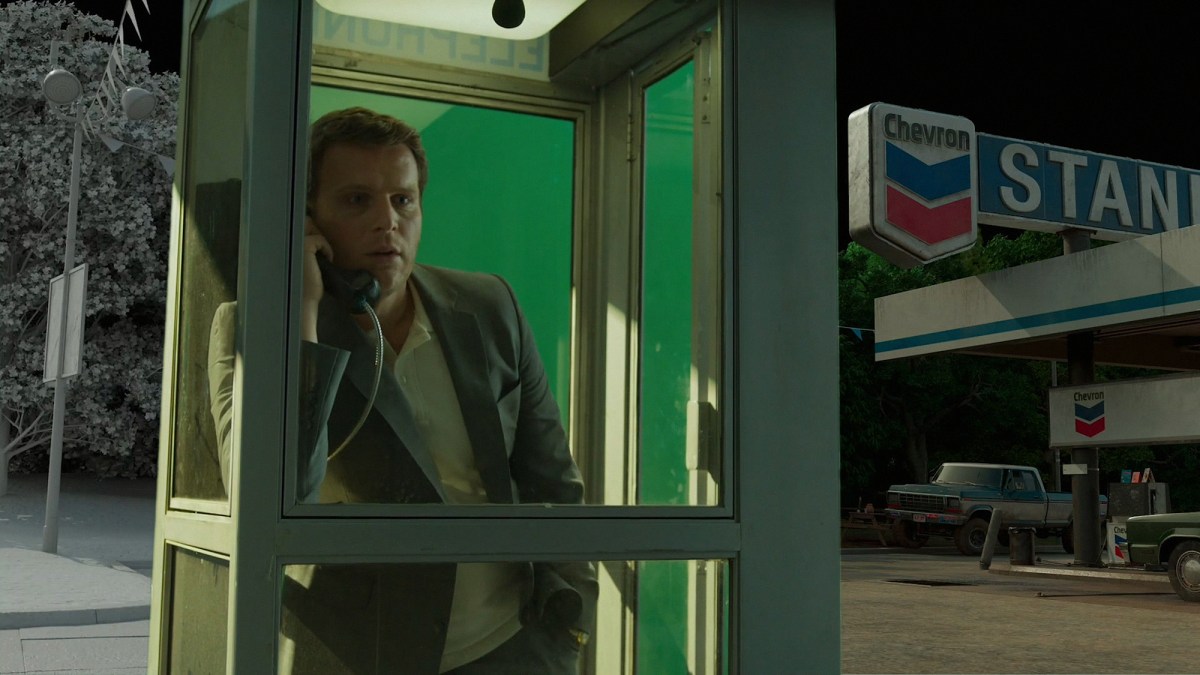
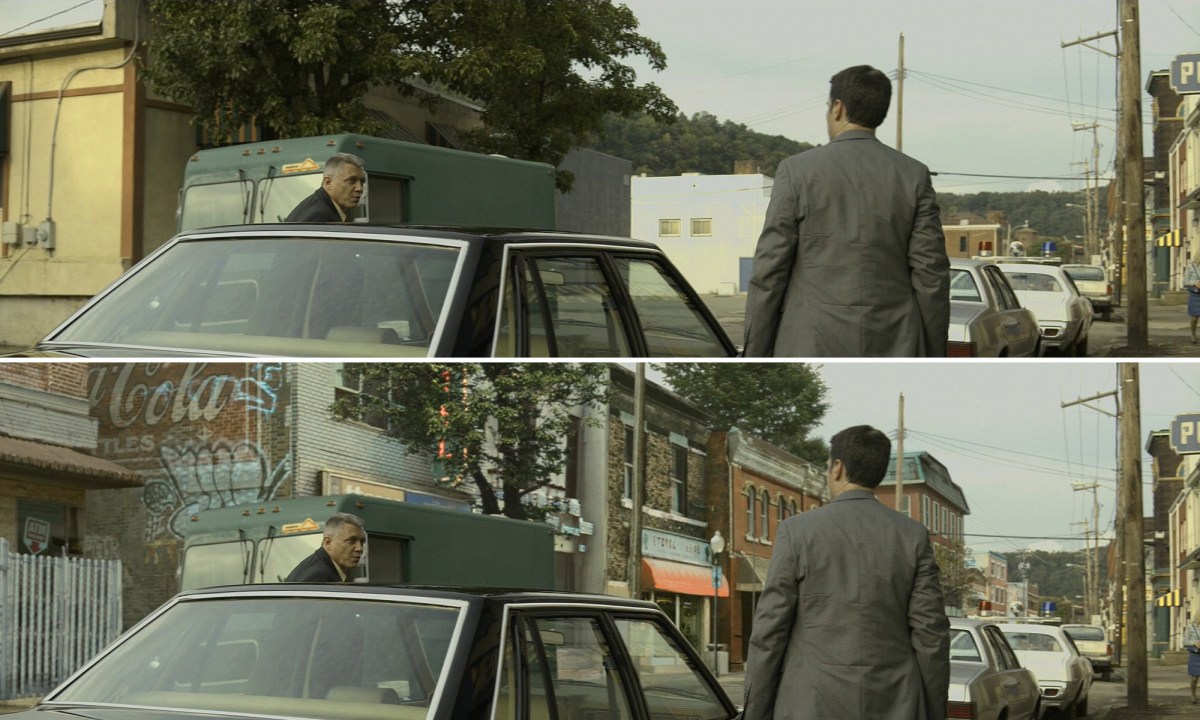
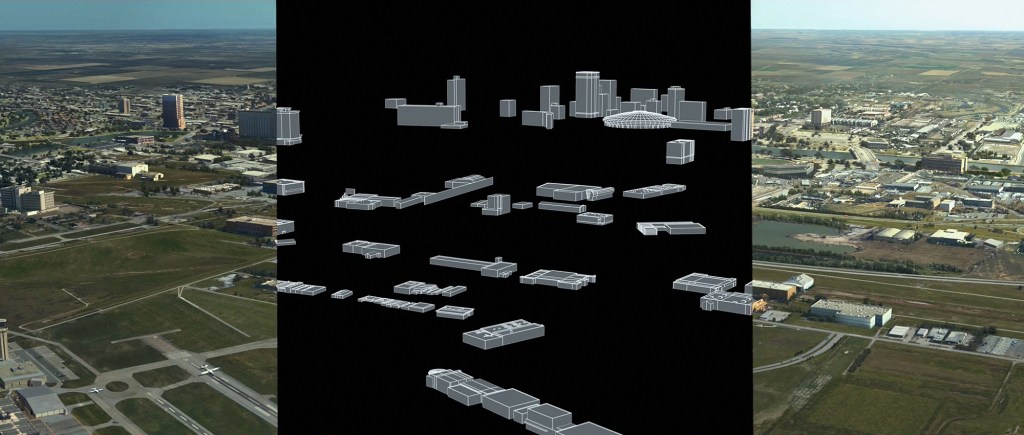
We worked with the production team behind Netflix’s second season of Mindhunter, initially to produce a promo shot which was published across their social media channels, and then to create some stand-alone VFX shots. The scene shots ranged from creating CG backdrops, torches and microphones, to recreating authentic vehicles and helicopters for search scenes. This fascinating series allowed us to become part of legendary Director, David Fincher’s world.
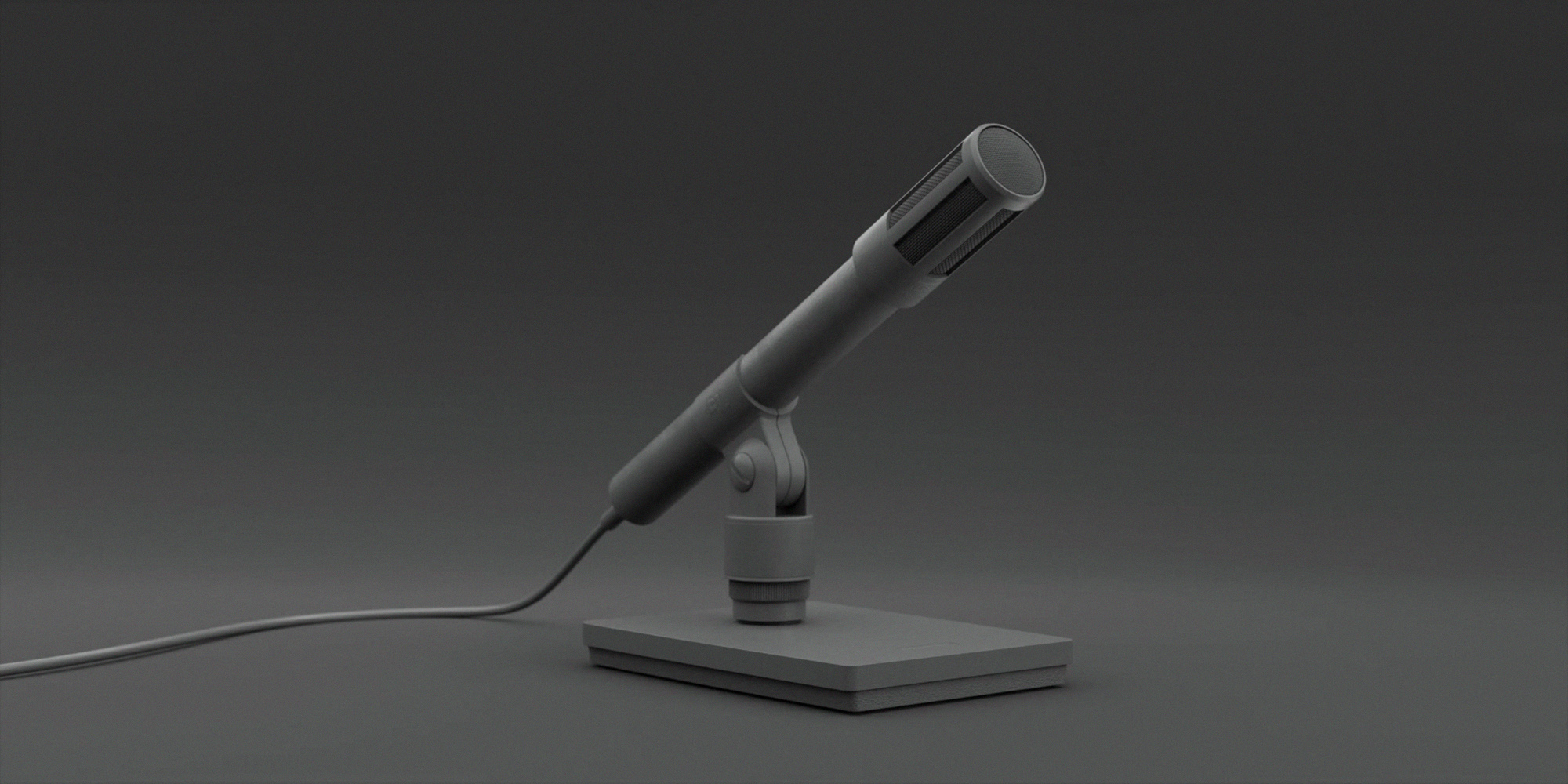
With microphones providing a pivotal accessory throughout both seasons, we were asked to create a teaser recreating their iconic first microphone, which also features in the opening credits, in CG. The teaser was used across their official Facebook, Twitter and Instagram channels before the launch of season 2, garnering hundreds of thousands of views.
… to final scene shots…
Providing final shots in 6K meant working in the finest of detail, at the highest quality. Working closely with Fincher, and the producer, Peter Mavromates, feedback was precise and invaluable, making for a smooth and speedy process. From researching types of trees for the woodland car scene, to playing with atmospheric lighting and weather conditions, we enjoyed this project from start to finish.
Going inside Mindhunter Season 2: there’s a contradiction at the heart of Mindhunter, the highly rated Netflix drama. For all the efforts of creator David Fincher and cinematographer Erik Messerschmidt to craft a minimalist aesthetic for this ripped-from-the headlines chronicle of the modern serial killer and its FBI profilers, the show itself continues to win plaudits for how it stylistically marries editorial with subject.
Season 1 was lauded for shining a light onto this particularly murky corner of the criminal psyche with its desaturated cinematography. “David and I continued with what we had put together for the first season,” Messerschmidt explains. “If anything, Season 2 is even more structured and formalist. That classical aesthetic is driven a lot by the content. The show is very measured in its approach to a story about serial killers so we felt the photography should be restrained and simple.”
Miles Crist / Netflix
Messerschmidt photographed all nine episodes of the new season which returned to Netflix after a two-year hiatus. Directors Andrew Dominik (The Assassination of Jesse James by the Coward Robert Ford), Carl Franklin (House of Cards) and Fincher took charge of blocks of three. Before taking responsibility to shape the look of Mindhunter’s first run, Messerschmidt had worked as a gaffer on shows like Mad Men and Bones, and then the feature film Gone Girl where he first came into contact with Fincher.
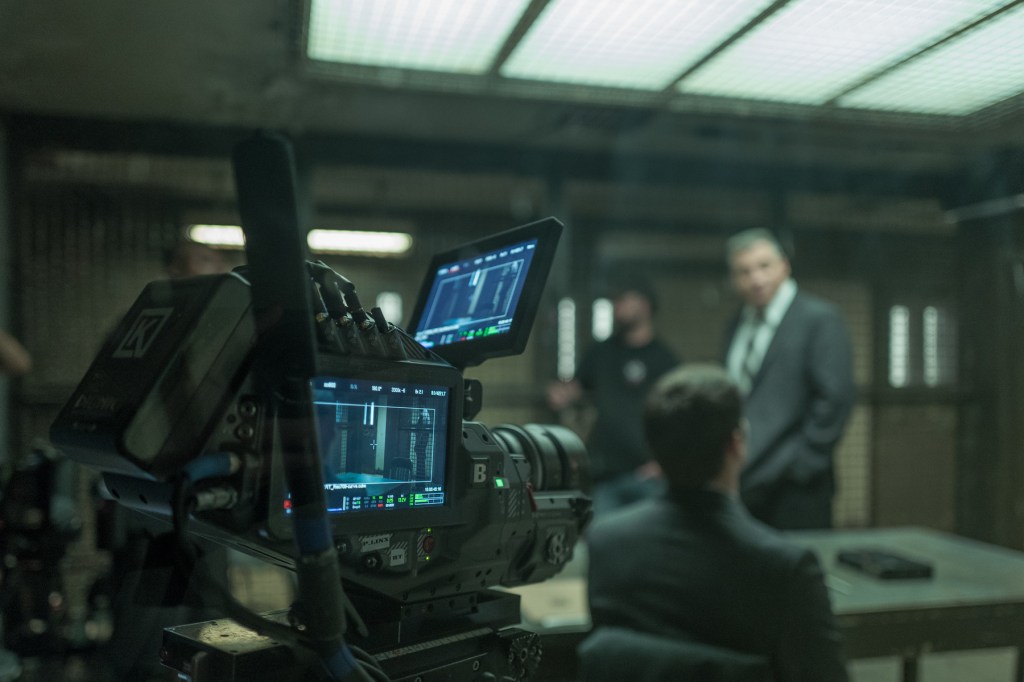
Definitive if subtle changes were made for Mindhunter’s latest season, the most notable of which was shooting with the custom XENOMORPH with HELIUM 8K S35 sensor and being able to monitor HDR on set.
A guide to Netflix, Disney+, HBO Max, Apple TV+, Amazon Prime Video and Hulu as they compete in the ongoing streaming wars and what it means for the stuff you actually watch.
In a world filled with police procedurals, Netflix’s “Mindhunter” has attracted a lot of attention.
Created by Joe Penhall, the series is a police procedural about two FBI special agents, Holden Ford (Jonathan Groff) and Bill Tench (Holt McCallany). It has attracted top-tier talent such as David Fincher, Carl Franklin (“One False Move”) and executive producer Charlize Theron.
The second season dropped last month on the streaming platform. The Australian-born editor Kirk Baxter, ACE, a two-time Academy Award-winner for Fincher’s “The Social Network” (2011) and “The Girl with the Dragon Tattoo” (2012), is the editor of four of the nine episodes.
In an exclusive interview, Baxter talked about serial killers, editing difficult material, and working with the notorious perfectionist Fincher.
You you have had a long and very successful creative collaboration with Fincher. How did you first meet?
Kirk Baxter: I got introduced to David through Angus Wall when Angus was editing “Zodiac” (2007). I got brought into helping out, so I met David when I was already cutting a scene for him. Things went well. I became a puppy that never left.
How you would describe your working methods?
Baxter: I try to rely on him as little as possible because I am familiar with what his days are like, especially during the shooting process. David is incredibly busy, and I like to get on with it.
We work through PIX [a workflow tool that allows production teams to securely share and review content], so I will put a lot of stuff up for him every day and it is the day’s PIX that we critique and do back and forth at his pace.
David is pretty good at being all-consuming. He will tend to get back to me immediately. I don’t really hit him with questions. I just hit him with work.
He shoots, I select, put something together and send it to him and I take the feedback kind of dryly. I don’t take anything from [it as] a personal affront. I just work until it is there, until we are happy with it. I am trying to outgrow the part where you loathe yourself until you like the scene. I am getting better, but I haven’t perfected it yet.
Wheat tends to happen is during the shooting process, the initial assembly is just misery. We all hate ourselves, hate the show, and then once it is beginning to take shape, there is more of a jovial atmosphere where you start to feel comfortable that things are working.
In Season 2, was there a conscious decision to take the work in different stylistic or formal directions?
Baxter: No. David might have had that conversation with the cinematographer Erik Messerschmidt, but certainly not with me. Again, rarely am I going to have a philosophical conversation about what we want to do. My communication with David is just by doing.
Mindhunter is not like other crime shows. In this video essay, Thomas Flight explores some of the inventive techniques creators Joe Penhall and David Fincher employ to inject drama and conflict into the show.
This is a detailed analysis of the ways in which Mindhunter pulls the audience into the lives of its characters as they explore the minds of some of the worst criminals on earth.
When David Fincher transitioned from music videos to feature films in the 1990s, the descriptors “glossy,” “slick” and “stylized” were frequently affixed to his work. Those adjectives were often aimed as pejoratives, categorizing Fincher as a technical virtuoso who created shiny but hollow thrillers.
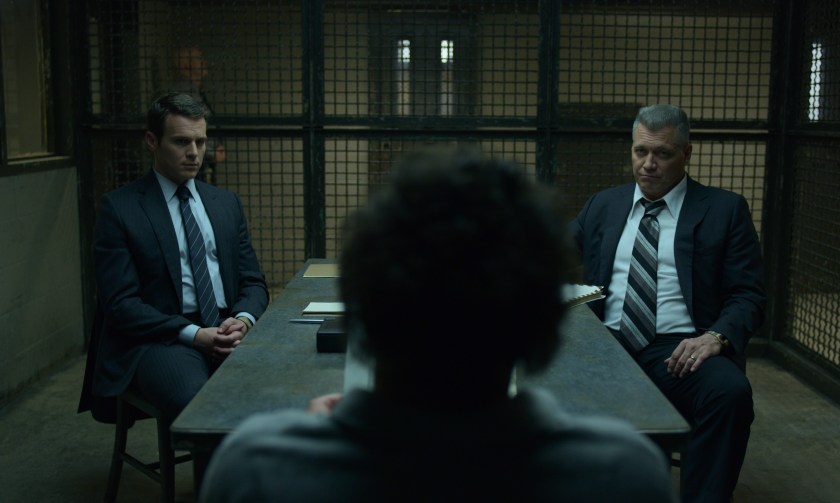
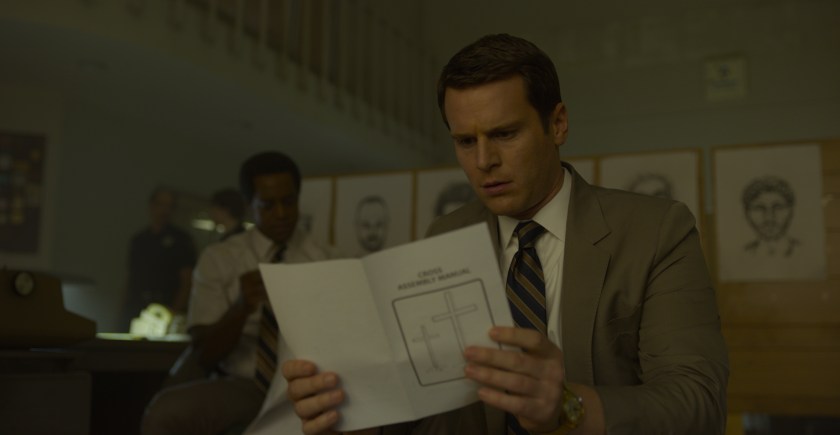
Watching the second season of Netflix’s Mindhunter—executive produced and partially directed by Fincher—the evolution of the filmmaker’s aesthetic is striking. As FBI profilers Bill Tench (Holt McCallany) and Holden Ford (Jonathan Groff) interview America’s most notorious serial killers, the camera rarely moves. Instead, it unobtrusively observes.
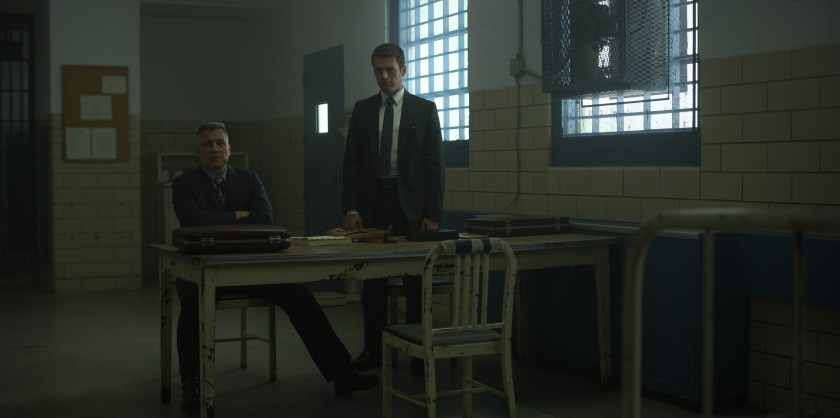
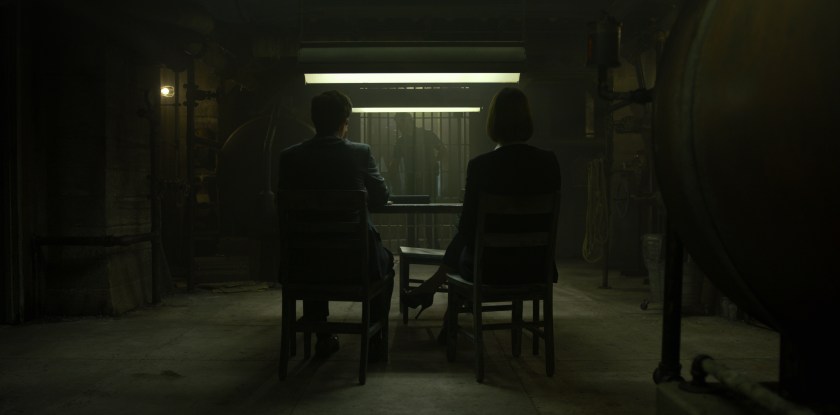
What hasn’t changed over the years is Fincher’s unwavering exactitude, exemplified by the show’s almost mathematically meticulous compositions. Cinematographer Erik Messerschmidt is the guardian of that precision, carrying season two’s restrained yet formal style across episodes directed by Fincher, Andrew Dominik (Killing Them Softly) and Carl Franklin (One False Move).
With season two now streaming on Netflix, Messerschmidt spoke with Filmmaker about the necessity of HDR monitoring, creating faux-anamorphic effects, and his hockey puck-sized secret weapon for eye lights.
Filmmaker: It’s been two years since season one of Mindhunter, which you shot on custom Weapon Red Dragons (nicknamed Xenomorphs). I guess it shows how quickly camera technology is changing, because since that time Red has gone to a universal DSMC2 brain and the Dragon sensor is only in their lowest-cost camera. Now the Monstro 8K VV and the Helium 8K S35 are Red’s top-of-the-line offerings. Did you change cameras for season two?
Messerschmidt: For season two we switched to Red’s Helium sensor, shooting in 8K 2:1 with 8:1 compression. Out of the 8K raster we framed for a 6.5K extraction area, which left room for stabilization in post. We did extensive lighting, color and workflow tests prior to the decision to switch camera sensors and ended up loving the results of the Helium. We found the noise floor to be substantially lower, the color fidelity to be better and the sensitivity to be higher than the Dragon.
Filmmaker: Did you have any additional custom Xenomorph tweaks for the new cameras?
Messerschmidt: For season two Red built us a new model of the Xenomorph dubbed the Mark II. The new body included the DSMC2 brain with the Helium sensor. It was upgraded with redesigned cooling, integrated lens motors and the new Teradek Bolt video transmitters.
Jason Hill is the hypnotic composer, producer, recording artist, songwriter, and multi-instrumentalist, admired for his arcane musical stylings and idiosyncratic approach. He is the frontman and thought leader of controversial post-punk band, Louis XIV, member of alternative supergroup, Vicky Cryer, and founder of The Department of Recording and Power, a voluminous vintage studio in Glendale, California. A contrarian musical nomad, Jason has thrived in myriad roles within the music business, working with David Bowie, The Killers, Robbie Williams, New York Dolls, Jet, Sky Ferreira, Macy Gray, The Virgins, Richard Butler of The Psychedelic Furs, and many others. After being tapped to fulfill the official trailer and teaser for Gone Girl, legendary director, David Fincher invited Jason to conjure a musical macrocosm for Netflix’s gripping criminal psychology thriller series, Mindhunter. Over two critically acclaimed seasons, Jason’s score negotiates the liminal space between masks of normalcy and unbridled savagery, masterfully evoking unseen traumas. In our sprawling discussion, Jason details his lifelong rejection of sonic mores and how he made Netflix history with his haunting re-imagining of the Mindhunter theme for the season two finale.
Before becoming a composer for media, you explored many artistic avenues in the music industry — Louis XIV, Vicky Cryer, and beyond. Could you describe some of your most fulfilling pursuits before you changed your professional trajectory? What are the advantages of having a strong pre-existing relationship to storytelling through music?
Well, it’s an interesting thought about the storytelling aspect. With songwriting, you’re trying to tell these mini stories, but I’ve had many, many fulfilling artistic projects. Louis XIV, I absolutely loved doing, and in fact, for the first time in 10 years, we’re in the middle of making another record. We’ve got a few songs so far, and it’s fun to come back around to it after we went pretty hard, toured the world, and made records. “The Best Little Secrets are Kept” is one of the records I’m very, very proud of. I just loved making it.
Looking back, I lived in this little, tiny…it wasn’t even an apartment, and it overlooked a Shell gas station. It didn’t have a shower or anything. I would literally connect a hose to the faucet and drag it out on the balcony that overlooked the gas station. In the middle of the night, I would hose myself to take a shower unless I was staying at girlfriends’ houses. I had a futon in the corner, but the rest of the place was just my recording gear. I was broke, but I was happy to be making music. That’s where all the Louis XIV material came about. It was essentially from those late nights, and that was a really great experience.
I’ve actually had so many great experiences related to music. There were times when me and my past bandmates moved to a place called Jamul up in the mountains, about an hour outside of downtown San Diego. We lived in this old adobe house on forty-six acres that an artist built. That was one of the places where we learned to sing harmonies and write together. That was also where I really learned how to record. We just had reel-to-reels, and I figured out how to do it. I’ve always lived in pursuit of trying to figure out how to do things by myself. If I signed a record deal, instead of giving another producer a bunch of money in the studio to make a record, it was like, “No. Let’s just buy a bunch of gear ourselves, and now, we can make records for the rest of our lives.” That’s why I have the arsenal of stuff I have to this day.
There are so many incarnations of my life in music, starting from the moment I first fell in love with it. I remember as a little kid; I was actually plagued by these things in my head, which later I learned were melodies. It would drive me nuts. To be honest with you, as a nine-year-old kid, I would have all these tiny, weird symphonies playing in my mind, but I didn’t know what they were until I started figuring out what music really was. Of course, I knew what music “was,” and I even wrote a song around age five, but at that point, I didn’t know how to make these melodies I was hearing come to life. It was like, “How do I get this out of my head and into the cosmos? How do I play it on a guitar or a piano?”. Oh god, it was so tough. That was a thing like, “I gotta figure this out because otherwise, it’s going to kill me.”
I think it’s always been a pursuit of the fog. It’s like a foggy mirror after a hot shower. Little by little, the fog comes clear, and you are able to see your reflection. That’s what music has been, for me, for my entire life, and now, I just have a lot more control over it. That said, it’s still this elusive thing, and I love that elusive thing. I love the feeling of not knowing, so I still dance in that realm.
The Glass Armonica, invented by Benjamin Franklin.
Taking place in the late ’70s through the early ’80s, Mindhunter charts the origin of the FBI’s Behavioral Science Unit and the practice of criminal profiling. Together, agents, Holden Ford and Bill Tench, alongside psychologist, Wendy Carr interview and analyze incarcerated serial killers across the nation, applying this groundbreaking knowledge to solve cases. In your collaboration with David Fincher, what concepts and musical references does he bring to the table, and how does that inform your approach?
[David Fincher] is so articulate. He’s a brilliant man. I can’t stress that enough, really. He gives you these prompts, but they’re rarely specific. Nowhere in there is he saying, “Do this,” or “Make this piece exactly like this.” He just gives you these open-ended questions.
This time around, one of his prompts was ‘the death of disco’ and what that sounded like. It was a very interesting thing to consider when you think of our score and where it ended up. How does finding out what the death of disco sounds like translate to season two of Mindhunter? I still don’t know, but it led me in a place of trying to figure it out, which was a bit of a mind fuck.







 The Fincher Analyst