30 Years of Kyle Cooper’s Classic Title Sequence for SE7EN

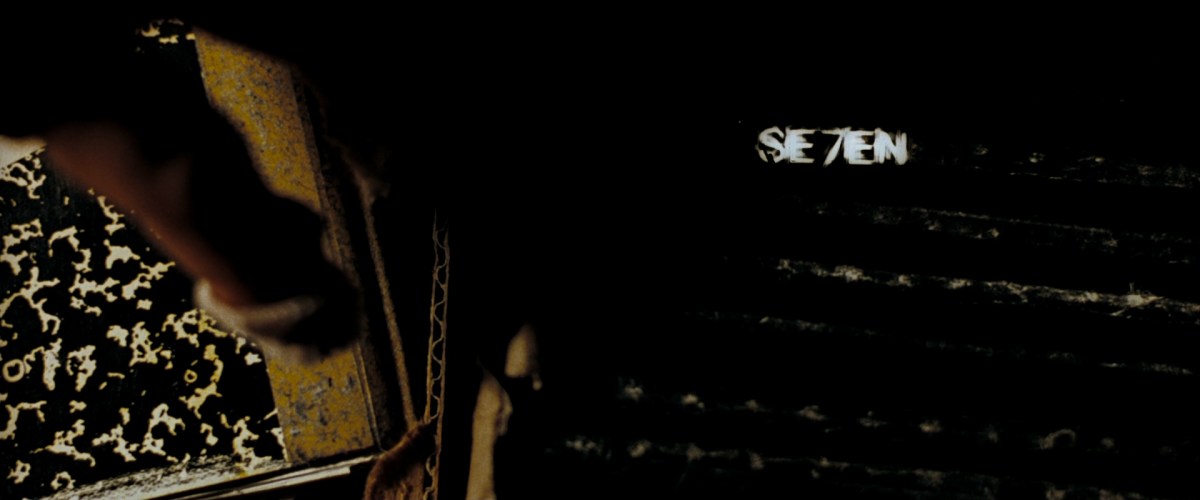
On September 22, 1995, David Fincher’s SE7EN introduced audiences to a darkness unlike anything seen before, accompanied by an opening title sequence from Kyle Cooper that has since become one of the most influential in film history.

September 26, 2025
Prologue Films (Instagram: 1, 2, 3, 4)

For this classic title sequence, David Fincher tasked Kyle Cooper, founder of Prologue Films, to get inside the mind of a serial killer, immediately setting an ominous tone. Typography was scrawled into scratch board and shot on film, and Cooper shot tabletop photography representing the preparation of the killer’s obsessive sketchbooks. This dark yet spirited sequence was called a “masterpiece of dementia” and was credited with the resurgence of a generation’s interest in film title design.

The audio of this video is pulled from Kyle’s interview on the 2010 Blu-ray Special Edition of SE7EN, where he discussed the making of the sequence in detail.

In Part 1, Kyle reflects on his early conversations with Fincher. The two bounced ideas back and forth, shaping a vision that would forever change the way opening credits were made. This reel pairs finished titles with original process photographs, every frame shot on film, every prop (from John Doe’s notebooks to the hand model) photographed and tested.

“People think there’s computer graphics in there, but we assembled the majority of the sequence by hand… it takes on a life of its own.” In Part 2, he explains how he created the unsettling typography. Every letter was scratched, smeared, and distorted through the camera itself, analogue from start to finish. This reel pairs final frames from the title sequence with the original process photography of John Doe’s notebooks, props, and hands, showing how the haunting visuals took shape long before digital tools.

“This is John Doe’s job: he gets up, makes his books, plans his murders, drinks his tea.” In part 3, he reveals how the titles were designed to immerse viewers directly into the fractured psyche of the killer. To capture the killer’s mindset, Kyle went beyond typography. He gathered real objects from his surroundings, fish hooks, razor blades, sewing needles, twine, even clumps of hair from his shower drain, and filmed them in-camera alongside hand-crafted journals. These raw analogue elements were photographed, tested, and layered into the sequence, blurring the line between prop and pathology.

Kyle has recalled in interviews that during the premiere, when the title sequence finished, the audience actually clapped, something almost unheard of for opening credits. Thirty years later, that impact still reverberates across cinema and design.

The SE7EN End Credits Crawl

The unease of SE7EN doesn’t end with the final scene. Even the closing crawl was designed to keep audiences trapped in John Doe’s world.

Kyle and Kim Cooper crafted the end credits entirely by hand. Each name was cut out and taped together into a single, massive scroll, almost like a tapestry. The piece was then shot with a video camera and lit from behind so the light bled through the lettering.

To deepen the sense of obsession, the crawl was embellished with objects John Doe might have owned: razor blades, fishing hooks, twine, screws, wire, flies, even hair pulled from a shower drain. Every detail was assembled practically, frame by frame, just like the opening titles.

We first show the original handmade scroll, now preserved in five long backlit panels at Prologue Films. Continue watching to see the crawl as it appeared in 1995. Instead of rolling upward like a traditional credit sequence, Fincher had it roll downward, a subtle inversion that mirrored the sick, twisted psychology at the heart of the film.
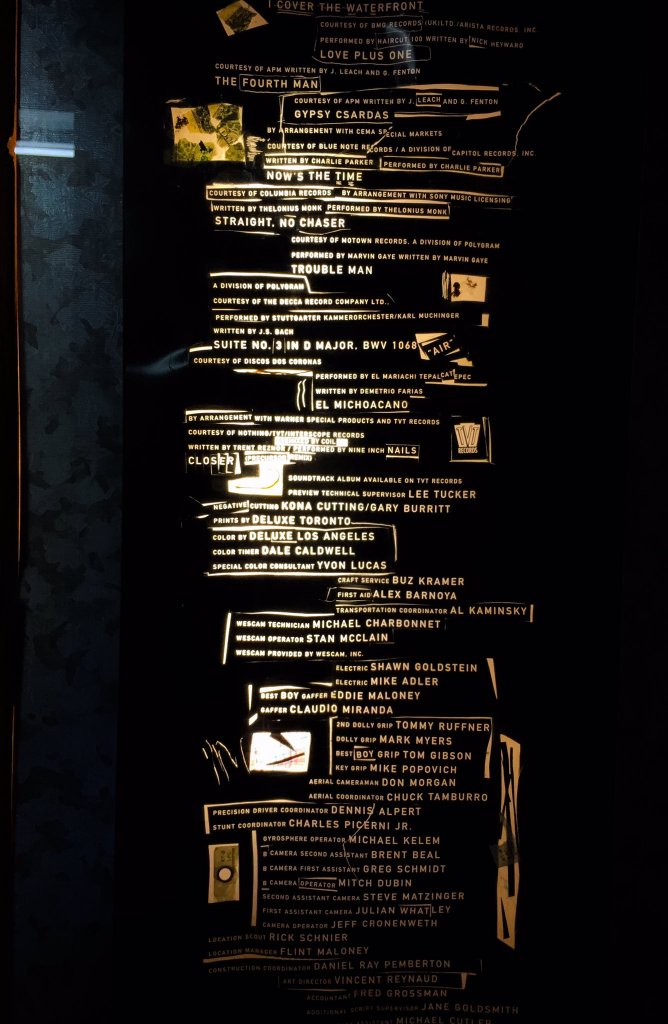
SE7EN end credits crawl panel, displayed at Prologue Films, photographed by Hideo Kojima.
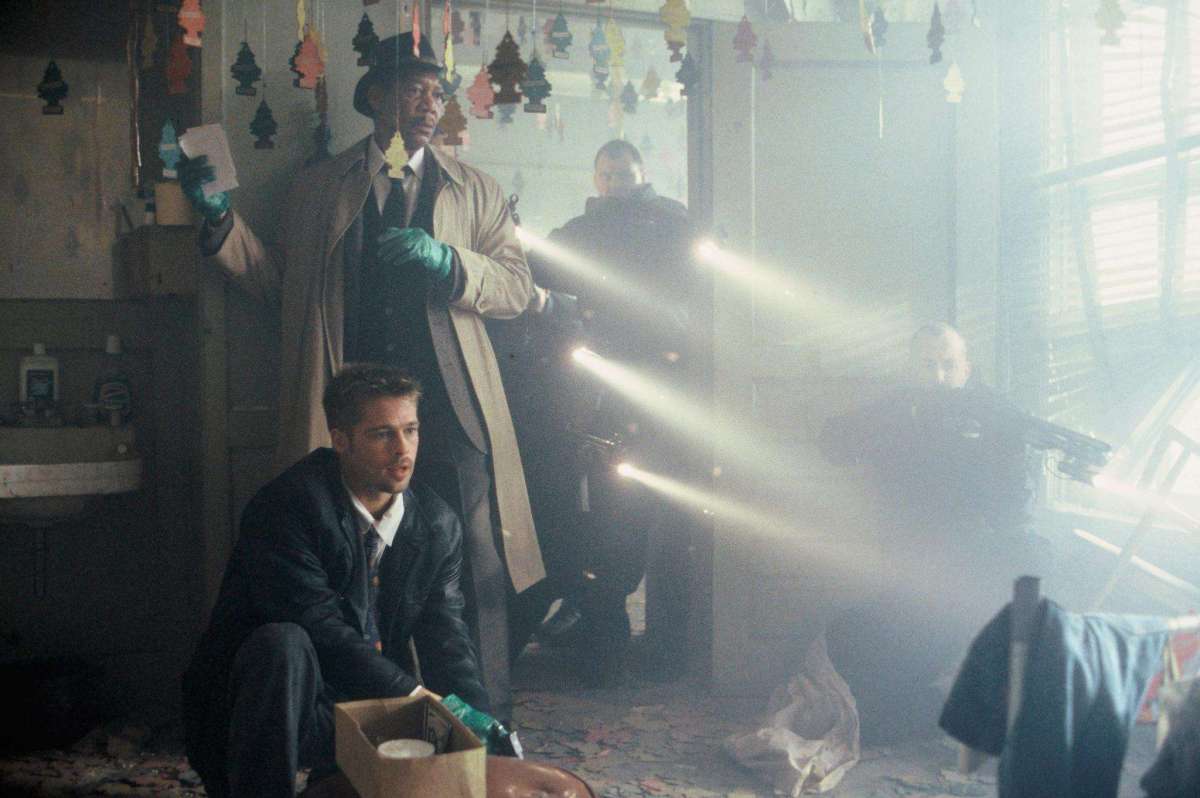
Se7en: The Serial Killer Chase as Existential Conundrum

David Fincher’s seminal serial killer procedural is more of a parable about how hope and idealism cope against evil.

James A Gill
September 6, 2025
Fanfare (Medium)

**This essay contains major spoilers for Se7en**

“If we catch John Doe and he turns out to be the devil, if he’s Satan himself, that might live up to our expectations. But he’s not the devil, he’s just a man.” — Detective William Somerset

“I don’t believe that you’re quitting because you believe these things you say. I don’t. I think you want to believe them because you’re quitting. You want me to agree with you and you want me to say ‘yeah, yeah, yeah, you’re right, it’s all f***ed up’…. but I won’t. I won’t say that. I don’t agree with you. I do not. I can’t.” — Detective David Mills

These are some of the lines exchanged between the heroes of David Fincher’s classic 1995 feature, Se7en, as they have a heart-to-heart conversation late in the film. It is a scene that contrasts considerably in tone and mood to the more memorably horrific and gory scenes in the film.

This scene may well be the most important, if not the most moving, in a film largely known for its bleak, macabre, and unforgiving atmosphere. As a moment of respite for the audience, the scene demonstrates how well detectives David Mills and William Somerset complement each other, despite their many superficial differences.

Released in September 1995, David Fincher’s Se7en proved to be a sleeper hit of 1995 (overall, and appropriately, the seventh highest-grossing film of 1995). It was a critical smash and a redemptive feature film success for Fincher (after the very mixed results of his film debut, Alien 3). Andrew Kevin Walker’s screenplay also received a BAFTA nomination for Best Original Screenplay. It is also, alongside 1991’s The Silence of the Lambs, considered the defining serial killer feature of the 1990s, forging a considerable impact on the genre going forward.

Read the full essay

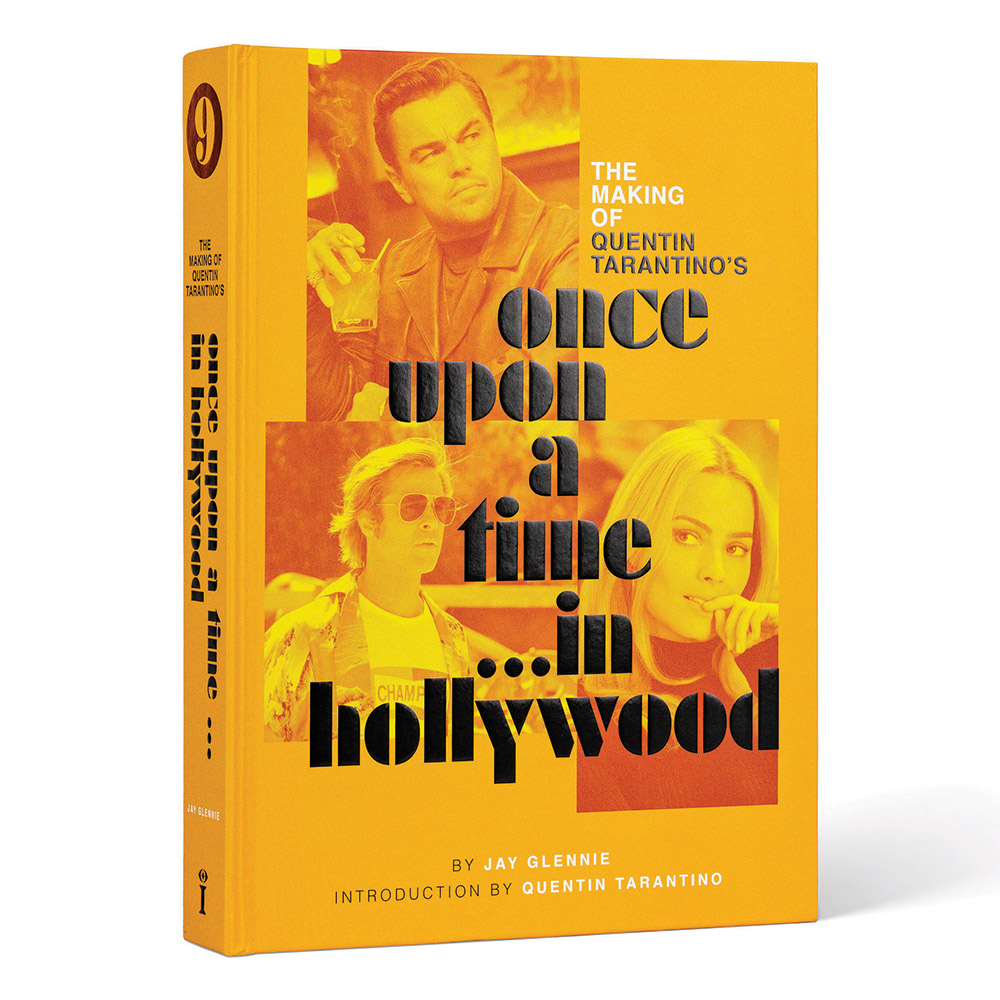
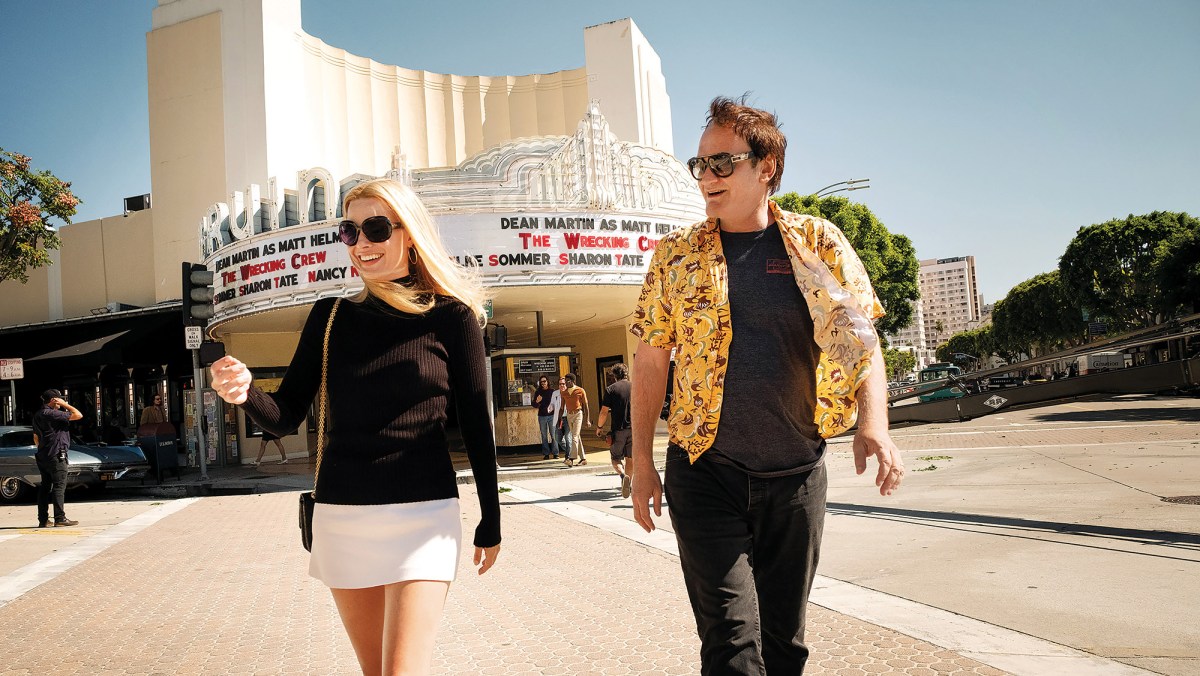
How Quentin Tarantino Bent Los Angeles to His Will to Make ‘Once Upon a Time in Hollywood’

In an exclusive excerpt from the revealing new book ‘The Making of Quentin Tarantino’s Once Upon a Time… in Hollywood,’ the film’s director and stars Leonardo DiCaprio, Brad Pitt and Margot Robbie explain how they took L.A. back to the summer of ’69.

The following is excerpted from The Making of Quentin Tarantino’s Once Upon a Time in Hollywood (Insight Editions), out October 28.

Jay Glennie
September 19, 2025
The Hollywood Reporter

“Rick, how are you doing with getting Hollywood Boulevard for me?” Quentin asked his location manager, Rick Schuler. “I’m doing well,” Schuler replied.

Quentin looked at his first assistant director, Bill Clark, and looked at Schuler. “Doing well” was not going to cut it. Once Upon a Time in Hollywood was a Los Angeles story, a Hollywood story, and it needed to be filmed in Los Angeles. It needed Hollywood as a backdrop. He wanted to convert Los Angeles back to 1969 — “You know, literally street by street, block by block.”

Schuler had been in discussion with the California Film Commission for weeks. Under Quentin’s gaze, he admitted, “Well, I think I’m 80 percent there.”

“Rick, if there’s anything I can do to help you out, I’ll be willing to do that,” Quentin replied.

Production designer Barbara Ling was also anxious to know what it was she was going to be working with. Schuler had been asking the Hollywood powers that be, responsible for the economic success of their city, to shut down eight blocks.

“They had been, like, ‘Eight blocks? No way!’ and had said no a hundred times,” Ling recalls. “I also remember, eight blocks was freaking out the producers budget-wise.”

Schuler had an idea how he could utilize the filmmaker’s extraordinary enthusiasm and will to best use. He had an idea he wanted to run by Bill Clark: Schuler had a meeting with the Hollywood neighborhood council. Would Quentin be willing to address them — just talk about the project? Talk about the movie, what Hollywood meant to him? It could help get things over the line.

The day of the meeting, Schuler sprung it on Quentin and Clark that he wanted to make the filmmaker the surprise star act of his pitch and have him come in at the end. Nobody on the council would know he was there beforehand.

“For whatever reason, Rick thought it would be best if he kept Quentin a surprise to the council members,” Clark says.

Read the full excerpt

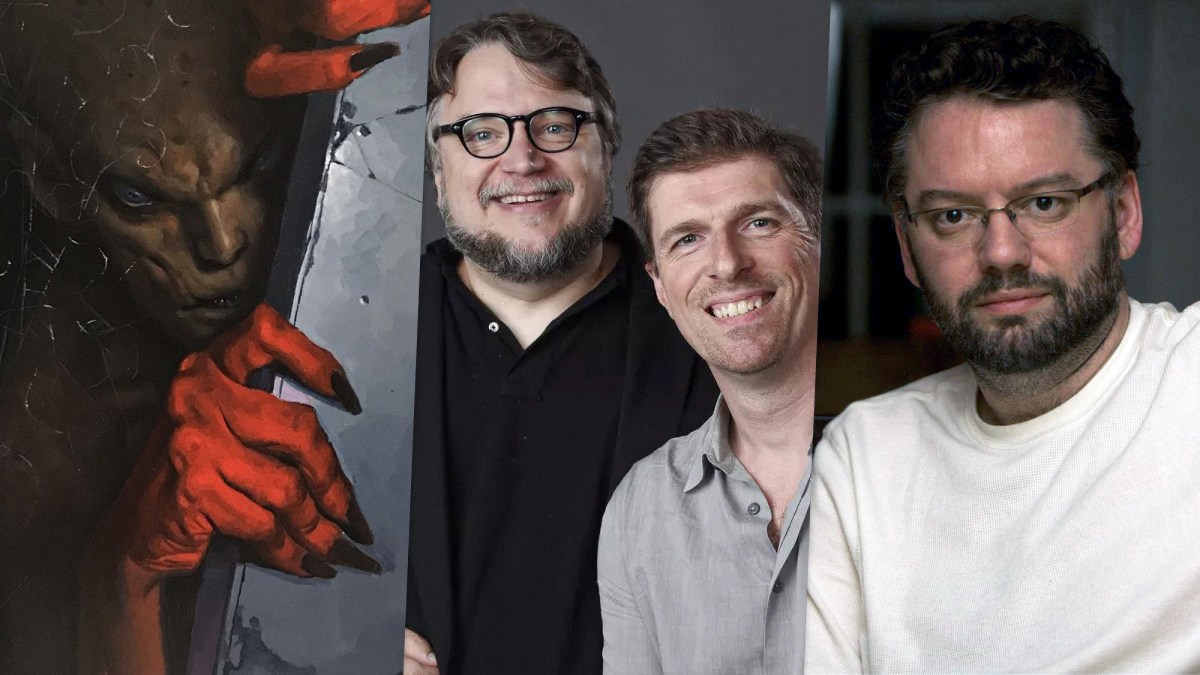
David Prior to Direct Guillermo del Toro and Chuck Hogan’s ‘The Boy in the Iron Box’ Netflix Movie Adaptation

Filming is set to get underway on the new horror movie in October.

Jacob Robinson
September 9th, 2025
What’s on Netflix

After being optioned for an adaptation, things are moving quickly with Netflix’s adaptation of Guillermo del Toro and Chuck Hogan’s Audible series The Boy in the Iron Box, which is scheduled to begin filming in October 2025. David Prior, who has worked with GDT before, will be writing and directing the project, it has now been revealed.

Here’s what we know so far.

Rupert Friend, Jaeden Martell and Kevin Durand Join Netflix Horror Movie ‘The Boy in the Iron Box’

Kasey Moore
September 19, 2025
What’s on Netflix

Netflix has officially confirmed that The Boy in the Iron Box will be making its way onto our screens via a new feature film and has added three cast members ahead of filming commencing next month in Canada.