From the infamous tales of his multi-take shooting style to the sheer technical precision consistently on display in his work, it is apparent that Fincher is methodical in his craft, a director who knows what he wants and sees very little point in doing the job if he is ever willing to settle for less than that.
Which is why, in a truly unique way, the opening intro to Fincher’s latest Netflix series, Mindhunter, is essentially a distillation of his entire filmmaking career into a single minute-and-a-half of unnervingly brilliant and precise cinematic craft.
Fincher’s first credit as a filmmaker may have technically been Alien 3, but his career didn’t really begin properly until 1995, with the release of Seven. The tale of a pair of detectives investigating the grisly murders of a serial killer, Seven is in many ways, in hindsight, the perfect introductory statement for Fincher’s body of work as a whole. On the surface, it’s a tightly-woven and meanly constructed narrative about a serial killer and the men trying to catch him. But just beneath the surface (and for our purposes, much more importantly) Fincher is using the narrative as a framework through which to explore themes such as the perverseness of mankind, the lasting wounds of grieving, and obsession.
That last one is important: obsession. Because it’s one he’s come back to again and again, and explored in increasingly interesting ways. Fight Club saw him creating a pop-cultural satire, one that delved deep into the depravity of its time and how the obsessions of a generation essentially derailed the concept of mental stability. Zodiac saw him confronting it in his most direct way yet, showing how Robert Graysmith’s and the nation-at-large’s obsession with the Zodiac murders came to engulf them.
What’s so intriguing about Mindhunter is that it tackles this thematic staple of Fincher’s work in a very similar way, yet it does so without even necessitating a single minute of footage from the series proper.
“I want to have no idea what’s going on in your head.”
David Fincher is issuing instructions to a
moustachioed man, who is gazing into a mirror, adjusting the shoulder strap on
the woman’s slip he’s wearing. The crew, similarly delicately, adjust the
lighting for this moment of self-fulfillment — one of a series of episode-puncturing
vignettes of Dennis Rader (played by Sonny Valicenti), aka The
BTK Killer.
Bind. Torture. Kill. And do it quickly.
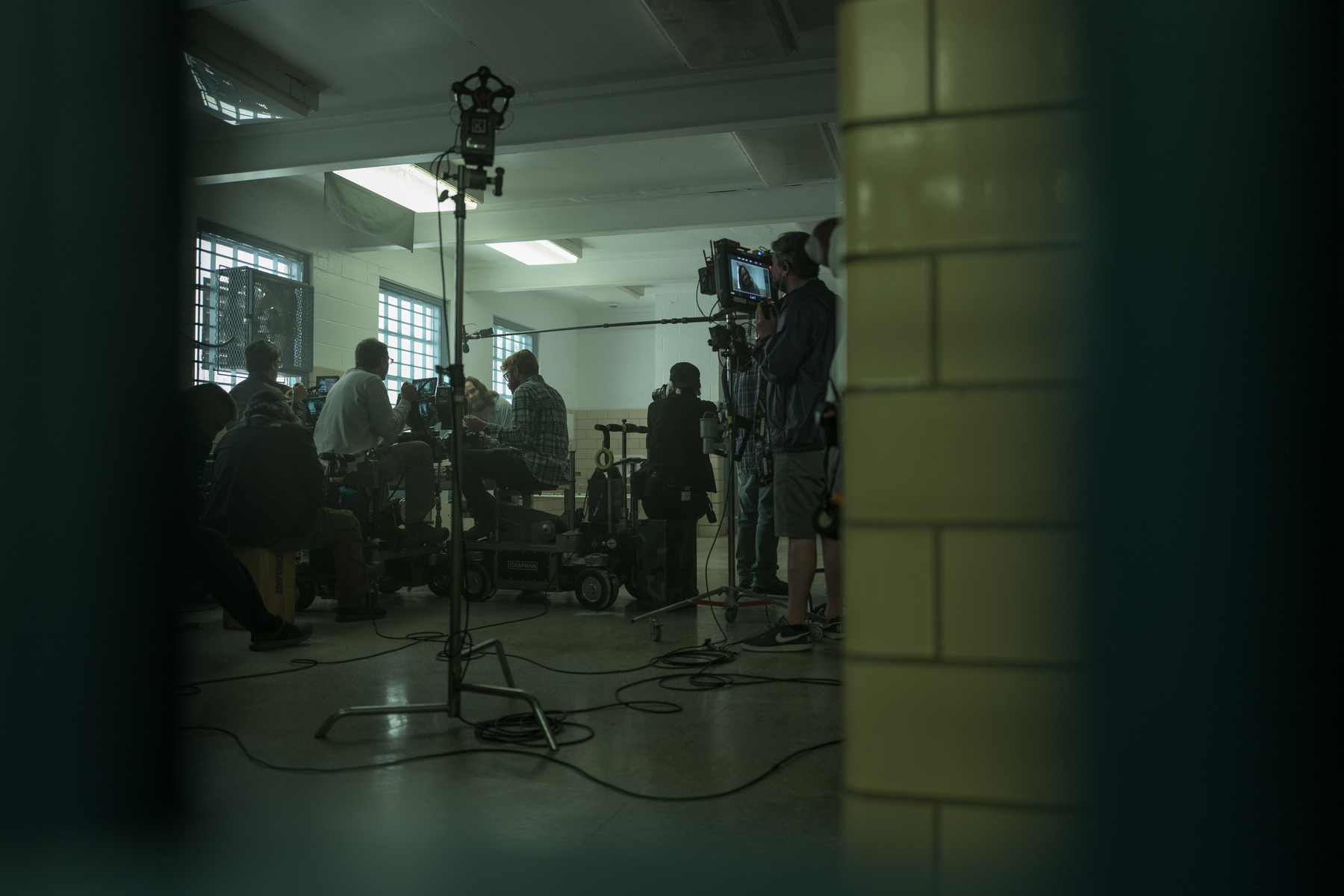
Fincher is on a tight schedule
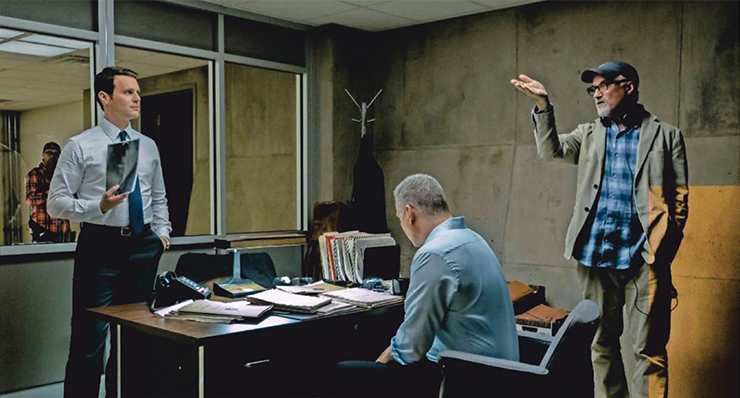
for these late additions to the lengthy shoot. While the scene is set, he sits
at the monitor with lead writer Courtenay Miles, adjusting dialogue, as
the art department present him with crime-scene photographs and mementos of victims
for sign-off. Multitasking can be murder.
Camera set, they shoot. Once. Twice. “That is fucking creepozoid,” says Fincher, after the third take. If you can manage to unsettle the director of Seven and Zodiac, then you’re probably doing your job. The next few days filming in this cavernous Pittsburgh studio will involve FBI office politics, masks (literal and figurative) and autoerotic asphyxiation. As one crew member puts it, “Some things you can’t unsee.”
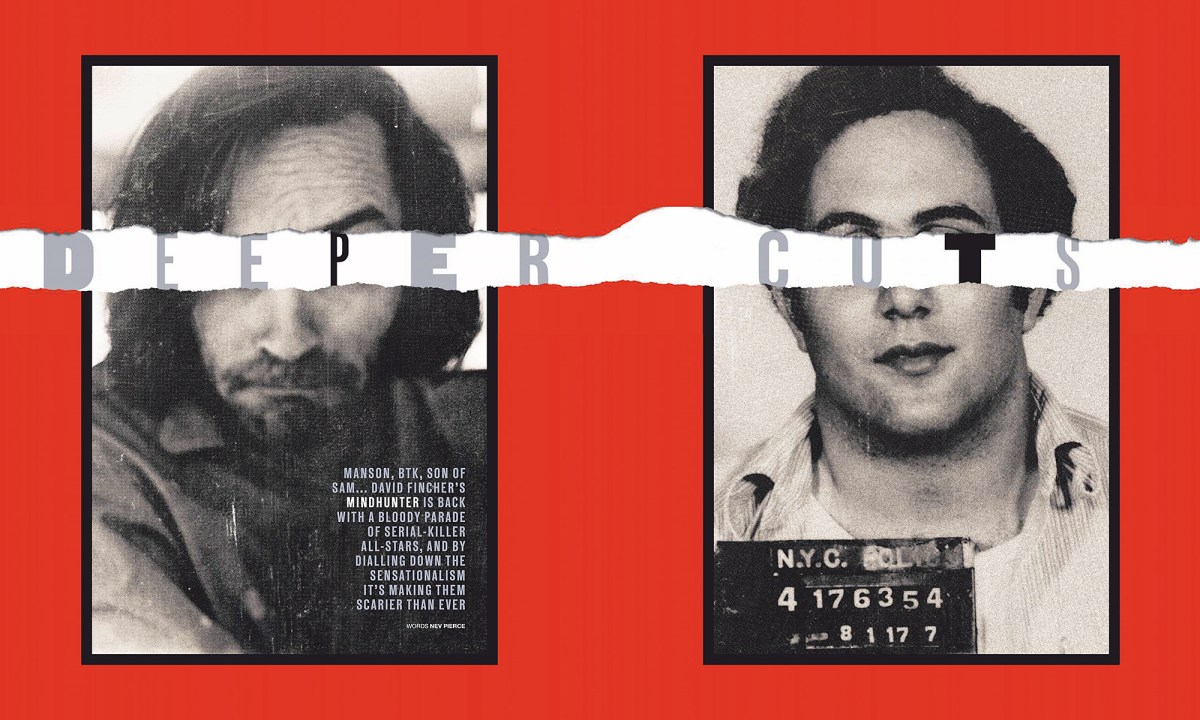
Back for its second season, Mindhunter has lost none of its fearlessness. BTK returns, of course, but following impactful portrayals of lesser-known serial killers Edmund Kemper and Jerry Brudos, this year is taking on the iconic — including arguably the two most famous serial killers of all: Charles Manson (Damon Herriman) and David Berkowitz, aka Son of Sam (Oliver Cooper). The latter we’ve previously seen on screen being commanded by a demon-possessed dog in Spike Lee‘s Summer Of Sam. And — on the 50th anniversary of the murders his ‘disciples’ carried out — Manson is everywhere, including in Quentin Tarantino‘s Once Upon A Time In Hollywood (portrayed by the same actor, Damon Herriman). But whereas most movies lean into the mythology of Manson, or embellish Berkowitz, Mindhunter is looking to re-examine reality. This isn’t hellhound hyperbole or gauze-softened myth. It’s the ugly truth.
“We want to believe they’re madmen,” says Courtenay Miles, “But when you read their history, their journals, letters, you see it is a human being in there. But it’s a human being gone wrong.” Miles was first assistant director on the debut series — the aide-de-camp to the director’s general — and made the unlikely but long-cherished transition to writer when Fincher gave her a shot. She immersed herself in the world of serial killers, and lost sleep as a result. “All of the characteristics that are in their mental structure and their compulsions are things that any other human being can identify with,” she says, reflecting on the long gestation of serial killers. “They’re made over 20 years. Nurturing these compulsions. That just got under my skin.”
Miles got the chance to be disturbed — and earn her first screenwriting credit — because Fincher cares considerably less about reputation than he does about his own lived experience. But while the first season saw him employ emerging directors (the most high-profile being Asif Kapadia, whose greatest achievements were in documentaries), here he’s joined behind the lens by two cinematic heavyweights. Carl Franklin is of late an in-demand director of TV, including House Of Cards, but was responsible for some astounding crime cinema in the 1990s: Devil In A Blue Dress and One False Move. In that grubby, merciless thriller, the wife of Bill Paxton‘s seemingly guileless cop observes, “Dale doesn’t know any better. He watches TV. I read non-fiction.” Mindhunter bridges that divide. The other director is Andrew Dominik, whose three features all deal with the ruthless reality beneath criminal lore and legends (Chopper, The Assassination Of Jesse James By The Coward Robert Ford, Killing Them Softly). Dominik has wrapped his two episodes. Franklin is shooting four, Fincher three — but, as Dominik puts it, “his tentacles are everywhere”.
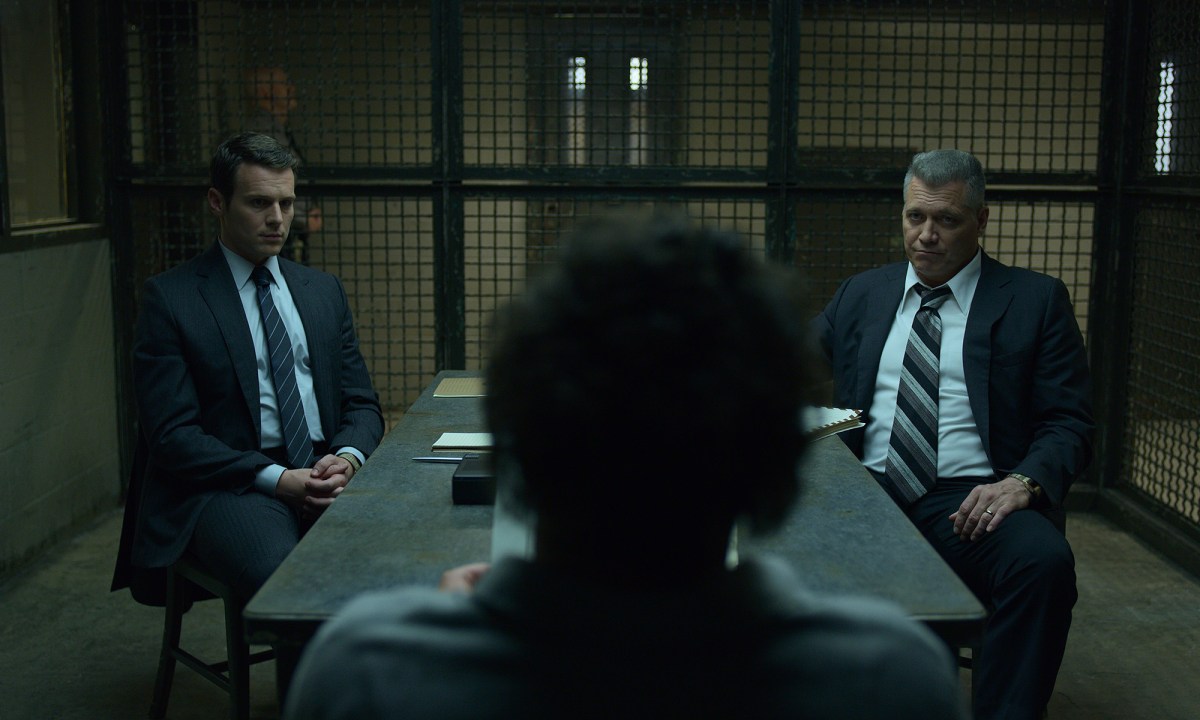
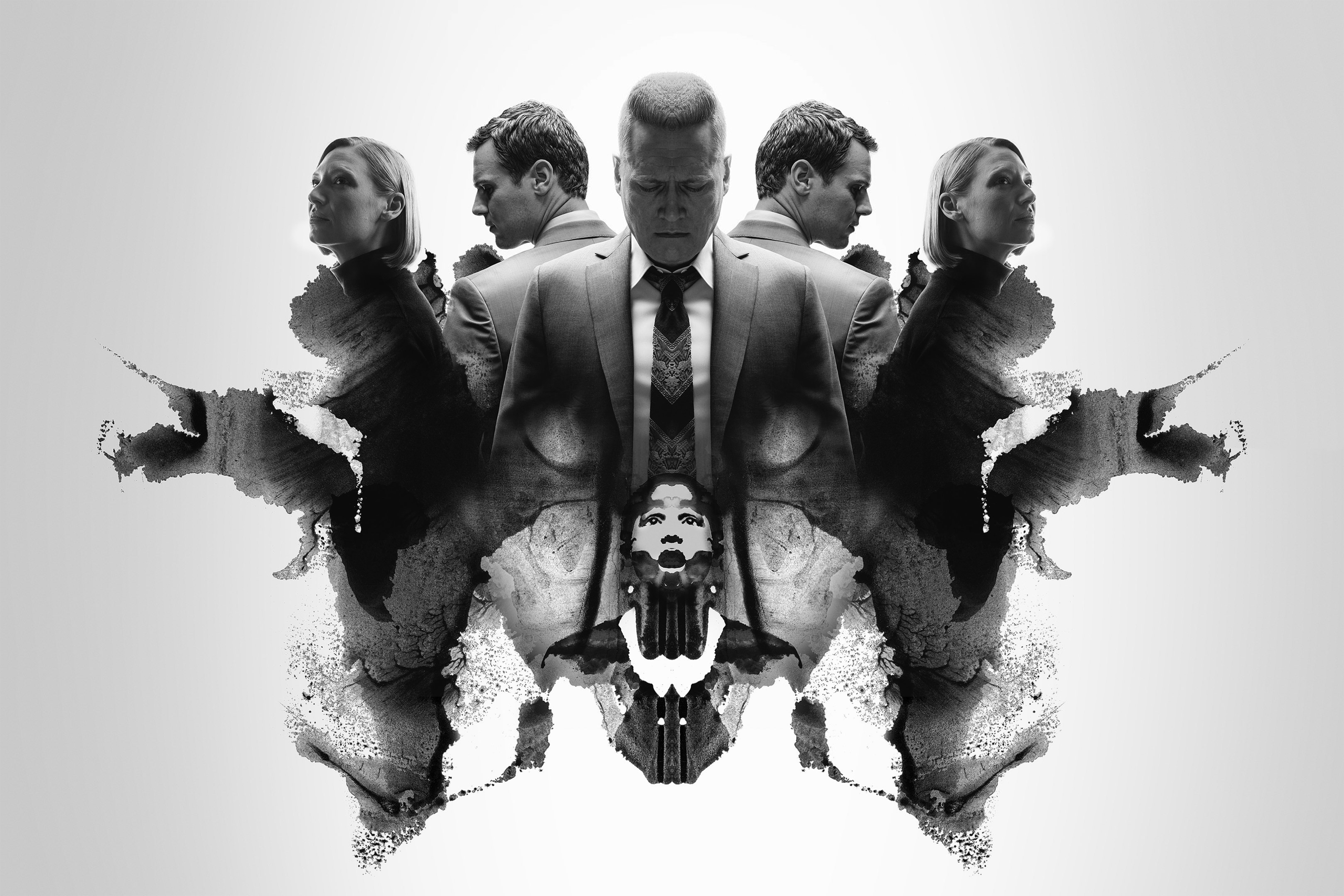
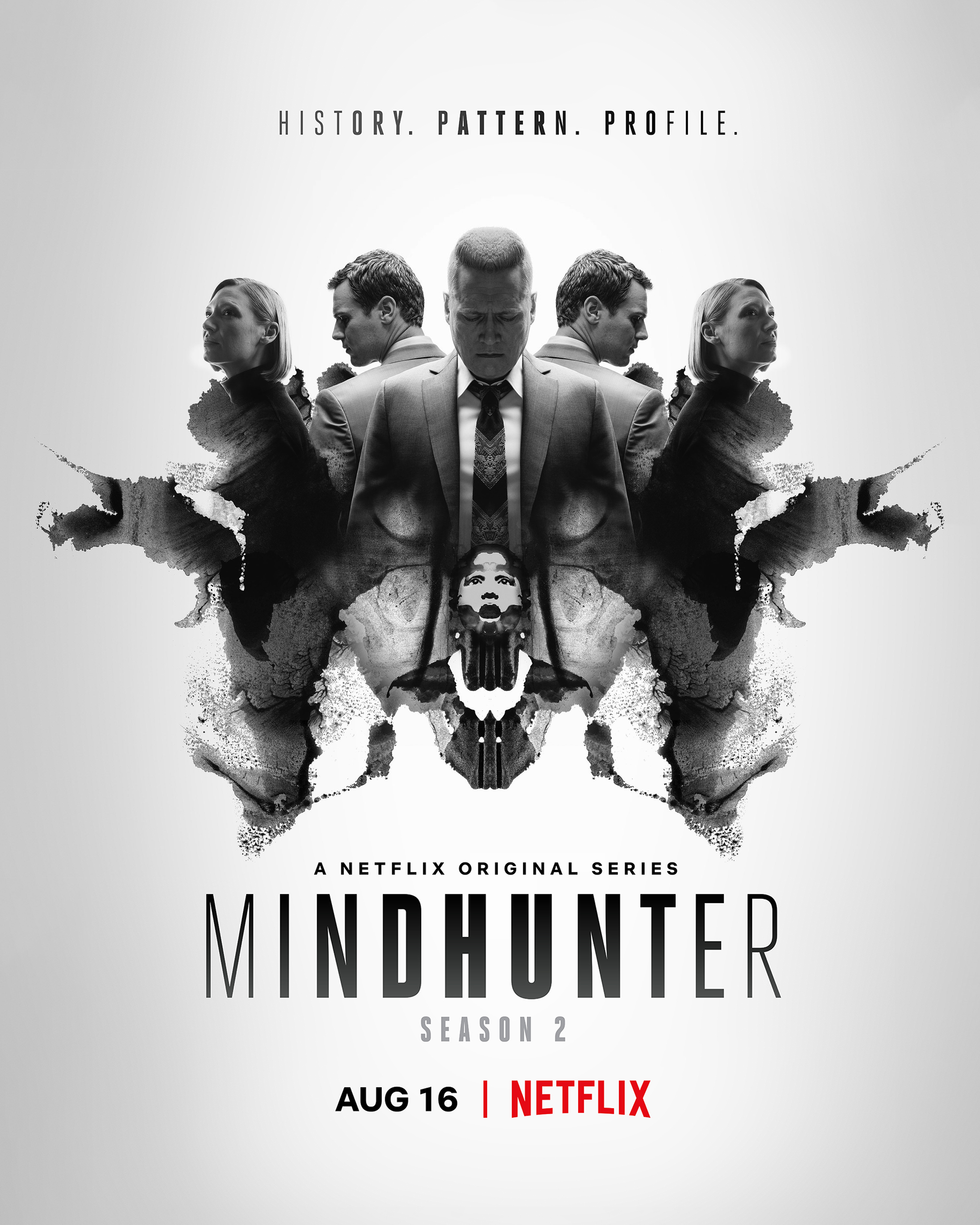
FBI agents Holden Ford and Bill Tench probe further into the psyches of those who have done the unthinkable. With help from psychologist Wendy Carr, they apply their groundbreaking behavioral analysis to hunting notorious serial killers.
Inspired by true events, Mindhunter Season 2 will premiere globally on Netflix on August 16, 2019.
The new season stars Jonathan Groff, Holt McCallany, Anna Torv, Joe Tuttle, Albert Jones, Stacey Roca, Michael Cerveris, Lauren Glazier, and Sierra McClain.
The series is directed by David Fincher (Gone Girl, The Social Network, Zodiac) as well as Andrew Dominik (The Assassination of Jesse James by the Coward Robert Ford, Killing Them Softly) and Carl Franklin (Devil In A Blue Dress, One False Move, episodes of House of Cards and The Leftovers).
David Fincher, Joshua Donen (Gone Girl, The Quick and the Dead), Charlize Theron (Girlboss, Hatfields & McCoys) and Cean Chaffin (Fight Club, Gone Girl) executive produce along with Courtenay Miles and Beth Kono.
Every story, as movie trailers never tire of informing us, has a beginning. The story of the cover-song trend in movie trailers began nine years ago, when the veteran trailer editor Mark Woollen found himself grappling with a difficult assignment. This was not unusual for Woollen, who is known for producing iconic, inventive mood-piece trailers for tough-to-market, tougher-to-summarize films by such directors as Terrence Malick, Steven Soderbergh, Michel Gondry, and Alejandro González Iñárritu. The brilliantly odd trailer for the Coen brothers‘ “A Serious Man,” punctuated by a rhythmically recurring shot of Fred Melamed bouncing Michael Stuhlbarg’s head off a chalkboard? That was Woollen. The trailer for Todd Field‘s “Little Children,” which used the sound of an oncoming train in lieu of music? That was Woollen, too. There are some films that can’t be marketed by traditional means; Woollen is the trailer auteur to whom auteurs turn for a nontraditional solution.
In early 2010, Woollen’s company, Mark Woollen & Associates, was tapped to produce a trailer for David Fincher’s “The Social Network.” As Woollen remembers it, it was March or April; Fincher was still busy in the editing room, and Trent Reznor and Atticus Ross had not yet written the movie’s score (which would win an Academy Award). With the Cambridge Analytica scandal and the election of 2016 still years away, the Facebook story seemed like curiously dry material for Fincher, the director of “Fight Club.” “It was kind of getting beat up in the press,” Woollen said. “Like, ‘How can you make a movie about Facebook? Are you gonna make a movie about eBay or Amazon next?'”
At first, Woollen wasn’t sure how to cut a trailer for a Facebook movie, either. But the answer turned out to be sitting on his hard drive. A few years earlier, while searching for something else, he’d downloaded an MP3 file from what he described as “some GeoCities-looking kind of Web site.” The file was a 2001 live recording of the song “Creep“—the first hit single by the British art-rock band Radiohead—as performed by Scala and Kolacny Brothers, a two-hundred-member girls’ choir from Belgium. The recording had a lot of the things that a trailer editor looks for in a piece of music. “It has this gentle introduction, it has moments that build and swell and rise, and then it can come down and land nicely,” Woollen said. “I felt, like, Here’s a track I can build a piece around.”
More important, the music seemed to work on a thematic level. Woollen, who was not a Facebook user, had been kicking around ideas about connectivity and loneliness. He played the choir recording on repeat while driving to work and thought about “lost, lonely voices that felt like they were speaking from the depths of the Internet.” In his business, Woollen said, “You’re always talking about trailers that invite you in, saying, ‘Come and see us, come and see us.'” He liked the counterintuitive notion of building a trailer around a song whose refrain is “What the hell am I doing here / I don’t belong here.” “The irresistible ingredient,” Woollen said, “was one hundred Belgian girls singing ‘You’re so fucking special’ in full voice.”
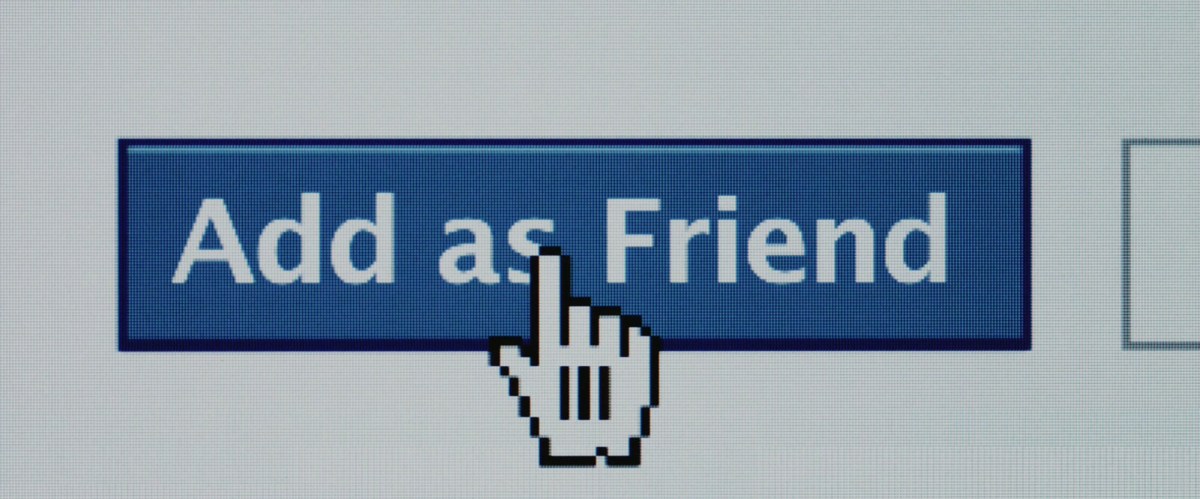
The finished trailer is an unsettling masterpiece. For fifty seconds, it plays like an ad for Facebook—a montage of photos, status updates, and unseen hands confirming friendships with the click of a blue-and-white button. Then, at the one-minute mark, a pixelated image of Jesse Eisenberg’s alarmingly dead-eyed Mark Zuckerberg fades into view. Woollen said that he was nervous about showing Fincher a cut that held back the director’s own footage in favor of stock photos and family pictures supplied by the staff of Mark Woollen & Associates. But Fincher liked it; the first time he screened “The Social Network” for the studio, he played Woollen’s trailer first.



 The Fincher Analyst