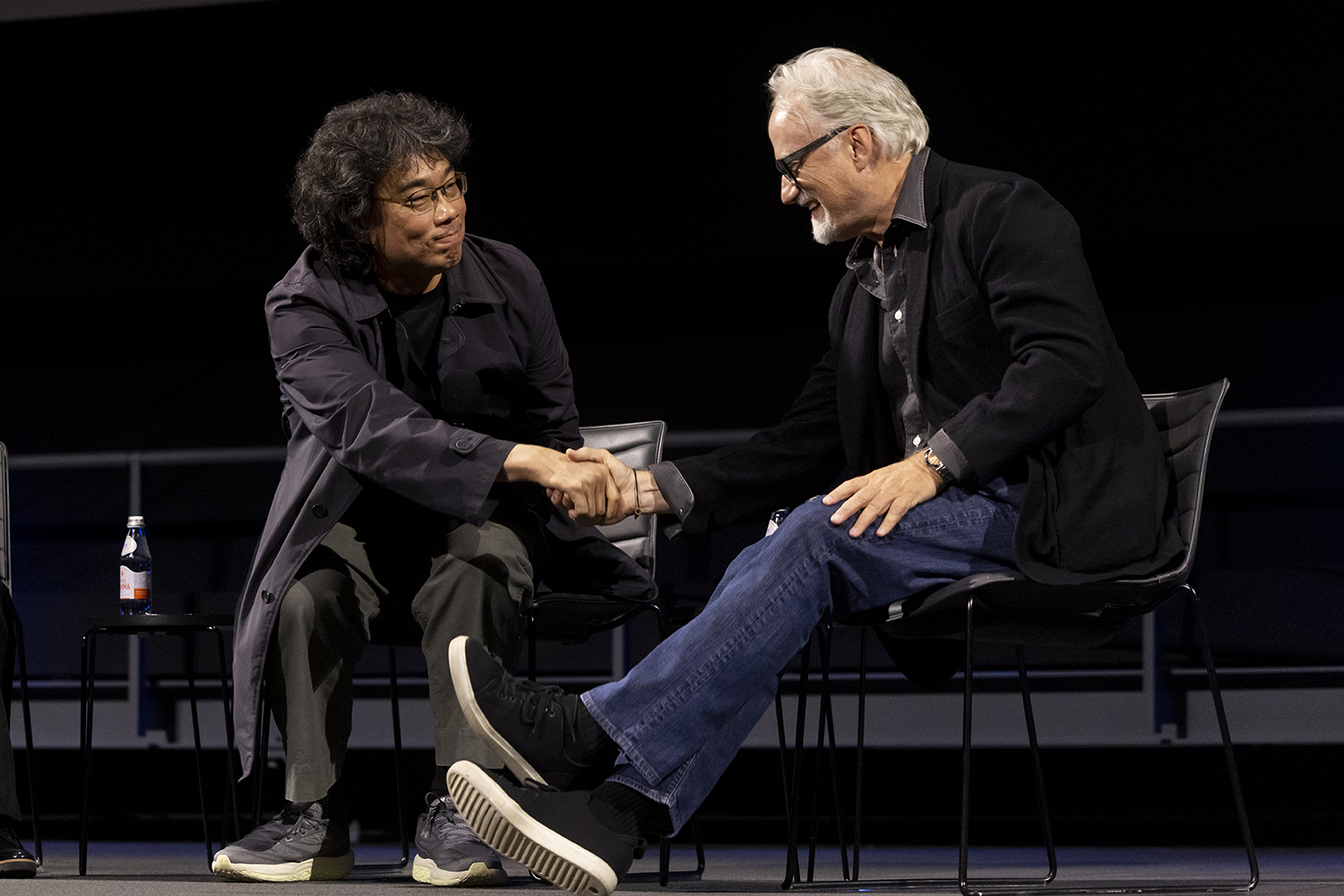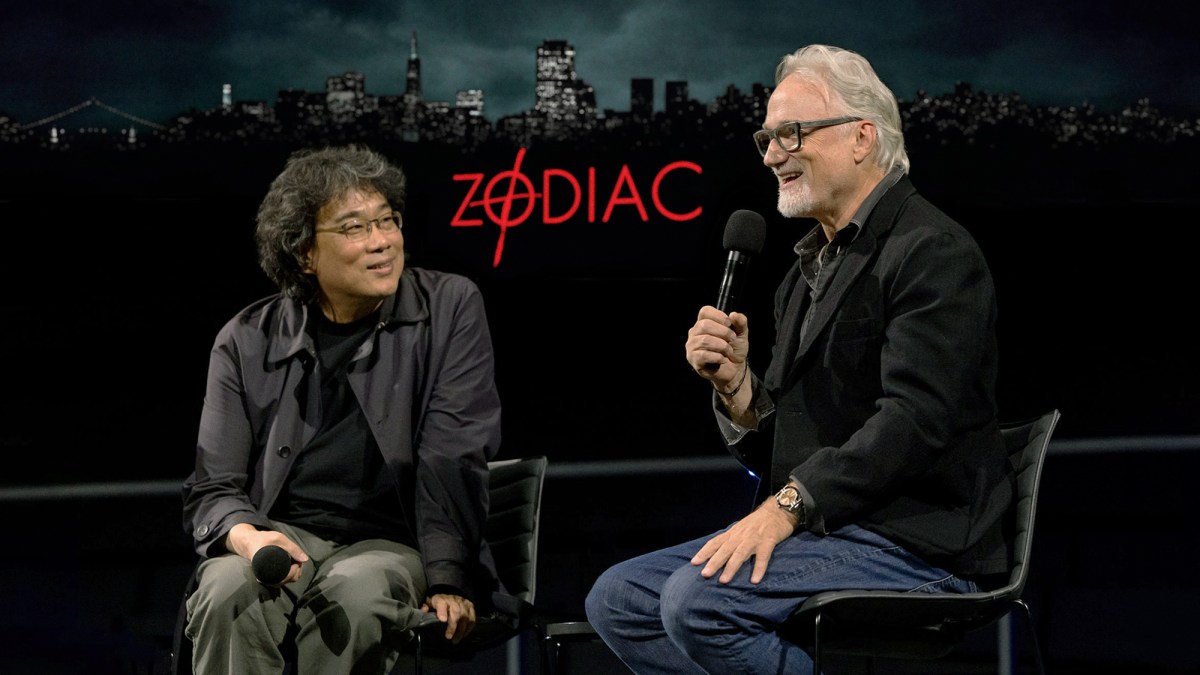
April 11, 2026
Academy Museum of Motion Pictures
Since his feature debut in 2000, filmmaker Bong Joon Ho has become a crucial contributor to the tremendous growth of South Korean cinema and its globalization. Known for his inquisitive mind and meticulous eye for detail, Bong’s creations, which span both realistic and fantastical realms, continue to impact the evolving atmosphere of the South Korean film industry as well as art and culture around the world.
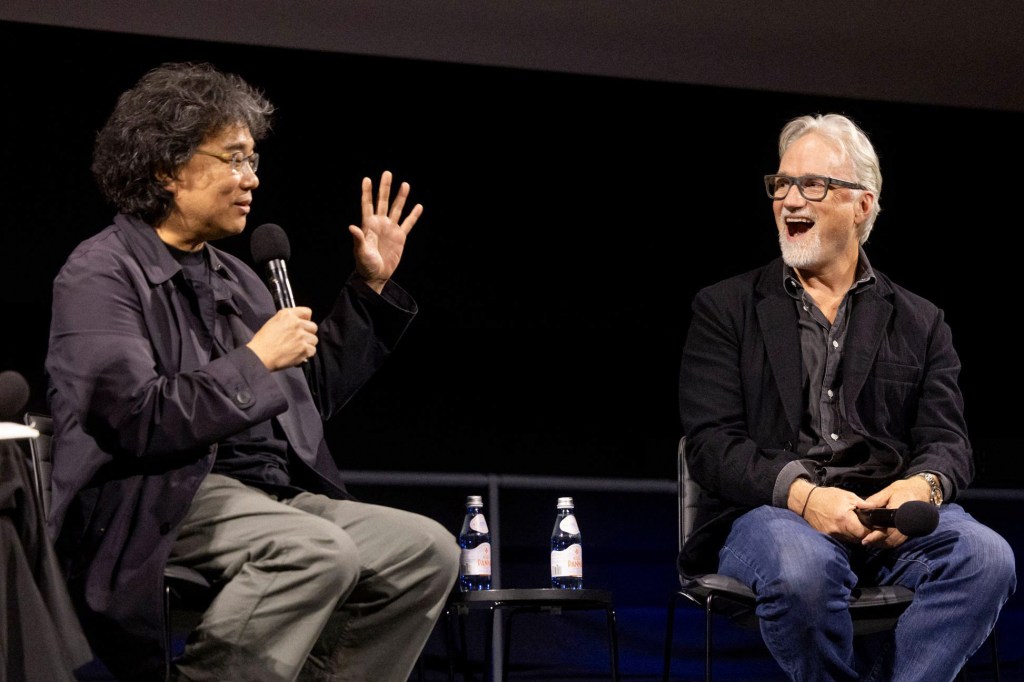
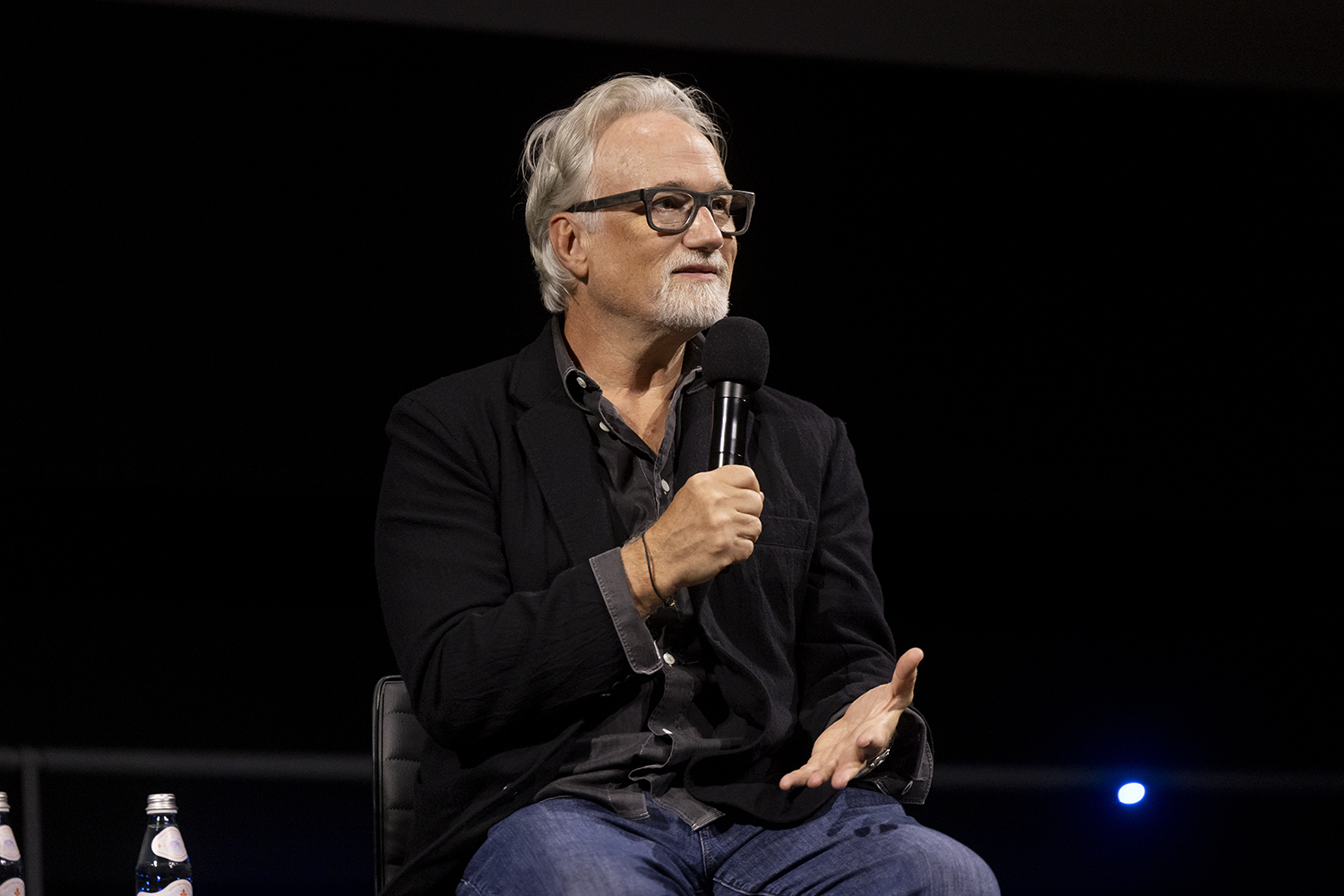
For one weekend in April 2026, Bong returned to the Academy Museum to create exhilarating memories on stage. On April 11, director David Fincher joined Bong for a conversation and screening of Fincher’s Zodiac (2007), a masterpiece thriller showcased via an original poster in the current exhibition, Director’s Inspiration: Bong Joon Ho.
Full Transcript
During the conversation, Bong Joon Ho spoke some English, but mostly Korean, which was translated by Korean-English Interpreter Iris Jang. Changes in language are indicated with brackets.
HYESUNG II, Academy Museum Associate Director of Film Programs:
OK. So, right before I usually welcome our guests, you know, I generally go over their bio… and then, I was thinking when I was preparing this intro… I was like, “Do I really need to go over their bio? I mean, it’s David Fincher and Bong Joon Ho!” It’s like, “Don’t we not know them?”
But then, I actually saw the suggested text, like a bio text, sent from Fincher’s team. And, I was like, “Oh, I’m reading this!” So, this is a very short bio of these two incredible directors.
“David Fincher directs movies, television, commercials, and music videos. He hopes that people like them, but if they don’t, it’s not for lack of effort.”
[LAUGHS]
So, I’m moving on to Bong Joon Ho’s bio.
[BIG LAUGHS]
Are you ready for this? This is actually my version.
Director Bong Joon Ho also directs movies. And my guess, my personal guess, is that he also hopes that people like them, and if they don’t, also my personal projection, I know for sure that it’s not for lack of effort, either.
So, anyway, I think it’s the perfect time that I stop talking and introduce our esteemed guest speakers. Thank you so much for joining us tonight, and please help me welcome two incredible, great auteurs of our time, Director David Fincher and Director Bong Joon Ho.
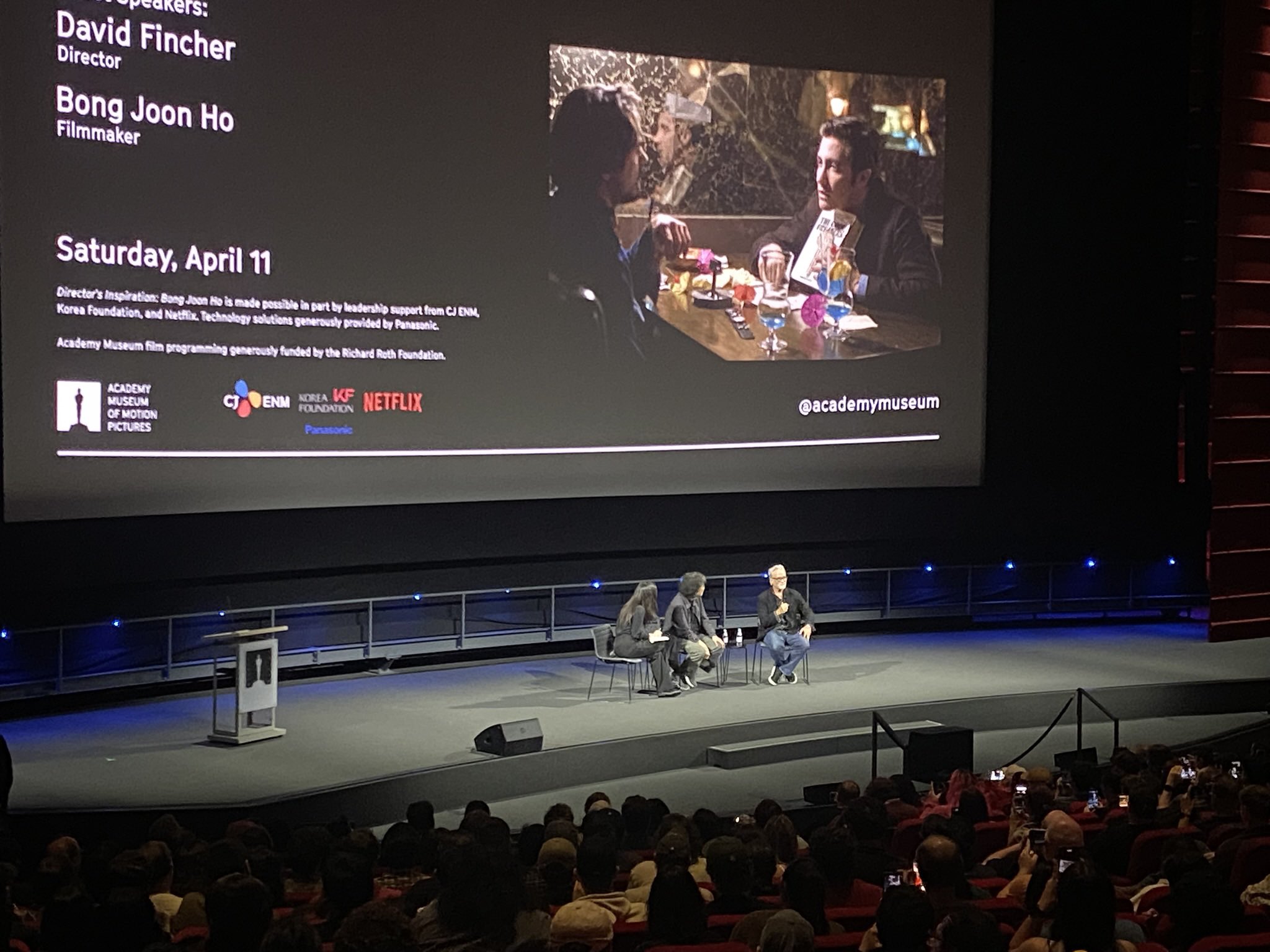
[APPLAUSE]
DAVID FINCHER: [Pointing at an image of Zodiac on the screen] It was shot in HD!
BONG JOON HO: We have very limited time, so, yeah… Actually, this is also my very first time watching Zodiac on this big screen. I’ve watched it so many times on DVD, Blu-ray… But I am so excited about this in 4K DCP… Yeah! [Korean:] I heard that he’s not watching the movie himself today. Oooh!
FINCHER: I’ve seen it!
[LAUGHS]
BONG: I heard that he doesn’t like to rewatch his own movies. [English:] Like many other directors.
FINCHER: Yeah. I don’t like looking at pictures of myself from high school, either. So…
BONG: Personally, I met him before. It was five or six years ago in your office.
FINCHER: Yeah. It must have been, at least, that, yeah.
BONG: [Korean:] His office was immaculately clean and organized. All the colored pencils were organized perfectly by color.
[LAUGHS]
BONG: I felt quite anxious, thinking I couldn’t touch or budge anything. [Fincher squirms and laughs nervously at being exposed like that] I’m curious about you. Do you dislike it when people assume that you’re going to be so obsessive? Is that something that you want to fight back on, perhaps?
FINCHER: No…
[LAUGHS]
FINCHER: No, I mean… Look, I just feel like you should do everything in your power to be as clear in what you’re trying to communicate as you can possibly be, and if that means staying a little late, or having an extra meeting, or sending a text in all caps, you should do it.
BONG: In Zodiac, we can see there are so many shots that are cut almost like razor sharp [slices the air, miming vertical and horizontal cuts with his extended hand; Fincher briefly squints and squirms, as if Bong was wielding a real blade in front of his face]. You’d think that there’s not even one millimeter that would be off. And especially in Zodiac, we see that.
FINCHER: I didn’t notice that. But when you watch a two-hour and 45-minute movie, and you don’t say, “I can probably take two minutes out of that,” then… I don’t know.
BONG: This is a serial killer movie. There are detectives portrayed in it, as well. In Seven, there’s a massive, big action sequence. [English:] But Zodiac… This movie is very quiet, very calm, and silent.
FINCHER: And that was the point. We weren’t making a movie about a serial killer. We were making a movie about the effects of a serial killer on the community and on the lives of people, some of whom probably shouldn’t have taken an interest, and some whose interest waned over time. So, for me, whereas there’s nothing about Seven that isn’t tied to the deeds of the archnemesis, this movie is much more about the accretion of… hopelessness. Or the hopelessness that one will find what one is looking for at the end of a journey like this, whether they can define it or not.
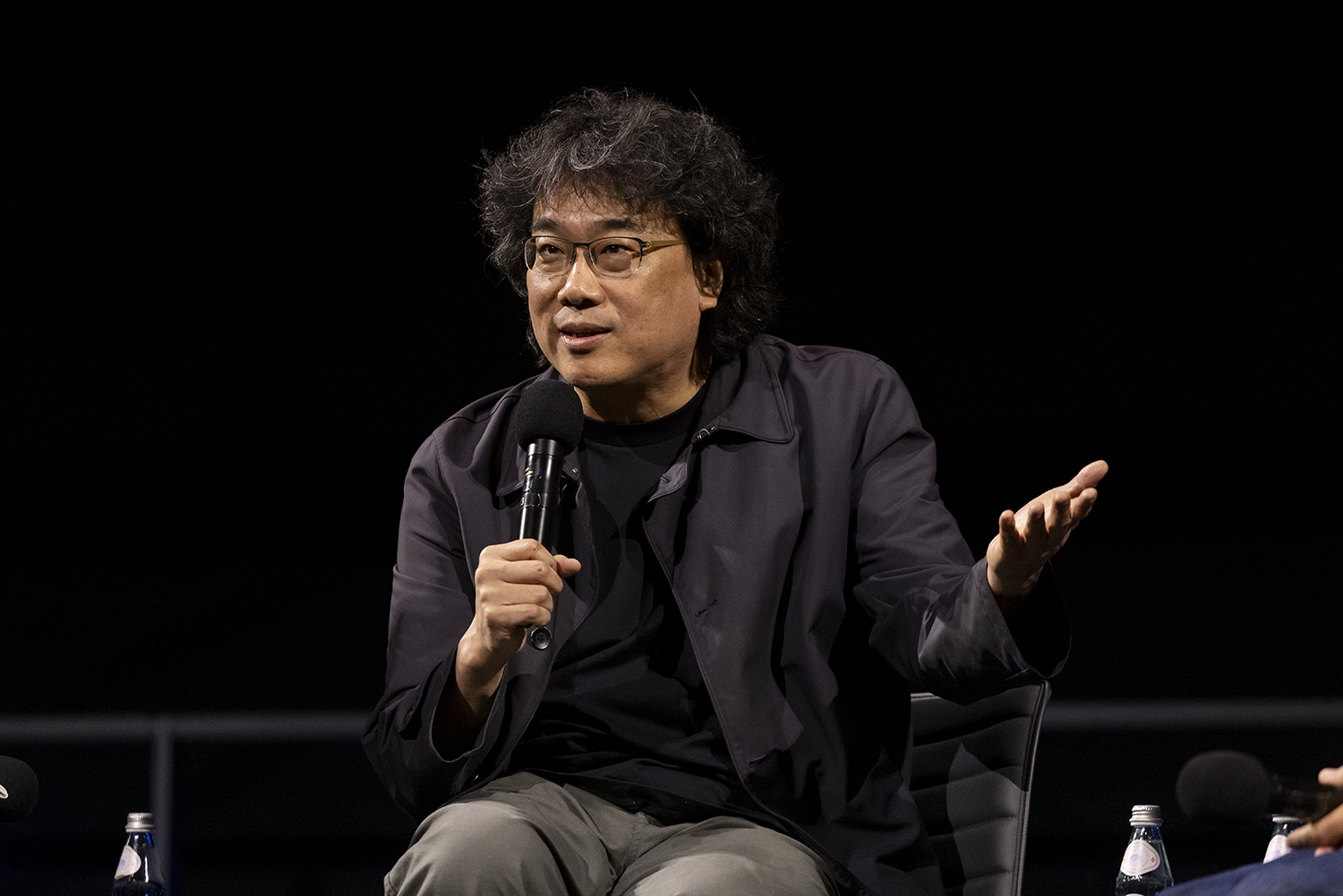
BONG: [Korean:] The feeling and the emotion of horror and sadness, I think, throughout this film, you are kind of drenched in it as if you’re getting wet under the rain. [English:] And also, the voiceover actors, for example, Jake Gyllenhaal and Mark Ruffalo, they are also very calm. [Korean:] They speak very quietly in the movie. [English:] They never shout like you.
[LAUGHS]
FINCHER: I wasn’t aware of that.
BONG: I love your voice, David.
[LAUGHS]
FINCHER: I grew up in a household with a journalist, one who had worked for Life magazine, and I had seen that environment, and that environment is a very specific… especially in that period of time. So often, San Francisco is treated via its Haight-Ashbury reputation. And this was really much more about the editorial room. If you look at the photographs, there’s a tiny bit of a hippie influence, but for the most part, it kind of looks like NASA. It’s a lot of the guys in glasses like this [points at his own horn-rimmed glasses], with shaved heads, and short-sleeved shirts and tees, or dress shirts and ties. We were trying to be as realistic about what this kind of world was, and how the word got spread in 1969, 1970, and on. So behaviorally… I think it worked, certainly to Robert [Downey Jr.]. He’s devastating with his tossed-asides. So, yeah, it wasn’t so much that I was looking for it to be any particular behavior, as much as I just wanted to go, “That looks like a newspaper guy, and that looks like a homicide investigator to me.”
BONG: [Korean:] At the time of the Zodiac murders, you were quite young. I’m curious if you have actual personal memories from that time.
FINCHER: Absolutely! Yeah. I was just talking to Robert backstage, but in Marin County at the time, this was the boogeyman, and it got so blown out of proportion. There are these stabbings in the Marin Headlands… But, yeah, I remember it very… Actually, there’s a scene in the movie that’s based on a conversation I had with my father, who was sort of particularly no-bullshit. I remember coming into his office and saying, “I just heard that this guy is called the Zodiac. What do you know about this?” And my dad said, “Oh, right. Well, he’s a serial killer who has threatened to take a high-powered rifle and shoot out the tires of a school bus and then pick off kids as they come out.” And I was like, “You know, you could give us a ride to work. You’re sitting at home writing…” Anyway, yeah, it was the boogeyman. It was what you kind of grew up with before Michael Myers.
BONG: I actually worked with Jake Gyllenhaal in my film Okja, and Mark Ruffalo in Mickey 17. Those two star in this film, Zodiac. As an eternal fan of the film myself, whenever we worked together, and we had catering meals together, we would always talk about the film. [English:] How great you are, and how amazing the set. [Fincher makes goofy facial gestures of discomfort] No, seriously.
FINCHER: Thank you very much.
BONG: [Korean:] I won’t say exactly which actor of the two, but…
FINCHER: Hmmm!
BONG: … they mentioned that they had taken about 20-something takes, and after the 20th time, you walked towards them, and they got very excited, thinking, “Oh, I wonder what he’s going to say to me.” [English:] But you passed the actor, and then you moved the prop behind the actor, and then, reshoot. Was it true?
FINCHER: Damn right!
[LAUGHS]
FINCHER: I mean, you know this: more than half the gig is making sure that there isn’t something that’s distracting people from what they’re supposed to be looking at. So, if you have somebody who is giving a hell of a performance, deep, and it happens to look like their hands are coming out of someone’s ear, you’ve got to go, “Dude, 18 inches.” So, yeah.
[LAUGHS]
FINCHER: I know Mark likes to tell this story.
[LAUGHS]
BONG: Sorry, Mark.
FINCHER: Anyway…
BONG: [Korean:] So, when he came and moved the prop, Mark asked, “Oh, what about my acting? What did you think?” And you said, “It’s great.”
FINCHER: Well, it was.
BONG: Not just in Zodiac, but all of your other films, there are so many compositions that feel so perfect and right that there couldn’t have been a better way to do it. Do you tend to draw storyboards before production, or do you act more naturally on set with your DP?
FINCHER: I used to. Not for me. Mostly to be able to… group think, so you have an indication, a storyboard to tell you we are on this side of the room, or over this shoulder. But on Panic Room, I famously prevized most of the movie because we had to, because there were so many hallways that had to have support in walls, and certain other walls could move around, so that if you decided we needed to shoot this shot and tilt up and look, it could be three hours to move this wall on the staircase out of the way, and move all this stuff around. So, we had to kind of do that. But what ended up happening was the actors kind of wilted. They all got sort of… I don’t want to say depressed, but there was definitely this feeling of, “We’re not getting to author where we’re going to be in the space,” and it never occurred to me that that was part of the dance. What I wanted to do was go, “Look, come hell or high water, if we hit these marks, you can do stuff in and out of this, but if we do this, this is kind of what the scene is.” That always felt to me like a great place to start. But I think it got a little stifling. And since then, I’ve done some previz for anything that’s going to be wire work, or somebody could get hurt with. And, also, actually, quite honestly, after House of Cards, and after Mindhunter, watching other directors work, watching Carl Franklin work was fascinating to me, or Jamie Foley, may he rest in peace, watching other people’s takes on it, and how they drew the cast out, I sort of felt, “Eh, I don’t need to do that anymore. I can spitball it.”
BONG: I’m sure there are many people watching this film for the second or third time. The color tone of this film transitions from yellow at the very beginning, into blue towards the end. [English:] Yellow in the first half and the other half blue. All those San Francisco Chronicle offices, also costumes, and many things.
FINCHER: After we had the music montage, we needed a way to say it’s now 1976, and so Don Burt, who’s a genius, came to me and said, “Why don’t we paint all these columns? We can do primary colors, so it’s like the Montreal Olympics.” I think it’s in one scene, two shots, but it really supports this idea that we’ve made this leap. And it’s a very subtle thing. Certainly, in terms of the illumination for the set, most of that stuff is still 28, 2,900 Kelvin, and it stays fairly consistent throughout the movie. But certainly, the Chronicle.
BONG: [Korean:] I’m sure it’s the same for all elements of film, but I feel like you’d be very sensitive to the color temperature as well.
FINCHER: I try to be sensitive to everything, even actors’ feelings when you move the prop.
BONG: I’m not just curious specifically of the color, but probably the emotion that’s tied to it, so this is a key question that I have for this film. It’s the question of time and the passing of time, which is what I’m curious about. You see these characters getting destroyed over their obsessions over time, and it’s portrayed partly through color. We see the detective who leaves the case, and we also see Robert Downey Jr.’s character kind of falling apart, as well. We feel the depth of time through your film, and I think that’s something that’s difficult that you were able to pull off here. We see Jake Gyllenhaal by the end. He pierces through that thickness and that depth of time, and he becomes sure of who the suspect is. We see that process for him through the passage of time.
FINCHER: Well, I hope so. As far as demarcating specific eras, years, to me… I knew those kitchens. I knew what a houseboat in Sausalito looks like and smells like. And I know what it’s like when the fog rolls in, but you still have sunlight. So, for me, it was more a concrete relationship to that. And, certainly, it was in this era, but it was a very concrete relationship to what Sausalito was like, what Vallejo was like, what Berryessa is like, and not so much trying to hone or curate a Pantone parallel. It was more about how do I make this stuff feel like what I know it should feel like? As far as the ending, one of the things that continually gets lost in the shuffle is that we bought Robert Graysmith’s book, and that’s what we were adapting. The movie was never meant to be like, “This is the definitive…” It was like this guy wrote two books about his obsession, and although he wasn’t writing a book about his obsession, it came through. That was what interested Jamie [Vanderbilt], and that’s what interested me about having this avatar to move through this story and to share the boots of. Because it isn’t any of his business. He’s just an interested bystander. And yet, what was fascinating was how his search for what he needed it to be for it to come to the end. That’s what we were trying to support.
BONG: In this film, we see Robert Graysmith, the cartoonist, has a very obsessive nature, and we see something similar in The Killer with Michael Fassbender’s character, as well. I’m curious if you’re drawn to these types of characters.
FINCHER: Not necessarily. The Killer is about a high-functioning and probably on the spectrum, OCD guy who is part of the gig economy, who is rationalizing what it is to be just this side of a serial killer, and how he navigates that world. The obsession of Robert Graysmith is much more a tale of somebody who, again, is just an interested bystander. And he finds himself clawing his way into the lives of the people whose job it really was. And upsetting it to the point where, finally, after 2 hours and 45 minutes, they go, “You go do you,” and he does. So, I don’t think there’s anything particularly obsessive. I feel like Fassbender is playing a guy who is not going to sleep well until he knows that he’s not on someone’s list. So, that’s what he goes about doing.
BONG: This might be a little bit off topic, but I want to ask you about your latest film.
[APPLAUSE]
BONG: Is it a Once Upon a Time in Hollywood sequel? Spinoff? [English:] Or a totally new movie?
FINCHER: I mean, it’s the character. But it’s not…
BONG: Brad Pitt.
FINCHER: Yeah.
BONG: But he’s not obsessive, right?
[LAUGHS]
FINCHER: It’s where Cliff ended up six years, seven years later.
BONG: [Korean:] I believe that it’ll be a very new kind of development of the character. We are all familiar with Quentin Tarantino’s version of Brad Pitt’s character, but you probably have a brand-new take on it.
FINCHER: Interestingly enough, I love Cliff Booth. I love him in that movie. He doesn’t say a lot, and now he has a much different job in this one, because he’s orchestrating a lot. But, yeah, I hope there are some very big surprises.
BONG: And I’m looking forward to it. I can’t wait to watch it.
[APPLAUSE]
FINCHER: Do you have any time next week?
BONG: [Korean:] Let’s go back to Zodiac. This actual real-life case happened, and then 40 years later, you made the film. Now, 20 years later, we’re talking about it here. There’s quite a bit of time that has passed.
FINCHER: You see a lot of phones do this. [He makes the circular hand motion of dialing on an old rotary phone]
BONG: [English:] Production was in 2006?
FINCHER: Yeah, I believe so. Well, we started maybe at the end of 2005.
BONG: [Korean:] Now, in 2026, looking back, what are your thoughts on the film? If you could go back, would you do anything different?
FINCHER: [Sarcastically] Me?
[LAUGHS]
FINCHER: I would do everything differently. I hate to say this, but the only time I feel remotely confident that I know what the movie is, is in the car, on the way to the airport, when you wrap the last day, and you’re going back to L.A. to cut, or whatever, you go, “Oh man, this is what it should have been!” So, it constantly evolves. And listen, you meet so many people in 20 years. You have an idea about what a characterization should be in order for it to be truthful, and read quickly, and you tend to make snap judgments. It’s a lot of pressure. I look at that now, and there’s a lot of stuff I’m very happy with, but there’s a lot of stuff that I go, “Hmmm, maybe it should be allowed to breathe over here, or maybe it should have been weirder.” I’m almost always in the camp of, [doing a stoner voice] “It should have been weirder.”
BONG: Even directors like Ridley Scott, when his first Alien movie was rereleased, I heard that he removed a few shots. So, I’m curious for you, are there any shots that you would remove, or you would add? [Smiling]
FINCHER: Too many smiles like that, I just start to sweat. No. Truthfully, I feel like films are a byproduct of their time. They are fashion. You should do everything you can to maintain the integrity of the intent. And, you know, there is a lot of tragic stuff that goes… I mean, just remastering Fight Club, a lot of tragic decisions that were made to do certain stuff in 8-bit, instead of 10-bit, to save $30,000 here. And in 4K, it’s an issue. The restoration of these things. But I feel like you take it as far as you can and then leave it. It’s a document of its era, of its time. And then, just never revisit it. But if given the opportunity to totally remake it, I probably would make every different decision.
BONG: As soon as the film opens, within the first scene, you can see how beautiful it is, the composition and cinematography. I’m also a big fan of Harris Savides. He worked with you multiple times on films, and also on films like Gus Van Sant’s Elephant, as well. We can’t move on without talking about him. Are there any thoughts that you would like to share?
FINCHER: I mean, no… I mean, Harris was a fucking genius and one of the most talented people I’ve ever been lucky enough to collide with. He was one of the greats. He’s one of the people who made you look at what you were doing on the day for its essence and its clarity, and he brought a lot of that to this. A lot of it was like, if you don’t know Harris, [imitating his voice] “Why are we shooting so many of these coverages? You’re never gonna have time for this.” And he was wrong,
[LAUGHS]
FINCHER: We used it all. No, but he’s truly one of those people who just saw things differently. And yet, he did not have a good time on it. He did not want to work with this digital camera. And he did not want to have a camera that was tethered to a recorder. But I would put this up with Birth, and Elephant, and some of the most amazing stuff that he ever did. And totally with both hands tied behind his back.
BONG: As a fellow director, I just want to ask for tips. [Fincher laughs, and Bong caresses Fincher’s leg] With this movie, Zodiac, it truly overcame the span of a long period of time to become a classic film. I’m curious about your tips.
[LAUGHS]
FINCHER: Well, I’m happy for the curation and being included in your open mic week here. I couldn’t be happier to be feted. Thank you.