
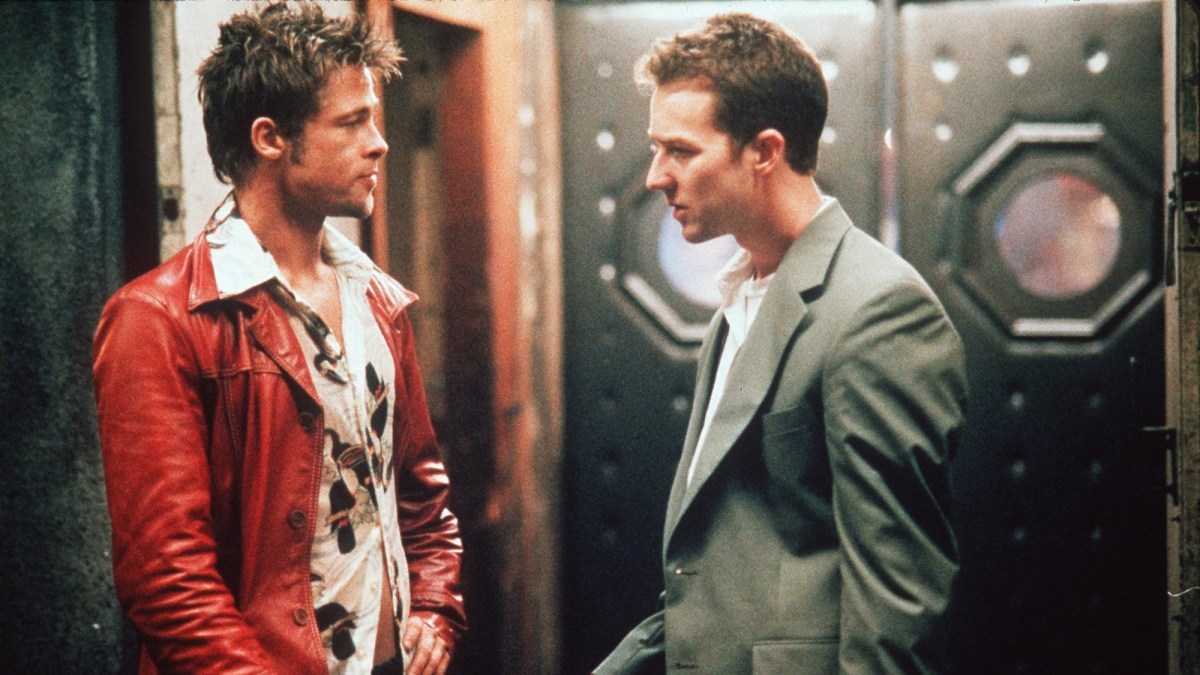
The former Head of Media for 20th Century Fox discussed how the studio and David Fincher butted heads.
Eric Goldman
April 9, 2026
Laughing Place
Both rule number one and rule number two is you’re not supposed to talk about Fight Club, but those rules were broken in a fascinating way Wednesday night at the Academy Museum in Los Angeles, alongside the world premiere screening of the new 4K restoration of the beloved film, prior to its upcoming one-night nationwide theatrical screenings and debuting on disc and digital. The screening included an insider’s look back at the highly contentious debate over how to market the decidedly subversive and provocative film, which found the filmmakers and cast frequently at odds with the studio releasing the movie, 20th Century Fox (now 20th Century Studios).
As a longtime fan of Fight Club, it was a thrill to see it on a big screen again, with the new 4K transfer looking terrific and highly detailed but not, thankfully, causing a movie that purposely exists within a world filled with so much grit and grime to look too clean and pristine. The sound presentation was also better than ever, capturing every brutal punch — and eventually explosions — along the way as the Narrator (Edward Norton) and Tyler Durden (Brad Pitt) grow their following. The film’s examination of consumerism and angry and aimless disaffected men remains as compelling, satirical, and darkly witty as ever, and even though it’s been used in so many TV shows and films since, “Where is My Mind?” remains a perfect needle drop at the film’s conclusion.
The screening was presented by the Marketing and Public Relations Branch of the Academy, and thus the film’s marketing campaign was the focus of the pre-screening guest speaker presentation. Fight Club has an interesting place in cinema — and marketing — history, as in its initial 1999 release, it was highly divisive with critics and a box office bomb. However, it went on to became a sensation via the home video market, gaining an ever-growing cult following and a critical re-evaluation as the years went by.
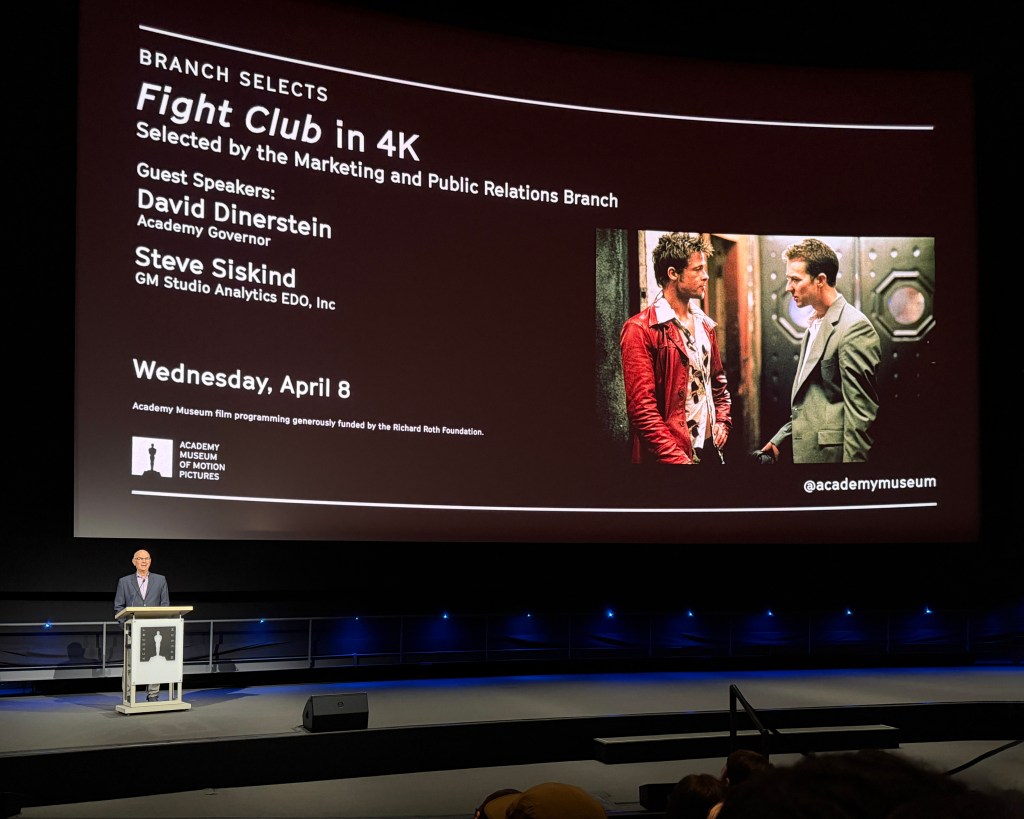
As Academy Governor David Dinerstein noted in his intro at the screening, “When Fight Club was released in 1999 by 20th Century Fox, it posed a unique challenge… The film defied easy categorization. Was it a crime thriller, a dark comedy, a psychological drama? In truth, it was all of those and something else entirely. Marketing a film like Fight Club meant grappling with its tonal complexity, its subversive themes and, of course, its unforgettable twists – elements that made it compelling but also difficult to distill into a traditional marketing campaign.”
However, Dinerstein added, “In retrospect, the very elements that made Fight Club difficult to market — its audacity, its controversy, its refusal to conform — are precisely what cemented its lasting cultural impact. Fight Club is not just a movie, it has become a cultural event.”
The main speaker of the evening, Steve Siskind, was the head of Media at 20th Century Fox at the time Fight Club came out, which gave him plenty of insight into the struggle over how to market it. As he put it, “It’s not an exaggeration to say that Fight Club was one of the most contentious and fascinating marketing campaign processes I’ve ever witnessed.”
 The Fincher Analyst