
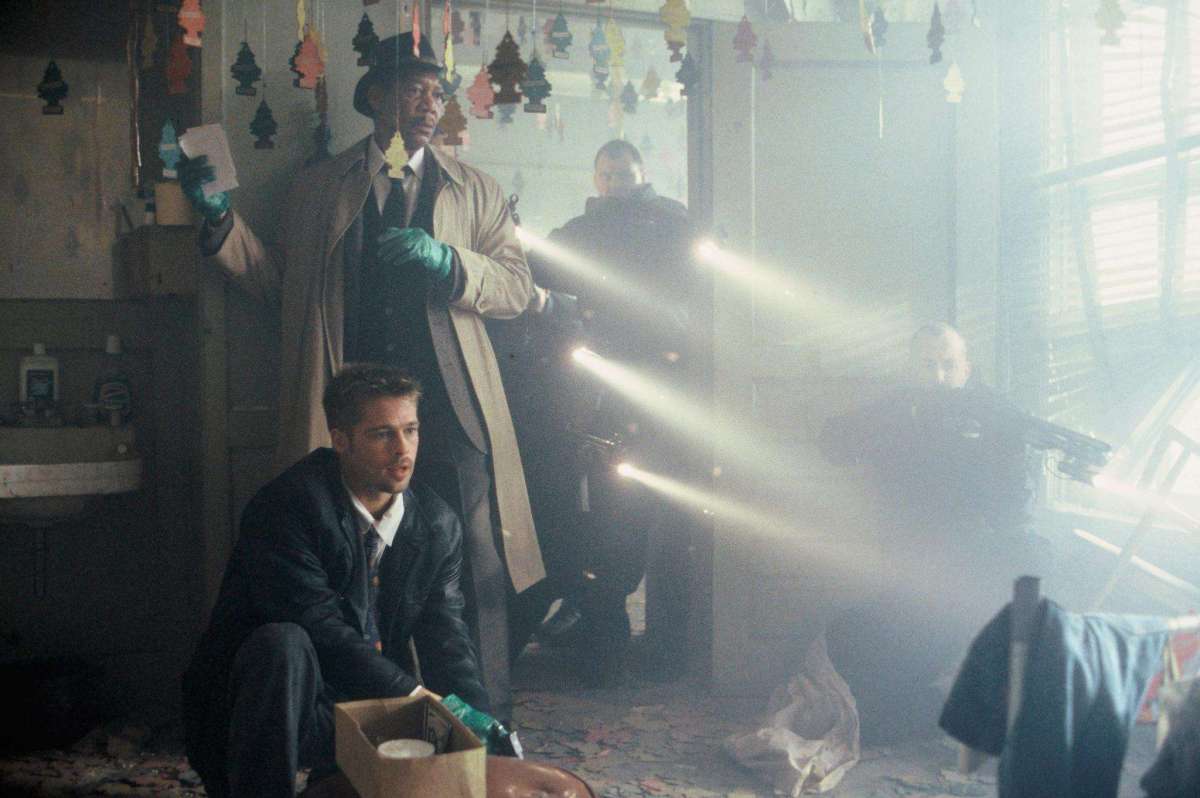
David Fincher’s seminal serial killer procedural is more of a parable about how hope and idealism cope against evil.
James A Gill
September 6, 2025
Fanfare (Medium)
**This essay contains major spoilers for Se7en**
“If we catch John Doe and he turns out to be the devil, if he’s Satan himself, that might live up to our expectations. But he’s not the devil, he’s just a man.” — Detective William Somerset
“I don’t believe that you’re quitting because you believe these things you say. I don’t. I think you want to believe them because you’re quitting. You want me to agree with you and you want me to say ‘yeah, yeah, yeah, you’re right, it’s all f***ed up’…. but I won’t. I won’t say that. I don’t agree with you. I do not. I can’t.” — Detective David Mills
These are some of the lines exchanged between the heroes of David Fincher’s classic 1995 feature, Se7en, as they have a heart-to-heart conversation late in the film. It is a scene that contrasts considerably in tone and mood to the more memorably horrific and gory scenes in the film.
This scene may well be the most important, if not the most moving, in a film largely known for its bleak, macabre, and unforgiving atmosphere. As a moment of respite for the audience, the scene demonstrates how well detectives David Mills and William Somerset complement each other, despite their many superficial differences.
Released in September 1995, David Fincher’s Se7en proved to be a sleeper hit of 1995 (overall, and appropriately, the seventh highest-grossing film of 1995). It was a critical smash and a redemptive feature film success for Fincher (after the very mixed results of his film debut, Alien 3). Andrew Kevin Walker’s screenplay also received a BAFTA nomination for Best Original Screenplay. It is also, alongside 1991’s The Silence of the Lambs, considered the defining serial killer feature of the 1990s, forging a considerable impact on the genre going forward.
 The Fincher Analyst