
Reverend Scott K
August 15, 2025
The Church of Tarantino
The Church of Tarantino is a podcast channel with weekly shows dedicated to discussing every and anything related to the films of Quentin Tarantino. One of our 4 unique monthly series drop an episode every Friday. Ranking Tarantino (1st Friday of the month), The Bible Study (2nd Friday of the month), Inglourious Blue Balls (3rd Friday of the month) & Tarantinoesque Film Review (4th Friday of the month). Whether we’re ranking various aspects of his films, dissecting his scenes, discussing all the projects he’s announced, or reviewing films that are like his, there’s something for every QT fan.
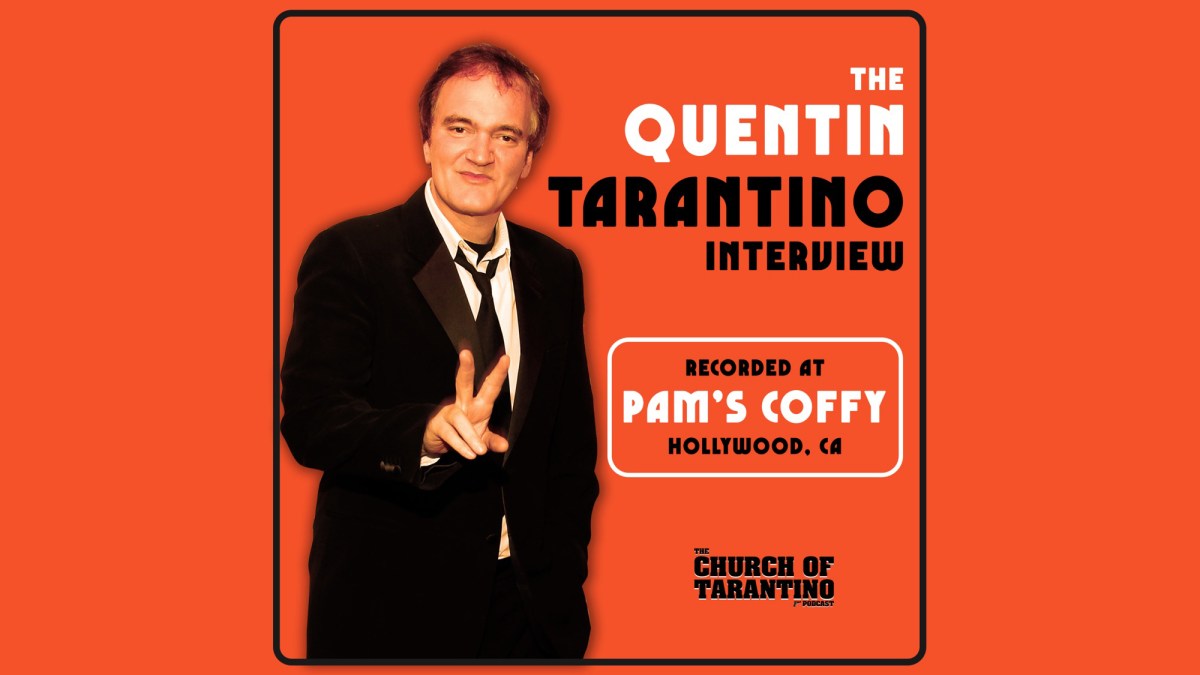
For this episode, join the Reverend inside Pam’s Coffy, for his first ever sit down with Mr. Quentin Tarantino, as they discuss the cancellation of The Movie Critic, the origin of The Adventures of Cliff Booth, why he handed it to Brad Pitt and David Fincher, his “favorite director”, what his next project is going to be, why Kill Bill: The Whole Bloody Affair is still unavailable to the public, the brilliance of the late great Michael Madsen and so much more, including the question he’s been dying to ask for over 2 and a half years: “What ever happened to the Untitled TV Series?” This is a must-listen for true Tarantino fans.
Listen to the podcast:
Apple Podcasts
Spotify
Rabbit Hole Podcast Network
Become a member of The Church of Tarantino: Apple Podcasts, Spotify
Follow us on our Socials: Facebook, Instagram, Threads, Blue Sky, Letterboxd
Email: TheChurchOfTarantino@gmail.com
We’re also on the Rabbit Hole Podcast Network.
Excerpts from the Transcript: The Adventures of Cliff Booth
[6:09] What is your next project?
A little film I wrote, that is now called The Adventures of Cliff Booth, starts shooting on Monday. Yeah, we start shooting on Monday [July 28, 2025]. We’ve been in rehearsal for the last two weeks. I left them to come down here, all right? I was in rehearsal with them earlier today, with Brad, and Elizabeth Debicki, and David Fincher. So, I’ve got that coming.
[16:32] What happened to The Movie Critic project, and how did it lead to The Adventures of Cliff Booth?
When I was in New York, I had just finished the last episode [of The Movie Critic series]. I had written it, and I was just getting ready to start the process of going around to the different networks and showing them the episodes. Because I had them all, it’s not like I give them the pilot, I’ll give them all of them, you know? It’s a long process, and I was just right at the beginning of it. The eight-episode series was The Movie Critic. So, I have The Movie Critic written as a script, and I have it written as eight episodes of a TV series.
I think after I did the work of writing the eight episodes, and was very happy with it, and it was like, “oh, this works out really good. This works out good. This will be cool”, I think once I was done and I knew I had done it, and now I was faced with the hard work in front of me of setting it up and doing it, I didn’t really want to do it that much, all right?
That’s too strong a word to say. But it was more like, “if I like this so much, could it be a movie? Is it really a movie?” And that was just enough of a question that made me want to investigate. No one’s waiting for this thing, per se. I mean, I can do it whenever I want. It’s already written.
So, OK, let me just not start it right now. Let me try writing it as a movie, and let me see if it’s better that way. It’ll be an interesting experiment anyway, having written eight episodes of a series, and now trying to make it a two-hour movie. Let’s just see how that works out. And so, I did that. And I was happy with it. And I was like, “oh, OK, no, I think this is going to be the movie.”
And then it wasn’t. I pulled the plug on it. And the reason I pulled the plug it’s not… it’s a little crazy, and you guys do this a lot too, it’s a little crazy to listen to podcasts, and hear all these amateur psychiatrists psychoanalyze as if they fucking know what they’re talking about, about what’s going on with me, about how I’m so scared, all right? of my tenth film, and how I’m living in terror, and fear, and I fucked myself royally, all right? and now I don’t know what to do, I don’t know whether to shit or go blind, and oh, my God! Oh, my God! I’m so fragile about my legacy! What’s going on? Oh, oh, I’m, I’m, I’m paralyzed with fear!
I’m not paralyzed with fear. Trust me, I’m not paralyzed with fear, all right? The thing about The Movie Critic is I really, really like it. But there was… there was a… ha, ha, ha! There was a challenge that I gave to myself when I did it. And I think you’ll appreciate this, both as a series and as a movie. Can I take the most boring profession in the world and make it an interesting movie? Ha, ha, ha! I mean, I heard your guys like, “OK, there is no Tarantino title more soft cocky than The Movie Critic. Every Tarantino title promises so much. Except The Movie Critic! Who wants to see a TV show about a fucking movie critic? Who wants to see a movie called The Movie Critic? You’re right! And that was the test. That was the test! If I can actually make a movie, or a TV show, about somebody who watches movies interesting, that is an accomplishment! And I think I did that. I think I did that, all right?
What ended up happening, why I lost my… desire, I will say, to do it, had nothing to do… It’s a spiritual sequel to Once Upon a Time in Hollywood insofar as they take place in the same world, and they take place in the same town. But there were no crossover characters. Cliff Booth was never in The Movie Critic. That’s all a bunch of bullshit. That never was the case. Ever, ever, ever. But it is the same town, except in 1977, as opposed to 1969.
And, frankly, to tell you the truth, it was pre-production that made me realize that I didn’t have… I wasn’t as… I was so excited about the writing, but I wasn’t really that excited about dramatizing what I wrote, once we were in pre-production. Partly because I’m using the skill set that I learned from Once Upon a Time in Hollywood. When we started Once Upon a Time in Hollywood, “how are we going to turn Los Angeles into the Hollywood of 1969 without using CGI?” Now, I had an idea, and I knew a couple of streets we could do it with. And I had an idea of how it could be accomplished, where it wouldn’t be Midas breaking the bank, all right? But it was still something we had to do. It was something we had to pull off. We had to achieve it. It wasn’t for sure we could do it.
And that has always been the case with every single movie I’ve done. It was like, “how exactly am I going to do this?” At the beginning of pre-production, I don’t know the answer. How are we going to burn down the theater in Inglourious Basterds, and actually have real fire, and real people in the real fire, and pull this off without having to do some phony special effects? How are we going to do that and not kill anybody? Well, I know the answer now, but we didn’t know the answer until the end of the movie when we shot it. It took us the whole movie to figure it out. How am I going to do Uma digging up through the ground in Kill Bill? How am I going to pull off the Crazy 88 sequence? If that’s not the Apocalypse Now Ride of the Valkyries sequence of fight scenes, then I failed. I’m a complete failure, all right? But I’ve never done a fight scene before, so that’s a tall order, you know? We’ve got to create the antebellum South in this world now, and we have to live in it every fucking day. And that means the white people and the black people are going to have to work together and deal with us, and know what we’re doing, and all be on the same page about it. Well, that’s a tough road to hoe, too, all right? How are we going to do that? Well, we all did. We all figured it out.
With The Movie Critic, there was nothing to figure out. Because I already kind of knew, more or less, how to turn LA into an older time. So, it was too much like the last one.
And then I wrote the Cliff Booth movie because I was like, “well, if I’m going to go back to that world, everyone really likes Cliff Booth, and I love Cliff Booth, and he seems like he could be the star of a series of paperbacks, you know? So, it was like, “another adventure with him would be different. And I think that’s what everybody wants. And the audience want that, and I think Brad wants it, and I want to work with him in another great role.” And so, then I wrote the Cliff Booth movie. And then I got under pre-production, and it was the same fucking thing, you know? It was like, “well, yeah, I love this script, but I’m still walking down the same ground that I’ve already walked. And there are no questions. I mean, there are a few things as far as certain sequences, and everything. But as far as like the, you know, “how is this ship going to sail,” which is always a question in my mind, there was no question that the ship would arrive at port. There’s no question that we won’t sink. There’s no ceiling for me to hit the head of my talent on. And it just kind of “unthused” me as we went forward. Until I finally just pulled the plug.
And I go, “no, this last movie, I got to not know what I’m doing. Again, I’ve got to be in uncharted territory. And have an idea how I’m going to pull it off, but not really know. And there has to be something to achieve. Does that make sense?
[25:51] Rick’s the star of Once Upon a Time in… Hollywood, and Cliff is the star of the novelization. Did you ever think of using it as the base for the new film?
The Cliff Booth movie takes place in 77. So, it’s a different point in his life. And when I pulled the plug, Brad was like saying, “if you want to do a Cliff Booth TV series, I’m there with you, man. I’ll do a nine-episode series.” But we’re doing it here, now. And like I said, I don’t see it as a series. I see it more as a series of novels. I could see myself writing, maybe down the line, like another Cliff Booth adventure, another Cliff Booth novel, and see where that goes.
But I’ve got the best in the world. I’ve got Brad. I’ve got my favorite director, David Fincher, directing it. And I like the idea of David Fincher… I like the idea of any great director, big director, adapting my work, all right?
[28:02] Once you step away from directing, is it a possibility that you’ll be writing for other directors?
The answer is yes. But if you asked me on the wrong, frustrated day, the answer would be no, or “no, I’m never doing this fucking thing again!” But then on other days, “oh, yeah, absolutely!” All right?
Look, one of the things I’m excited about the film is, it’s not that I haven’t gotten respect as a writer, I’ve gotten a tremendous amount of respect as a writer. It would be a fallacy to say that. However, because I direct my own stuff, I don’t think I’ve gotten the respect as a writer that I entirely do, because most people just think, “well, he’s writing stuff for himself to do”, all right?
And so, the idea that… I mean, I think David Fincher is the best director… I think me and David Fincher are the two best directors, all right? So, the idea that David Fincher actually wants to adapt my work, to me shows a level of seriousness towards my work that I think needs to be taken into account.
[28:54] What was Brad Pitt’s role in the inception of The Adventures of Cliff Booth as a film by David Fincher?
[Brad] was the glue that put us together.
[29:21] What is your role in the production of The Adventures of Cliff Booth?
I’m one of the producers of the movie and everything. But look, I’m moving back and forth between here and Israel, so I won’t be on the set every day, and everything. But, yeah, I’ll be around if they need me to do something. I will. But it’s a little more like I’ve given David a gigantic novel written in screenplay form, and it’s his job to attack it. Ha, ha, ha! I’m not like this Hollywood screenwriter, “here you go! Here’s your 120 pages! All right? Do seven a day! You should be fine!” No, no. I’m giving him an unwieldy thing, and I haven’t tamed myself whatsoever. And it’s his job to shrink it.
[30:23] With David Fincher having an exclusive deal with Netflix, which has released some of their films in theaters in limited runs, and your name being attached, and Brad Pitt’s, and David Fincher’s, will Netflix do a limited release of the film in theaters?
Well, they might. It’s not their business model. I don’t hold it against the company for not following what’s not their business model. You can decree that it’s not their business model, but it is just what it is.
I wouldn’t be surprised if they came out with a two-week release of it. At least limited to some degree. And then, I think at least as far as the big cities are concerned, they’ll probably have screenings, so they’re probably going to want it to do good in the Oscars. So, there’ll be screenings for it around town and everything.
Yeah, I could decry that. I could complain about that. I could go, “oh, isn’t it a shame?” I tend to look at it in the most positive way, all right? I tend to look at it in the positive light. And the positive light is a light I’ve never had before. Every movie I’ve ever done in the last 30 years, all nine of them, they had to do well at the box office, or else it’s tainted, or else it’s a flop. It’s considered you’re a hit, or break even, or a flop. And that’s always been the sword of Damocles hanging over your head through the making of the movie, getting your release date, going through pre-production, and leading up, and you’re doing all your press, and everything. And it all comes down to that opening weekend, OK? If you have a bad opening weekend, it’s not going to be better the second weekend, all right? And it’s still kind of only broken down into four or five weeks at the most now, for the last 10 years, of being viable. And the thing about it is, if Once Upon a Time in Hollywood didn’t do well at the box office, that would have tainted the entire thing. It wouldn’t change the movie one iota. But the fact that it could be successful in today’s world was meaningful. And watching it with an excited, jam-packed audience for three weekends was meaningful, you know? And if no one cared, and no one had shown up, it wouldn’t have been the same thing.
So, this movie that I’m doing with Netflix is the biggest budget movie I’ve ever done by 100 million, all right? It’s like a $200 million movie. And the box office doesn’t matter. It doesn’t matter fuck all. Not fuck all, all right? They don’t care. They don’t care. So, it’s like gambling with the casino’s money, you know? That sword of Damocles that I have existed under, that I have lived under my entire career, just doesn’t exist. We make a good movie, or we don’t, all right? But that crap table at Vegas, that’s always part of the first step, is just completely gone. So that’s kind of fucking cool, all right? It’s a tyranny unless you win. When you win, yeah, yeah! Now you got big dick energy, and now you got the blue veiner, all right? Way to go! It’s all good! We did it! We did it! We fucking won! We fucking beat Despicable Me 3, you know? And so, it feels great. But when you don’t beat them, fucking sucks. Ha, ha, ha!
But the fact is that pressure just evaporates. It just doesn’t exist. It’s not there. Their tickets have already been bought. You bought your subscription. Their business idea is that you will join Netflix, if you are not already a member, to see the movie. Or we’ll see.
[1:14:14] What dictates the kind of violence (comedic, cathartic, dramatic) you are going to represent in a scene?
Usually, if you look at it, it’s dictated by the story, you know?
Like in the movie coming up that we’re getting ready to do now, there are a couple of fun bits where Cliff gets to do his thing. And that has the fun of a Billy Jack kind of thing. He’s kind of a Billy Jack kind of character.
But then, there’s a scene where the bad guys do some violence, and it’s horrific. And that’s not meant to be fun at all. It’s meant to be hard to watch. But then, the trepidation is like, “oh, wow, Cliff’s going to have to fight those guys, and he doesn’t know they’re that good!” But we do. Ha, ha, ha!
[1:42:18] What is Quentin Tarantino’s favorite Tarantino film?
Once Upon a Time in Hollywood is my favorite film I’ve made. I guess Inglourious Basterds is the best. I think Kill Bill is the ultimate Quentin movie. Like nobody else could have made it. Every aspect about it is so particularly ripped, like with tentacles, and bloody tissue. From my imagination, and my id, and my loves, and my passions, and my obsessions. Kill Bill is the movie I was born to make. I think Inglourious Basterds is my masterpiece. But Once Upon a Time in Hollywood is my favorite.
 The Fincher Analyst